HL Biology Unit 6.4 - Homeostasis
 Call Kai
 Learn
Learn Practice Test
 Spaced Repetition
 Match
Match Flashcards
 Knowt Play
1/26

Name | Mastery | Learn | Test | Matching | Spaced | Call with Kai |
|---|
No analytics yet
Send a link to your students to track their progress
27 Terms
What is osmoregulation?
The maintenance of internal water and solute balance to prevent lysis/shrinkage of cells
What units are used to describe osmotic concentration?
Osmoles per liter (1 osmole = 1 mol of fully dissolved substance)
Label the 5 parts of the kidney
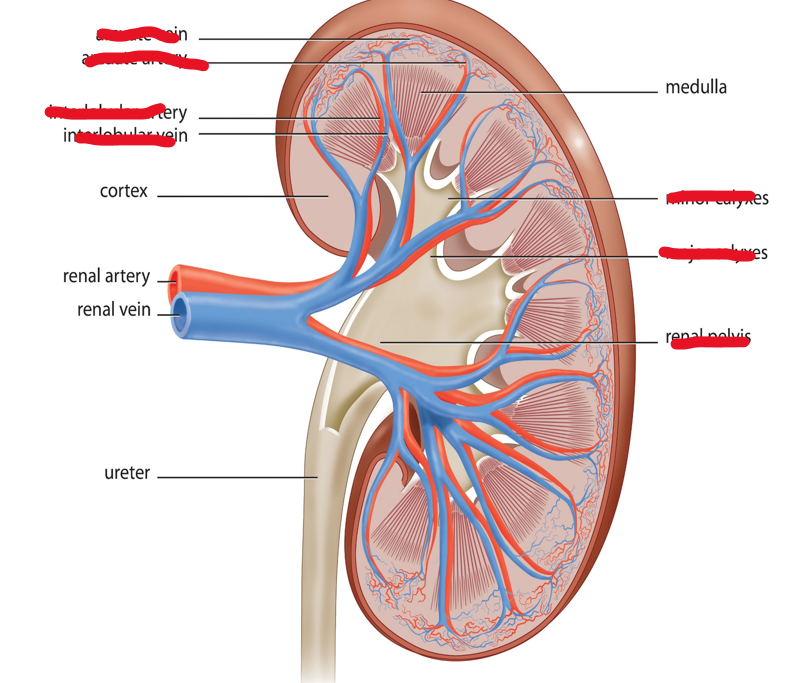
What does the Renal Vein do?
Where FILTERED blood w/diluted amounts of toxins, water, salt, and plasma is CARRIED AWAY from the kidney
What does the Renal Artery do?
Where UNFILTERED blood with lots of toxins, water, salt, and plasma is CARRIED TOWARDS the kidney
What is a nephron?
The “functional unit” of the kidney that filters substances from blood, which are too small to see
What are some methods of maintaining homeostasis in the body?
Maintaining: body temperature, blood pH, blood glucose concentration, blood osmotic concentration
What hormones are involved in blood glucose regulation?
Insulin and Glucagon
What do α cells do in blood glucose regulation?
Synthesize/secrete glucagon that signals liver to break down glycogen into glucose to release into the blood, increasing blood sugar when glucose levels are low
What do β cells do in blood glucose regulation?
Synthesize/secrete insulin to stimulate glucose uptake in skeletal muscles and liver tissue, making glycogen for glucose storage to decrease blood sugar when glucose is too high
What is Type I (early onset) Diabetes?
An autoimmune disease that kills β cells, patients require regular insulin injections and blood tests
What is Type II (late onset) Diabetes?
A disease involving a deficiency in glucose receptor/transporters, so the body may not respond to insulin
Name the parts of the nephron
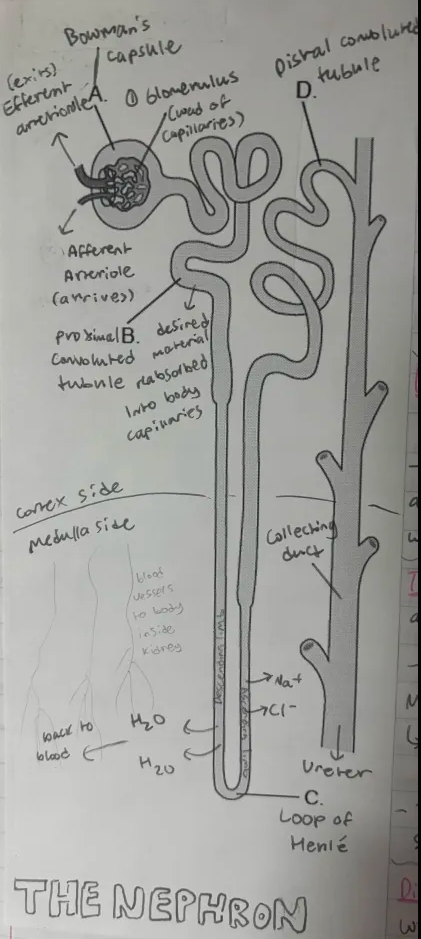
What is the function of the Glomerulus and what adaptations does it have for those functions?
Where all the fluid in blood is exchanged/filtered, then sent through to the rest of the nephron.
This is where ultrafiltration occurs, made more efficient by fenestrated capillaries that allow fluid to flow through, but not blood cells.
What is ultrafiltration?
Filtration that occurs under very high pressure in order to filter blood
What is the function of the Proximal Convoluted Tubule and what adaptations does it have for those functions?
Where filtrate (fluid) from the Glomerulus flows to and where glucose, amino acids, and salts are selectively absorbed using active transport.
Microvilli are present in order to increase surface area for absorption.
What is the function of the Tube of Henle and what adaptations does it have for those functions?
Where filtrate flows after the Proximal Convoluted Tubule for water to be reabsorbed. The loop dips into the hypertonic medulla and is longer in length, allowing for higher water absorption (ex. camels have longer loops of henle because they require more water).
Why is the medulla hypertonic? How is this concentration maintained?
The active transport of salts on the ascending side of the loop of henle allows the medulla to remain hypertonic to draw water back into the body from incoming filtrate.
What is the function of the Distal Convoluted Tubule and what adaptations does it have for those functions?
Similar to the Proximal Convoluted Tubule, more ions are exchanged and passed out of the nephron into the body, but there is less absorption because microvilli are not present
What is the function of the Collecting Duct and what adaptations does it have for those functions?
Where filtrate goes for final water adjustments through selective permeability, controlled by the Anti-Diuretic Hormone
What does the Anti-Diuretic Hormone (ADH) do?
ADH promotes the formation of aquaporins, which are membrane channels that form on the walls of the Collecting Duct that increase permeability. Increased ADH = Increased permeability = Increased urine concentration (less water is kept, more is reabsorbed into blood).
Where does urine go after the nephron?
After exiting the ureter of then nephron, it is stored in the bladder and eventually released through the urethra.
What are peripheral thermoreceptors?
Sensory neurons/receptors that detect temperature changes and signal the brain to respond in different ways to perform thermoregulation
What are 6 methods of thermoregulation?
Shivering: small muscle movements generate warmth
Vasodilation/constriction: dilation = increased blood flow = more heat lost through skin, constriction is the opposite and allows for warmth
Sweat: liquid evaporating off skin takes heat with it, allowing cooling
Goosebumps: raising hair traps warm on skin, like fur coats
Brown Adipose Tissue: Specialized fat cells to be metabolized for heat production
Thyroxin: a hormone secreted by the thyroid gland that regulates metabolic rate, and therefore, body temperature
What is uncoupled respiration?
When energy produced by respiration isn’t used for work, but is instead dissipated throughout the body (ex. Brown Adipose Tissues are metabolized to spread warmth)
What are osmoregulators?
Organisms that maintain a constant internal solute concentration (ex. freshwater animals, terrestrial organisms)
What are osmoconformers?
Organisms that have internal solute concentrations isotonic to their external environments (ex. Marine invertebrates)