Herpes Viruses
 Studied by 0 people
 Call Kai
 Learn
Learn Practice Test
 Spaced Repetition
 Match
Match Flashcards
 Knowt Play
1/48

There's no tags or description
Looks like no tags are added yet.
Name | Mastery | Learn | Test | Matching | Spaced | Call with Kai |
|---|
No analytics yet
Send a link to your students to track their progress
49 Terms
Herpesviridae key features
- dsDNA genome, linear
- Icosahedral
- Enveloped
- Tegument layer between capsid and envelope
- Lytic replication
- Latency (once infected, infected for life)
- Has its own DNA polymerase which can be a drug target
Tegument layer
Layer between capsid and envelope of herpes viruses
Human herpes virus subfamilies
- Alpha herpesvirus
- Beta herpesvirus
- Gamma herpesvirus
Alpha herpesvirus
HHV1, HHV2, and VZV (Varicella Zoster)
Short reproductive cycle (12-18 hours for the cycle), latency in sensory nerve ganglia
Beta herpesvirus
CMV (Cytomeaglovirus), HHV-6, HHV-7
Longer reproductive cycle (over 24 hours), latency in stem cells
Gamma herpesvirus
EBV (Epstein-Barr Virus), HHV8
Infect T or B cells, latency in lymphoid tissue
Alpha herpesvirus latency
Latency in sensory neuron cells which are cells that do not divide
Viral genome exists as non-integrated piece of DNA that is hiding out and not producing new virions
CMV latency
Latency in hematopoietic stem cells which are cells that do divide
Viral genome passed down in new cells but not producing virus or lysing cells during latency
HHV6/HHV7 latency
Latency in T cells which are cells that do divide
The viral genome is integrated into the host genome and those cells are replicated, can be passed to germ line
EBV latency
Latency in B cells which are cells that do divide
New viral genome goes into daughter cells
Natural reservoir of alpha herpesviruses
Humans
Transmission of alpha herpesviruses
HHV1: Direct contact (saliva, kissing), can be spread when someone is asymptomatic
HHV2: Direct contact (sexual, vertical)
VZV: Respiratory droplets or direct contact with open wound
Latency site of alpha herpesviruses
HHV1: Trigeminal ganglia
HHV2: Sacral ganglia
VZV: Dorsal root ganglia
All in sensory ganglia just in different places, for HHV1 and 2 it is close to the site of innoculation!
Vaccines for alpha herpesviruses
Only for VSV
Which virus causes oral/genital sores from the alpha herpesviruses
HHV1 more commonly making mouth sores, HHV2 making genital sores, but both can do either
HSV1 and HSV2 pathogenesis
- Close contact (kissing, etc) allows virus to go in and invade epithelial cells at the site of innoculation and undergo the lytic cycle quickly (12-18 hours)
- Lytic cycle causes syncytia formation, and when that lyses leads to fluid filled vesicles
- Vesicles can pop leading to ulcerations
- Virus goes up trigeminal ganglia by retrograde transport up the axon and establishes latency
Where can HSV1 and 2 have inoculation at
- Oral mucosa
- Genital skin
- Conjunctiva (from horizontal transmission)
HSV1/2 latency
Virus goes up axon into the trigeminal ganglia and establishes latency by the LAT gene. Keeps sensory neurons which they reside in from dying. Hangs out until reactivation (stress, UV light, etc.)
Latency is permanently established, cannot be removed
Herpetic whitlow
HSV1 or HSV2 goes into the finger (autoinoculation)
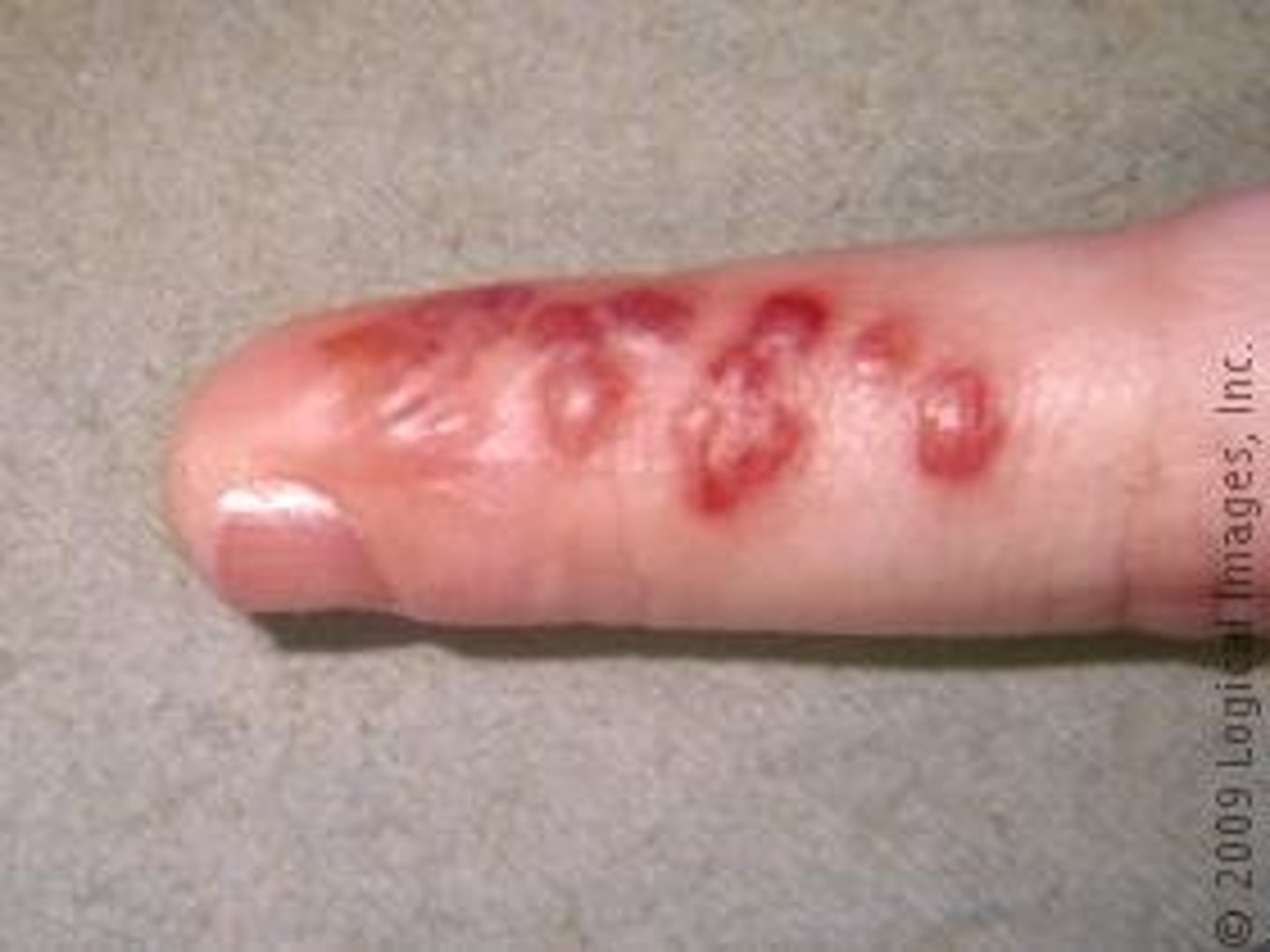
Virulence factors of HSV1 and HSV2
- Hijacking host cell machinery
- Viral DNA polymerase
- Neuronal trophism (immune cells do not go here)
- Restricted genome expression (maintains inactive state and maintains life of neuron)
HSV1 and HSV 2 samples
Skin swabs or scrapings, can sometimes look at CSF, blood, or tissue but not common unless dissemination has happened (mainly in immunocompromised people)
HSV1 and HSV2 testing methods
PCR is main form of testing, can be done on swabs, blood, or CSF. Can detect virus and differentiate between HSV1 and HSV2
Serology can also be done for screening in those with high risk of reactivation, transplant, and pregnancy
Culture and microscopy can be done but rarely are
VZV transmission
Transmitted through respiratory droplets
VZV pathogenesis
- Virus breathed in by respiratory droplets and infect tonsils and lymphnodes at first, doing lytic cycle and causing damage to those tissues
- Lysis of cells in the tonsular crypt allows virus to get into bloodstream (primary viremia)
- From there it gets into other organs and replicates more (secondary viremia)
- Skin and mucous membranes are involved, leading to fluid filled lesions and ulceration, as well as pain and itching
- During secondary viremia, it goes to the dorsal root ganglion and becomes latent
- It takes 10-20 days to see a rash occur
Radiation of VZV on the skin
Goes to trunk first and then spreads to the extremities
VZV primary infection
Consists of scalp involvement, exanthem, oral mucosa involvement
Very important to check for oral mucosa involvement as these virus can go into the lungs, invading pulmonary epithelial and endothelial cells and lead to VZV associated lung infection which can cause death
Incubation period of 10-21 days
VZV reactivation
High risk of reactivation due to waning cell mediated immunity with age, immunosuppression, or other stressors. CD8+ cells kill cells displaying viral antigen become less effective over time
Once reactivated, it affects a specific dermatome that is associated with the dorsal root ganglion where the virus went latent, can lead to pain/chronic pain syndrome
VZV samples
Tissue swab or scraping, biopsy, blood, CSF
Testing for VZV
Serology
Does not show if someone has risk of reactivation of shingles, even with high titres for VZV this only protects from primary infection, not reactivation
VZV vaccines
Live attenuated vaccine (childhood) and recombinant vaccine (adulthood)
Live attenuated VZV vaccine
- 2 doses, one at 12-15 months, and one at 18 months
- 98% effective
Recombinant VZV vaccine
- Glycoprotein + Adjuvant
- 2 doses, 2-6 months apart
- For people over 50 or immunocompromised
- More than 90% effective
Epstein Barr Virus Pathogenesis
Spread by saliva, coughing, or talking
- Gets into susceptible host leading to lytic cycle in the throat/tonsils which produces lots of new virions and puss, ulceration, inflammation, etc.
- Then infects B cells where latency occurs in lymphoid tissue
- Reactivation occurs when memory B cells differentiate into plasma cells, reactivation asymptomatic but can spread virus
EBV hallmarks
Atypical blood lymphocytes on a smear
EBV chronic complications
Oncogene virus, can cause different types of cancer
- Epithelial malignancy
- Malignant lymphoma
- TK T cell lymphoma
EBV samples
Tissue biopsy or blood (most common)
EBV testing
Serology is most common, PCR can be used in disseminated infection
EBV antibody testing
- Monospot
- EBV specific antibodies
Monospot testing
Old way of testing for EBV, looking at patients non-specific antibodies to EBV
Add to sheep RBC and see clumping in presence of nonspecific EBV antibodies, but has low sensitivity and can produce false positives or negatives
EBV specific antibody testing
Looking for viral nucleocapsid antigen (VCA) and nuclear antigen (EBNA)
Viral nucleocapsid antigen:
IgM: Within 2 days, disappear in 6 weeks (active infection)
IgG: Positive forever (recent or latent infection)
Nuclear antigen:
IgG: Positive forever (latent infection)
CMV transmission
Contact with any bodily fluid, most common in childhood with saliva/urine and in adults by sexual contact, transfusion, or organ transplant
CMV pathogenesis
- Invades epithelial cells with no clinical manifestation
- Goes into the bloodstream and activates monocytes and T lymphocytes and goes around the body in these cells
- Then goes into hematopoetic stem cells where it becomes latent and can be transferred to daughter cells/germ line
- Reactivation is linked to immunosuppression or severe inflammation where it can go into retina, lung, colon, genitourinary organs
CMV samples
CSF, tissue biopsy, blood (most common)
CMV testing
PCR is gold standard for monitoring infection
Serology for screening and risk stratification
HHV 6 and 7
AKA "Roseola", a common childhood illness
Belongs to beta herpesvirus subfamily, latency in T cells and integrates genome into host genome. Reactivation is common but there is no sign for it.
HHV6 in early childhood due to waning maternal antibodies, HHV7 later in childhood
Infects CD4+ cells leading to fever, immune activation, and a rash once the fever is broken
Transmission of HHV6 and HHV7
Saliva (parent to child, child to child)
HHV8
AKA Kaposi Sarcoma-Associated Herpesvirus
Belongs to gamma herpesvirus and establishes latency in B cells
Complications of HHV8
Causes soft tissue cancer (Kaposi's sarcoma) and B-cell cancer (lymphoma)
Virulence factor: Expresses viral genes that mimic host genes leading to cancer
Transmission of HHV8
Close contact, saliva, blood
In non-endemic areas can be spread by sexual contact
Most common in Sub Saharan Africa and Mediterranean
 Note
Note  Flashcards (22)