Exam 2
0.0(0)
Studied by 2 people Call Kai
 Learn
Learn Practice Test
 Spaced Repetition
 Match
Match Flashcards
 Knowt Play
Card Sorting
1/57

Earn XP
Description and Tags
Last updated 11:35 AM on 3/9/23
Name | Mastery | Learn | Test | Matching | Spaced | Call with Kai |
|---|
No analytics yet
Send a link to your students to track their progress
58 Terms
1
New cards
5 major chordate characteristics they all have during their lifestyle
Endostyle
Pharnygeal gill slits
Dorsal hollow nerve cord
Notochord
Post-anal tail
Pharnygeal gill slits
Dorsal hollow nerve cord
Notochord
Post-anal tail
2
New cards
Which structures are lost/ retained in adult humans?
Only thing not lost: Dorsal holow nerve cord → In spinal cord
3
New cards
What happens to the post anal tail in humans
Becomes coccyx bone
4
New cards
What happens to the endostyle
Becomes thyroid gland
5
New cards
What happens to notochord
Intervertebral discs of our vertebral column
6
New cards
Describe how vertebrate chordates differ from invertebrate chordates
Invertebrate don’t have a cranium with tripartite brain or enlarged heard with multicelluar sense orangs
7
New cards
Geological period when cohrdates first appeared:
Cambrian
8
New cards
Know how fish compare to other vertebrate groups
Fish have more than other vertebrate groups
9
New cards
Valid vertebrate taxa vs invalid → Monophylies, paraphylies, polophylies
What if we put all fish in their own taxanomic grouping separate from tetrapods, what would be wrong with this? If we did that, fish grouping would be a paraphyly, tetrapods would be fine and be a monophyly
10
New cards
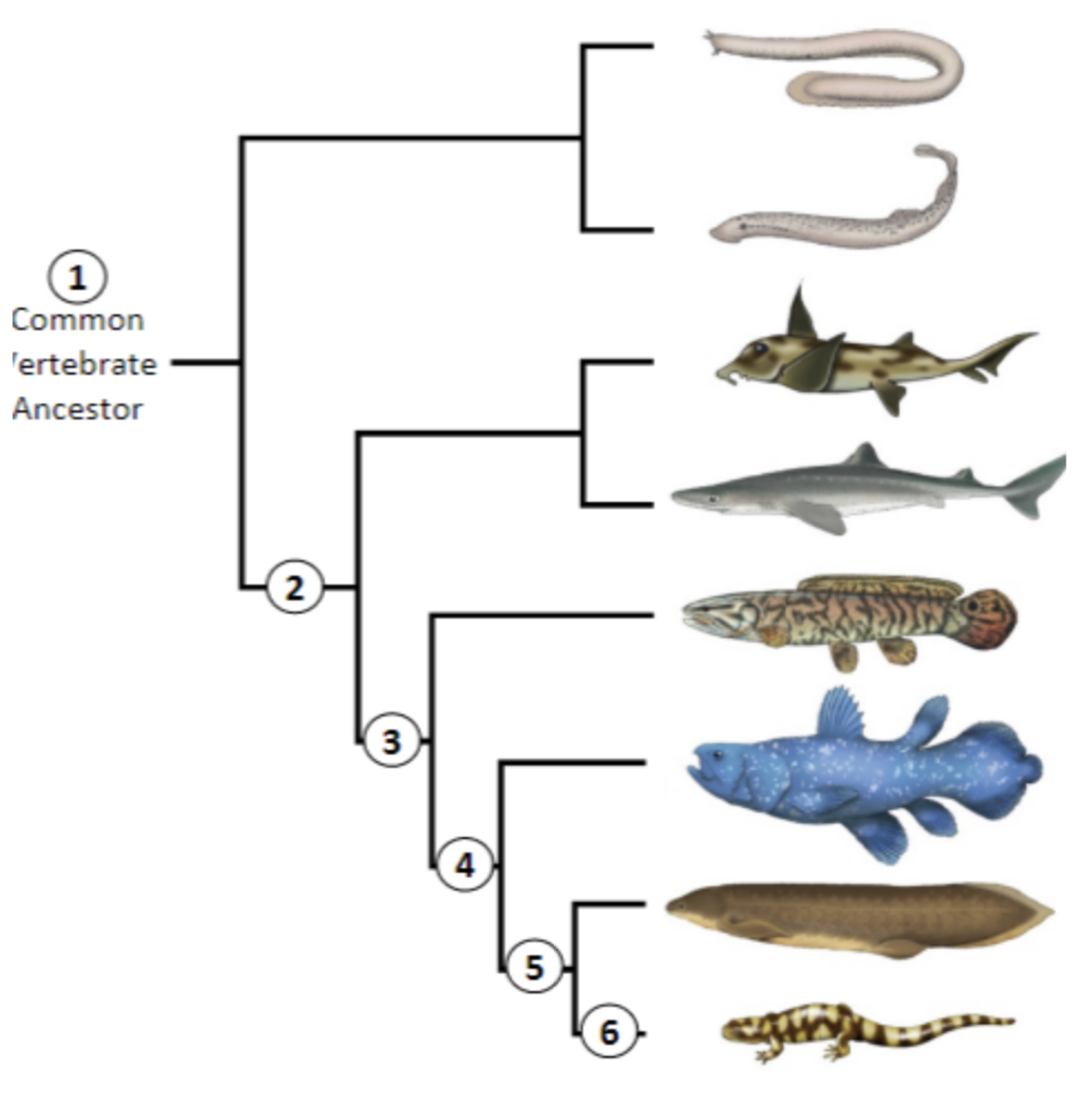
Given vertebrate phylogeny, name taxa and derived traits shown
**Agnatha**
2 myxini (hagfish)
3 lamprey petromyzontida
\
**Gnathasomata**
4 chondrythes
5 actinopterygii
6 sarcopterygii
2 myxini (hagfish)
3 lamprey petromyzontida
\
**Gnathasomata**
4 chondrythes
5 actinopterygii
6 sarcopterygii
11
New cards
What class does a celocanth fit within?
Sarcopterygii
12
New cards
Name differences among higher fish taxa and known their interactions with humans
commercially
commercially
(infraphylum agnatha/ gnathostomata) (5 classes) (Superclass oesthichtyhes)
13
New cards
How are actinopterygii different from sarcopterygii
Actinopterygii have fins supported by bony rays, which are flexible and can be controlled individually. Sarcopterygii, on the other hand, have fins that are supported by fleshy, muscular lobes that are less flexible and cannot be controlled individually.
\
lungfish, have lungs and can breathe air, allows them to survive in oxygen-poor environments- sarcop
Coelacanths have a lobe-shaped tail fin, a specialized type of lung, andskull to move independently from their body (sarcop)
\
Actinopterygii have a swim bladders while Sarcopterygii do not have a swim bladder and instead rely on their fleshy lobes to control their buoyancy.
\
Scales: The scales of Actinopterygii are typically thin and flexible, while the scales of Sarcopterygii are thicker and more rigid.
\
lungfish, have lungs and can breathe air, allows them to survive in oxygen-poor environments- sarcop
Coelacanths have a lobe-shaped tail fin, a specialized type of lung, andskull to move independently from their body (sarcop)
\
Actinopterygii have a swim bladders while Sarcopterygii do not have a swim bladder and instead rely on their fleshy lobes to control their buoyancy.
\
Scales: The scales of Actinopterygii are typically thin and flexible, while the scales of Sarcopterygii are thicker and more rigid.
14
New cards
How is osteichthyes different from other classes
bony skeleton, swim bladder, and fins and scales
15
New cards
Hagfish of commercial importance
Meat skin and slime used in textiles and manufacturing cosmetics and military
16
New cards
Which group of fish have the biggest commercia importance?
Teleosts
17
New cards
When fish first appeared/ diversified/ etc.
First diversify: Ordovician
First go crazy with diversity: Devonian “Age of fishes”
First go crazy with diversity: Devonian “Age of fishes”
18
New cards
Out of the periods, which fish survived from present day/ went extinct based on period
chart/ how do they compare to eachother in terms of species diversity
chart/ how do they compare to eachother in terms of species diversity
Actinopterygians have high amount of species diversity
Sarcopterygians have high amount of diversity if you lump in tetrapods
Sarcopterygians have high amount of diversity if you lump in tetrapods
19
New cards
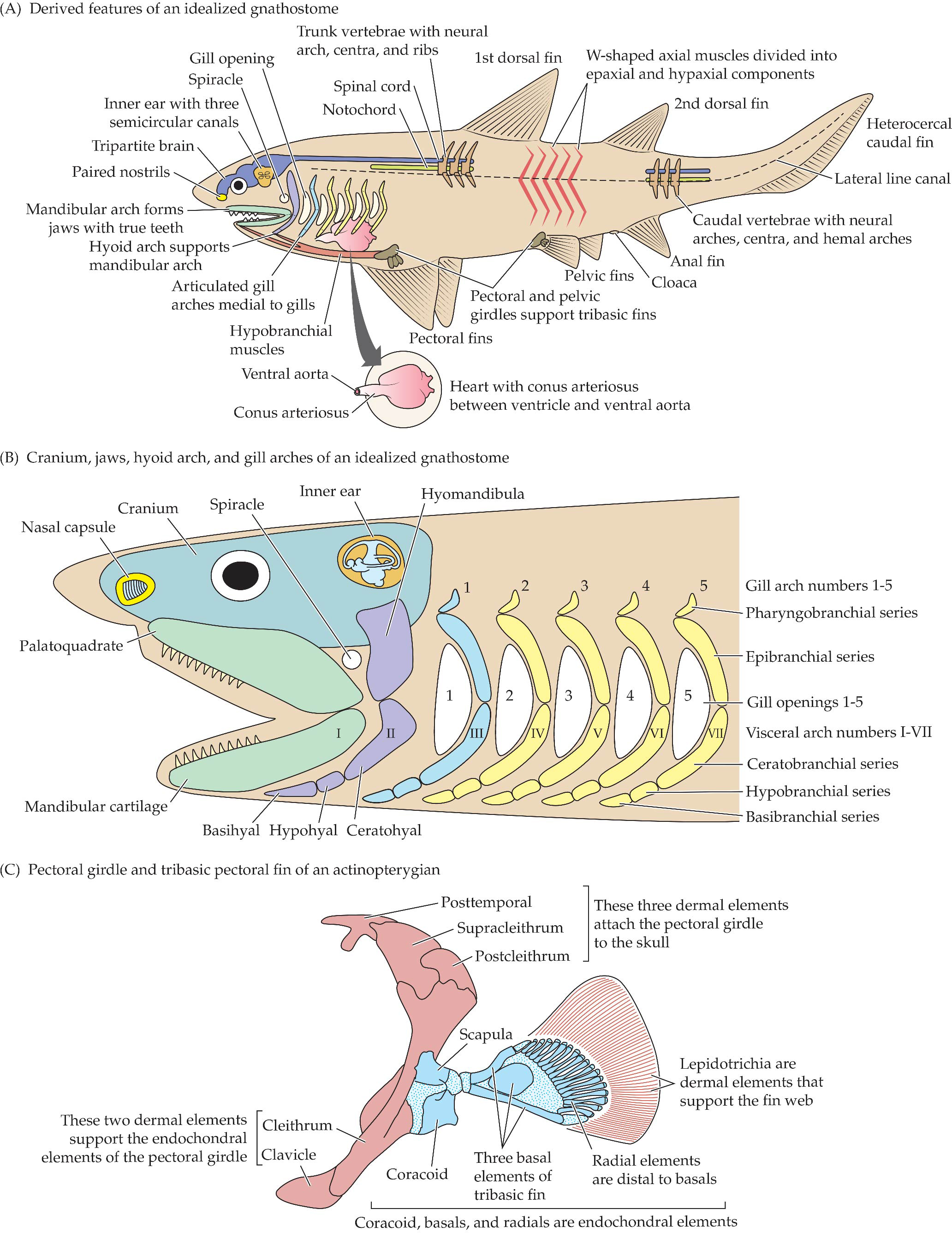
Name visceral arches that gave rise to ...
Jaws → V1
○ Hyoid bone → V2
○ Pharyngeal jaws → V7
○ V3 is the first visceral arch but it’s the first gill arch (they have like 5 gill arches)
○ Hyoid bone → V2
○ Pharyngeal jaws → V7
○ V3 is the first visceral arch but it’s the first gill arch (they have like 5 gill arches)
20
New cards
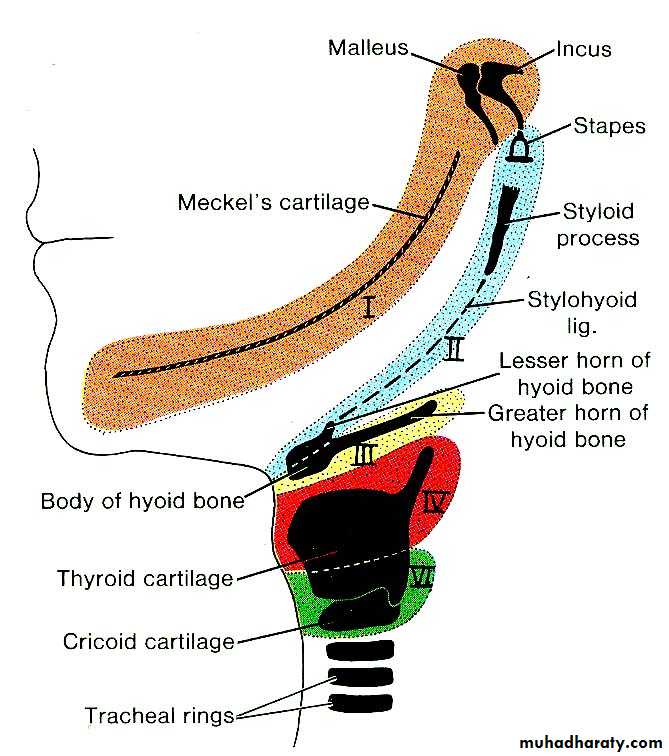
Specific fate of visceral arches in adult humans
V1 → Mandible/ jaw
○ V2 → Part of the hyoid bone, stylohyoid ligament/ process
○ INSERT CHART (orange blue yellow red green)
○ We don’t have a V7, it was lost in development
○ V2 → Part of the hyoid bone, stylohyoid ligament/ process
○ INSERT CHART (orange blue yellow red green)
○ We don’t have a V7, it was lost in development
21
New cards
Compare contrast jaws of various cartilagionous and bony fish
Sharks vs skates and rays vs chimeras
\
**Similarities**
1. Both cartilaginous and bony fish have jaws that are hinged to the skull, allowing them to open and close their mouths to capture prey.
2. Both types of fish have teeth, which are used to grasp and manipulate food.
3. The jaw structure of both types of fish can vary widely within their respective groups.
\
**Differences**
1. Cartilaginous fish have jaws that are not fused to the skull, whereas in bony fish, the jaws are fused to the skull.
2. upper jaw of cartilaginous fish is not directly attached to the skull-supported by ligaments & muscles. Upper jaw of bony fish directly connected to skull.
Cartilaginous fish = multiple rows of teeth continually replaced throughout lives, bony fish have one set of teeth not replaced once lost.
1. Cartilaginous-more robust and powerful jaws than bony fish, allows them to capture and eat larger prey.
2. In bony fish, the lower jaw shorter than upper jaw, cartilaginous fish, lower jaw is typically longer than the upper jaw.
\
**Similarities**
1. Both cartilaginous and bony fish have jaws that are hinged to the skull, allowing them to open and close their mouths to capture prey.
2. Both types of fish have teeth, which are used to grasp and manipulate food.
3. The jaw structure of both types of fish can vary widely within their respective groups.
\
**Differences**
1. Cartilaginous fish have jaws that are not fused to the skull, whereas in bony fish, the jaws are fused to the skull.
2. upper jaw of cartilaginous fish is not directly attached to the skull-supported by ligaments & muscles. Upper jaw of bony fish directly connected to skull.
Cartilaginous fish = multiple rows of teeth continually replaced throughout lives, bony fish have one set of teeth not replaced once lost.
1. Cartilaginous-more robust and powerful jaws than bony fish, allows them to capture and eat larger prey.
2. In bony fish, the lower jaw shorter than upper jaw, cartilaginous fish, lower jaw is typically longer than the upper jaw.
22
New cards
Primary and secondary selective forces that selected for jaws in gnathostomes
Primary: Getting differnt kinds of food/ new feeding behaviors
Secondary: Courtship functions like biting during copulation & parental function like holding eggs in mouth
Secondary: Courtship functions like biting during copulation & parental function like holding eggs in mouth
23
New cards
PRIMARY and secondary selective forces for Adaptions for fins
Primary: Moving around better, being more agile and speedy Secondary: Spines for defnse or bright colors for visual signals and species recognition
24
New cards
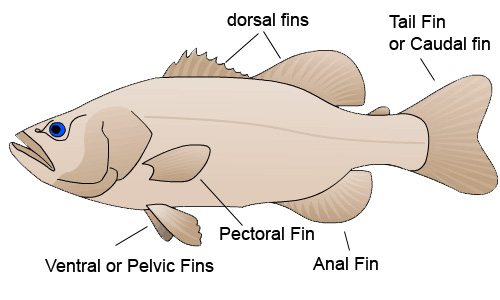
Know fin types and functions
Pectoral, dorsal, adipose, ccaudal, anal/ cloacal, pelvic (know where they are in a chart)
25
New cards
Function of pectoral fin
steer and maintain depth; homologous to tetrapod forelimbs
26
New cards
Function of dorsal fin
prevent rolling and assist with sudden turns
27
New cards
Function of adipose fin
unknown function; potentially for sensory input (e.g., sound, touch, pressure changes, etc.)
28
New cards
Function of caudal fin
forward propulsion
29
New cards
Functions of pelvic fin
up/down movement
stability
steering
locomotion
reproduction
sensory perception
stability
steering
locomotion
reproduction
sensory perception
30
New cards
Function of anal/Chloacal fin
stabilization and propulsion in some species (e.g., knife fish)
31
New cards
Types of Caudal Fins
(A) Heterocercal – vertebrae extend to upper fin lobe; reverse heterocercal extends to lower lobe; asymmetrical
•(B) Protocercal – vertebrae extend to tip of caudal fin; symmetrical
•(C) Homocercal – vertebrae extend short distance into caudal fin; symmetrical
•(B) Protocercal – vertebrae extend to tip of caudal fin; symmetrical
•(C) Homocercal – vertebrae extend short distance into caudal fin; symmetrical
32
New cards
Chondrichtyhes: KNow major taxonomic groups and assign individuals to them
Subclass: Holocephali & Elasmobranchii
Superorder: Selachimoprha and batoidea
Great white shark would be in elasmobranchii sublacc and selachimorpha super order
Superorder: Selachimoprha and batoidea
Great white shark would be in elasmobranchii sublacc and selachimorpha super order
33
New cards
Name and explain similarities/ differences between chondricthyian taxa
similarities
* Both Elasmobranchii and Holocephali have skeletons made of cartilage instead of bone.
* Both groups have five to seven gill slits on each side of their bodies for respiration.
* Both groups are carnivorous and have teeth that are constantly replaced throughout their lives.
* Both Elasmobranchii and Holocephali have a unique system of sensing electrical signals called the ampullae of Lorenzini.
* Both groups are found in marine environments.
\n Differences
* Elasmobranchii includes sharks, rays, and skates, while Holocephali includes chimaeras, also known as ghost sharks or ratfish.
* Elasmobranchii have separate openings for the mouth and gills, while Holocephali have a single opening for both.
* Elasmobranchii have multiple rows of teeth that are replaced continuously, while Holocephali have a single set of teeth that are not replaced.
* Elasmobranchii have a streamlined body shape, while Holocephali have a more bulky, boxy shape.
* Elasmobranchii have a heterocercal tail fin (where the upper lobe is larger than the lower lobe), while Holocephali have a diphycercal tail fin (where the upper and lower lobes are about the same size).
* Both Elasmobranchii and Holocephali have skeletons made of cartilage instead of bone.
* Both groups have five to seven gill slits on each side of their bodies for respiration.
* Both groups are carnivorous and have teeth that are constantly replaced throughout their lives.
* Both Elasmobranchii and Holocephali have a unique system of sensing electrical signals called the ampullae of Lorenzini.
* Both groups are found in marine environments.
\n Differences
* Elasmobranchii includes sharks, rays, and skates, while Holocephali includes chimaeras, also known as ghost sharks or ratfish.
* Elasmobranchii have separate openings for the mouth and gills, while Holocephali have a single opening for both.
* Elasmobranchii have multiple rows of teeth that are replaced continuously, while Holocephali have a single set of teeth that are not replaced.
* Elasmobranchii have a streamlined body shape, while Holocephali have a more bulky, boxy shape.
* Elasmobranchii have a heterocercal tail fin (where the upper lobe is larger than the lower lobe), while Holocephali have a diphycercal tail fin (where the upper and lower lobes are about the same size).
34
New cards
Why is a cartilaginous skeleton more derived than partially ossified skeleton in chondrichthyans
Spiny sharks are now thought to be stem chondricthyians
\
represents a highly specialized adaptation that has evolved to meet the specific needs of these animals.
Cartilage is a highly flexible and durable connective tissue that is lightweight and allows for efficient movement in water. The cartilaginous skeleton of chondrichthyans has evolved to be highly specialized for their predatory lifestyle, allowing them to swim and maneuver quickly
\
partially or fully ossified, meaning that it is hardened by the deposition of calcium salts. This adaptation provides bony fish with greater structural support and rigidity, which is necessary for supporting their heavier bodies and more complex locomotion on land or in more turbulent water environments.
\
represents a highly specialized adaptation that has evolved to meet the specific needs of these animals.
Cartilage is a highly flexible and durable connective tissue that is lightweight and allows for efficient movement in water. The cartilaginous skeleton of chondrichthyans has evolved to be highly specialized for their predatory lifestyle, allowing them to swim and maneuver quickly
\
partially or fully ossified, meaning that it is hardened by the deposition of calcium salts. This adaptation provides bony fish with greater structural support and rigidity, which is necessary for supporting their heavier bodies and more complex locomotion on land or in more turbulent water environments.
35
New cards
Know how chondrichtyian taxa differed from one another in terms of how specious they are (how many/ which group has most)
36
New cards
How are rays/ skates different from one another?
key differences in their body shape
\-tail structure:
\-mouth position
\-reproductive strategy
\-habitat
\-Gil openings
\-tail structure:
\-mouth position
\-reproductive strategy
\-habitat
\-Gil openings
37
New cards
Name and explain similarities and differences between actinopterygii taxa
Know subclass: Clidistia, chondrostei, neopterygii
From neopterygii, know infraclass holostei and teleostei
Which groups are more diverse, least, middle of the road?
From neopterygii, know infraclass holostei and teleostei
Which groups are more diverse, least, middle of the road?
38
New cards
3 mods of oviparity in actinopterygii
Demersal- female fish lays her eggs on or near the bottom of the water body, usually attaching them to vegetation, rocks, or other substrates. After the eggs are laid, the male fish may fertilize them externally or internally.
Pelagic- the female fish releases her eggs into the open water column male then fertilizes the eggs externally or internally, and the eggs develop and hatch on their own.
Egg-carriers- the female fish retains her eggs inside her body until they are ready to hatch, rather than laying them outside of her body. The eggs are typically fertilized internally by the male, and the developing embryos receive nourishment from the yolk sac
Pelagic- the female fish releases her eggs into the open water column male then fertilizes the eggs externally or internally, and the eggs develop and hatch on their own.
Egg-carriers- the female fish retains her eggs inside her body until they are ready to hatch, rather than laying them outside of her body. The eggs are typically fertilized internally by the male, and the developing embryos receive nourishment from the yolk sac
39
New cards
Sarcopterygii clades: Actinistia vs rhipidistia
In rhipidistia, know dipnomorpha vs tetrapodomorpha
What’s the most diverse clade of these clades? Tetrapodomorpha
\
While dipnomorphs and tetrapodomorphs share some similarities, such as the presence of lobed fins and a lung-like organ for breathing air, they are also distinct in many ways. For example, dipnomorphs have flattened bodies and are adapted for bottom-dwelling in freshwater habitats, while tetrapodomorphs have more elongated bodies and are adapted for shallow water habitats where they could move around on land. Additionally, the limb-like fins of tetrapodomorphs are much more developed than the fleshy fins of dipnomorphs, and likely played a critical role in the evolution of tetrapods.
What’s the most diverse clade of these clades? Tetrapodomorpha
\
While dipnomorphs and tetrapodomorphs share some similarities, such as the presence of lobed fins and a lung-like organ for breathing air, they are also distinct in many ways. For example, dipnomorphs have flattened bodies and are adapted for bottom-dwelling in freshwater habitats, while tetrapodomorphs have more elongated bodies and are adapted for shallow water habitats where they could move around on land. Additionally, the limb-like fins of tetrapodomorphs are much more developed than the fleshy fins of dipnomorphs, and likely played a critical role in the evolution of tetrapods.
40
New cards
Pulls for life on land
Food availability- wider variety of food options
Oxygen availability- more oxygen in air on land therefore, greater energy availability
Reduced predation- early tetra pods could escape predation more easily
Oxygen availability- more oxygen in air on land therefore, greater energy availability
Reduced predation- early tetra pods could escape predation more easily
41
New cards
Pushes for life on land
Competition for resources- less competition for resources on land
Changes in aquatic environment- changes in water, quality temperature, and oxygen content may have led to pushing tetra pods onto land
Access to new habitats- access to new niches to further expand their evolution
Changes in aquatic environment- changes in water, quality temperature, and oxygen content may have led to pushing tetra pods onto land
Access to new habitats- access to new niches to further expand their evolution
42
New cards
3 major group of organisms that colonized land and know order in which they did this
First plant → 470 mya
First arthropods → 425 mya
First tetrapods → 360 mya
First arthropods → 425 mya
First tetrapods → 360 mya
43
New cards
Know major groups of fish that gave rise to tetrapods, know where tetrapods/ tetrapodomprhs belong on fish phylogeny (In class sarcopterygii part of superclass osteichthyes)
Lobe fish
Lungfish
Lungfish
44
New cards
In “late devonian lobe finned fish and amphibious tetrapods” chart, know which are tetrapods vs tetrapodomprhs
Tetrapodomprhs:Tiktaalik, Eusthenopteron
Tetrapod: Acanthostega
Tetrapod: Acanthostega
45
New cards
Why are tetrapodomorphs different interms of skeletal structure? / 4 major skeletal
transitions
transitions
Limbs from fins
Pelvic bone connects to vertebral column
Shoulder girdle no longer attached to head, free of head, support of forelimbs now
Pelvic bone connects to vertebral column
Shoulder girdle no longer attached to head, free of head, support of forelimbs now
46
New cards
2 opposing hypothesis for where this colonization of land happened/ where were
tetrapodomprhs first living when they transitioned to land?
tetrapodomprhs first living when they transitioned to land?
Freshwater hypothesis
Marine/ intertidal/ estuarine hypothesis
Marine/ intertidal/ estuarine hypothesis
47
New cards
The aquatic hypothesis:
This hypothesis proposes that tetrapodomorphs lived in shallow water environments, such as estuaries, swamps, or marshes, and gradually evolved adaptations to life on land. According to this hypothesis, the development of limbs with digits and other anatomical changes that allowed for terrestrial locomotion were driven by the need to move between aquatic habitats during seasonal or climatic changes, or to escape from predators.
48
New cards
The terrestrial hypothesis:
This hypothesis proposes that tetrapodomorphs lived on land or in very shallow water, such as intertidal zones, and evolved adaptations for terrestrial locomotion before venturing back into water. According to this hypothesis, the development of limbs with digits and other anatomical changes were driven by the need to move across and exploit terrestrial habitats, such as forests, and that the ability to breathe air and live on land may have also provided a competitive advantage over aquatic species.
49
New cards
Locomotion on land is different from that in water, why?
Gravity: orgs affected by gravity on land more than on water
Density : water is denser than air
Viscosity : water = more viscous than air
Friction : friction between organism and ground is larger, orgs need to generate more force
\
Density : water is denser than air
Viscosity : water = more viscous than air
Friction : friction between organism and ground is larger, orgs need to generate more force
\
50
New cards
Novel adaptations allowing tetrapods to walk on land
Limb structure: development of a shoulder girdle and hip socket that allowed for more robust attachment of the limbs to the body.
Locomotor muscles: Tetrapods also evolved stronger and more complex muscles to allow for more powerful movement on land.
\
Skin: The skin of tetrapods also changed to prevent water loss, as water is more readily lost in air than in water. The development of scales and eventually keratinized skin helped prevent dehydration.
Senses: The visual and auditory senses of tetrapods also became more developed for life on land. For example, some tetrapods developed a lateral line system that allowed them to detect vibrations in the ground.
Posture and gait: tetrapods developed a more upright posture and a specialized gait that allowed them to move more efficiently on land. For example, many tetrapods developed a diagonal or "opposite" gait, in which the front and back limbs on opposite sides of the body move together.
\
Locomotor muscles: Tetrapods also evolved stronger and more complex muscles to allow for more powerful movement on land.
\
Skin: The skin of tetrapods also changed to prevent water loss, as water is more readily lost in air than in water. The development of scales and eventually keratinized skin helped prevent dehydration.
Senses: The visual and auditory senses of tetrapods also became more developed for life on land. For example, some tetrapods developed a lateral line system that allowed them to detect vibrations in the ground.
Posture and gait: tetrapods developed a more upright posture and a specialized gait that allowed them to move more efficiently on land. For example, many tetrapods developed a diagonal or "opposite" gait, in which the front and back limbs on opposite sides of the body move together.
\
51
New cards
Novel adaptations allowing tetrapods to breathe on land
Lungs: The skin of tetrapods also changed to prevent water loss, as water is more readily lost in air than in water. The development of scales and eventually keratinized skin helped prevent dehydration.
\
Mouth and nostrils: To allow air to enter the lungs, tetrapods evolved a mouth and nostrils that could be closed to prevent water from entering the respiratory system while on land.
\
Tetrapods evolved respiratory muscles, such as the diaphragm, to facilitate the movement of air into and out of the lungs. These muscles contract and relax to change the volume of the lungs and allow for inhalation and exhalation.
\
\
Mouth and nostrils: To allow air to enter the lungs, tetrapods evolved a mouth and nostrils that could be closed to prevent water from entering the respiratory system while on land.
\
Tetrapods evolved respiratory muscles, such as the diaphragm, to facilitate the movement of air into and out of the lungs. These muscles contract and relax to change the volume of the lungs and allow for inhalation and exhalation.
\
52
New cards
Novel adaptations allowing tetrapods to pump blood on land
Heart structure: Tetrapods evolved a more efficient heart structure, with a three-chambered heart in amphibians and a four-chambered heart in reptiles, birds, and mammals. The four-chambered heart allows for complete separation of oxygenated and deoxygenated blood, increasing the efficiency of oxygen transport.
\
Blood vessel structure: The blood vessels of tetrapods evolved to accommodate the higher blood pressure required to pump blood to the lungs and the rest of the body on land. The arteries that carry blood away from the heart became thicker and more muscular, and the veins that carry blood back to the heart developed valves to prevent backflow.
\
Hemoglobin: The oxygen-carrying molecule hemoglobin in tetrapods evolved to have a higher affinity for oxygen in the lower oxygen environment on land, allowing for more efficient oxygen uptake and transport.
\
Blood vessel structure: The blood vessels of tetrapods evolved to accommodate the higher blood pressure required to pump blood to the lungs and the rest of the body on land. The arteries that carry blood away from the heart became thicker and more muscular, and the veins that carry blood back to the heart developed valves to prevent backflow.
\
Hemoglobin: The oxygen-carrying molecule hemoglobin in tetrapods evolved to have a higher affinity for oxygen in the lower oxygen environment on land, allowing for more efficient oxygen uptake and transport.
53
New cards
Novel adaptations allowing tetrapods to see on land
Eye structure: evolved eyes with more complex structures
\-iris & a pupil that allowed for greater control of the amount of light entering the eye
\- The lens of the eye became more curved for better focus on objects at varying distances.
\
Visual acuity: To see effectively on land, tetrapods evolved greater visual acuity, or the ability to distinguish fine details. This was accomplished through the development of a fovea, a specialized area of the retina with a high concentration of photoreceptor cells that provides sharp, detailed vision.
\
Color vision: Many tetrapods evolved color vision to help them distinguish between different objects and food sources on land. The development of multiple types of cone cells in the retina allowed for the perception of different colors.
\
Eye position: In many tetrapods, the position of the eyes shifted from the sides of the head to the front, allowing for better depth perception and the ability to accurately judge distances.
\
Visual processing: Tetrapods evolved more complex neural processing of visual information, allowing them to recognize and respond to visual stimuli more effectively. This included the development of the visual cortex, a specialized area of the brain that processes visual information.
\-iris & a pupil that allowed for greater control of the amount of light entering the eye
\- The lens of the eye became more curved for better focus on objects at varying distances.
\
Visual acuity: To see effectively on land, tetrapods evolved greater visual acuity, or the ability to distinguish fine details. This was accomplished through the development of a fovea, a specialized area of the retina with a high concentration of photoreceptor cells that provides sharp, detailed vision.
\
Color vision: Many tetrapods evolved color vision to help them distinguish between different objects and food sources on land. The development of multiple types of cone cells in the retina allowed for the perception of different colors.
\
Eye position: In many tetrapods, the position of the eyes shifted from the sides of the head to the front, allowing for better depth perception and the ability to accurately judge distances.
\
Visual processing: Tetrapods evolved more complex neural processing of visual information, allowing them to recognize and respond to visual stimuli more effectively. This included the development of the visual cortex, a specialized area of the brain that processes visual information.
54
New cards
Novel adaptations allowing tetrapods to hear on land
Ear structure: Tetrapods evolved ears that were better suited for detecting airborne sounds, rather than sounds transmitted through water. This included the development of a tympanic membrane (eardrum) that vibrates in response to sound waves and middle ear bones that amplify and transmit these vibrations to the inner ear.
\
Inner ear structure: The inner ear of tetrapods evolved to detect sounds in the lower frequency range typical of airborne sounds, with a greater sensitivity to higher frequencies. The cochlea, a spiral-shaped structure in the inner ear that detects sound vibrations, became more complex and differentiated to allow for better detection and discrimination of sounds.
\
Neural processing: Tetrapods evolved more complex neural processing of auditory information, allowing them to distinguish between different sounds and localize their source. This included the development of the auditory cortex, a specialized area of the brain that processes auditory information.
\
Inner ear structure: The inner ear of tetrapods evolved to detect sounds in the lower frequency range typical of airborne sounds, with a greater sensitivity to higher frequencies. The cochlea, a spiral-shaped structure in the inner ear that detects sound vibrations, became more complex and differentiated to allow for better detection and discrimination of sounds.
\
Neural processing: Tetrapods evolved more complex neural processing of auditory information, allowing them to distinguish between different sounds and localize their source. This included the development of the auditory cortex, a specialized area of the brain that processes auditory information.
55
New cards
Novel adaptations allowing tetrapods to smell on land
Nasal cavity structure: Tetrapods evolved a more complex nasal cavity with increased surface area to allow for better detection of airborne odor molecules. This included the development of turbinate bones, which increase the surface area of the nasal cavity, and the development of olfactory receptors in the nasal epithelium.
\
Olfactory receptor genes: The evolution of the olfactory receptor genes in tetrapods allowed for greater sensitivity to a wider range of odorants on land. The number of olfactory receptor genes increased in many tetrapod species, providing the ability to detect more diverse odors.
\
Chemical communication: As tetrapods evolved to live on land, they also developed a greater reliance on chemical communication through the use of pheromones, which are chemical signals that convey information between individuals. This required adaptations to the olfactory system to allow for the detection and discrimination of pheromones.
\
\
\
Olfactory receptor genes: The evolution of the olfactory receptor genes in tetrapods allowed for greater sensitivity to a wider range of odorants on land. The number of olfactory receptor genes increased in many tetrapod species, providing the ability to detect more diverse odors.
\
Chemical communication: As tetrapods evolved to live on land, they also developed a greater reliance on chemical communication through the use of pheromones, which are chemical signals that convey information between individuals. This required adaptations to the olfactory system to allow for the detection and discrimination of pheromones.
\
\
56
New cards
Novel adaptations allowing tetrapods to eat on land
Jaw structure: Tetrapods evolved stronger and more robust jaws that were adapted for crushing and grinding plant material and capturing and holding prey.
\
Teeth: In herbivorous tetrapods, the teeth evolved to have sharp edges for slicing through tough plant material, while in carnivorous tetrapods, the teeth evolved to be sharp and pointed for gripping and tearing flesh.
\
Digestive system: breakdown absorption of nutrients from their food. development of a longer intestine and the evolution of specialized enzymes to digest different types of food.
\
Feeding behavior , herbivorous tetrapods developed the ability to graze or browse on vegetation, carnivorous tetrapods developed different hunting strategies, such as ambush or pursuit hunting.
\
Teeth: In herbivorous tetrapods, the teeth evolved to have sharp edges for slicing through tough plant material, while in carnivorous tetrapods, the teeth evolved to be sharp and pointed for gripping and tearing flesh.
\
Digestive system: breakdown absorption of nutrients from their food. development of a longer intestine and the evolution of specialized enzymes to digest different types of food.
\
Feeding behavior , herbivorous tetrapods developed the ability to graze or browse on vegetation, carnivorous tetrapods developed different hunting strategies, such as ambush or pursuit hunting.
57
New cards
Novel adaptations allowing tetrapods to reproduce on land
Internal fertilization lead to more successful fertilization
Amniotic egg allows for reproduction in a terrestrial environment
Courtship behavior :allowed for more successful selection of mate
Parental care: greater reliance on parental care to ensure survival of offspring
Amniotic egg allows for reproduction in a terrestrial environment
Courtship behavior :allowed for more successful selection of mate
Parental care: greater reliance on parental care to ensure survival of offspring
58
New cards
What senses were lost in tetrapods as they colonized land?
Sense of water displacement → Lateral line system
Electroreception → Apullae of lorenzini
Electroreception → Apullae of lorenzini

