Natural Resource Conservation- Aquatic Envs: Ecosystems - Wetlands
 Call Kai
 Learn
Learn Practice Test
 Spaced Repetition
 Match
Match Flashcards
 Knowt Play
1/44

There's no tags or description
Looks like no tags are added yet.
Name | Mastery | Learn | Test | Matching | Spaced | Call with Kai |
|---|
No analytics yet
Send a link to your students to track their progress
45 Terms
River Continuum Concept (RCC)
Ecological concept describing streams/rivers as continuously changing ecosystems, where physical, chemical, and biological conditions change along a longitudinal gradient (from headwaters to mouth)
Rivers are a single integrated system- upstream shapes downstream
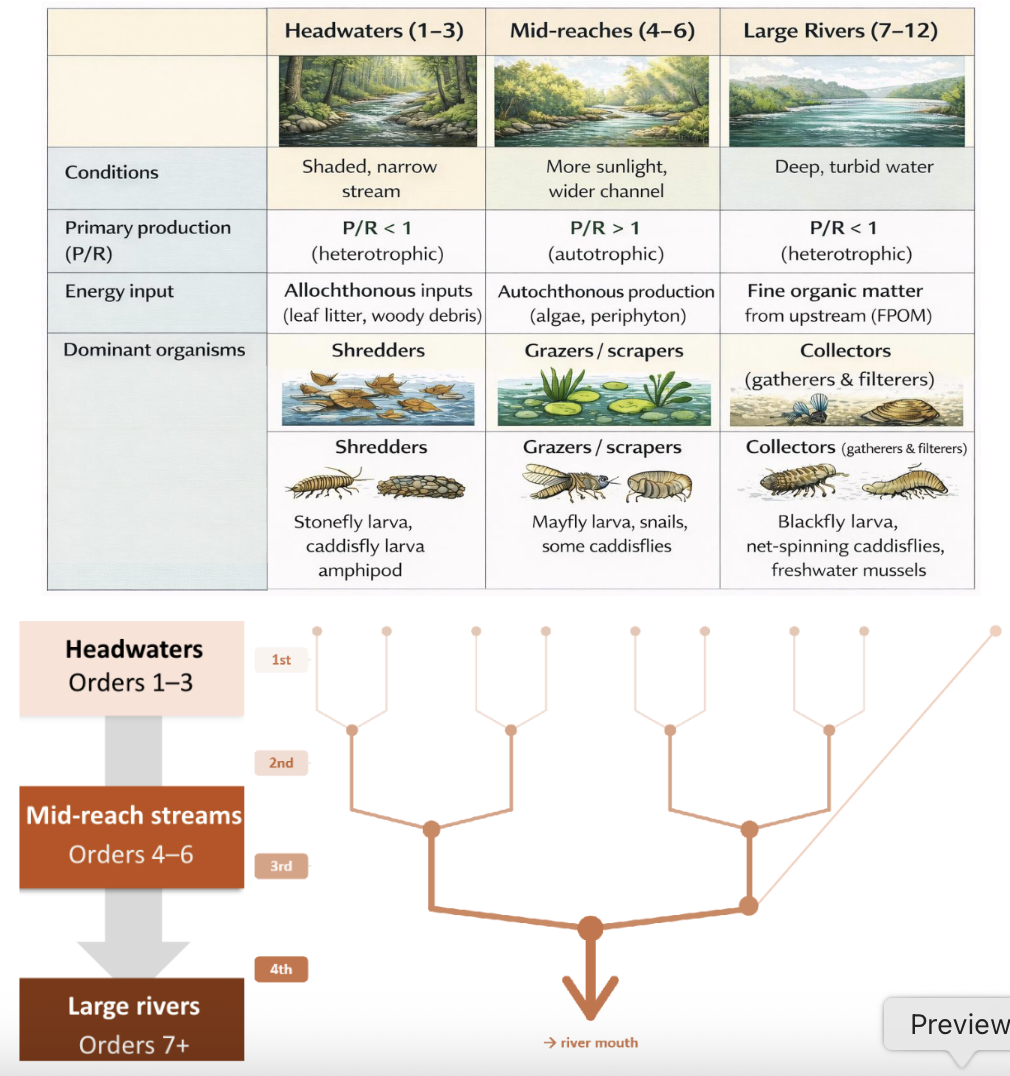
Stream Order
Headwaters (1st) → Larger Rivers (7+)
Headwaters
Mid-reach Streams
Large Rivers
Key Rule:
Only two streams of the same order merging moves up one order
Headwaters
Heterotrophic, allochthonous (dense canopy), shredders dominant organisms (what they break goes downstreams)
Orders 1-3
Mid-reach Streams
Medium rivers, generally open canopies, algae and aquatic plants (primary productivity happening), autotrophic, autochthonous, grazers/scrapers are dominant organisms
Orders 4-6
Large Rivers
Deep, high turbidity, input from wetlands and floodplains, not much plant growth, heterotrophic, allochthonous, collector gathers and filters are dominant organisms
Orders 7+
Each Stream Order is Influenced by:
Conditions (canopy cover, turbidity)
Primary Production (P/R)- amount of energy produced to the amount of energy used
Energy Source
Dominant Organisms
Autotrophic
Primary production greater than respiration (produce more than consuming)
P/R > 1
Heterotrophic
Respiration is greater than primary production (use more than producing)
P/R < 1
Autochthonous
Organic matter is produced within the river/stream itself
Mainly algae and plants
Allochthonous
Organic matter is originating from outside the stream
Leaf litter, animals drowning
Dominant Organisms (functional feeding group)- 5 invert groups:
Shredders
Grazers/Scrapers
Collector Gatherers
Collector Filterers
Predatory
Shredders
Breaking down organic material into smaller parts
Grazers/Scrapers
Getting algae and microbes off of surfaces in stream/riverbed
Collector Gatherers
Getting material from sediment
Collector Filterers
Getting material from flowing water
Predatory
Catching live macroinvert prey
Flow Regimes and Hydrological Connectivity
Impacted by:
Magnitude- volume of water discharged
Frequency- how often flood/low flows occur
Timing- seasonal pattern of flows
Duration- length of high/low flow events
Rate of Change- speed or rise and fall
Human Alterations- influence all 5 components
Dams, tile drainage, and impervious surfaces
High vs Low Flow
High Flow- carves out channels, promotes erosion and deposition, allows for diverse habitats to be maintained, creates heterogeneous landscape
Bad when it happens too often
Flashy is too much
Low Flow- concentrates organisms, changes temp, often seasonal and gives biological cues to animals in the system
Thermal Stratification
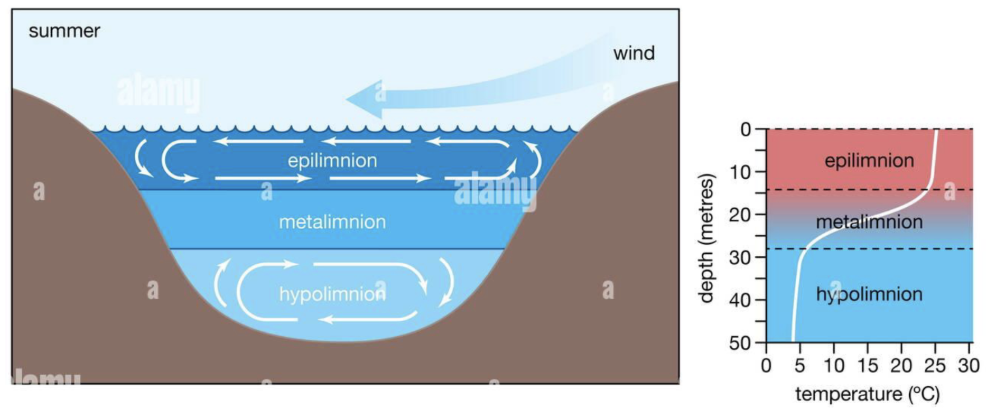
Separation of lakes into distinct horizontal layers based on temperature and density differences
Occurs in temperate lakes > 10m in depth
Water density is temperature-dependent
Densest at 4℃
Epilimnion
Uniformly warm, well-mixed, high O2, light penetrates and photosynthesis can occur
Metalimnion
Barrier between top and bottom layer
Thermocline
Rapid drop in temp every meter you go down
Generally drop 1℃ every 1 meter down
Hypolimnion
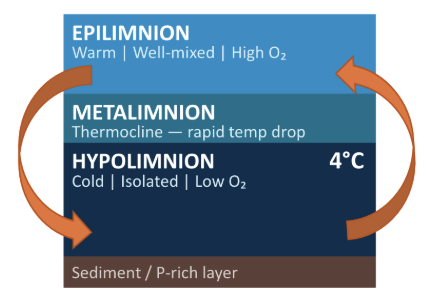
Uniformly cold (4℃), isolated, low O2, sunlight cannot penetrate,
Metalimnion prevents mixing, quickly leading to hypoxic and anoxic zones
Seasonal Turnover
Epilimnion cools, becomes denser, and sinks to bottom, causing mixing the mixing of layers
Dimictic lake- turnover happens twice a year (spring and fall)
Generally good but depends on lakes conditions
Critical for oxygenation of bottom layer
Internal Loading
Internal Loading
Release of P when oxygen depleted in hypolimnion
When oxygen is high, iron is bound to P so P is bound up in sediment
When oxygen is low, organisms in sediment use iron, turning it into a form that cannot bind P so P becomes available to aquatic system
Leads to algal blooms
Ex. Lake Erie Dead Zone
Lake Trophic State Classification
3 Variables Measured:
Total phosphorus concentration
Chlorophyll-a concentration- proxy for algal biomass
Secchi disk depth- shows water transparency
Lakes Slowly Age Through 4 Classifications
Oligotrophic
Mesotrophic
Eutrophic
Hypereutrophic
Ex. Lake Erie
Eastern Basin- mesotrophic
Western Basin- eutrophic
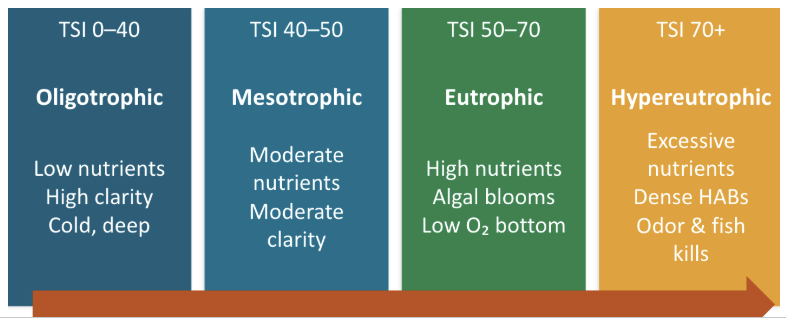
Oligotrophic
Low nutrients, high clarity, cold, deep
TSI 0-40
Mesotrophic
Moderate nutrients and clarity
TSI 40-50
Eutrophic
High nutrients, algal blooms, low O2 bottom
TSI 50-70
Hypereutrophic
Excessive nutrients, dense HABs (harmful algal blooms), odor, fish kills
Even all nutrient input stopped, still will be loaded for long time
Hard to recover from this state
TSI 70+
Wetlands
Areas inundated/saturated by surface or groundwater at a frequency and duration that supports vegetation adapted for life in saturated soil conditions
Key Characteristics of Wetlands
Hydric Soils
Hydrophytic Vegetation
Wetland Hydrology
Hydric Soils
Anaerobic (oxygen depleted) soils formed under prolonged water conditions,
Very distinct, not super firm
Take a long time to form
Hydrophytic Vegetation
Plants have morphological or physiological adaptations that allow them to survive in water logged conditions
Ex. Stilt Root- above ground part of root allows for oxygen transfer, provide support/stabilization
Wetland Hydrology
Water present for enough time to cause soil inundation/saturation
Dictates development of hydric soils and hydrophytic vegetation
Basically, have to be able to tell it is regularly flooded
Wetland Types
Marshes
Swamps
Bogs/Fens
Saline Wetlands/Estuaries
Others- prairie potholes, vernal pools, riparian wetlands
Marshes
Periodically or constantly flooded, dominated by herbaceous soft-stemmed plants, can be fresh of salt water
Swamps
Periodically or constantly flooded, dominated by woody plants (trees), can be in tropical areas
Mangroves
Bogs/Fens
Dominated by moss and decaying plant matter, peat accumulating, generally found in boreal zones
Saline Wetlands/Estuaries
Freshwater meets and mixes with the saltwater sea, creates brackish water
Tidal flats, salt marshes, mangroves, etc.
Wetland Function
Among the most productive systems on Earth
Water Quality Improvement
Flood Attenuation
Carbon Sequestration
Wildlife Habitat
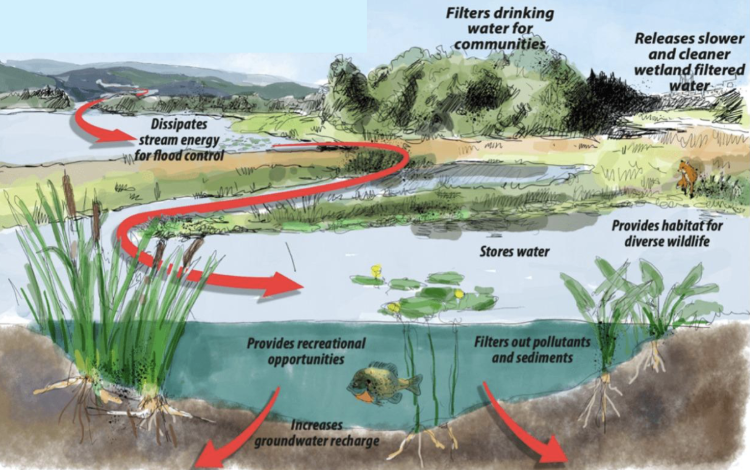
Wetland Water Quality Improvement
All wetland plants settle nutrients and allows for denitrification (remove nitrogen from the system), also sequester phosphorus, important for removing nutrients and preventing overload
Wetland Flood Attenuation
Increases groundwater recharge and base flow, allowing continued flow in streams during times of little rain, returns water more slowly which reduces flooding
Carbon Sequestration
Carbon sink when healthy
When drained, C released back into the atmosphere
Wildlife Habitat
Biodiversity hotspots
Habitat for birds and fish
Distributed globally
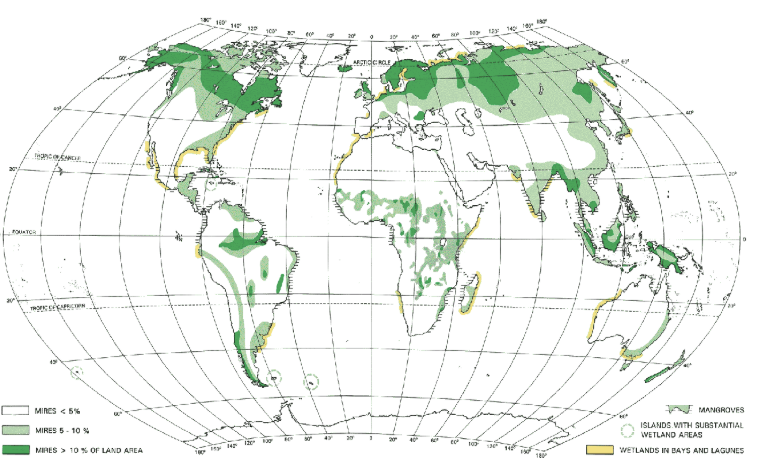
Wetland Threats
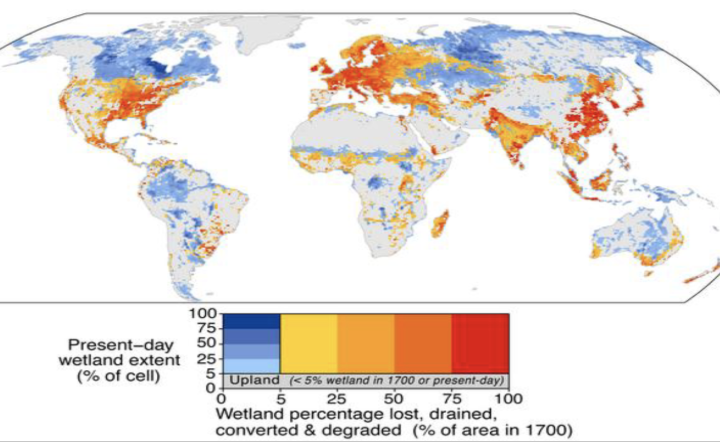
Threatened worldwide
Drainage- 35% in world’s lost since 1970s
Michigan lost 40%, Ohio lost 90%