Women's Health- Breasts
 Studied by 0 people
 Call with Kai
 Learn
Learn Practice Test
 Spaced Repetition
 Match
Match Flashcards
 Knowt Play
1/69

There's no tags or description
Looks like no tags are added yet.
Name | Mastery | Learn | Test | Matching | Spaced | Call with Kai |
|---|
No analytics yet
Send a link to your students to track their progress
70 Terms
collects excess fluid in bodies tissue and returns it to the bloodstream; makes immune cells to help with infection
What are the two functions of lymph nodes?
Central (deep within axilla), subscapular (posterior), pectoral (anterior), lateral, supraclavicular, infraclavicular
What are the groups of lymph nodes?
- Against the anterior thoracic wall extending from the clavicle and 2nd rib down to the 6th rib
- from the sternum to the mid axillary line (line from armpit down), serves as more rectangle than round
What is the location of the female breast?
up into the armpit
Axillary tail of the breast tissue extends....
Breast proper, tail; lymph nodes, nipple, areola (breast tissue surrounding nipple), glandular tissue (milk glands, milk ducts), mostly consist of adipose tissue
What is the basic anatomy of the female breast?
Where milk extrudes from during breast feeding
What is the purpose of the nipples in breasts?
Produce milk
What is the purpose of milk glands in the breast?
Connect the gland to the nipple
What is the purpose of milk ducts in the breast?
Breast lump (doesn't have to be abnormal), breast pain, discoloration, discharge from nipples (could be blood), enlarged lymph nodes (provider has to determine if benign or needs to be investigated), shape change (dimpling)
What are concerning findings in a women's breast?
Infection or cancer
What can large lymph nodes indicate?
peua d' orange
What is a change in texture that is highly suspicious of breast cancer?
1. Clarify when during the menstrual cycle that the exam is done.
2. Any discomfort, pain, lumps?
3. If lump is present, ask about location, duration, and change in size throughout the cycle
4. Any nipple discharge? If so, when? Ask about color, consistency, quantity
What are questions that are important to ask during a clinical breast examination?
Galactorrhea
flow of milk from breasts other than within normal lactation
Lactation
production of milk for a period of time after birth; milk production with the intent of breastfeeding
Fibroadenoma
What is the most common palpable mass in 15-25 year olds?
usually fine, round, mobile, tender
What is a fibroadenoma mass like?
Cysts, fibrocystic changes, cancer
What are the most common palpable masses in 25-50 year olds?
usually soft to firm, round, mobile, often tender
What is a cyst mass like?
Nodular, ropelike
What is a fibrocystic change like?
Irregular, firm, not clearly delineated from surrounding tissue
What is a cancer mass like?
Cancer until proven otherwise
What is the most common palpable mass in people over the age of 50?
Fibroadenomas, cysts, mastitis (inflammation of the breast), cancer
What is the most common palpable mass in those who are pregnant/breastfeeding?
Fibroadenoma
benign tumor (new growth) made of epithelial cells
Cyst
closed sac that contains fluid or can have solid qualities to it
Simple cyst
cyst that has just fluid contents
Complex cyst
cyst which has fluid and solid qualities
Fibrocystic disease
condition marked by palpable lumps in breast, usually associated with pain and tenderness, that fluctuates with the menstrual cycle (usually gets better after the period is over)
Pain is subjective, they tell you; tenderness is something you find when examining patient, objective
What is the difference between pain and tenderness?
Inspection (looking at it)
What is the first step when examining the breast?
Check for asymmetry (same size or position, if new or old), skin changes (puckering or fullness, retraction, change in skin texture), contour changes, retraction (done in 4 views)
What should you do during inspection of the breast?
Arms at sides, arms overhead with hands pressed together, hands on hips, and leaning forwards
What are the 4 views you use to look for retraction of the breast?
Palpation
What is the second step during examination of the breast?
Supine (on back)
What position is palpation of the breast best performed in?
Use fingerpads of 2nd, 3rd, and 4th fingers; breast can feel soft, lumpy, nodular, uneven texture (usually normal, can change with menstrual cycle)
How do you perform palpations and what do you feel for?
1. Be systematic (done same each time)
2. Can be done in circular manner or up and down or like a clock
3. Nipple should be palpated as well
4. Remember to palpate tail of breast and axilla
What are the 4 things that must be done when palpating the breast?
May show discharge that is otherwise not seen
Why is it important to palpate the nipple?
Into four quadrants based on horizontal and vertical lines which intersect at the nipple (50% of cancers are in the upper outer)
How is the breast divided?
1. upper outer 2. upper inner3. lower outer4. lower inner
Four quadrants of the breast
1. upper outer- 50%2. upper inner- 15%3. lower outer- 11%4. lower inner- 6%5. nipple - 18%
Percentage of four breast quadrants (and nipple)
Upper outer
Which quadrant is most breast cancer found in?
As the time on the face of the clock (i.e. 3 o'clock, and the distance in centimeters or inches from the nipple); say size of lump, quadrant, and about how far from the nipple
How can physical findings be localized?
Mammogram
X-ray of breasts, breast is compressed between 2 plates to flatten and spread out tissue, takes about 20 minutes
It gets a better image, but can be uncomfortable
Why are the breasts pressed between two plates in a mammogram?
Black and white digital image, then read by radiologist (we get report from them)
What does a mammogram produce and who reads it?
The tope plate compresses and squeezes breast, so don't go before period because breasts can be tender and bad for image, can be uncomfortable
Why should someone get a mammogram after their period ends?
Millisievert (measure of radiation dose)
What is a measure of radiation?
3 millisieverts per year
How much radiation are we exposed to over a year (average)?
0.4 millisieverts per year (be aware of how much radiation patient has already been exposed to), about 2 months of radiation
How much radiation is in a mammogram?
1. Calcifications
2. Masses
3. Density
What 3 things will a radiologist look for?
Calcifications
tiny mineral deposits within the breast tissue, they appear as white spots on the image, they may or may not be cancerous
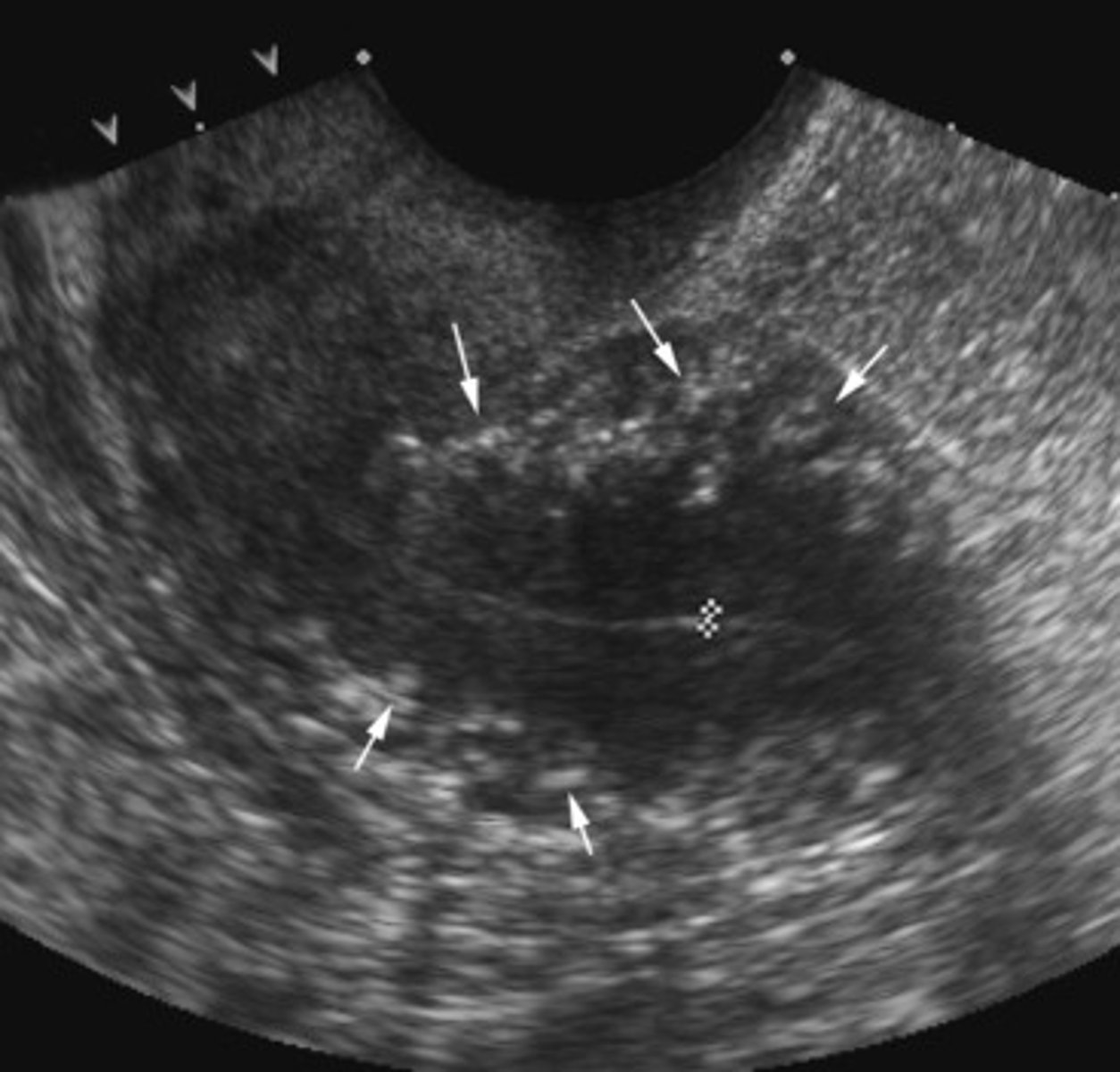
Macrocalcifications
large calcium deposits
1. Aging of breast arteries
2. Old injuries
3. Inflammation (most common causes)
What are macrocalcifications most likely caused by?
Non-cancerous cases
What are macrocalcifications usually related to?
About half of all women over 50
Who are macrocalcifications found in?
Microcalcifications
tiny specks of calcium in breast, more concerning but don't always mean cancer
Mass
an important change that can occur with or without calcifications; it can represent a cyst, non cancerous tumor, or breast cancer
1. mass does not change overtime 2. no family history of breast cancer etc.
When is a mass less concerning?
Density
how fibrous, glandular, or fatty the breast is
Harder to see things, less fat, higher risk of cancer
What is bad about dense breasts?
- Cannot diagnose breast cancer (evaluatory, need a biopsy, findings are only suspicious of cancer)
- Test isn't perfect at finding breast cancer (as with any lab test, there are false positives and negatives)
- Patients with breast implants may need more or special imaging
- Doesn't work as well in younger women (have dense breasts) or men
4 Mammogram Limitations
Mammogram, ultrasound, MRI, CT scan
What are the rankings for the best diagnostic tests to diagnose breast cancer?
- Women b/w 40-44 have the option to start screening with a mammogram every year
- Women b/w 45-54 should get mammograms every year
- Women 55 and older can switch to a mammogram every other year, or they can choose to continue yearly mammograms. Screening should continue as long as the woman is in good health and is expected to live atleast 10 more years
- All women should understand what to expect when getting a mammogram for breast cancer screening- what the test can and cannot do
What are the recommendations by the American Cancer Society for women at average risk of breast cancer?
Recommendations
Different entities have different what?
Done by the patient
What is a breast self examination (BSE)?
Done by the clinician
What is a clinical breast exam?
Clinical Breast Exam and Breast Self Exam
What is not recommended by ACS among average risk women at any age?
Patient has no symptoms, complaints, and you (provider) feel nothing abnormal
What is a screening mammogram?
Patient has a complaint or you (provider) appreciate something on physical exam
What is a diagnostic mammogram?
- Gender (female)
- Age (77% of breast cancers are over the age of 50)
- Dense breasts (harder to see something abnormal)
- Family history
- Tobacco and alcohol use (relative risk)
- History of other cancers/had previous chest radiation
- Early onset of menses and late onset of menopause (able to get pregnant for a long time, lots of estrogen)
- People who have never ben pregnant (always on menstrual cycle)
- People who have had 1st child after 30
What are risk factors for breast cancer?
- Stop alcohol and smoking use
- Maintain healthy weight
- Regular physical activity
- Regular mammograms
What should you do to prevent breast cancer?
 Note
Note  Flashcards (121)