Kinesiology Quiz #1
 Call Kai
 Learn
Learn Practice Test
 Spaced Repetition
 Match
Match Flashcards
 Knowt Play
1/30

There's no tags or description
Looks like no tags are added yet.
Name | Mastery | Learn | Test | Matching | Spaced | Call with Kai | Chat |
|---|
No analytics yet
Send a link to your students to track their progress
31 Terms
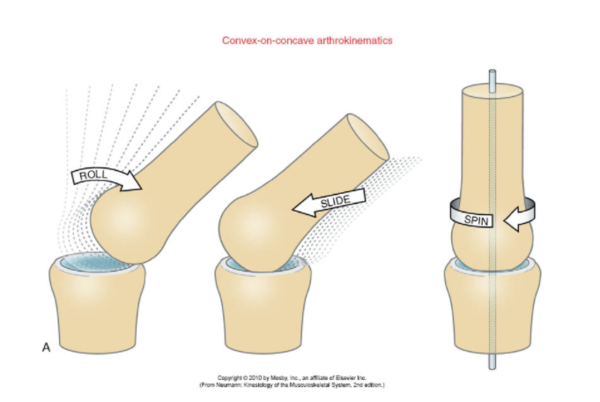
Arthrokinematics motions
Arthrokinematics motions are movements between the joint surfaces.
Roll - occurs when one surface rolls over another, like a tire rolling on the ground (ex: shoulder or hip - ball & socket joint)
Spin - when one surface rotates on a fixed axis, like a doorknob turning (ex: radial spinning - pronation/supination)
Glide (or translation) - when one surface slides over another, like a drawer sliding open (carpals of wrist (deviation, or waving motion, tarsals of foot)
Osteokinematic motions
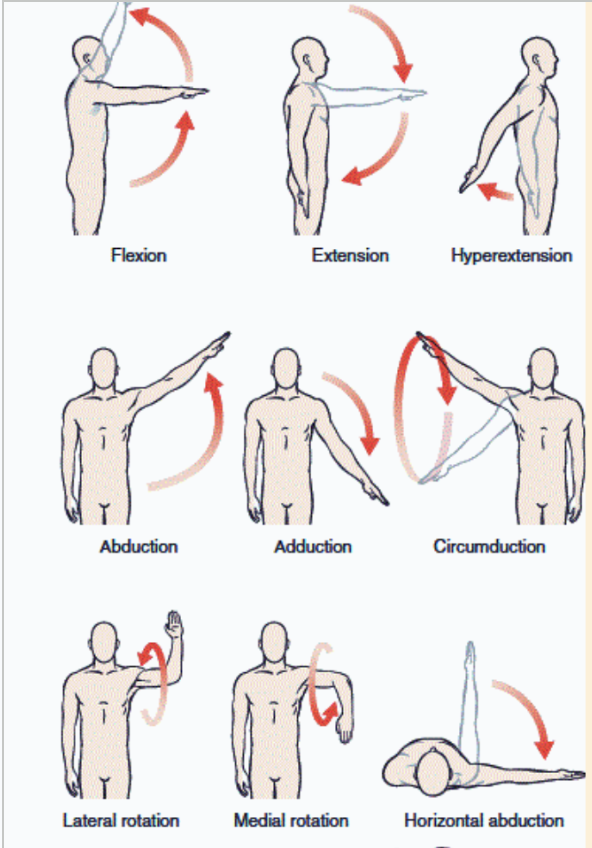
Osteokinematic motions are movements of limbs through space about a joint.
Describes clear movements of bones which are visible from the outside.
Movement occurs around a joint axis
Gross movement
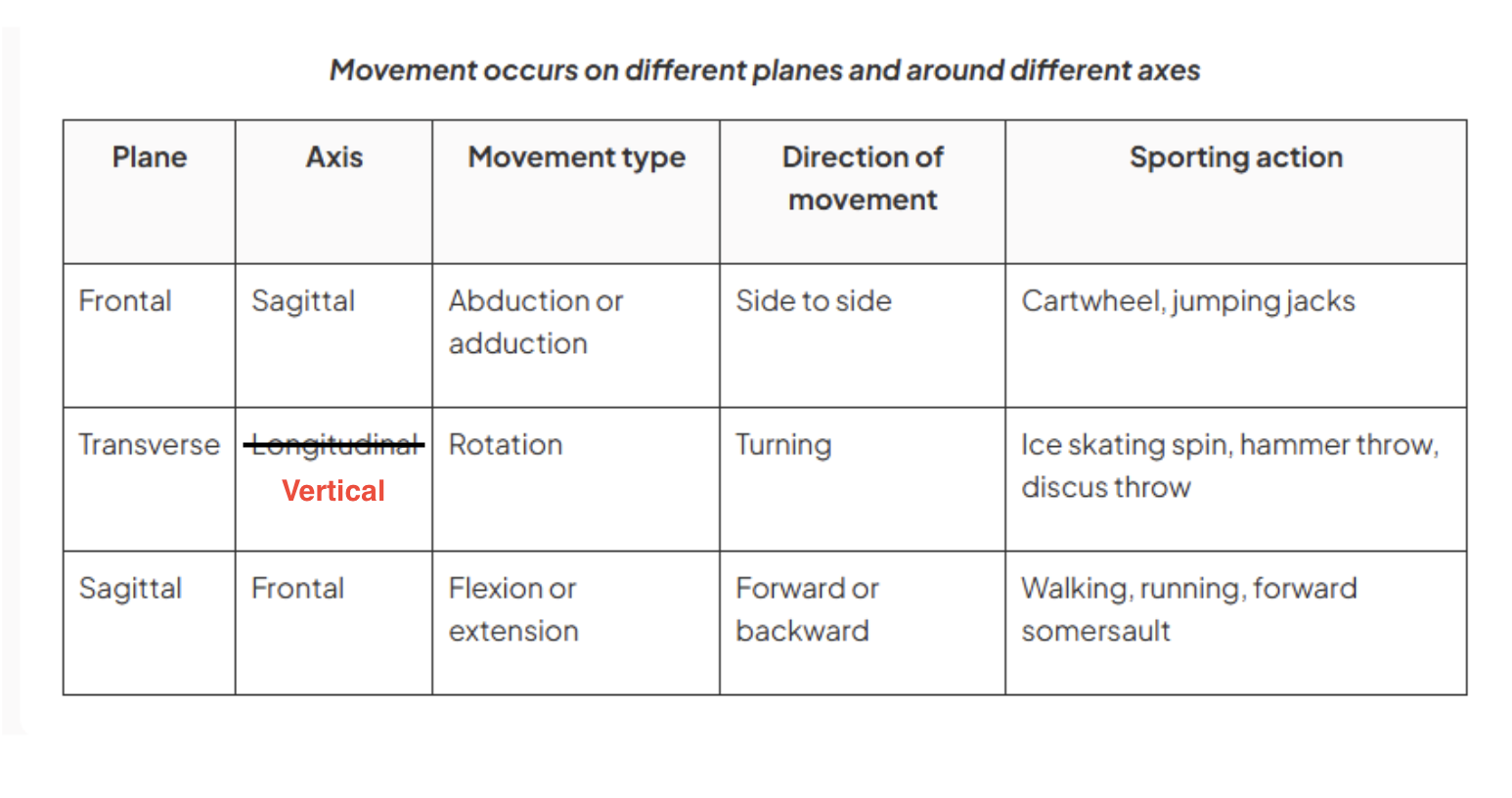
flexion/extension
abduction/adduction
medial rotation/lateral rotation
Concave-Convex Rule
Convex moving on concave (glide) - movement occurs in opposite direction
Concave moving on convex (rolls/slides) - movements occurs in the same direction
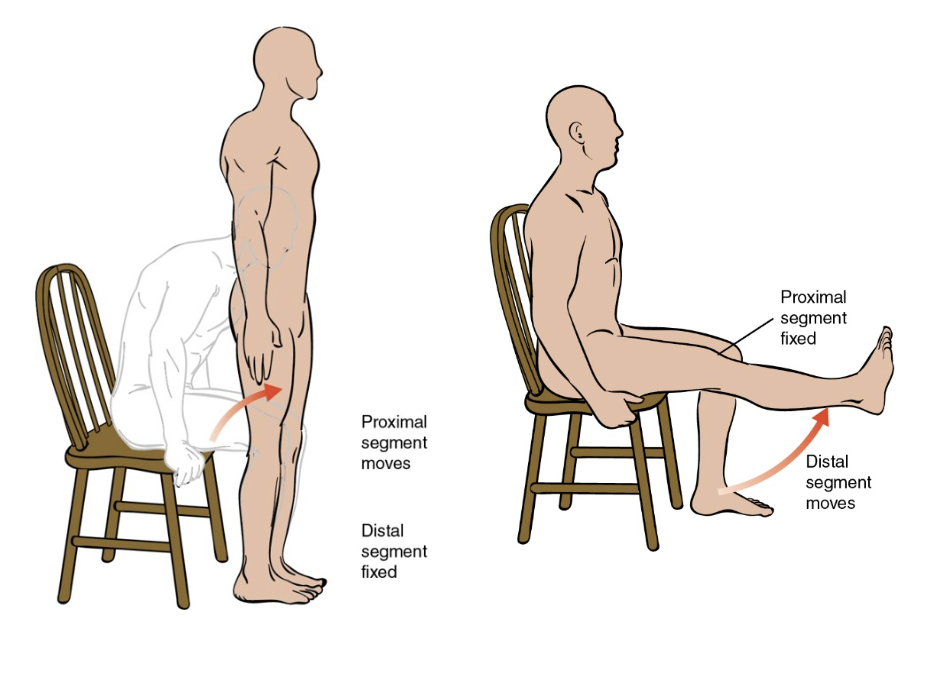
Kinetic Chain
It is the series of connected rigid links
refers to interrelated parts of the body (i.e., joints and muscles) and how they work together to perform movement.
limb segments
influence the type of movements
closed kinetic chain: distal segment is fixed, proximal segment free to move
open kinetic chain: distal segment free to move, proximal segment fixed
Planes of Movement
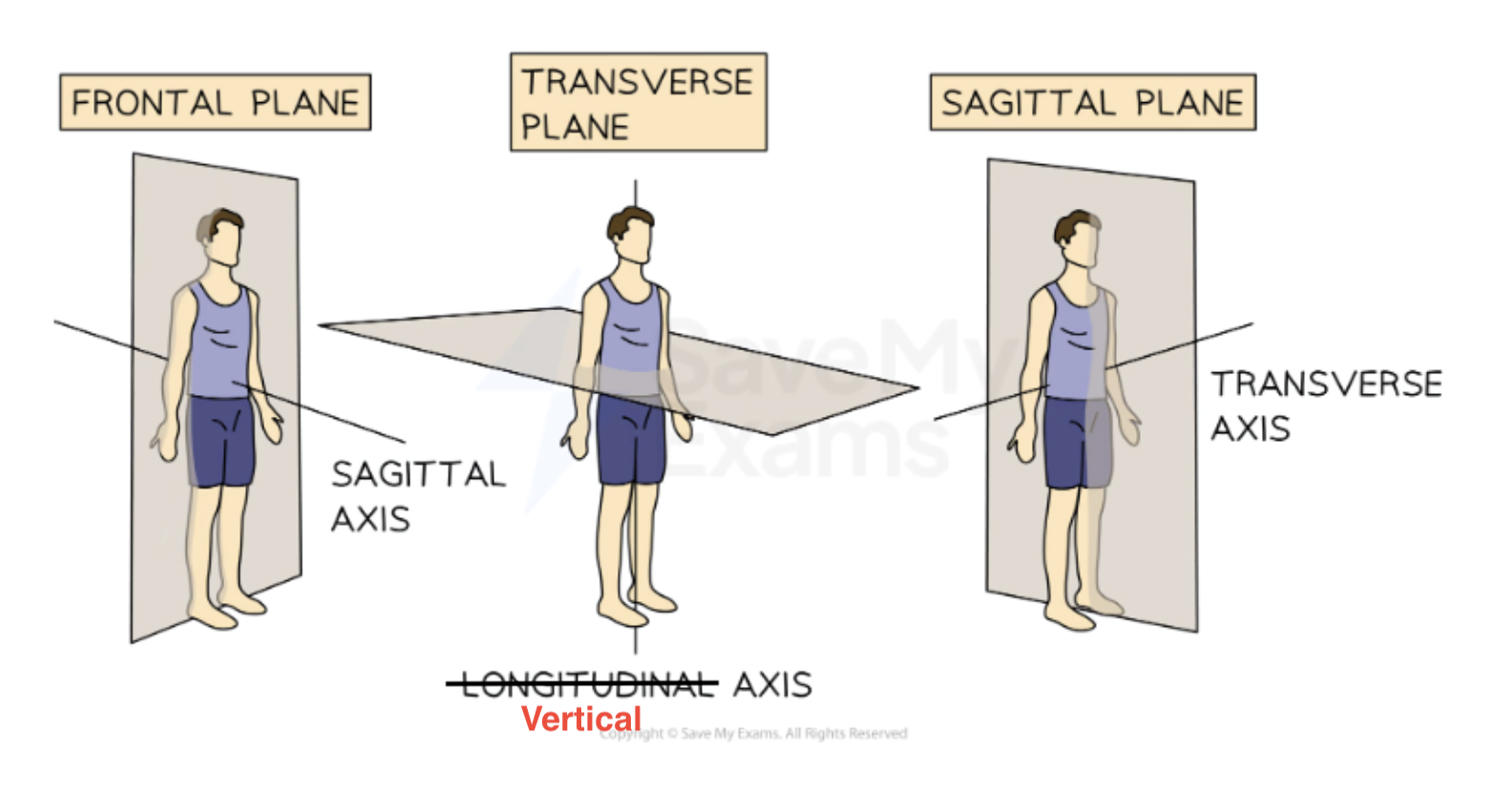
Sagittal plane passes through body
divides body into right and left
Frontal plane passes through body
divides body into anterior and posterior
Transverse plane passes through body
divides body into superior and inferior
Axes of Movement
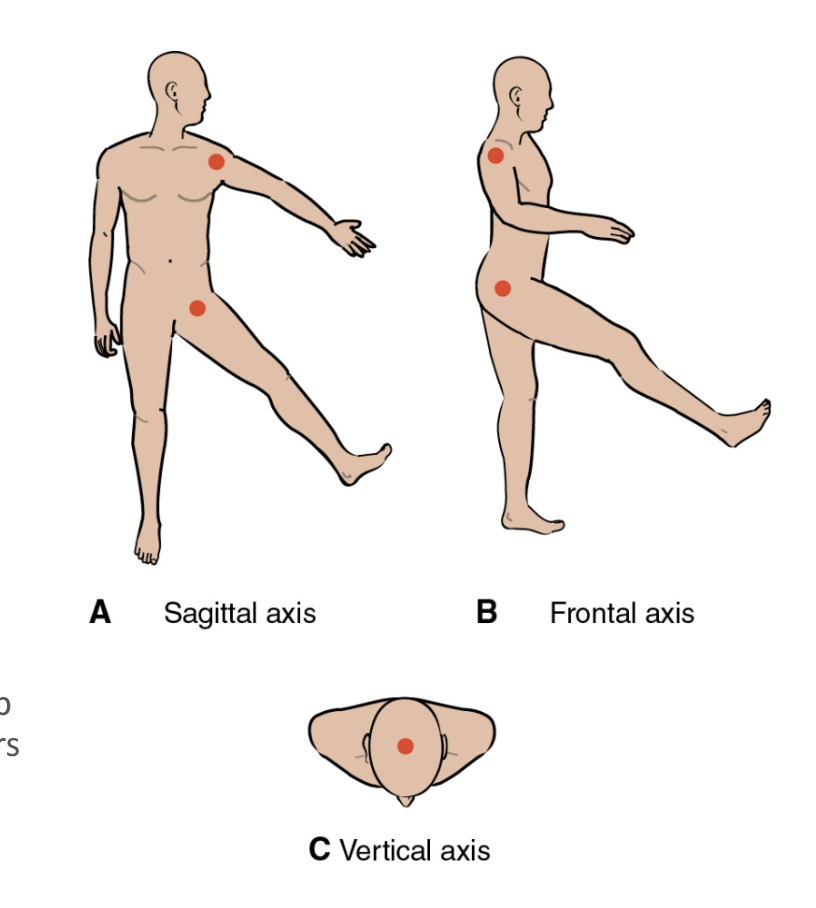
Sagittal axis passes through joint
anterior to posterior
Frontal axis passes through joint
side to side
Vertical axis passes through joint
superior to inferior
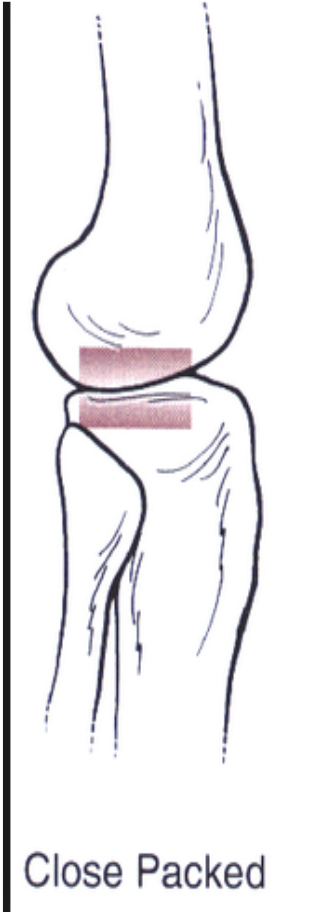
Pack Positions - Closed Pack Position
Congruent
Ligaments & capsule under max tension
Joint surface tightly packed
Cannot be pulled apart with traction
Most stable position
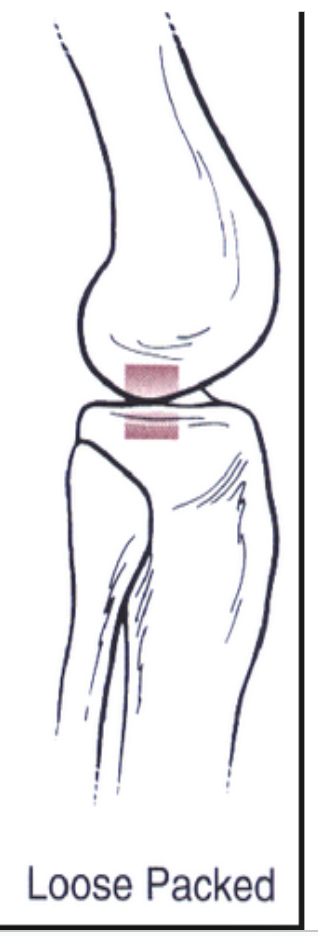
Pack Positions - Loose Packed Position
Resting position
Ligaments and capsule relaxed
Max space within joint
Can be pulled apart by traction
Newton’s First Law of Motion
First Law of Motion:
an object at rest will remain at rest unless acted on by an external force
tendency to resist changes in a state of motion is inertia
Newton’s Second Law of Motion
Second Law of Motion:
The acceleration of an object depends on the mass of the object and the amount of force applied
Bigger mass = more force required
Newton’s Third Law of Motion
Third Law of Motion:
For every action force, there is a reaction force equal in strength and opposite in direction
Law of action-reaction
for every action there is an equal and opposite reaction
Biomechanics
The application of mechanics to the study of human movement.
Mechanics is the study of forces exerted on an object.
Kinetics: force
Kinematics: Time, space, mass
Force
Amount of push or pull applied to objects or body segments
push creates compression → ←
pull creates traction ← →
Internal forces: muscle contraction, ligamentous restraint
External forces: gravity, any externally applied resistance
Gravity
Mutual attraction between the earth and an object
Ground reaction: upward force a supporting surface exerts when an object pushes downward on the support surface
ex: stepping on a tissue box vs. a brick
Friction
Force between two surfaces that increased resistance to motion of one surface across another
increased by compression
decreased by traction
Force
Linear forces: two or more forces acting along the same line; ex - tug of war
Parallel forces: occur in the same plane and in the same or opposite direct; ex - brace
Force couple: two or more forces act in different directions; produces clockwise or counterclockwise rotation; ex - merry-go-round
Concurrent forces: two or more forces acting on an object; push or pull in different directions
ex - anterior and posterior deltoid applying force, creating concurrent force in the middle deltoid
Optimal Length
sarcomeres length that produces greatest amount of force
ex: bicep completely flexed = muscle is short (actin filaments smashed up on M line)
bicep/arm extended = fully lengthened muscle (actin far away from M line, not a lot of force generating)
Optimal length = in between fully shortened & fully lengthened; in the middle
ex: bicep curl - middle is optimal length
Optimal Muscle Length Tension
In order to allow for one part of the muscle to have enough ability to generate the force the other one has to slack off
If both muscles are in optimal tension = no function
Ex: Hamstrings (cross hip & knee joint) - hip extension & knee flexion
In order to allow the hip to work through the two positions, one must shorten, one must lengthen
one portion has to tighten, other relaxes
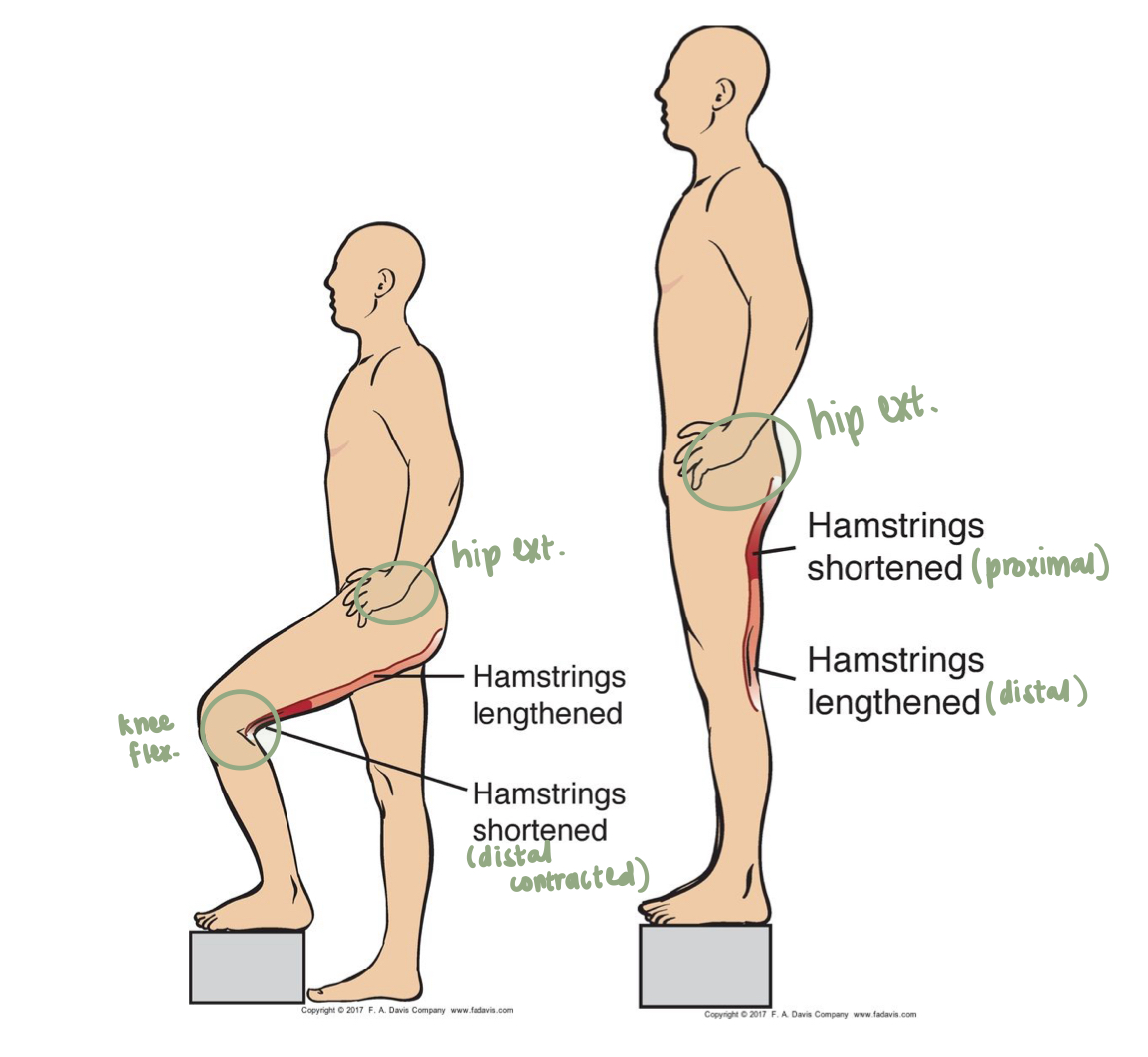
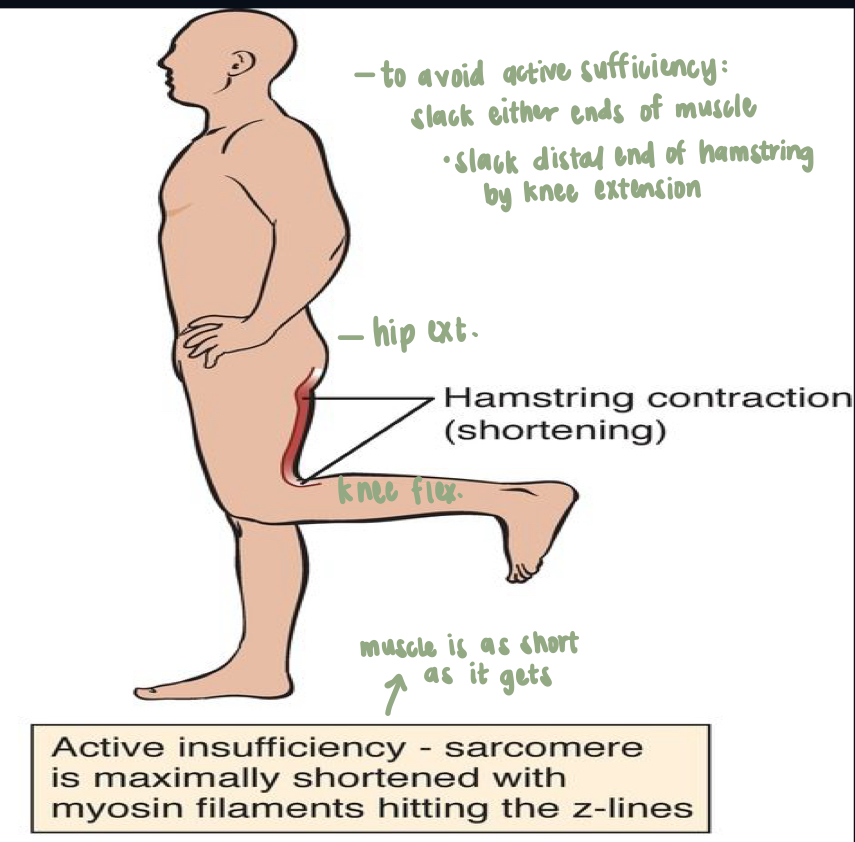
Active Insufficiency
Muscle is contracted/shortened
actin will slide into m-line and will not be able to move further due to shortened muscle
no further room for muscle to shorten; lacking further actin motion because the muscle is as short as it gets
slack one of the joints in order to get optimal length (extend knee)
In order to see true hip extension, slack distal end of hamstring via knee extension
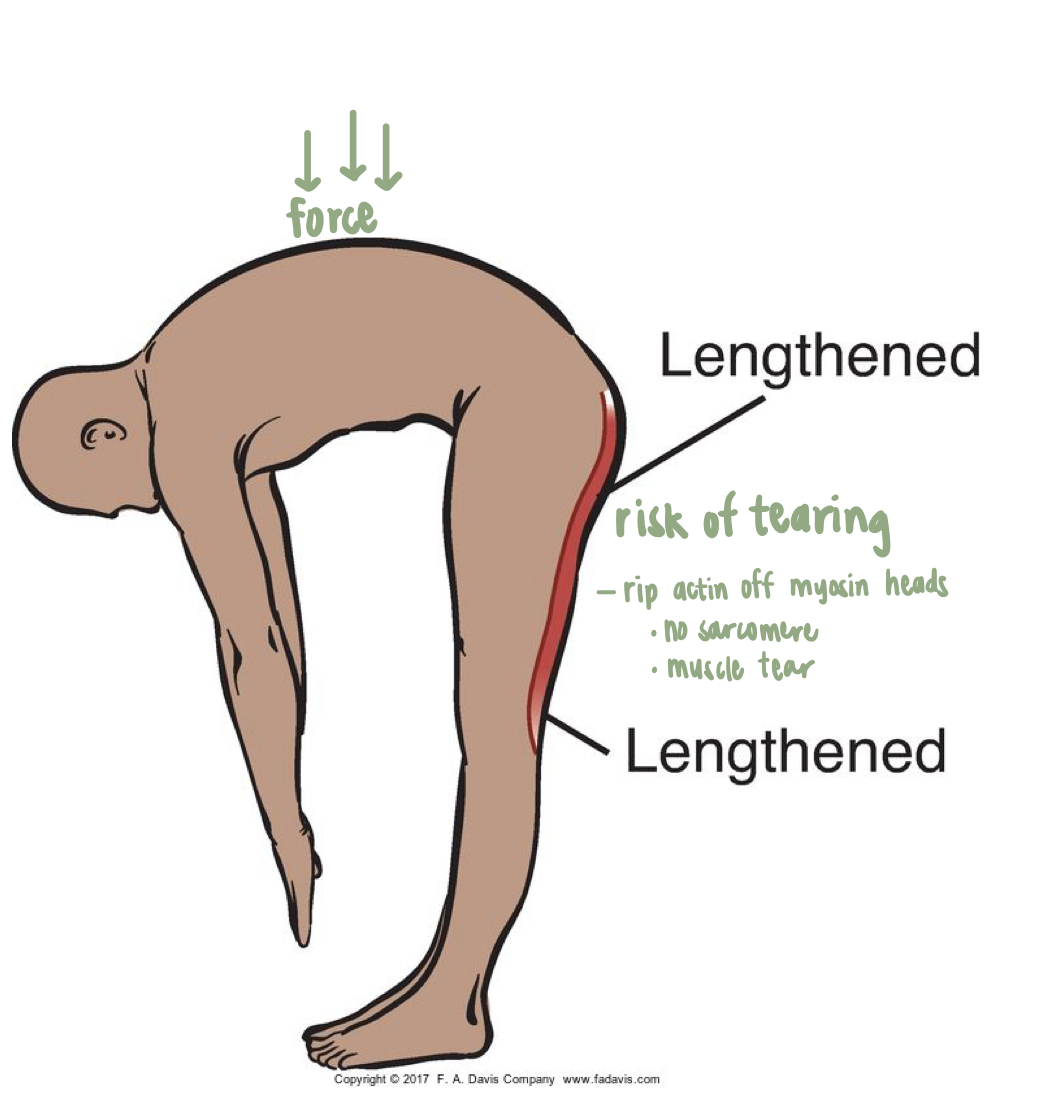
Passive Insufficiency
Both ends of muscle is lengthened
Add force = risk of tearing
rip actin off myosin heads
no sarcomere
muscle tear
Avoid active & passive insufficiencies
Compound exercises
more muscles involved
acting in optimal length
avoid injury
squats, deadlifts, push ups
squats - involve glutes, quads, hamstrings, gastroc, trunk
Range of Motion
Active (AROM): what individual is able to do
Active assistive (AAROM): muscle doing part of work w/ provided assistance
Passive (PROM): no muscle activating, external force to move joint)
Self - passively ranging themselves
Functional - what joint needs to do for that task, for that person; ROM required for task
Limitations for ROM:
muscle weakness
changes in muscle movement
orthopedic issues
circulation issues
pain swelling
structural impairment (ex: scar)
ligament or tendon injury
ROM Contraindications
joint dislocation
unhealed fracture
soft tissue damage around a joint (tear)
heterotopic ossification (HO) [bone grows in tissues where it typically wouldn't]
MMT Grades
5 (Normal): Complete ROM against gravity with full resistance
4 (Good): Complete ROM against gravity with some resistance
3 (Fair): Complete ROM against gravity
2 (Poor): Complete ROM with gravity eliminated
1 (Trace): Evidence of slight contractility; no joint motion
0 (Zero): No evidence of contractility
How gravity impacts MMT
Gravity impacts MMT by showing how hard a muscle has to work during this test. When testing a muscle with gravity, it makes it easier for the muscle to move. In order to test the strength of the muscle, the movement should be done against gravity to show how strong the muscle actually is.
If the muscle cannot overcome the force of gravity (cannot go against gravity, muscle not strong enough), the muscle should be tested with gravity eliminated.
Depending on the test location, gravity can either support or hinder muscular movements during MMT. While gravity resistance might make muscles appear weaker, gravity-assisted test positions can make muscles appear stronger. In order to lessen this impact and provide a more accurate measurement of the muscle’s actual strength, therapist may move the body in postures that diminish or completely eliminate the effect of gravity.
Gravity impact on MMT
Gravity affects muscle manual testing(MMT) by adding natural resistance. Testing against gravity shows stronger muscles while testing in gravity-eliminated positions helps assess weaker muscles.
Types of joints
non-axial joint: slight gliding motion
intercarpal & intertarsal joints
uniaxial joint: motion in one place about one axis (one degree of freedom)
pivot joint - allows rotation on a single axis
radioulnar joint - allows rotation of forearm
hinge joint - elbow, knee, ankle
flexion & extension
biaxial joint: two planes of motion about two axes (two degrees of freedom)
MCP flexion/extension & abduction/adduction
triaxial joint: three planes of motion about three axes (three degrees of freedom)
ball & socket joint - hip & shoulder joints
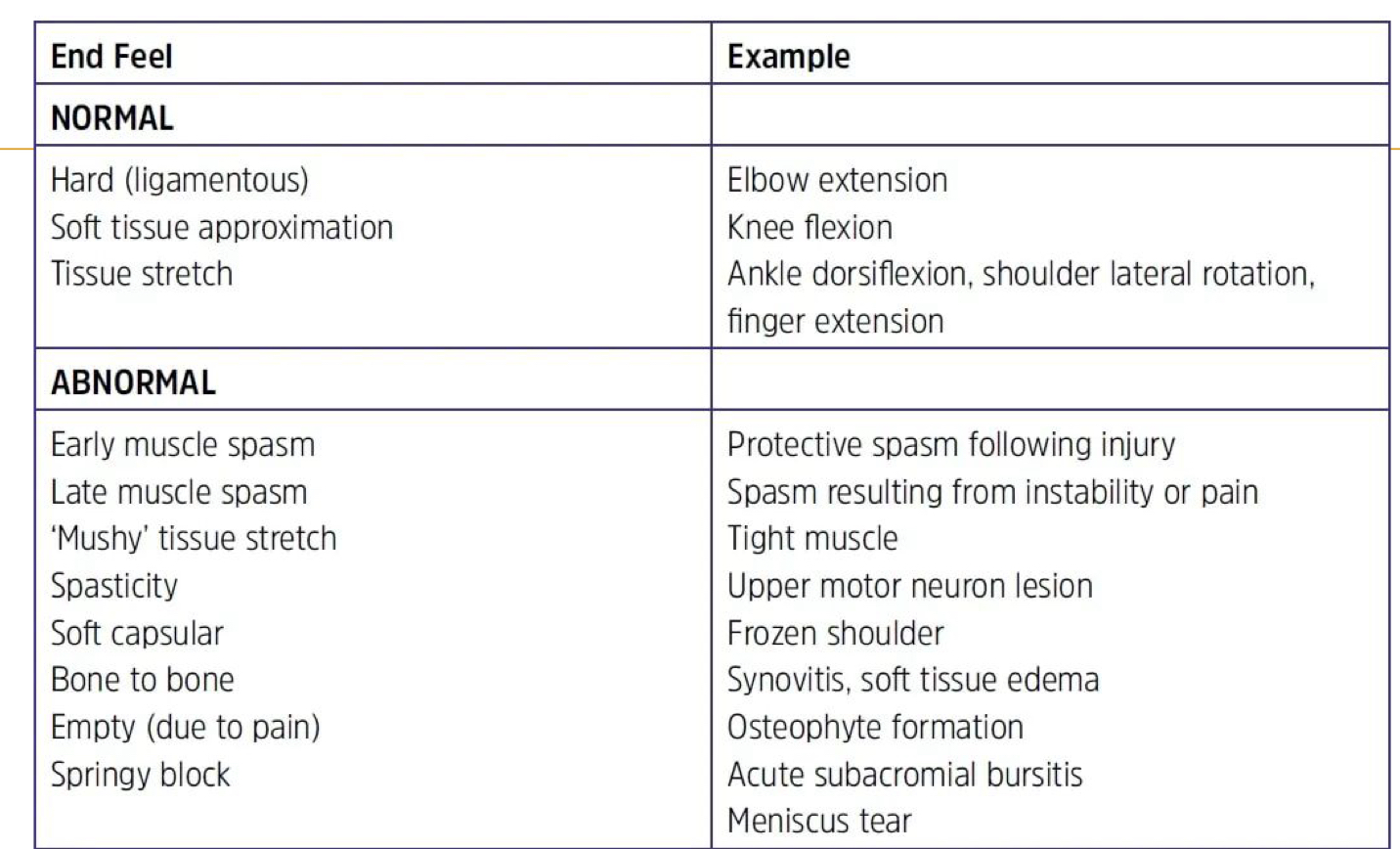
Types of end feel (osteokinematics)
sensation perceived when passively moving a patient’s joint to the end of its ROM
use to determine reason for the limitation of further motion at the joint
normal end feel: what is expected at end of normal ROM
abnormal end feel: when end of ROM is not normal
pain, swelling, muscle guarding, changes in anatomy