Team # 3 - Organizational Change Ch. 11
 Call Kai
 Learn
Learn Practice Test
 Spaced Repetition
 Match
Match Flashcards
 Knowt Play
 Podcast
1/38

There's no tags or description
Looks like no tags are added yet.
Name | Mastery | Learn | Test | Matching | Spaced | Call with Kai |
|---|
No analytics yet
Send a link to your students to track their progress
39 Terms
What Is Organizational Change?
Organizational change is the process by which a company or institution shifts its structure, strategy, operations, culture, or technology in order to adapt to internal or external pressures.
It’s how an organization intentionally moves from the way things are now to a new, different way of operating.
Organizations may change as a means to manage internal or external pressures.
Change is inevitable, and being able to adapt to change will help the process go more smoothly.
Six Distinct Forces that Act as Stimulants for Change
[6 Forces - NTECSW]
Nature of workforce: Increased cultural diversity, aging population, new entrants to job market, outsourcing, globalization.
Technology: Faster, cheaper and more mobile computers, online music sharing, deciphering of the human genetic code.
Economic Shocks: Rise and fall of crypto stocks, low / high interest rates, changing financial markets.
Competition: Globalization, global competitors, mergers, growth of online business (E-commerce).
Social Trends: Ability for customers to share information online (reviews, videos), rise of discount and “big box” retailers.
World Politics: Global financial crises, opening of new markets in China, government changes around the world, extreme weather (e.g. natural disasters).
![<p>Organizational Change Targets Available</p><p>[8 Targets]</p>](https://assets.knowt.com/user-attachments/166a3107-4926-4467-89bf-d51849d99319.webp)
Organizational Change Targets Available
[8 Targets]
Organizations have many opportunities to engage in change. This ranges from engaging in Corporate Social Responsibility (CSR), changing their motivation structures, redesigning jobs, creating and dismantling teams, increasing and decreasing leadership through empowering employees, and more.
Change may be required for the organization to survive. Different areas that organizations can engage in include:
Purpose: Create missions, visions and objectives.
Technology: Improve equipment, facilities and workflow.
Structure: Update organizational design, coordination and mechanisms.
Tasks: Update job designs for individuals and groups.
People: Update recruiting and selection practices; improve training and development.
Culture: Clarify or create core values or beliefs.
Strategy: Clarify or create strategic and operational plans.
Objective: Set or modify specific performance targets.
Change Agents
People who act as catalysts and assume the responsibility for managing change activities within organizations.
They see a future for the organization that others have not identified, and they are able to motivate, invent, and implement this vision.
Can be managers, nonmanagers, employees of the organization, or hired outside consultants.
This can include both outside and inside change agents.
Outside Change Agents
They are people that are hired that are not a part of the organization. Instead they are retained to assist in undertaking change efforts. Managers may choose to hire an outside change agent when undertaking major change efforts.
Outsiders can offer a different and unbiased perspective, that insiders may not possess.
However, due to this they may implement more drastic changes, that may be out of reality and scope.
Outsiders may do this, as they do not have to live with the daily consequences of the decisions after they are implemented.
This can be harmful and helpful depending on the situation.
They also may lack the valuable knowledge that someone inside may have on the organization’s history, culture, operating procedures and personnel.
Inside Change Agents
Staff that are designated or hired to act as change agents that work within the organization. This can be internal staff specialists or managers acting as change agents.
Inside change agents may be more thoughtful (and more cautious) because they have to live with the consequences of their actions related to the change.
However, in some cases insiders can posses a more biased perspective, and may be reluctant to make certain changes.
Four Approaches to Managing Change
[LKAA]
Lewin’s Three-Step Model (Created by Kurt Lewin)
Kotter’s Eight-Step Plan for Implementing Change (Created by John Kotter)
Action Research
Appreciative Inquiry (AI)

Lewin’s Three-Step Model Explanation (Kurt Lewin)
Lewin argued that successful change should follow three steps: Unfreezing the status quo, moving to a new state, and refreezing the name change to make it permanent.
The status quo is an equilibrium state.
Equilibrium state means a condition of balance or stability where opposing forces or influences are equal, so there is no net change happening.
To move from this equilibrium, to overcome the pressures of both individual resistance and group conformity, unfreezing must happen in one of three ways:
Driving forces;
Restraining forces;
Combination of both approaches (driving + restraining)
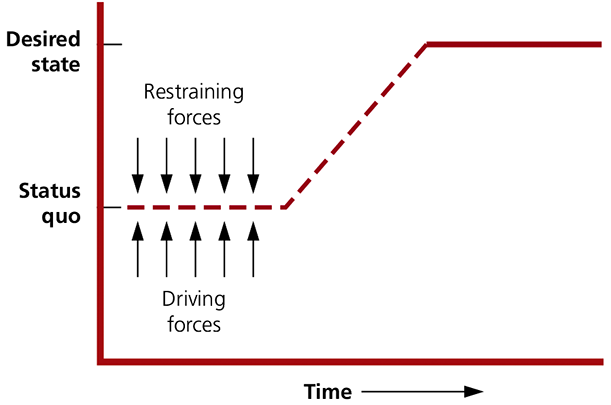
Unfreezing
Lewin’s Three-Step Model Explanation (Kurt Lewin)
Change efforts to overcome the pressures of both individual resistance and group conformity. Disruption of the current equilibrium, where people realize that change is needed. Unfreezing must happen through the:
Driving Forces (Reasons to change): Forces that direct behaviour away from the status quo and can be increased.
Encourages movement away from the current way of doing things (the status quo).
Restraining Forces (Resistance to change): Forces that hinder movement from the status quo (existing equilibrium) and can be decreased.
The things that hold people or organizations back from changing. They keep things the way they currently are (the status quo).
Combination Approach: Third alterative is to combine the first two approaches. Companies that have been successful in the past are likely to encounter restraining forces because people question the need for change.
Organization both increases the driving forces and decreases the restraining forces at the same time to make change happen.
Sometimes just pushing harder for change (increasing driving forces) creates resistance. So organizations also try to reduce the things that cause resistance (restraining forces).
Moving
Lewin’s Three-Step Model Explanation (Kurt Lewin)
Efforts to get employees involved in the change process. Implementation of the new behaviors or processes. Once the movement stage begins, it is important to keep the momentum going.
Organizations that build up to change do less well than those that get to and through the moving stage quickly.
Ensure there are methods to address problems, ask questions, and maintain encouragement through the moving stage.
Refreezing
Lewin’s Three-Step Model Explanation (Kurt Lewin)
Stabilizing a change intervention by balancing driving and restraining forces. Ensuring that stabilization occurs and make the new way the norm.
When change has been implemented, the new situation must be refrozen so that it can be sustained over time.
Without this last step, change likely will be short-lived and employees will try to go back to the previous equilibrium state.
The objective is to stabilize the new situation by balancing the driving and restraining forces.
Counterpoint to Lewin’s Theory
This model follows change as an “episodic activity.” That means it does not account for an ongoing process of change.
Some experts have argued that organizational change should be thought of as balancing a system made up of five interacting variables within the organization, people, tasks, technology, structure, and strategy.
The episodic approach for handling organizational change has become obsolete in modern day business.
Developed in the 1950s and 1960s, it reflects the environment of those times, treating change as the occasional disturbance in an otherwise peaceful world.
The fact paced technological advancement of today has led into areas that various people may have no experience in (e.g. AI, globalization, social and environmental issues).
Argue that disruptions in the status quo are not occasional, temporary, and followed by a return to an equilibrium state. There is, in fact, no equilibrium state. Managers today face constant change, bordering on chaos.
Kotter’s Eight-Step Plan for Implementing Change Explained
(John Kotter)
John Kotter of Harvard Business School built on Lewin’s three-step model to create a more detailed approach for implementing change. Kotter began by listing common failures that occur when managers try to initiate change. This included managers:
May fail to create a sense of urgency about the need for change, a coalition for managing the change process, or a vision for change;
May not effectively communicate the vision or;
May not anchor the changes into the organization’s culture;
May fail to remove obstacles that could impede the vision’s achievement, or;
May not provide short-term and achievable goals;
May declare victory too soon.
Kotter then established eight sequential steps to overcome these problems. Kotter’s first four steps essentially represent the “unfreezing” stage. Steps 5 through 7 represent “moving.” The final step works on “refreezing.” Kotter’s contribution lies in providing managers and change agents with a more detailed guide for successfully implementing change.
Kotter’s Eight-Step Plan for Implementing Change (John Kotter)
Establish a sense of urgency by creating a compelling reason for why change is needed.
Form a coalition with enough power to lead the change.
Coalition: A group of influential people inside the organization who work together to lead and support the change.
Create a new vision to direct the change and strategies for achieving the vision.
Communicate the vision throughout the organization.
Empower others to act on the vision by removing barriers to change and encouraging risk-taking and creative problem-solving.
Plan for, create, and reward short-term “wins” that move the organization toward the new vision.
Consolidate improvements, reassess changes, and make necessary adjustments in the new programs.
Reinforce the changes by demonstrating the relationship between new behaviours and organizational success.
Kotter’s Eight-Step Plan for Implementing Change
Short Version
RCVCERRR(3 Rs)
Reason: Communicate why change is necessary and required as soon as possible.
Coalition: Organize a group of people with authority in the organization to lead and support the change.
Vision: Create a clear vision of the change required, and how it can be achieved.
Communication: Share information throughout the organization about the changes to come, why and how.
Empowerment: Ensure that staff feel supported. Remove obstacles and create an environment where employees can contribute to the change.
Rewards: Emphasize early successes to provide motivation for employees to continue to believe in the change.
Review and Revise: Solidify the improvements, review the changes made, and make the necessary revisions using this information.
Reinforce: Adapt the change as a part of the organization's identity. Show how the changes have improved the organization.
Action Research
(and Five Steps)
A change process based on the systematic collection of data and then selection of a change action based on what the analyzed data indicate. Its value is in providing a scientific method for managing planned change.
Action research consists of five steps: diagnosis, analysis, feedback, action, and evaluation.
Diagnosis: Change agent asks questions, reviews records, interviews employees, and actively listens to their concerns.
Analysis: Change agent organizes this information into primary concerns, problem areas, and possible actions.
Feedback: Requires sharing with employees what has been found from the first and second steps.
Action: Employees and the change agent carry out the specific actions they have identified to correct the problems.
Evaluation: Determine the action plan’s effectiveness, using the initial data gathered as a benchmark.
Benefits of Action Research
The two main benefits to action research include:
Problem focused: Change agent objectively looks for problems, and the type of problem determines the type of change action.
Lowering of Resistance: Because action research involves employees so thoroughly in the process, it reduces resistance to change. Once employees have actively participated in the feedback stage, the change process typically takes on a momentum of its own.
Action Research Five Steps Detailed
Diagnosis: Change agent asks questions, reviews records, interviews employees, and actively listens to their concerns.
Analysis: Followed by diagnosis. Change agent organizes this information into primary concerns, problem areas, and possible actions.
Feedback: Participation from other employees involved in the program, as they are the ones on the front line, and can identify a problem and offer solutions. This step requires sharing with employees what has been found from the first and second steps. Employees with the help of the change agent, develop action plans for bringing about any needed change.
Action: After going through feedback, the employees and the change agent carry out the specific actions they have identified to correct the problems.
Evaluation: Understanding the action plan’s effectiveness, using the initial data gathered as a benchmark.
Appreciative Inquiry (AI) and Four D’s
An approach to change that seeks to identify the unique qualities and special strengths of an organization, which can then be built on to improve performance. Focuses on an organization’s successes rather than on its problems (like in the previous theories). This differs from the other approaches in the sense that it focuses on positives, over looking for problems, then for a solution.
This process consists of four steps (Four D’s):
**Note: The 4 D’s often are undertaken in a large group meeting over the course of two to three days, and that is overseen by a trained change agent.
Discovery: Identify what people think are the strengths of the organization. Employees recount times they felt the organization worked best or when they specifically felt most satisfied with their jobs.
Dreaming: Employees use information from the discovery phase to speculate on possible futures for the organization, such as what the organization will be like in five years.
Design: Based on the dream articulation, participants focus on finding a common vision of how the organization will look, and agree on its unique qualities.
Destiny: Participants define the organization’s destiny or how to fulfill their dream, and they typically write action plans and develop implementation strategies.

Individual Resistance
Individual sources of resistance to change reside in basic human characteristics such as perceptions, personalities, and needs. Individuals sometimes worry that being asked to change may indicate that what they have been doing in the past was somehow wrong.
Managers should not overlook the effects of peer pressure on an individual’s response to change.
As well, the manager’s attitude (positive or negative) toward the change and the manager’s relationship with employees will affect an individual’s response to change.
There are four reasons why an individual may resist change. This includes: Self-interest, misunderstanding and lack of trust, different assessments, low tolerance for change.
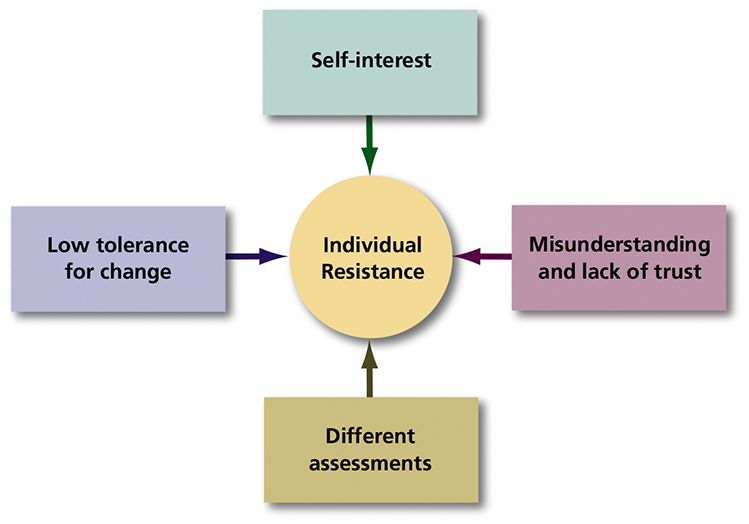
Four Reasons why Individuals May Resist Change
Self-interest: People worry that they will lose something of value if change happens. Thus, they look after their own self-interest rather than that of the total organization.
Misunderstanding and lack of Trust: People resist change when they don’t understand the nature of the change and fear that the cost of change will outweigh any potential gains for them. This often occurs when they don’t trust those initiating the change.
Different Assessments: People resist change when they see it differently than their managers do and think the costs outweigh the benefits, even for the organization. Managers may assume that employees have the same information that they do, but this is not always the case.
Low Tolerance for Change: People resist change because they worry that they do not have the skills and behaviour required of the new situation. They may feel that they are being asked to do too much, too quickly.
Organizational Resistance
6 Forces
Organizations, by their very nature, are conservative. They actively resist change. Government agencies, corporations, educational institutions and other organizations are all highly resistant to change. In the sector of business, this can leave once thriving organizations behind when there is a shift in society, and the economy.
There are six notable sources of organizational resistance. This includes:
Structural inertia
Limited focus of change
Group inertia
Threat to expertise
Threat to established power relations
Threat to established resource allocations
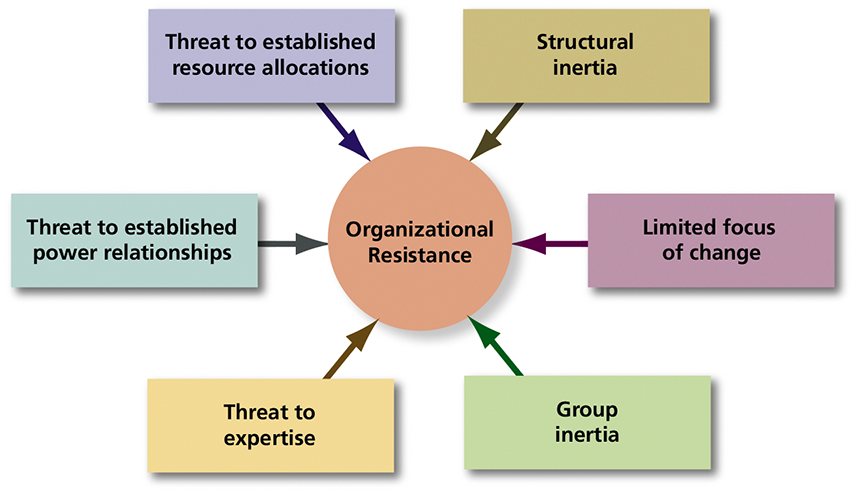
Six Sources of Organizational Resistance
Structural Inertia: Organizations have built-in mechanisms—such as their selection processes and formalized regulations—to produce stability. When an organization is confronted with change, this structural inertia acts as a counterbalance.
Limited Focus of Change: Organizations are made up of several interdependent subsystems. One cannot be changed without affecting the others. Limited changes in subsystems tend to be nullified by the larger system.
Group Inertia: Even if individuals want to change their behaviour, group norms may act as a constraint.
Threat to Expertise: Changes in organizational patterns may threaten the expertise of specialized groups.
Threat to Established Power Relationships: Any redistribution of decision-making authority can threaten long-established power relationships within the organization.
Threat to Established Resource Allocations: Groups in the organization that control sizable resources often see change as a threat. They tend to be content with the way things are.
8 Tactics to Deal with Resistance to Change
Communication: Explaining why a change is happening and considering all stakeholders (not just shareholders) makes it more effective.
Participation: Involving employees in decision-making can reduce resistance and increase commitment, especially if they have relevant expertise.
Building support and commitment: Encouraging overall organizational commitment, addressing fears through counseling, training, or short leave can help them accept change.
Positive relationships: Trust in managers and support from co-workers make people more open to change.
Implementing changes fairly: Change should be implemented fairly. Employees need to understand the reasons behind it and perceive it as consistent and just.
Manipulation and co-optation:
Manipulation: Using tricks or false information to get compliance.
Co-optation: Giving leaders of resistance a role just to gain their support.
Both are cheap but risky—if employees realize they’re being tricked, trust is lost.
Selecting people who accept change: Selecting individuals or teams with these traits makes change easier. Motivated, learning-focused teams adapt better.
Coercion: Using threats or pressure to force compliance (e.g., closing a plant, blocking promotions). Effective on some, but risky and can harm trust, similar to manipulation and co-optation.
Three Approaches to Embrace Change
OB Scholars that work on a more proactive approach to how organizations can embrace change by transforming organizational culture. This includes three approaches:
Managing paradox
Stimulating an innovative culture (Innovation)
Creating a learning organization
Paradox Theory
The theory that the key paradox in management is that there is no final optimal status for an organization. In a paradox situation, we are required to balance tensions across various courses of action. There is a constant process of finding a balancing point, a dynamic equilibrium, among shifting priorities over time.
Paradox Meaning: A statement, situation, or idea that seems self-contradictory or absurd, but may actually reveal a truth when examined more deeply.
Think of riding a bicycle: You must maintain forward momentum, or you will fall over.
From this perspective, there is no such thing as a separate discipline of “change management” because all management is dealing with constant change and adaptation.
Specific paradox concepts include: Learning, organizing, performing and belonging.
Specific Paradox Concepts
The idea of paradox sounds abstract, but more specific concepts have begun to emerge from a growing body of research. Several key paradoxes have been identified.
Learning is a paradox because it requires building on the past while rejecting it at the same time.
Organizing is a paradox because it calls for setting direction and leading while requiring empowerment and flexibility.
Performing is a paradox between creating organization-wide goals to concentrate effort and recognizing the diverse goals of stakeholders inside and outside the organization.
Belonging is a paradox between establishing a sense of collective identity and acknowledging our desire to be recognized and accepted as unique individuals.
Stimulating an Innovative Culture (Innovation)
Innovation Meaning: A new idea applied to initiating or improving a product, process, or service.
Creating an environment where new ideas, creativity, and experimentation are encouraged and supported. It’s about making the organization open to change, not just reacting to it. This means integrating innovation as a part of the daily work, which makes organizational change easier because people are used to thinking differently and trying new approaches.
Organizations that have innovation built in include:
Google (20% time to work on personal projects, collaborative spaces, encouraged to take risks).
Apple ( R&D focus, creating new technology, cross-disciplinary design teams).
Amazon (customer-driven innovation, new services)
Structural Variables
Sources of Innovation
One potential source of innovation. A comprehensive review of the structure–innovation relationship leads to the following conclusions.
Organic structures positively influence innovation: Because they are lower in vertical differentiation, formalization, and centralization, organic organizations facilitate the flexibility, adaptation, and cross-fertilization that make the adoption of innovations easier.
Long tenure in management is associated with innovation: Managerial tenure can provide the legitimacy and knowledge of how to accomplish tasks and obtain desired outcomes through creative methods.
Innovation is nurtured when there are slack resources: Having an abundance of resources allows an organization to afford to purchase or develop innovations, bear the cost of instituting innovations, and absorb failures.
Interunit communication is high in innovative organizations: Innovative organizations are high users of committees, task forces, cross-functional teams, and other mechanisms that facilitate interaction across departmental lines.
Idea Champions
Individuals who actively and enthusiastically promote an idea, build support for it, overcome resistance to it, and ensure that the idea is implemented.
Champions often have similar personality characteristics: extremely high self-confidence, persistence, energy, and a tendency to take risks.
They usually display traits associated with transformational leadership.
They inspire and energize others with their vision of the potential of an innovation and through their strong personal conviction in their mission.
Situations can also influence the extent to which idea champions are forces for change.
Learning Organization
An organization that has developed the continuous capacity to adapt and change. The Dimensions of the Learning Organization Questionnaire (DLOQ) has been adopted and adapted internationally to assess the degree of commitment to learning organization principles.
The DLOQ measurements include: Continuous learning, inquiry and dialogue, team learning, embedded system, empowerment, system connection, strategic leadership.
Characteristics of a learning organization: Shared vision guides everyone, old habits are discarded, organization seen as a connected system, open, fearless communication, teamwork over personal/departmental interests.
Learning Organization - DLOQ 7 Measurements
The DLOQ measurements include:
Continuous learning: Opportunities for ongoing education and growth are provided. Learning is designed into work so that people can learn on the job.
Inquiry and dialogue: The organizational culture supports questioning, feedback, and experimentation. People gain productive reasoning skills to express their views and the capacity to listen to and inquire into the views of others.
Team learning: Work is designed to use teams to access different modes of thinking; collaboration is valued by the culture and rewarded; teams are expected to learn by working together.
Embedded system: Necessary systems to share learning are created, maintained, and integrated with work; employees have access to these high- and low-technology systems.
Empowerment: People are involved in setting and implementing a shared vision; responsibility is distributed so that people are motivated to learn what they are held accountable to do.
System connection: The organization is linked to its communities; people understand the overall environment and use information to adjust work practices; people are helped to see the effect of their work on the entire organization.
Strategic leadership: Leadership uses learning strategically for business results; leaders model, champion, and support learning.
5 Characteristics of Learning Organization
Five basic characteristics of a learning organization. It’s one in which people put aside their old ways of thinking, learn to be open with each other, understand how their organization really works, form a plan or vision on which everyone can agree, and then work together to achieve that vision.
The organization has a shared vision that everyone agrees on.
People discard their old ways of thinking and the standard routines they use for solving problems or doing their jobs.
Members think of all organizational processes, activities, functions, and interactions with the environment as part of a system of interrelationships.
People openly communicate with each other (across vertical and horizontal boundaries) without fear of criticism or punishment.
People suppress their personal self-interest and fragmented departmental interests to work together to achieve the organization’s shared vision.
Single-Loop Learning
A process of correcting errors using past routines and present policies. Most organizations engage in this learning style.
This type of learning has been likened to a thermostat, which, once set at 17°C, simply turns on and off to keep the room at the set temperature. It does not question whether the temperature should be set at 17°C.
Double-Loop Learning
A process of correcting errors by modifying the organization’s objectives, policies, and standard routines. Double-loop learning challenges deeply rooted assumptions and norms within an organization. It provides opportunities for radically different solutions to problems and dramatic jumps in improvement.
To draw on the thermostat analogy, a thermostat using double-loop learning would try to determine whether the correct policy is 17°C, and whether changes might be necessitated by a change in season.
Learning Organizations Three Problems it Solves
Proponents of the learning organization envision it as a remedy for three fundamental problems of traditional organizations: fragmentation, competition, and reactiveness.
Fragmentation based on specialization creates “walls” and “chimneys” that separate different functions into independent and often warring fiefdoms.
Overemphasis on competition undermines collaboration. Managers compete to show who is right, who knows more, or who is more persuasive. Divisions compete when they ought to cooperate and share knowledge. Team leaders compete to show who the best manager is.
Reactiveness misdirects management’s attention to solving problems rather than being creative. The problem solver tries to make something go away, while a creator tries to bring something new into being. An emphasis on reactiveness to problems pushes out innovation and continuous improvement and, in its place, encourages people to constantly run around “putting out fires.”
Suggestions for Managing Learning
What can managers do to make their firms learning organizations? Here are some suggestions:
Establish a Strategy: Managers need to make their commitment to change, innovation, and continuous improvement explicit.
Redesign the Organization’s Structure: The formal structure can be a serious impediment to learning. Flattening the structure, eliminating or combining departments, and increasing the use of cross-functional teams reinforce interdependence and reduce boundaries.
Reshape the Organizations Culture: To become a learning organization, managers must demonstrate by their actions that taking risks and admitting failures are desirable traits. This means rewarding people who take chances and make mistakes. Managers also need to encourage functional conflict.
Summary of Organizational Change Chapter
Forces of change include the nature of the workforce, technology, economic shocks, competition, social trends, and world politics.
Drivers of organizational change can be viewed through the lens of Lewin’s three-step model, Kotter’s eight-step plan for implementing change, action research, or appreciative inquiry.
Resistance to change may occur in individuals or the organization as a whole.
Change can be managed through use of the paradox theory, by stimulating a culture of innovation, or by creating a learning organization.
How Kotter’s Model is Like White Water Rafting
Organizations operate in constant, unpredictable change—like a fast-moving river.
You can’t “pause” or “refreeze” (unlike Lewin’s model).
Leaders must continuously guide, adjust, and respond to new challenges.
Success depends on team coordination, communication, and strong leadership.
There is a clear direction (destination), but the path is not fixed.
Just like rafting, organizations must navigate change in real time—not step-by-step in calm waters.
Think of Kotter’s model like white water rafting—you’re constantly moving, facing unexpected obstacles, and adjusting as you go. You still have a goal, but how you get there requires continuous leadership and teamwork.

