TEAS English + Language Usage: Conventions of Standard English
 Call Kai
 Learn
Learn Practice Test
 Spaced Repetition
 Match
Match Flashcards
 Knowt Play
1/81

Name | Mastery | Learn | Test | Matching | Spaced | Call with Kai |
|---|
No analytics yet
Send a link to your students to track their progress
82 Terms
compound noun
a noun that is made up of two or more words, sometimes written with hyphens
ex: mother-in-law; court-martial
how to make compound nouns plural
an -s or -es is added to the noun portion of the word
ex: mothers-in-law; courts-martial
relative pronouns
which, that, who — help clarify or describe a noun
homophones
words that sound alike but are spelled differently
affect and effect are confusing because they can both be used as a _____ or a ______
noun; verb
affect (n)
feeling, emotion, or mood that is displayed
ex: a patient has a flat affect
note: rarely used outside of technical medical so if noun for is needed on a test, you can safely select effect
affect (v)
to alter, to change, to influence
ex: The sunshine affects the plant’s growth
note: while the very form of effect isn’t rare, affect (v) is usually the best bet on a test when a verb is needed
effect (n)
a result, a consequence
ex: What effect will this weather have on our schedule?
note: if a noun is needed on a test, it is usually effect
effect (v)
to bring about, cause
ex: These new rules will effect order in the office
note: not always, but generally speaking affect (v) is more common than this one
homographs
words that share the same spelling, but have multiple meanings (usually a noun/verb or noun/adjective meaning)
ex: bank, content, fine, lead, object
a polite request can be followed by a _____ instead of a ______
period; question mark
Put commas where they belong in these sentences:
Bob caught three fish and I caught two fish.
After the final out we went to a restaurant to celebrate
Studying the stars I was awed by the beauty of the sky
I will bring the turkey the pie and the coffee.
Wow you know how to play this game.
Bob caught three fish, and I caught two fish.
After the final out, we went to a restaurant to celebrate.
Studying the stars, I was awed by the beauty of the sky
I will bring the turkey, the pie, and the coffee.
Wow, you know how to play this game.
Put commas where they belong in these sentences:
No I cannot come tomorrow.
John Frank who coaches the team was promoted today.
Thomas Edison an American inventor was born in Ohio.
You John are my only hope in this moment.
This is the last time correct?
You are my friend not my enemy.
No, I cannot come tomorrow.
John Frank, who coaches the team, was promoted today.
Thomas Edison, an American inventor, was born in Ohio.
You, John, are my only hope in this moment.
This is the last time, correct?
You are my friend, not my enemy.
Put commas where they belong in these sentences:
July 4 1776 is an important date.
He is meeting me at 456 Delaware Avenue Washington D.C. tomorrow morning.
Paris France is my favorite city.
John Smith PhD will will be visiting your class today
“You can start” she said “with an apology.”
July 4, 1776, is an important date.
He is meeting me at 456 Delaware Avenue, Washington, D.C., tomorrow morning.
Paris, France, is my favorite city.
John Smith, PhD, will will be visiting your class today.
“You can start,” she said, “with an apology.”
semicolons are used
to connect major sentence pieces of equal value
3 use cases of semicolons
between closely connected independent clauses NOT connected with a coordinating conjunction
ex: You are right; we should go with your plan.
between independent clauses linked with a transitional word
ex: I think we can agree on this; however, I am not sure about my friends
between items in a series that has internal punctuation
ex: I have visited NY, NY; Augusta, Maine; and Baltimore, MD
colons must come
after a complete independent clause
exs: to make a list, for explanations, to give a quote, separate title and subtitle, in time, after the greeting in a formal letter
periods and commas go _____ the quotation marks; colons and semicolons go _____
inside; outside
question marks and exclamation points go ______ the quotation marks when they are part of the quote
inside
apostrophes are used to show
possession
the deletion of letter in contractions
an apostrophe is not needed with these possessive pronouns:
his, hers, its, ours, theirs, whose, and yours
hyphens are used to
separate compound words
dashes are used to
show a break of a change in thought
ellipsis marks are used to
show that words have been removed from a quotation
brackets are used to
place parentheses inside parentheses
add clarification or detail to a quote that is not part of the quote
List the 8 parts of speech
nouns
pronouns
verbs
adjectives
adverbs
prepositions
conjunctions
interjections
noun
person, place, thing, idea
types of nouns
common
proper
general
specific
collective
common noun
generic names for people, places, and things
ex: boy, girl, school, car
proper noun
specific people, places, and things
ex: Paris, Madonna, Statue of Liberty
general noun
names of conditions or ideas
ex: beauty, strength, peace, truth
specific noun
names of people, places, and things understood by the senses
ex: friend, city hall, cough, silk
collective nouns
names of a group of people, places, or things that may act as a whole
ex: choir, class, herd, team, public
pronoun
stands in for a nound
types of pronouns
personal
intensive
relative
interrogative
demonstrative
indefinite
reciprocal
personal pronouns
singular and plural
I, you, he, she, it, we, us, mine, yours, theirs, they, them, etc.
intensive pronouns
I myself, you yourself, he himself, they themselves, etc.
relative pronouns
which, who, whom, whose
interrogative pronouns
used to refer to nouns in the form of a question — they take the place of the noun that answers the question
what, which, who, whom, whose
demonstrative pronouns
refer to specific things that are either near or far away:
that, that, these, those
indefinite pronouns
non-specific people, things, or amounts:
all, any, each, everyone, either/neither, one, some, several, none, nobody, other
reciprocal pronouns
each other, one another
verb
indicates something’s action or state of being; or the action that has been done to something
note: verbs are required in a sentence. no verb = no sentence
types of verbs
transitive
intransitive
action verbs
linking verbs
transitive verbs
a verb whose action indicated a receiver
ex: she plays the piano. john joined the crowd
intransitive verbs
do not indicate a receiver of an action
ex: He slept. Sharon collapsed.
action verbs
show what the subject is doing
ex: He sings. Run! I talk with him everyday. She reads.
linking verbs
link the subject of a sentence with a noun, pronoun or adjective
ex: I am John. Shirley felt tired. That soup smells good.
active voice of a verb
when the subject is doing the action
ex: Jon drew the picture
passive voice of a verb
when the subject is acted upon
ex: The picture is drawn by Jon
verb tenses
present - I talk
past - I talked
future - I will talk
present perfect - I have talked
past perfect - I had talked
future perfect - I will have talked
adjective
a word that modifies a noun or pronoun
articles
adjective used to distinguish nouns as definite or indefinite
note: the ONLY articles are a, an, and the
the three degrees of adjectives for comparison include
positive - difficult; smart
comparative - more difficult; smarter
superlative - most difficult; smartest
adverbs
modify a verb, adjective, or another adverb — answers where, when, how, or to what extent something was done
note: not and never are considered adverbs
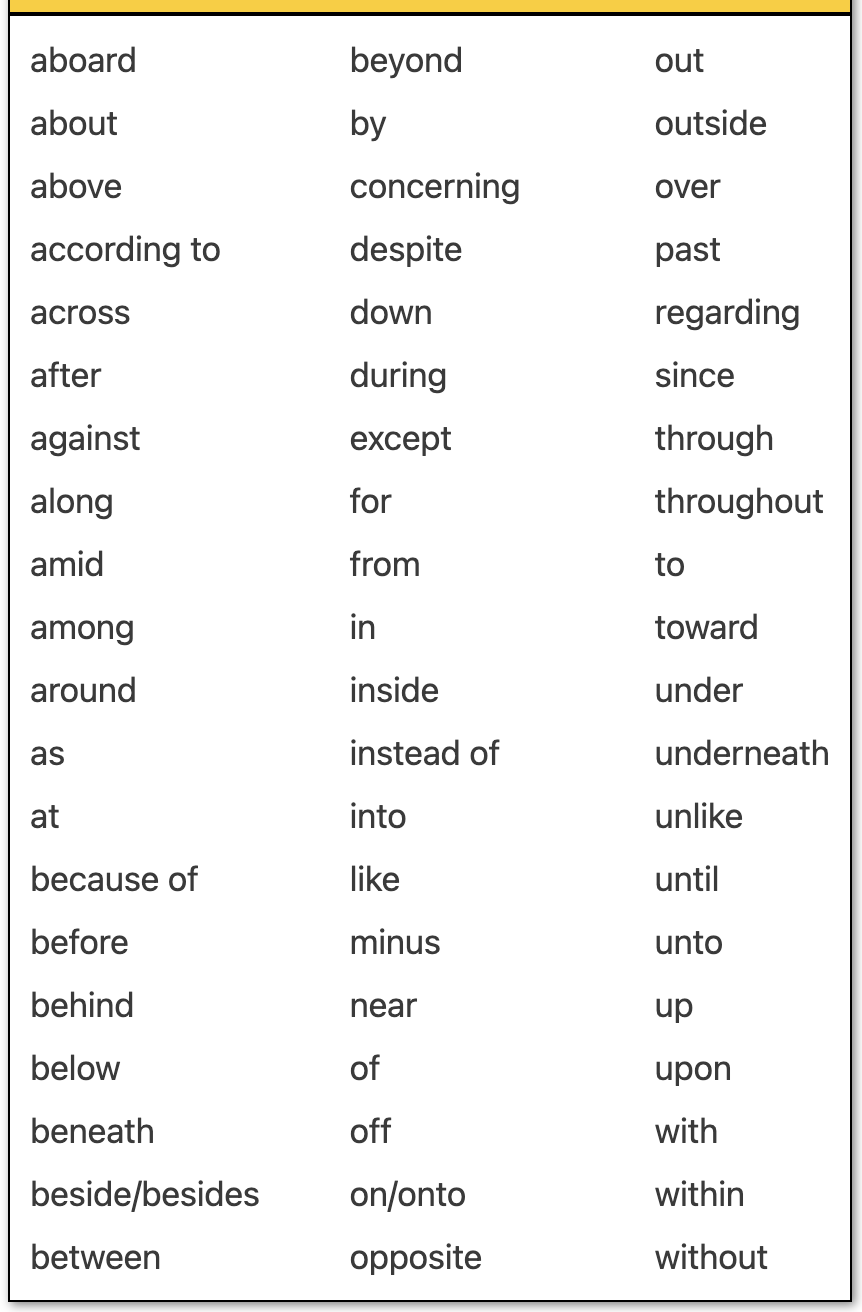
preposition
a word placed before a noun or pronoun that shows the relationship between an object and another word in time or space
conjunction
joins words, phrases, or clauses and show the connection between the joined pieces
types of conjunctions
coordinating conjunctions
correlative conjunctions
subordinating conjunctions
coordinating conjunctions
connect equal parts; include FANBOYS:
for, and, nor, but, or, yet, so
correlative conjunctions
show the connection between pairs:
either/or, neither/nor, not only/but also
subordinating conjunctions
join subordinate (dependent) clauses with independent clauses:
after, although, whenever, because, unless, until, so that, while….
interjections
words of exclamation
subject of a sentence
names who or what the sentence is about;
will be complete (including all its modifiers) or simple (without modifiers)
predicate of a sentence
explains or describes the subject
compound subjects
two or more nouns joined by and, or, nor
with a compound subject joined by or/nor, the verb must agree with _____
the subject that is closest to the verb
ex: Stan or Phil wants to read the book.
Either the blanket or the pillows arrive tomorrow.
complement
a noun, pronoun, or adjective that is used to give more information about the subject or verb in the sentence
direct objects
a noun or pronoun that receives the action of a verb —> find the verb and ask who or what?
ex: I took the blanket.
Jane read books.
Indirect objects
a word or group of words that show how an action had an influence on someone or something —> find the verb and ask to/for whom or what?
note: if you have an indirect object, you always have a direct object
ex: We taught the old dog (indirect) a new trick (direct).
I gave them (indirect) a math lesson (direct).
antecedent
that noun that has been replaced by a pronoun
—> a noun and its antecedent must agree in number: John — he; John and Rick — they
clause
a group of words that contains both a subject and a predicate (verb)
independent clause
contains a complete thought
dependent (subordinate) clause
does not contain a complete thought — cannot stand as a complete thought on its own
types of dependent clauses include
adjective clauses
adverb clauses
noun clauses
adjective clauses
a dependent clause that modifies a noun or pronoun;
begin with a relative pronoun or verb (who, which, where, when) and come after the noun
ex: I learned the reason why I won the award.
adverb clause
dependent clause that modifies a verb, adjective, or adverb;
usually immediately before or after the independent clause
noun clause
dependent clause that can be used as a subject, object, or complement
4 classifications of sentence structure
simple
compound
complex
compound-complex
simple sentence has
one independent clause with no dependent clauses; may have compound elements
ex: Judy watered the lawn.
Judy and Alan watered the lawn.
Judy watered the lawn and pulled the weeds.
Judy and Alan watered the lawn and pulled the weeds.
compound sentence has
two or more independent clauses with no dependent clauses (usually joined with a comma or semicolon)
ex: The time has come, and we are ready.
I woke up at dawn; the sun was just coming up.
complex sentence has
one independent clause and at least one dependent clause
ex: Although he had the flu, Harry went to work.
Marcia got married, after she finished college.
compound-complex sentence has
at least 2 independent clauses and at least 1 dependent clause
ex: John is my friend who went to India, and he brought back souvenirs.

