Chapter 3- Amount of substance
 Studied by 0 people
 Call Kai
 Learn
Learn Practice Test
 Spaced Repetition
 Match
Match Flashcards
 Knowt Play
1/25

There's no tags or description
Looks like no tags are added yet.
Name | Mastery | Learn | Test | Matching | Spaced |
|---|
No study sessions yet.
26 Terms
what is a mole?
unit of measurement for substances
it always contains the same number of particles
amount of substance meaning?
the number of particles in a substance and is measured in moles
avogrado constant?
6.02 × 10^23
what is the avogrado constant?
the number of particles per mole
it allows the number of particles present in a sample of a substance with know mass to be found
how to calculate number of particles using the avogrado’s constant?
number of particles = moles x avogrado constant
2 ways to calculate moles?
moles = mass/ mr
moles = volume (dm³) x concentration (mol/dm³)
what is molar mass?
mass per mole, and has the units g/mol
what is molar gas volume?
gas volume per mole and has the units dm³ /mol
what is empirical formula?
the simplest whole number ration of atoms of each element present in a compound
what is molecular formula?
the number and type of atoms of each element in a molecule.
the true number of each atom in the molecule
how to find the molecular formula of a molecule?
using the Mr of the empirical formula and the true Mr of the molecule.
this gives a multiplier value, which can be used to scale up the empirical formula
how to find the multiplier?
Mr of molecule / empirical Mr
what is water of crystallisation?
the water that is part of the crystalline structure.
the molecules are stoichiometrically chemically bonded into the crystal structure
what is the limiting reagent in a reaction?
the reactant that is not in excess.
it will be used up first, causing the reaction to stop
what is the ideal gas equation?
pV = nRT
p = pressure in Pascals
V = volume in m³
T = temperature in Kelvin
n = moles
R = ideal gas constant (which is 8.31JK^-1 mol^-1
what are the values for room temp and pressure?
room temp- 20C
pressure- 101kPa (1atm)
how to convert from cm³ to m³?
how to convert from dm³ to m³?
how to convert from kPa to Pa
x10^-6
x10^-3
x10³
how to calculate percentage yield?
(real yield/ theoretical yield) x100
most experiments have a percentage yield of less than 100%
why do most experiments have a percentage yield of less than 100%?
incomplete reaction
loss of products on equipment
unwanted side reaction
what is the atom economy of a chemical reaction?
a measure of how well atoms have been utiilised
how to calculate atom economy?
(Mr of desired product / Mr of reactants) x100
characteristics of reactions with high atom economies?
they produce a large proportion of desired products and few unwanted waste products
important for sustainability as they make the best use of natural resources
why is it desirable to have a high atom economy?
because it means there is little to no waste product
therefore, process is more economically viable for industrial scale manufacture
helps to preserve raw materials
what is stoichiometry?
the ratio of amount, in moles, of each substance
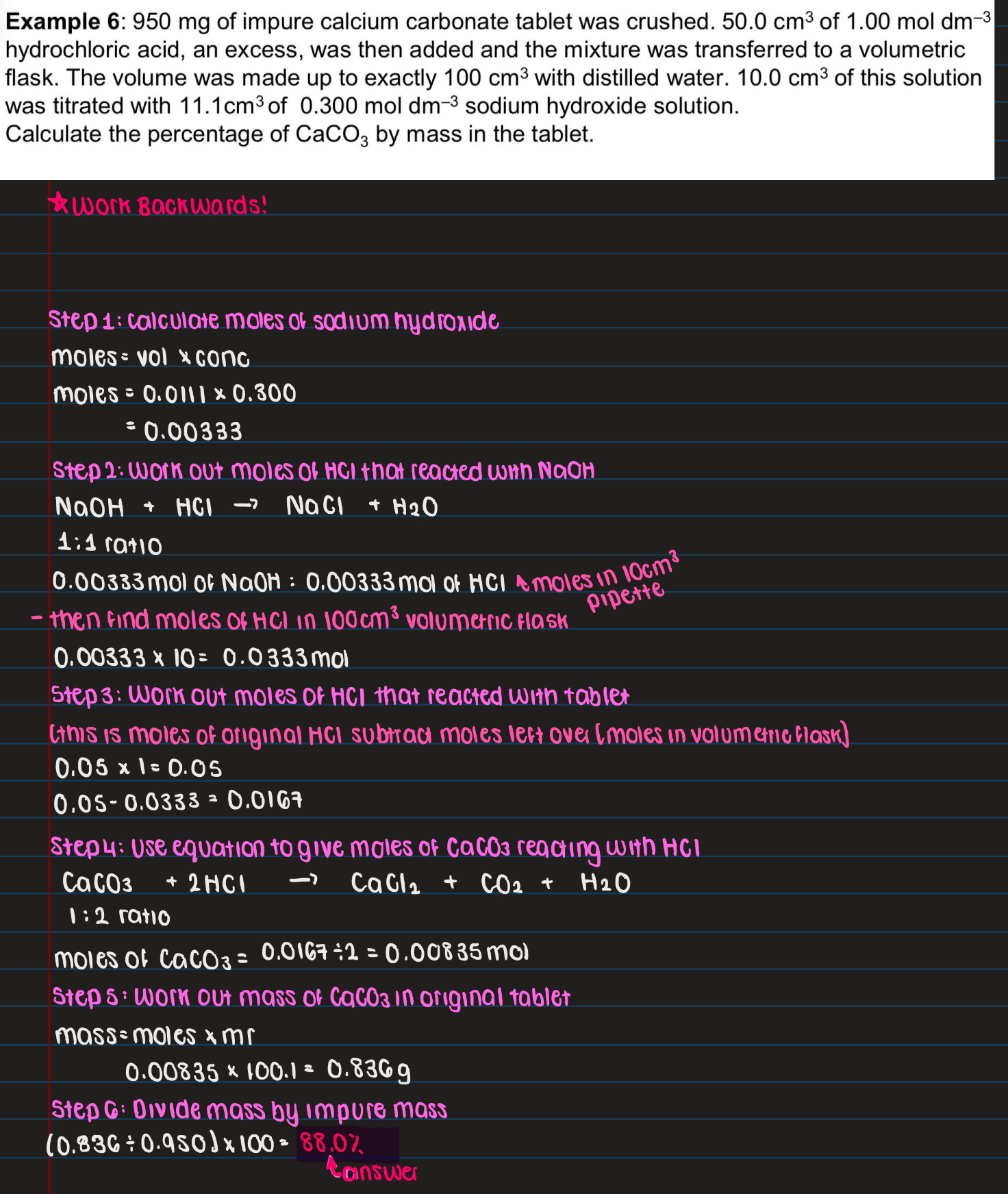
how to do back titrations?
calculate moles of the base (e.g- sodium hydroxide)
work out moles of the acid (e.g- hcl) that reacted with the base
then find moles in the bigger volume
work out moles of acid that reacted with the substance at beginning
moles of original acid - moles in volumetric flask
use equation to give moles of the substance reacting with the acid
work out mass of the substance
divide this mass by mass given at beginning
multiply by 100
example of back titration?
 Note
Note  Flashcards (53)