SEASONS TEST SCIENCE 8 FLASHCARDS
 Call Kai
 Learn
Learn Practice Test
 Spaced Repetition
 Match
Match Flashcards
 Knowt Play
1/52

There's no tags or description
Looks like no tags are added yet.
Name | Mastery | Learn | Test | Matching | Spaced | Call with Kai |
|---|
No analytics yet
Send a link to your students to track their progress
53 Terms
How many and what are the names of the “Half’s” of earth?
There are 4 half’s of earth. The northern hemisphere the southern hemisphere, the western hemisphere and the eastern hemisphere.
What are the northern hemisphere and the southern hemisphere divided by?
They are divided by the equator at 0° latitude.
What are the western hemisphere and the eastern hemisphere divided by?
They are divided by the prime Meridian longitude at 0° longitude and the anti-Meridian at 180° longitude.
Draw a diagram of what the side view and the top view of latitude lines look like.
Side View: straight lines that don’t intersect
Top View: circles coming from north pole(not intersecting)
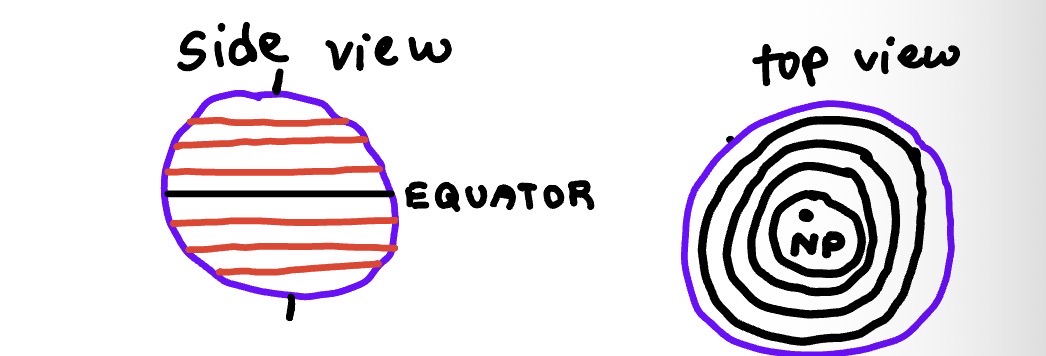
Do latitude lines cross/intersect?
Latitude lines never cross.
Where do latitude lines “run”?
They “run” east and west.
What are they labeled in relative to what?
They are labeled in degrees north and degrees south of the equator.
Highest value of latitude
North Pole at 90° north and the south pole at 90° south.
Lowest value of latitude
The equator at 0°.
What are the reference latitudes ? Name all of them.
the equator
two the North Pole
number three the South Pole
number four the tropic of cancer
number five the tropic of Capricorn
number six the Arctic Circle,
#7 the Antarctic Circle.
Degrees of the equator.
0°
Name the degrees of the North Pole.
90° north
Name the degrees of the South Pole
90 degrees south
Name the degrees of the tropic of cancer.
23.5° north
Name the degrees of the tropic of Capricorn.
23.5° south
Name the degrees of the Arctic Circle.
66.5° north
Name the degrees of the Antarctic Circle.
66.5 degrees south
LAT-itude=
FLAT-iTunes
Are latitude lines parallel
Yes
Draw a diagram of what the top and side views of longtitude lines look like.
Top View: Lines coming out from the North Pole straight lines from every different direction, pizza looking
Side View: Rounded lines coming from North Pole to South Pole straight line in middle
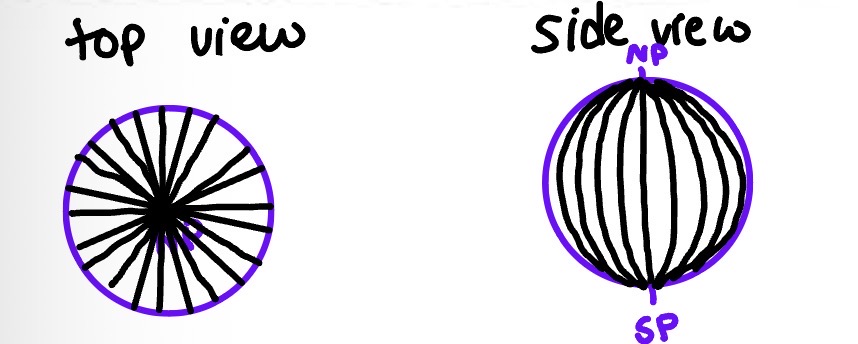
Where do longitude lines run?
They run North and South
What are longitude lines labeled relative to what?
They are labeled in degrees E and degrees West of the Prime Meridian(0 degrees)
What is the highest value of longitude?
Anti-Meridian (180 degrees)
What is the lowest value of longitude?
Prime Meridian(0 degrees?)
Where do they start and end at?
They start and end at the North & South piles
Are longitude lines parallel?
They aren’t parallel.
Where do longitude lines meet?
They meet at the north and south poles.
LONGITUDE LINES ARE?
LONG!
What 3 latitude or longitude lines don’t need a degrees North, south, east, or west?
Equator (0 degrees)
Prime Meridian(0 degrees)
ANTIMERIDIAN(180 degrees)
What is a Earth’s revolution?
It is Earth’s 360 degrees complete orbit around the Sun.
How many days approximately does it take for Earth to revolve around the sun?
365.24 days aka 1 year
Evidence #1a: proving earth revolves
We can see stars during the night time.
Evidence #1B: proving earth revolves
We see different constellations at different times of the year.
Evidence #2: proving earth revolves
Seasons occur in a yearly cycle.
What is Earth’s rotation?
It is the spin of Earth on its axis.
What degrees is Earth’s axis tilted at with respect to what?
It is tilted at 23.5 degrees with respect to the perpendicular of the Ecliptic.
How long does one earth rotation take?
24 hours or 1 day
How does earth rotate when viewed from what?
It rotates counterclockwise when viewed From the North Pole.
Evidence #1: for Earth’s rotation
Startrails!
Startrails
Almost all stars “appear to move at 15 degrees per hour(360 degrees/24 hours
Except for Polaris
Polaris
North Star
How long was this picture taken for if it was 45 degrees swept out of the sky?
45/15 =3 hours
Evidence #2: proving Earth rotates
Coriolis Effect
Coriolis Effect
Apparant deflection of objects that move within a rotating system (Earth)
The object doesn’t actually deflect from it’s path, it appears to do so because of Earth’s rotation
How are obejcts deflected?
Objects are deflected from the direction of travel.
Where are objects in the Northern Hemisphere deflected towards?T
They are deflected to the right!
Where are objects in the Southern Hemisphere deflected towards?T
They are deflected to the left.
What are seasons caused by?
The Angle of Insolation
Insolation
incoming solar radiation
What is the highest angle of insolation?
90 degrees
High Angles of Insolation description
High temperature
High intensity
During the summer
At midday (12 pm)
Light is concentrated on Earth’s surface
Low Angle of Insolation Description
Low Temperature
Low Intensity
During the Winter/Fall
During the sunrise/sunset
Light is diffused on Earth’s surface
What do low and high angles have in common?
They have the same amount of energy but they cover different areas.

