Sociolinguistics - Lecture 10
 Studied by 0 people
 Call Kai
 Learn
Learn Practice Test
 Spaced Repetition
 Match
Match Flashcards
 Knowt Play
1/27

There's no tags or description
Looks like no tags are added yet.
Name | Mastery | Learn | Test | Matching | Spaced |
|---|
No study sessions yet.
28 Terms
Linguistic Styles
the different ways an individual speaks within a variety — can be related to different things
formality
persona
interlocutors
stances
Style
the set of linguistic variants (across different variables) with ideologically-related social meanings
Style-Shifting
how individuals adopt different ways of speaking from one context to another; or from speaking with one interlocutor to another; or from assuming one aspect of identity to another
can happen moment-by-moment in an interaction
Register
the patterns of variants appropriate for a particular activity, topic, or domain
it’s about how language is conventionally used (and prescribed norms) for that situation
NOT the same as style
Style vs Register
style: what a speaker is doing with language, given the potential social meanings they wish to convey
register: conventions of how language is used in a particular setting and about how speakers adapt lingustically to fit into that context
Accommodation/Convergence
when a speaker shifts their linguistic style to be more like their interlocutor — signal affiliation with them
Divergence
when a speaker shifts their linguistic style to be less like their interlocutor — signal non-affiliation with them
Models of Style: Attention-to-Speech Model
key: style is linked to formality and how much we monitor our language use
style is studied through collecting language data across a variety of tasks that differ in degree of formality
the traditional sociolinguistic interview
there’s an inverse relationship between attention paid to speech and vernacular use
more attention paid to speech → less vernacular use
less attention paid to speech → more vernacular use
compute the rates of variant use across different social sub-groups and different styles (tasks)
Attention-to-Speech Model: Sociolinguistic Interview
original sociolinguistic interview involved five tasks:
minimal pairs: pairs of words whose pronunciations differ by only one sound (most formal task → pay most attention to speech)
word list: words in isolation are read aloud
reading passage: an excerpt is read aloud
careful speech: the start of the sociolinguistic interview
casual speech: the middle/end of a sociolinguistic interview (least formal task → pay least attention to speech)
Attention-to-Speech Model: Style x Class Effect
first crucial finding: social stratification parallels stylistic variation
second crucial finding: cross-over effect
Style x Class: First Finding
social stratification parallels stylistic variation
the way people speak varies systematically with their social class.
differences are consistent across a range of styles (formality)
variants that are seen as more formal are usually the ones that are used at higher rates by the upper class group
Style x Class: Social Stratification
different social classes have different rates of use of the nonstandard/stigmatized variant
Style x Class: Stylistic Variation
different styles have different rates of use of the nonstandard/stigmatized variant
Style x Class: Second Finding
cross-over effect
hypercorrection in the second-highest social class — speakers over-apply or over-use a prestige variant
this group has the most linguistic insecurity
low classes may encounter the standard less often or just not aspire to join the highest social classes, so less susceptible to cross-over effect
Style x Class: Sociolinguistic Indicator
social stratification with no stylistic variation

Style x Class: Sociolinguistic Marker
social stratification with stylistic variation
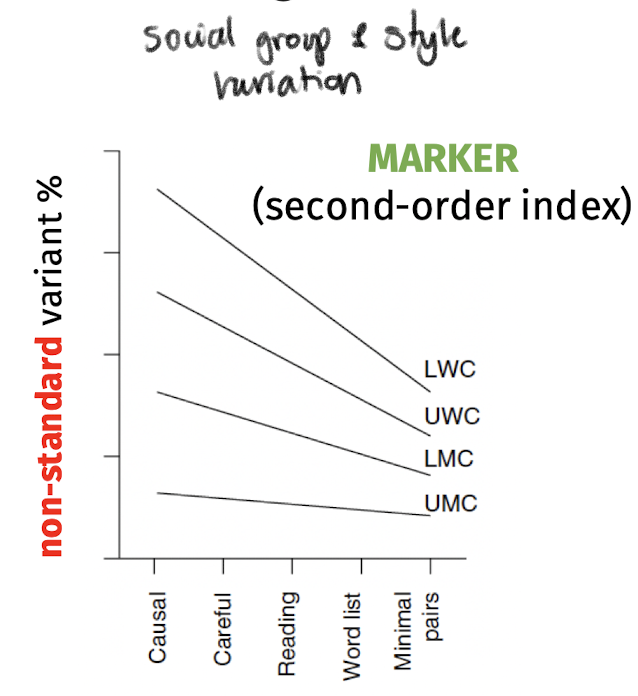
Attention-to-Speech Model: Criticisms
style viewed as one-dimensional
model doesn’t truly capture language in use
Models of Style: Audience Design
key: style-shifting happens in order to shape speaker’s relationship with their audience
goes beyond interview settings and considers actual language in use
study a very small number of speakers
often focus on only one speaker but with exquisite detail and/or with a ton of data
focus on audience
interlocutors, passive audiences, or eavesdroppers
any audience may affect speaker’s style
lots of room for accommodation or divergence here
Audience Design: Criticism
can’t account for the full range of style-shifting that’s observed in most people
relies on a responsive dimension — style-shifting is a reaction or a consequence of a change in context
there may be instances where style-shifting is more agentive and this model doesn’t account for this
Audience Design: Refinement
Bell tried to refine the model, proposed nine key ideas of style:
style is what an individual speaker does with a language in relation to self and others
style derives meaning from the association of linguistic features with particular social groups
speakers design their style primarily for and in response to their audience
Audience Design applies to all codes and levels of a language repertoire
a speaker’s range of styles generally derives from and echoes the range that exists among speakers in the community
speakers show a fine-grained ability to design their style for a range of different addressees, and to a lessening degree for other audience members
styling according to topic or setting derives its meanings and direction from the underlying association of topics or settings with typical audience members
as well as ‘ Responsive’ dimension of style, there is the ‘Initiative’ dimension where a shift in style itself initiates a change in the situation rather than resulting from such a change
such initiative style shifts are in essence ‘Referee Design’, by which the linguistic features associated with a group can be used to express affiliation with that group (i.e., the referee)
Models of Style: Speaker/Referee Design
key: speakers have agency and are proactive, they don’t just simply respond to their audience
comes from Bell’s refinement points (8) and (9)
speakers consciously or unconsciously shaping who they are and how they’re perceived
style-shift as an initiative/active process towards forming and performing their own social identities
speakers stylize linguistic features in order to call up associations with particular groups or identities
conscious, deliberate use of linguistic features
features at least second-order indexes
key: particular groups not necessarily part of the immediate audience
Models of Style: Crossing
happens when individuals use linguistic features belonging to another ethnic/racial/cultural group that is different from them
relates to some extent to linguistic/cultural appropriation
style-shifting with an initiative dimension
Models of Style: All Together (Linguistic Style)
First Wave Variation
researchers investigated broad correlations between variation and macro-social
Second Wave Variation
researchers began focusing on how individuals use language within their networks, emphasizing local identities and (social) practices
Third Wave Variation
researchers’ focus shifted to how people actively use language to construct and express their personhood
Community of Practice
any group of people who share an activity or a profession or a social group on a regular basis
expect to have its own linguistic forms
some forms/variants may index an identity associated with that community of practice (second/third order indexicality), while other forms may be more unconscious
Community of Practice: Co-membership
defined by three criteria
mutual engagement: direct personal contact
a shared repertoire: shared social and stylistic practices like use of slang, jargon, ways of pronouncing words, jokes, ways of dressing, interests in music, etc…
a jointly negotiated enterprise: all members are working towards a specific goal
 Note
Note  Flashcards (70)