2.2aggregate demand 2.3 aggregate supply
 Studied by 0 people
 Call with Kai
 Learn
Learn Practice Test
 Spaced Repetition
 Match
Match Flashcards
 Knowt Play
1/15

There's no tags or description
Looks like no tags are added yet.
Name | Mastery | Learn | Test | Matching | Spaced | Call with Kai |
|---|
No analytics yet
Send a link to your students to track their progress
16 Terms
AD
the total planned expenditure on goods and services at a given price level
Components of AD
consumption- 60%
Investment- 17%
Government Spending- 20.9%
Net exports- -2.9%
Why is AD sloping downwards
The interest rate effect: At higher average price (AP) levels, there are likely to be higher interest rates. Higher interest rates reduce investment and are an incentive for households to save - and vice versa
The wealth effect: As AP increases, the purchasing power of households decreases and the AD falls - and vice versa
The exchange rate effect: As AP falls, interest rates are likely to fall too. Lower interest rates lower the exchange rate. With a lower exchange rate, the economy's goods/services are more attractive abroad and exports increase, thereby increasing real GDP
influences on consumption
changes to interest rates
Changes to consumer confidence
Changes to wealth
Investment
the total spending on capital goods by firms
Influences on investment
rate of economic growth
Interest rates
demand for exports
influence of government and regulations
influences of government expediture
Government expenditure is influenced by the trade/business cycle and spending linked to achieving policy aims
Social Protection (Welfare payments such as state pension, universal credit)
Health care services
Education
influence on net trade
Change in Condition | Effect on Exports | Effect on Imports | (X-M) |
|---|---|---|---|
UK real income increases | Little effect | Consumers purchase more | Trade balance weakens |
Real income increases abroad | Customers overseas purchase more UK products; exports increase | Little effect | Trade balance strengthens |
UK £ appreciates | Exports more expensive for customers overseas; exports decrease | UK consumers' money goes further abroad; imports increase | Trade balance weakens |
UK £ depreciates | Exports less expensive for customers overseas; exports increase | UK consumers' money is worth less abroad; imports decrease | Trade balance strengthens |
World economy booms | Increased demand for UK exports | Little effect | Trade balance strengthens |
World economy slows | Decreased demand for UK exports | Little effect | Trade balance weakens |
Protectionism increases | Depends on retaliation measures from other countries | Decreased demand for imports as they are more expensive | Trade balance strengthens |
Protectionism decreases | Likely to increase | Increased demand for imports as they are less expensive |
Aggregate supply
the total supply of goods and services available to a particular market from producers.
why SRAS is upwards sloping
The SRAS curve is upward sloping due to two reasons
The aggregate supply is the combined supply of all individual supply curves in an economy which are also upward sloping
As real output increases, firms have to spend more to increase production e.g. wage bills will increase
Increased costs result in higher average prices
SRAS
Influenced by changes in the costs of production
where at least one factor of production is fixed
LRAS
Influenced by a change in the productive capacity of the economy
changes in the quality and quantity of FoP
factors affecting SRAS
Change in Condition | Explanation | Impact on SRAS |
|---|---|---|
Increase in costs of raw materials/energy | As the price of input costs rise, fewer goods/services can be produced with the same amount of money | SRAS decreases - shifts left |
Decrease in costs of raw materials/energy | As the price of input costs decrease, more goods/services can be produced with the same amount of money | SRAS increases - shifts right |
Appreciation of E/R | Producers often import raw materials | SRAS increases - shifts right |
Depreciation of E/R | Producers often import raw materials | SRAS decreases - shifts left |
Decrease in tax rates | Taxes represent an additional cost for firms | SRAS increases - shifts right |
Increase in tax rates | Taxes represent an additional cost for firms | SRAS decreases - shifts left |
The classical LRAS view
LRAS is perfectly inelastic (vertical) at a point of full employment of all available resources
in the long- run, an economy will always return to this full employment level of output

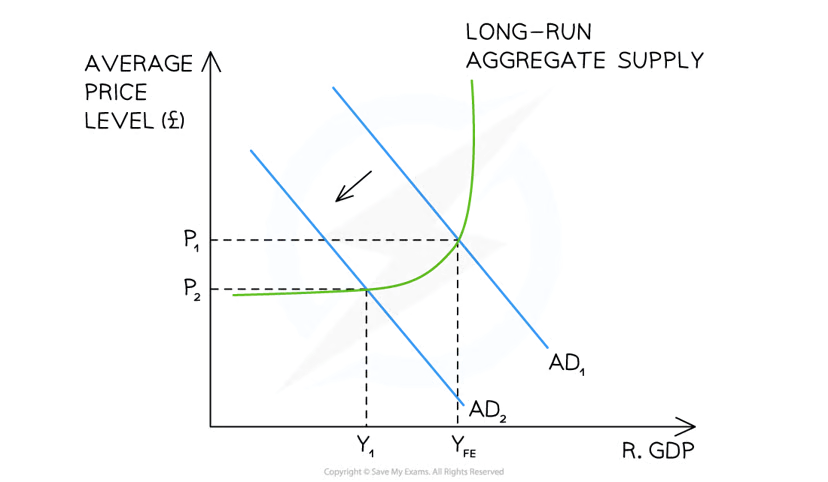
The Keynesian LRAS view
Supply is elastic at lower levels of output as there is a lot of spare production capacity in the economy
The Keynesian view believes that an economy will not always self-correct and return to the full employment level of output (YFE)
factors influencing LRAS
Technological advances: these often improve the quality of the factors of production e.g. development of metal alloys
Changes in relative productivity: process innovation often results in productivity improvement e.g. moving from labour intensive car production to automated car production
Changes in education and skills: over time this increases the quality of labour in an economy
Changes in government regulations: these can improve the quantity of the factors of production. e.g. deregulation of fracking (extracting oil from shale deposits) increased oil reserves
Demographic changes and migration: a positive net birth rate or positive net migration rate will increase the quantity of labour available
Competition policy: regulating industries so as to prevent monopoly power results in more firms supplying goods/services in an economy and this increases the potential output of an economy
 Note
Note  Flashcards (40)