Unit 5A: Mental and Physical Health
 Studied by 0 people
 Call Kai
 Learn
Learn Practice Test
 Spaced Repetition
 Match
Match Flashcards
 Knowt Play
1/4

There's no tags or description
Looks like no tags are added yet.
Name | Mastery | Learn | Test | Matching | Spaced | Call with Kai |
|---|
No analytics yet
Send a link to your students to track their progress
5 Terms
health psychology
… … is a field that explores how biological, psychological, and social factors influence health and illness — it examines behaviors, thoughts, and emotions related to health, as well as how individuals and communities can promote well-being and prevent illness
stress, hypertension, immune suppression
… is a physiological and psychological response to challenges or demands that exceed an individual’s coping abilities – involves the activation of the body’s stress response system, including the release of hormones like adrenaline and cortisol, which prepare the body to react to perceived threats or pressures
… is high blood pressure that can be caused by stress, can cause headaches/migraines
… … is being more susceptible to illness, can be caused by stress
eustress, distress
stressors
… is positive stress that motivates individuals to achieve goals, improve performance, and enhance well-being – arises from situations perceived as challenging but manageable, stimulating feelings of excitement and satisfaction
… is negative stress that exceeds and individual’s ability to cope effectively, leading to feelings of anxiety, frustration, or overwhelm – results from situations perceived as threatening, harmful, or beyond one’s control
… … … are traumatic experiences as a child that can affect a person both mentally and physically — includes things like abuse, neglect, household challenges, etc
general adaptation syndrome, flight-fight-freeze, alarm stage, resistance stage, functioning exhaustion stage, tend-and-befriend theory, fight-or-flight
reactions to stress
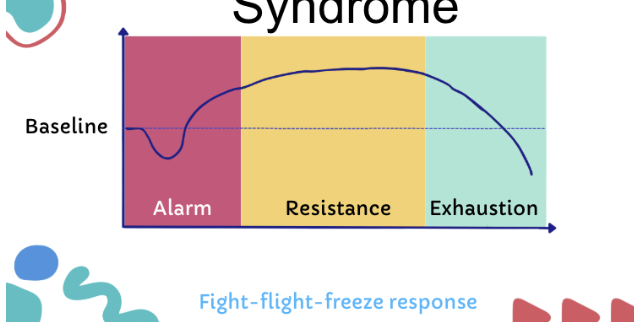
… … …, proposed by Hans Selye, describes the body’s physiological response to stressors through the 3 stages: alarm, resistance, and exhaustion – this model helps explain how individuals respond to various stressors, whether physical, psychological, or environmental – it is our bodies’ …-…-… response
During the … …, the body perceives a stressor and activates the “flight-or-fight” response – the sympathetic nervous system releases stress hormones like adrenaline and cortisol, preparing the body to respond to the perceived threat, and physiological changes include increased heart rate, heightened senses, and a surge in energy
If the stressor persists, the body enters the … …, where it attempts to adapt to and cope with the ongoing challenge – hormone levels stabilize to sustain the heightened state of readiness, allowing individuals to continue … despite the stressor’s presence – however, physiological resources are gradually depleted
If stress continues without relief or adaptation, the body enters the … … – physiological resources become depleted, and chronic stress can lead to physical and mental exhaustion, increased vulnerability to illness, and impaired cognitive functioning
the …-…-… … says that in response to stress, individuals, especially women, are biologically predisposed to to seek social connections and support (befriending) and nurture others (tending) – this theory contrasts with the traditional …-…-… response (ex: during a natural disaster, people may collaborate to provide aid and emotional support to help with community resilience and coping)
problem-focused coping, solution, emotion-focused coping
coping with stress
…-… … is actively managing or altering stressful situations through direct actions or problem-solving strategies – aims to change the stressful circumstances or one’s response to them by seeking out a …, thereby reducing the impact of stressors (ex: when faced with a work deadline, someone may break down tasks, set priorities, and allocate time efficiently to meet the deadline)
…-… … is regulating emotional responses to stressors, rather than altering the stressors themselves – aims to manage the emotional distress caused by stressors through strategies like seeking emotional support, distraction, or reframing the situation (ex: following a significant loss, someone may talk to friends or participate in support groups to process grief and find comfort in shared experiences)
Explore top notes

