B cell Activation and Germinal Center Responses - 4
 Call Kai
 Learn
Learn Practice Test
 Spaced Repetition
 Match
Match Flashcards
 Knowt Play
1/40

Earn XP
Description and Tags
8.3 and 8,4 - Immunology
Name | Mastery | Learn | Test | Matching | Spaced | Call with Kai |
|---|
No analytics yet
Send a link to your students to track their progress
41 Terms
8.3
B cell activation
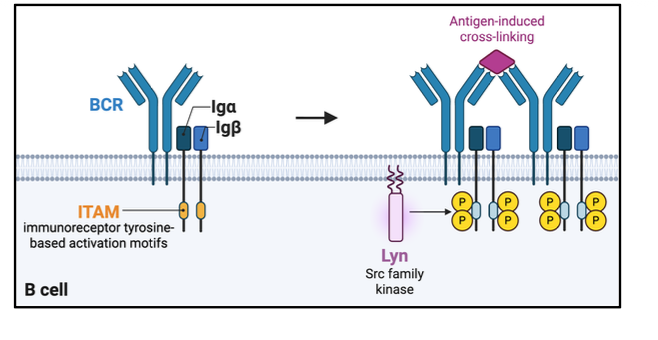
Cytoplasmic tails of the BCR complex are
phosphorylated by src family kinases
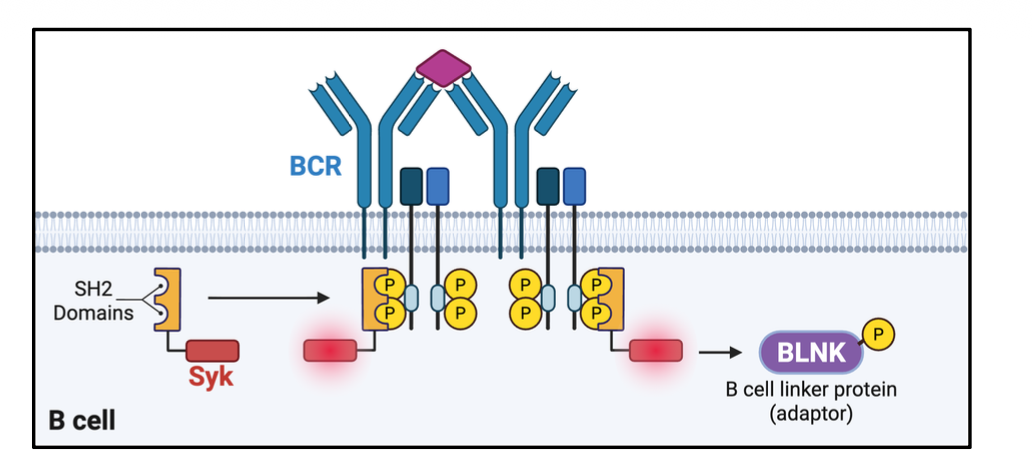
Phosphorylated ITAMS recruit
kinase Syk, which phosphorylates BLNK
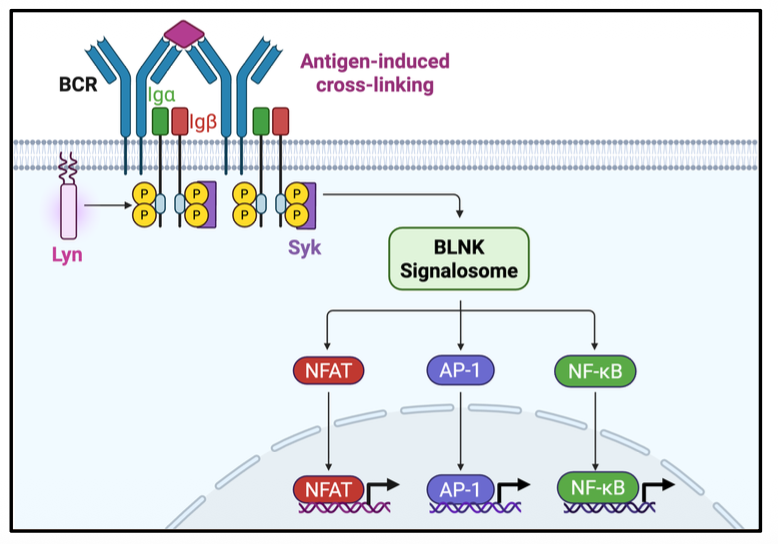
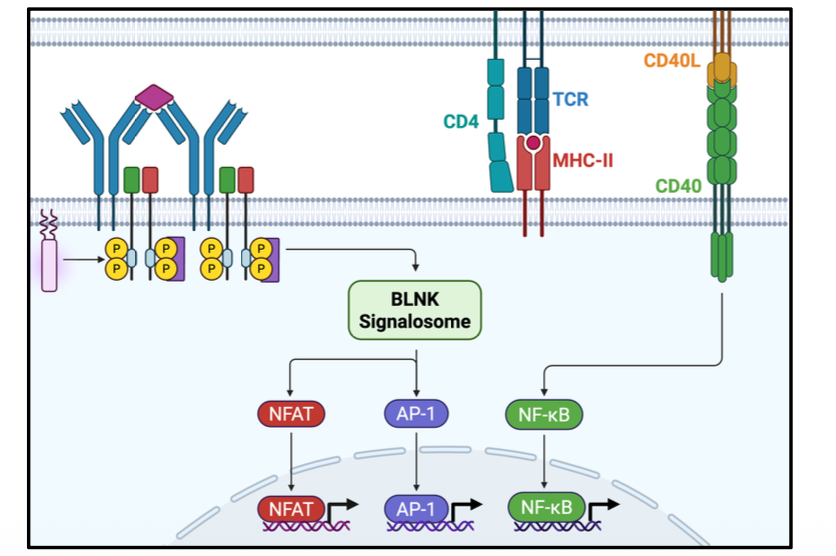
B cell activation requires 3 critical transcription factors
NFAT, AP-1, and NF-KB by BLNK signalosome
increases transcription
TI antigens induce
earlies B cell response without requiring T cell help
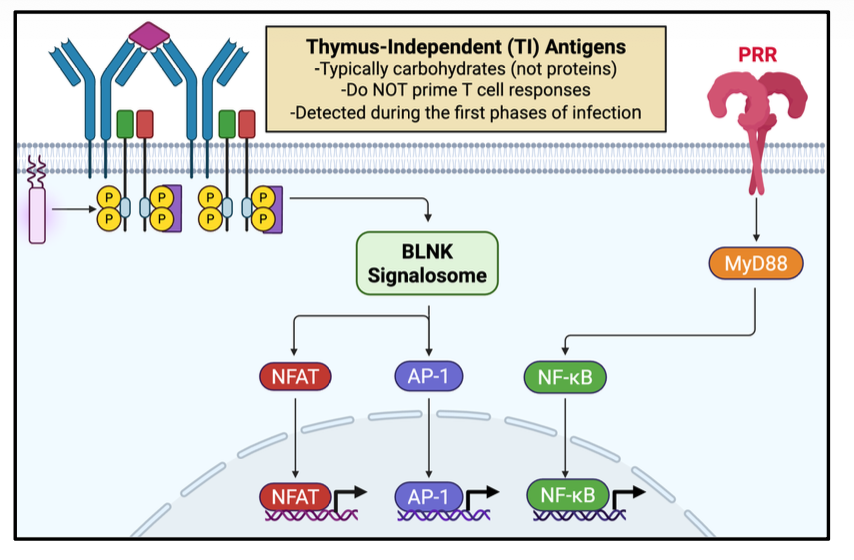
Thymus independent (TI) antigens
typically carbs (not proteins)
Do NOT prime T cell responses
Detected during first phases of infection
DCs secrete IL-6 in SLOs to
induce differentiation of T follicular helper cells (Tfh)
Tfh cells migrate to lymphoid follicles to provide T cell help to naive B cells
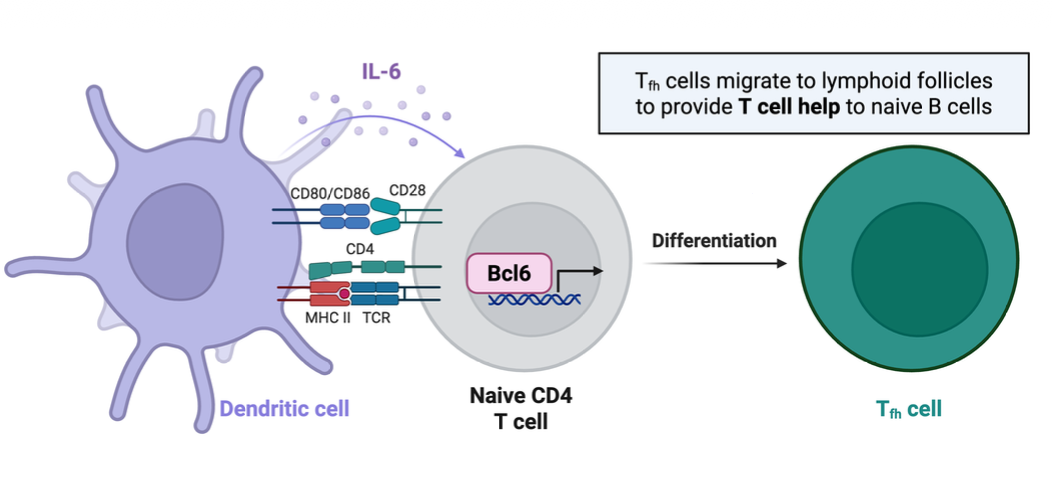
Thymus-Dependent antigens
induce endocytosis and are processed for presentation to Tfh cells
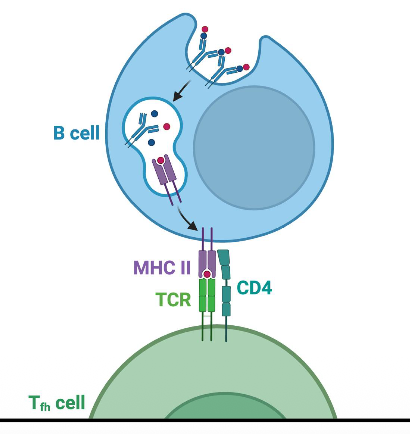
TD antigens induce
enhanced B cell activation via T cell help
Naive B cell and Tfh cell exchange signals that initiate B cell activation in a process called T cell help
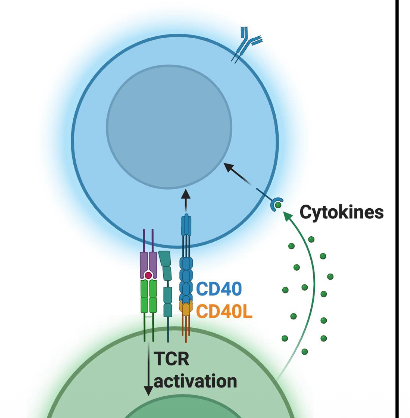
CD40 provides key
transcriptional activation in naive B cells recognizing TD antigens
T cell help also involves secretion
of key Tfh–derived cytokines
Tfh release the signature cytokine IL21
STAT3 induces genes promoting proliferation + differentiation
Other Tfh derived cytokines selectively induce class-switch recombination
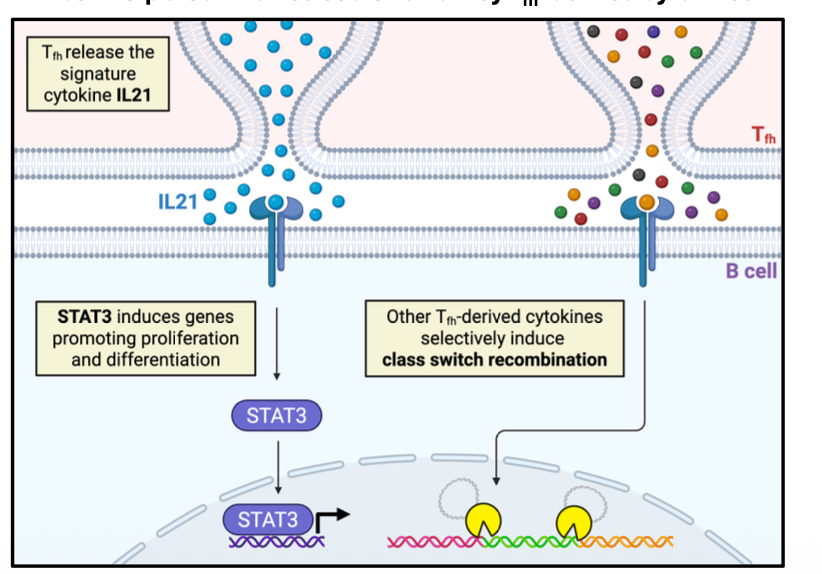
Tfh-derived cytokines determine
class switching in activated B cells
Response Type 1 - IFN-gamma targets
targets IgG isotype

Response Type 2 - IL-4 targets
targets IgE isotype

Response Mucosal - with IL-21 and TGF-beta
targets IgA isotype

Summary 8.3
B cell activation occurs when BCRs are crosslinked
Src/Syk family kinases recruit downstream signals including transcription factors
Source of NFkB is variable depending on timing and type of antigen
Different types of antigens recruit different B cell responses
TI antigens are likely carbohydrates and do not recruit T cell help
TD antigens enhance B cell activation using additional signals
Summary 8.3 pt. 2
Tfh cells provide critical help for the B cell to develop enhanced responses
Tfh cells influence the survival and proliferation of B cells
Tfh cells secrete cytokines to polarize the type of immunoglobulin
8.4
Germinal Center Responses
Specialized chemokine gradients guide naïve lymphocytes to
appropriate SLO compartments
primary follicle - naive B cell (CXCR5 with CXCL13)
paracortex - naive T cell (CCR7 with CCL19/21)
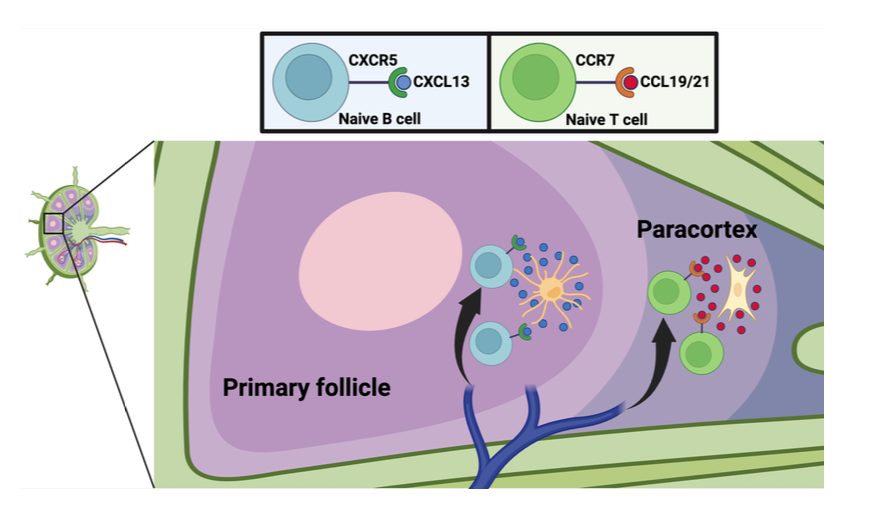
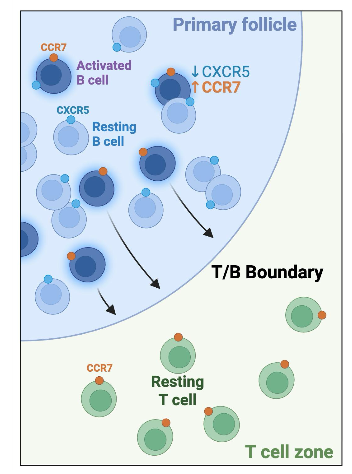
Activated B and Tfh cells find each other
at the T/B boundary
Upon activation, B cells
downregulate CXCR5, and upregulate CCR7
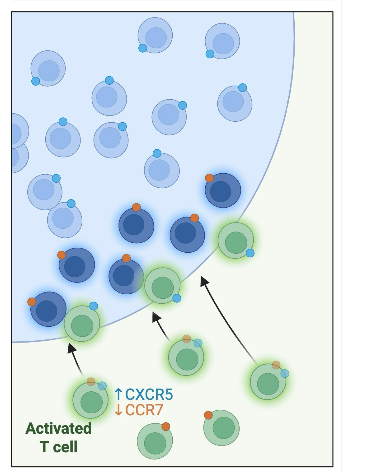
T cell activation results in opposite
downregulation of CCR7 and upregulation of CXCR5
B cell interactions with Tfh cells result in two major outcomes
Leave follicle or remain in follicle
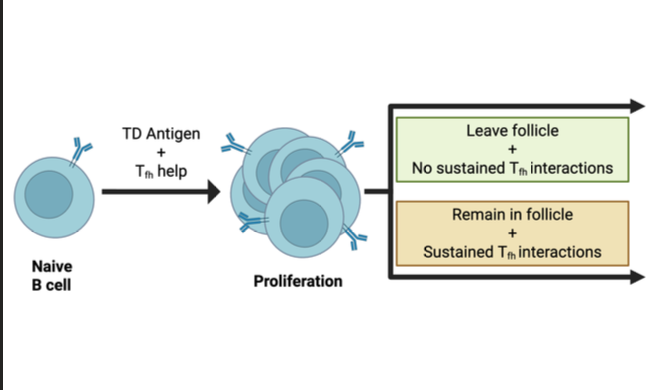
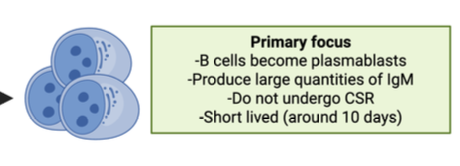
if B cell leaves follicle
no sustained Tfh interations
Primary focus
B cells become plasmablasts
produce larger quantities of IgM
Do not undergo CSR
Short lived (around 10 days)
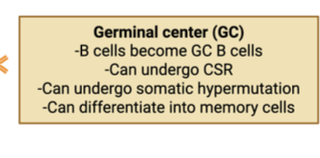
if B cell remain in follicle
sustained Tfh interactions
Germinal center (GC)
B cells become GC B cells
Can undergo CSR
can undergo somatic hypermutation
can differentiate into memory cells
The germinal center is comprised of different zones
where antibody responses are fine tuned
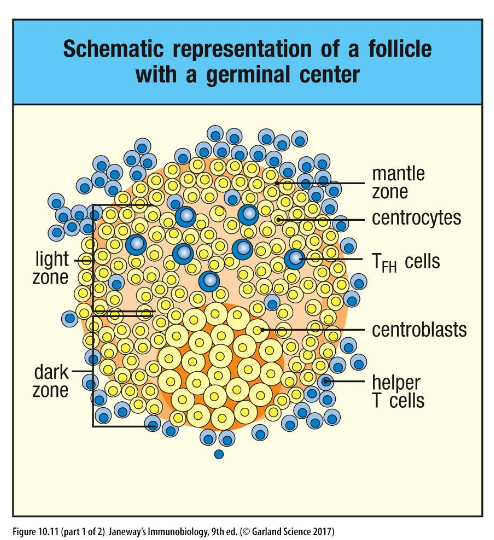
Mantle zone
Peripheral edges of follicle
• Contains resting B cells (not activated, not proliferating)
Dark Zone
Contains rapidly proliferating B cells (centroblasts) that express CXCR4 → attracted to CXCL12 produced in dark zone
Densely packed region of proliferating cells (appears dark)
Region where immunoglobulin genes are mutated
Light Zone
Contains TFH cells
• Contains slower proliferating B cells (centrocytes) that lose CXCR4 and express CXCR5 → attracted to CXCL13 in light zone
• Region where B cells that have undergone immunoglobulin mutation interact with TFH to test reactivity of new Ig
• Cells can return to dark zone for additional rounds of mutation
B cells in dark zones activate
AID
result in Ig V regions = somatic hypermutation
Activation-induced deaminase (AID) initiates somatic hypermutation (SHM) by converting cytosine to uracil in the DNA of immunoglobulin (Ig) variable (V) regions, leading to high-rate nucleotide substitutions. This process, occurring in germinal center B cells, increases antibody affinity for antigens, enabling affinity maturation.
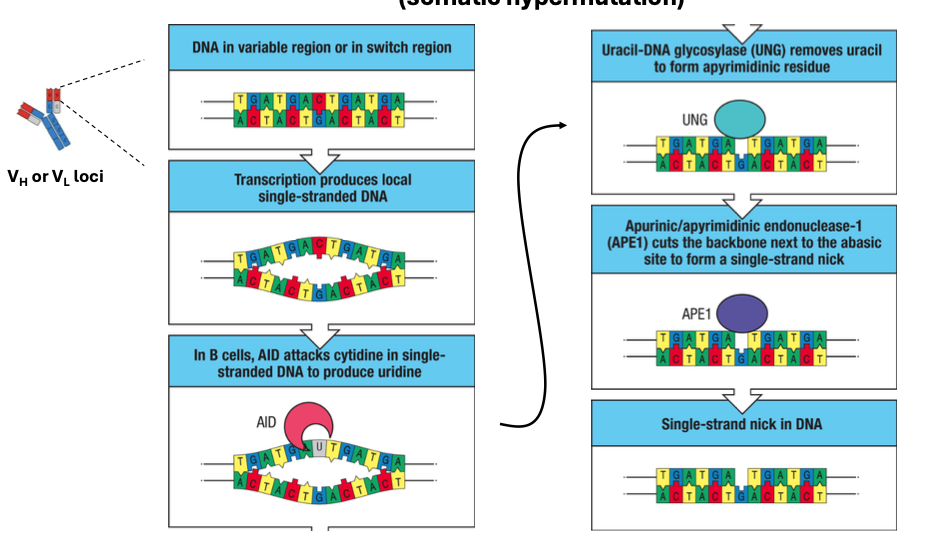
purpose of somatic hypermutation
to increase antibody affinity
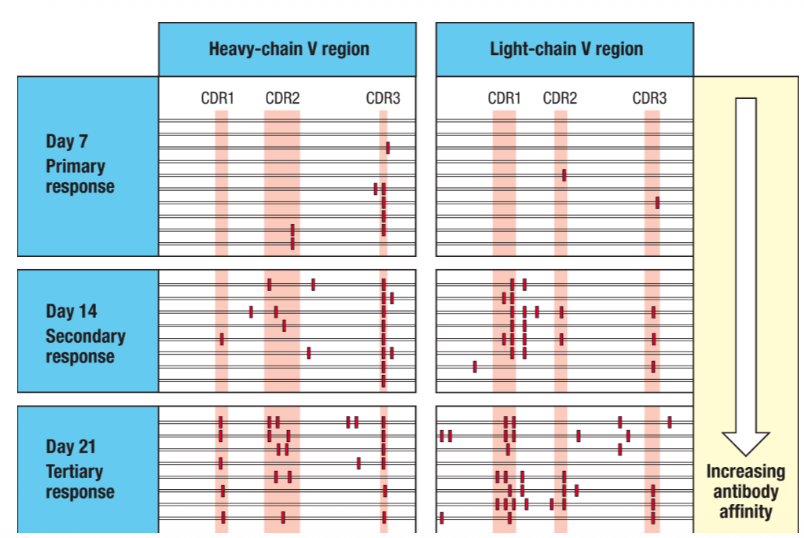
somatic hypermutation and increase antibody affinity
Initially the BCR of a B cell may be specific enough for an antigen to bind successfully, but weakly
the Antibodies from this B cell may not be very effective
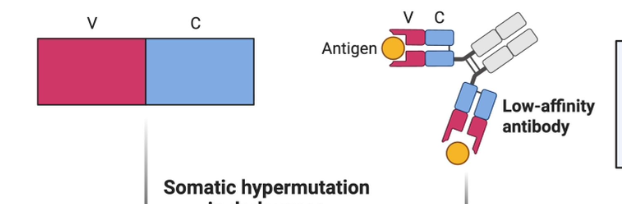
Somatic hypermutation
results in new clones whose Ig binds the antigen more tightly, resulting in antibodies more likely to promote effector functions
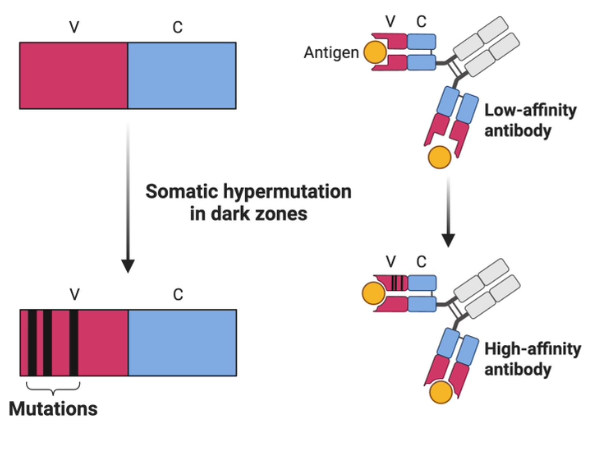
Mutated B cells are “tested” in light cells
using Tfh cells
only high affinity clones survive (affinity maturation)
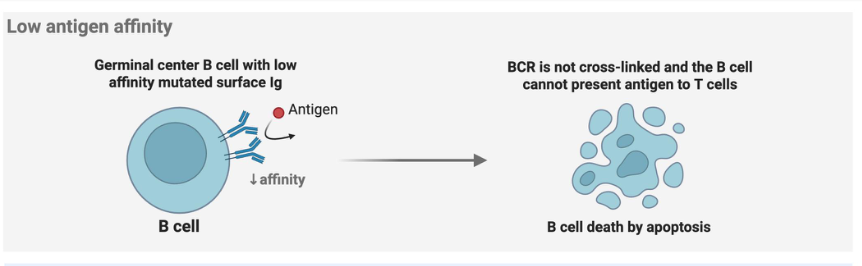
Low antigen affinity
Germinal center B cell with low affinity mutated surface Ig
BCR is not cross-linked and the B cell cannot present Ag to T cells
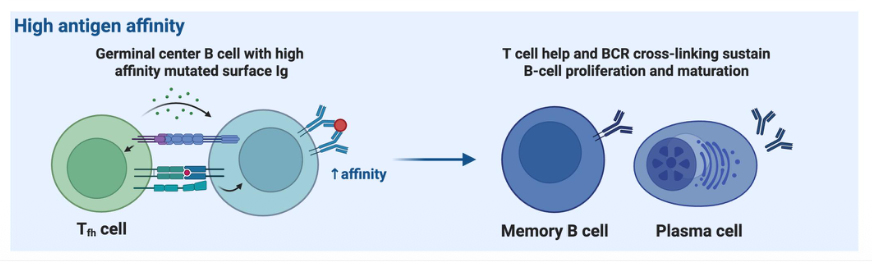
High antigen affinity
Germinal center B cell with high affinity mutated surface Ig
T cell help and BCR cross linking sustains B cell proliferation and maturation
Germinal center responses yield
higher quality antibodies than those expressed during early infection
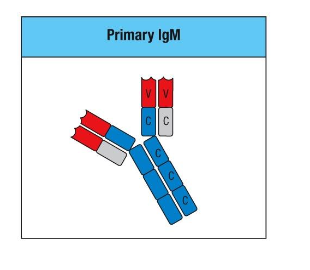
TI antigen-responsive B cells
TD antigen-responsive plasmablasts
Rapid production of low affinity IgM
• Important initial protection but not completely effective
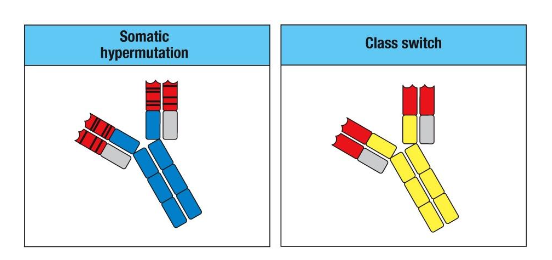
TD antigen-responsive GC B cells
Slower production of higher affinity antibodies
• Class switch recombination unlocks new effector functions
• Differentiation into memory cells can provide durable protection
Summary 8.4
Tfh and B cells must physically interact to provide help
Both B and T cells move toward the boundaries of follicles to find one another
Availability of this interaction is dependent on chemokine signaling
B cell responses are dynamically influenced by T cell help
Without T cell help, B cells form primary foci that secrete low affinity IgM
Tfh signals help B cells form high affinity antibodies of specific isotype
Summary 8.4 pt 2
Germinal center reactions are a combined effort to produce high affinity antibodies
Dark zone centroblasts are undergoing somatic hypermutation in V regions
Light zone centrocytes interact with Tfh to receive survival signals
Explore top notes

Explore top flashcards
