2.1 pressurised metered-dose inhalers pMDIs
 Studied by 0 people
 Call with Kai
 Learn
Learn Practice Test
 Spaced Repetition
 Match
Match Flashcards
 Knowt Play
1/23

There's no tags or description
Looks like no tags are added yet.
Name | Mastery | Learn | Test | Matching | Spaced | Call with Kai |
|---|
No study sessions yet.
24 Terms
These are the oldest form of modern inhaler devices,
having been introduced in the 1950s
pMDIs are still the most widely used of the inhalation devices
A common example is the Salbutamol inhaler.
pMDIs are considered to be portable and user-friendly, consisting of three major components:
The canister
The metering valve
The actuator/ mouth piece
canister
the canister is where the formulation resides
the canister is produced in aluminium/ stainless steel due to the inertness of these materials
with optional coatings like epoxy resin- designed to enhance compatibility of the cannister with sensitive formulations
the metering valve
allows a metered (measured) quantity of the formulation to be dispensed with each actuation.
The actuator/ mouthpiece
enables the patient to operate the device and directs the aerosol into the patient's lungs.
Formulations within pMDIs consist of
a fine powder which is dissolved/ suspended in a liquid propellant
along with surfactants + other excipients
Upon activation,
the metering valve releases a predetermined dose of the formulation as a fine spray
The spray results from volume expansion within the valve,
where the high-speed gas flow breaks up the liquid into small droplets.
what are propellants?
a gas, such as a fluorocarbon, that is used in aerosols to force the contents out of the container
Propellants in pMDIs
single largest contributor as a medicine to the NHS’s carbon emissions.
Propellant systems maintain a constant pressure
ensuring consistent spray characteristics
Historically, chlorofluorocarbons (CFCs) were used as propellants,
but they were phased out under the Montreal Protocol due to their ozone-depleting properties.
Hydrofluoroalkanes (HFAs) are now widely used,
offering similar efficacy but requiring reformulation due to differences in solubility and volatility.
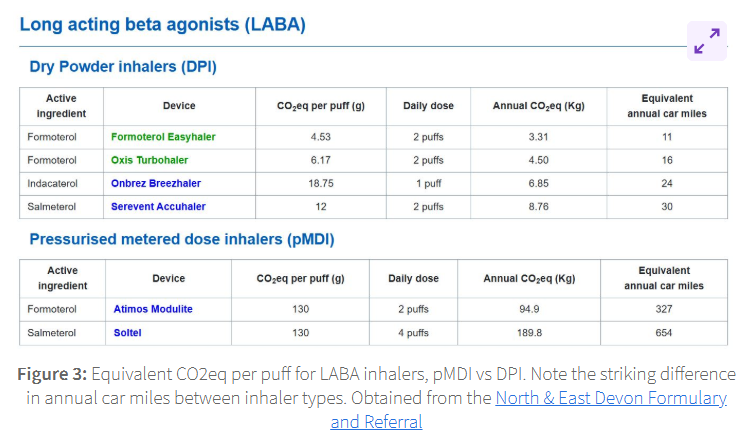
These propellants are powerful greenhouse gases
and are thousands of times more powerful than CO2
CO2 has a global warming potential, GWP of 1
the 2 most common propellants:
norflurane (HFA 134a) → GWP = 1300
apaflurane (HFA 227ea) → GWP = 3350
propellants are safe to the person using them,
but contribute significantly to climate change
pMDIs make up 70% of inhalers prescribed in the UK
consequently causing 3% of the NHS’s overall carbon emissions
The NHS is encouraging healthcare professionals
to give people over the age of 12 the option of changing to a lower-carbon inhaler.
pMDIs rely on accurate coordination between actuation (release into mouth) and inhalation.
without proper inhaler technique this results in sub-optimal dosing and therefore necessitates the use of spaces for patients to achieve the right dose at the hight time
Spacers help address issues like high-velocity droplet deposition in the oropharynx
and improve drug delivery to the lungs through tidal breathing.
watch video
 Note
Note  Flashcards (30)