Hearing Science - Anatomy & Physiology of the Ear
 Studied by 1 person
 Call Kai
 Learn
Learn Practice Test
 Spaced Repetition
 Match
Match Flashcards
 Knowt Play
1/89

There's no tags or description
Looks like no tags are added yet.
Name | Mastery | Learn | Test | Matching | Spaced | Call with Kai |
|---|
No analytics yet
Send a link to your students to track their progress
90 Terms
What are the three major sections of the ear?
Outer Ear, Middle Ear, and Inner Ear
What is considered the Outer Ear?
Pinna and Ear Canal
What is considered the Middle Ear?
Typmanic Membrane, Ossicles, and Eushtachian Tube
What is considered the Inner Ear?
Semi-circular Canals, Cochlea and CNVIII
Define Pinna:
The entirety of what you see on the outside that collects the sound and amplifies it by 8db.
Define Ear Canal:
Tube that sound reverberates in and increases in a particular frequency range.
Define Tympanic Membrane:
Ear drum, structure that seperates the outer ear from the middle ear, made of three layers (1. thin layer of skin, 2. fibrous (gives this it’s shape and stiffness characteristics), 3. mucus lining similar to the middle ear space), responsible for converting acoustic energy into mechanical energy.
Define Ossicles:
The three smallest bones of the human body
Define Eustachian Tube:
Tube that connects the middle ear space to the back of the nose, whether this opens or closes properly determines whether you have an ear infection.
Define Semi-Circular Canals:
Reponsible for balance and orienting you to your environment
Define Cochlea:
Where sound is going to go before brain processing, responsible for hearing.
Define CNVIII:
The vestibulochlear nerve: one nerve with both balance and hearing branches that only fork or split at the inner ear.
Vestibulo (balance) cochlear (hearing)
The three major sections of the ear work together to convert sound from its original form (acoustic energy —> sound waves) to a _____________ signal that is transmitted to and interpreted by the brain.
Bioelectrical
Tympanum:
The air-filled space that houses the ossicular chain and Eustachian tube
What is the pinna made up of?
Cartilage and fibrous tissue
Describe the characteristics of the external auditory canal (aka: ear canal):
S-shaped, narrows as it gets closer to the eardrum, made up of two portions of the canal (cartilaginous portion and boney portion).
What are the two portions of the ear canal?
Cartilaginous portion (holds the sebaceous glands which secrete cerumen (wax)), and boney portion (thin layer of skin covering bone).
What is the shape of the ear canal and what purpose does it serve?
S-shaped, it serves as eardrum protection from things reaching it.
The three main functions of the outer ear are sound _____________, ______________, and protection of the ________ ________.
Amplification ; Directionality ; Tympanic Membrane
How do the structures of the outer ear (pinna and ear canal) amplify sound and in what frequency region?
Pinna (amplifies by around 8dB), Ear Canal (sound reverberates in there and increases sound in a particular frequency range: 2700-3400 Htz)
How does the outer ear protect the middle ear?
Ear Wax (supposed to be removed once a month)
What is step 1 of the transduction of sound through the ear?
The collection of acoustic energy, will remain acoustic from the pinna through the ear canal.
What is the structure separating the outer ear from the middle ear?
The tympanic membrane.
What are the structures of the middle ear?
The Ossicles and the Eustachian Tube.
What is the air filled space beyond the tympanic membrane?
Tympanum
Which bone is located posteriorly to the tympanum and containing air pockets?
Mastoid Bone
What is the tympanic membrane responsible for?
Converting acoustic energy into mechanical energy.
List all three ossicles:
Malleus (connected to the tympanic membrane), Incus (glue that holds them together, middle child), Stapes (imbedded into the oval window fo the cochlea)
What are all three ossicles together called?
Ossicular chain
Where is the Eustachian tube located?
Connects the tympanum to the nasopharynx
What is the primary function of the Eustachian tube? How does it accomplish this?
To equalize pressure in the middle ear space to atmospheric pressure in ear canal.
Swallowing, chewing, or yawning cause the contraction of muscles in the back of the throat, which pulls open the tube. This opening allows a small amount of air to flow in or out of the middle ear, balancing the pressure on both sides of the eardrum. This equalization process is what causes the “pop”.
What is step 2 of the transduction of sound through the ear?
Converting acoustic energy into mechanical energy
The middle ear muscles ________ in response to _____ ________.
Vibrate ; Sound Pressure
What are the steps of transduction of sound through the ear?
Collection of acoustic energy (OE)
Sound pressure hits TM, converting acoustic energy to mechanical energy
(1 & 2’s medium is air, high admittance)
What are the two primary middle ear muscles?
Tensor Tympani Muscle & Stapedius Muscle
Define Tensor Tympani Muscle:
Middle ear muscle that attaches specifically to the malleus.
Define Stapedius Muscle:
Middle ear muscle that attaches to the footplate of stapes and helps protect your hearing against loud noise by contracting at around 90 dB. When this muscle contracts it stiffens the ossicular chain.
What is impedance and what is its unit of measure?
The resistance/opposition to (impedes) the flow of energy.
Measured in 'ohms’
Impendance is related to what characteristics of a system?
Related to the mass and stiffness characteristics of a system, as well as the force acting on the system
How does Newton’s Second Law apply to hearing (what is the relationship between impedance and force)?
Newton’s Second Law of motion says if the mass of the object is large and heavy, I must apply more force:
I have an ear infection (im adding mass to my system) and if I’m talking at a normal volume I will have a hard time hearing myself. Applying more force (or going louder) will be able to help me overcome the ear infection and hear myself.
What is admittance and what is its unit of measure?
The ease of (admits) flow of energy through a system dependent upon the mass, stiffness, and force applied to the system (meaning your auditory system has a unique mass and stiffness characteristic and it’s individual to everyone, your voice is unique).
Measured in ‘mmhos’
What is the relationship between impedance and admittance?
They are inverse of each other.
Impedance impedes and admittance admits.
When my auditory system is healthy, I have ____ admittance.
High
My auditory system will _______ sound in order to overcome that potential loss.
Amplify
Define Impedance Matching:
To match the impedance of a source to the impedance of a new system to transfer as much energy as possible to avoid losing energy.
WHEN TWO SYSTEMS ARE DIFFERENT THE ENERGY TRANSFER IS NOT EFFICIENT (experiencing energy loss)
To make a system vibrate, energy needs to be tranferred to the system from _______ system.
Another
An example demonstrating that when two systems are different, the energy transfer is not efficient:
Air mediums VS fluid filled mediums, sound is absorbed and damaging
Impedance matching is an important function of the middle ear space as it serves to match what?
It serves to match the impedance of the middle ear space to the impedance of the fluid filled space of the cochlea.
What three ways does the middle ear enhance signal intensity?
1. [Primary Way] Collecting sound over large surface area (TM) and directing to smaller surface area (footplate of stapes) – enhances by 23 dB
2. Lever action of ossicles – enhances by ~2.4 dB
3. Natural concave shape of the TM.
OVERALL: your middle ear system enhances the intensity of the sound by around 25 dB.
What is housed inside the cochlea?
Basilar membrane and the Organ of Corti
What are the three chambers of the cochlea?
(top chamber) The Scala Vestibuli, (bottom chamber) the Scala Media, (bottom-most chamber) the Scala Tympani.
Define Perilymph:
Fluid in the Scala Vestibuli, composition is high in sodium and low in potassium
Define Endolymph:
Fluid in the Scala Media, composition is low in sodium and high in potassium.
What runs the length of the cochlea and how is it organized?
The Basilar Membrane is organized tonotopically (by frequency).
The base of the basilar membrane is at the footplate of the stapes, the center of the snail shell is the apex where all low frequencies are.
What structures comprise the outer ear?
The pinna which is made up of cartilage and fibrous tissue.
In what ways does the ear canal, specifically, protect the tympanic membrane?
By being s-shaped, getting narrower as you get closer to the eardrum, and containing wax, the tympanic membrane is protected from things reaching it. Wax traps particles and bacteria.
Why is the impedance matching function of the middle ear important in the transduction of sound through the ear? How is it accomplished?
To make a system vibrate, energy needs to be transferred to the system from another system, and to define impedance matching is to say that it matches the impedance of a source to the impedance of a new system to transfer as much energy as possible to avoid losing energy. So, impedance matching matches the impedance of the middle ear space to the impedance of the fluid filled space of the cochlea.
The inner ear houses the organs for hearing and balance. Which structure(s) are responsible for balance and which is responsible for hearing?
The semi-circular canals are responsible for balance and orientating you to your environment. The cochlea is where sound is going to go before brain processing; this is responsible for hearing.
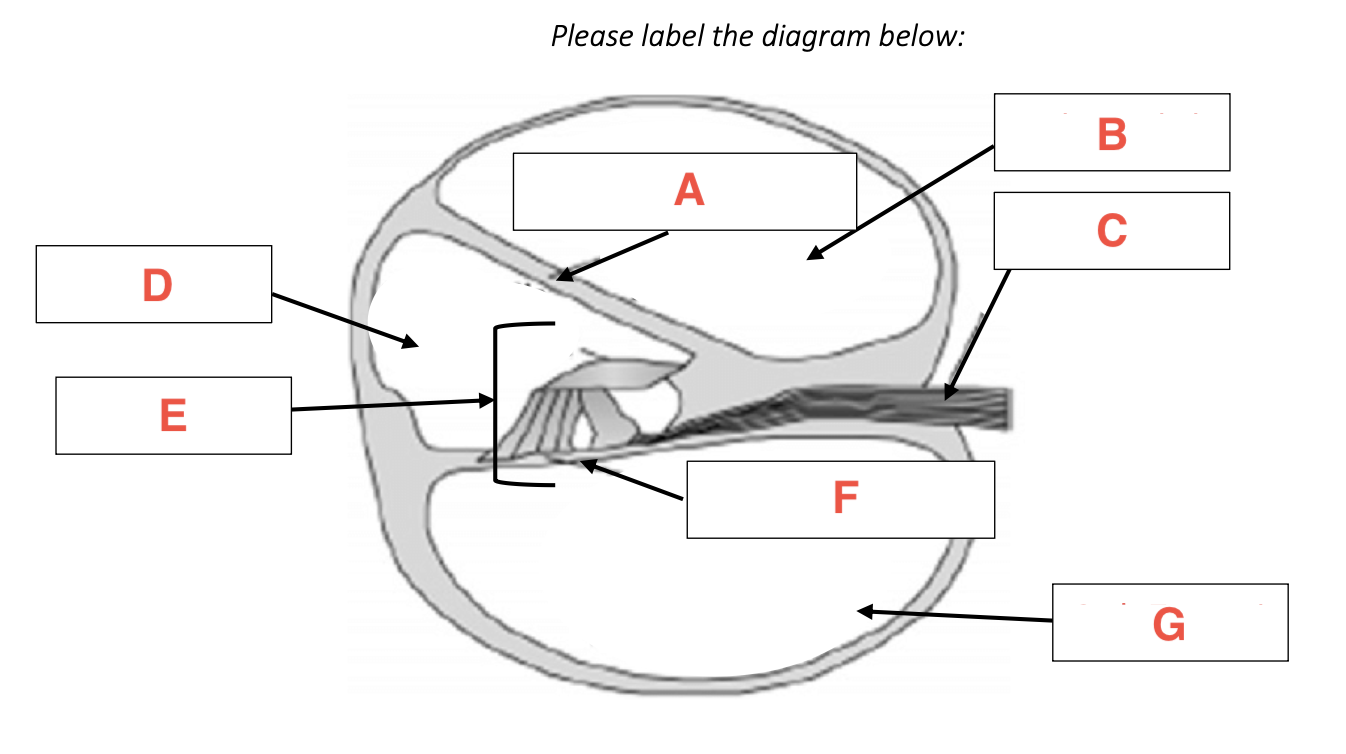
Label A:
Eustachian tube
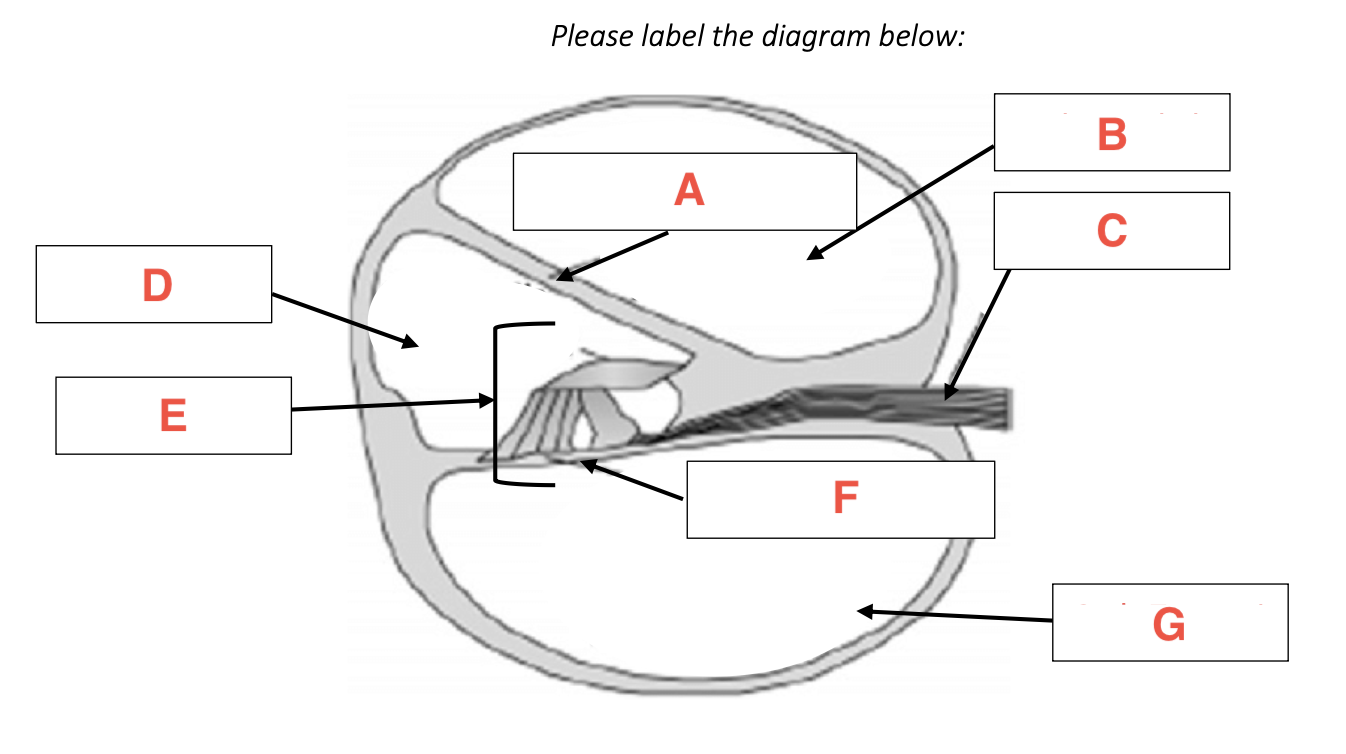
Label B:
Scala Vestibuli
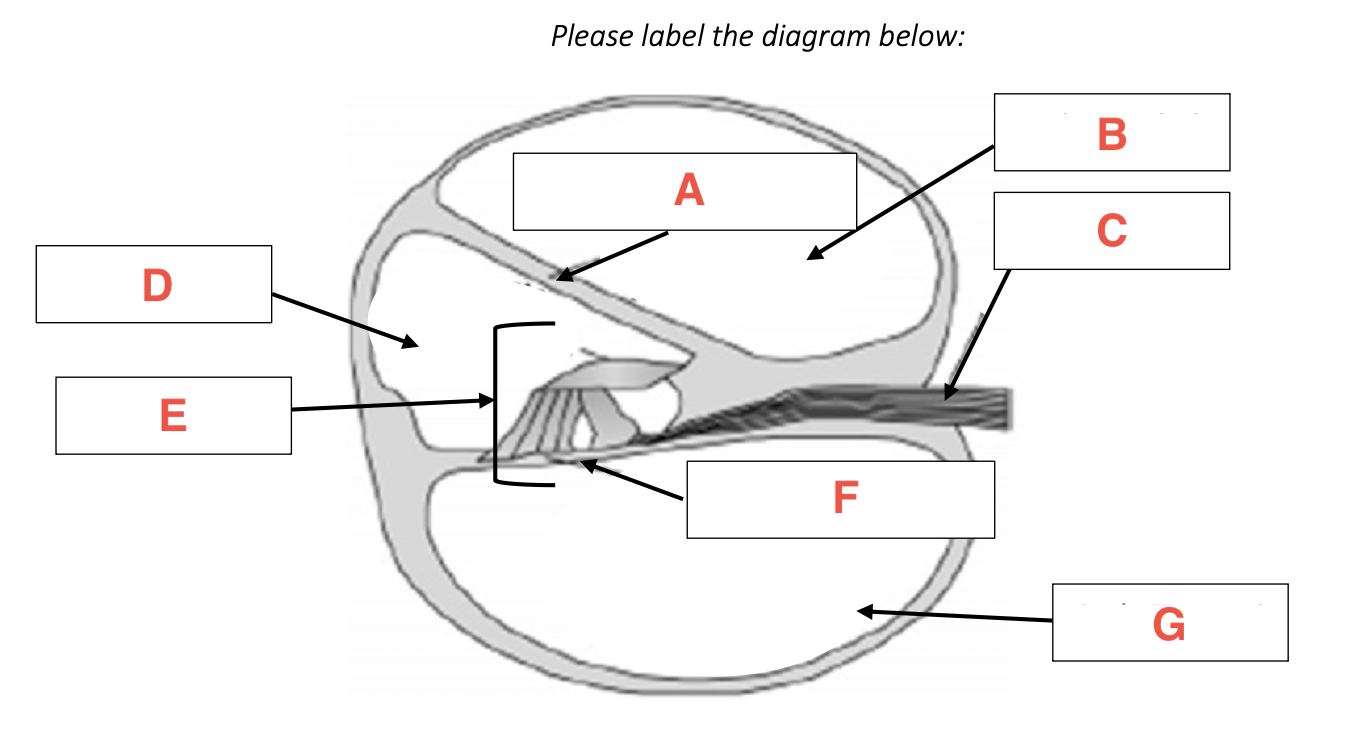
Label C:
Cochlea Nerve
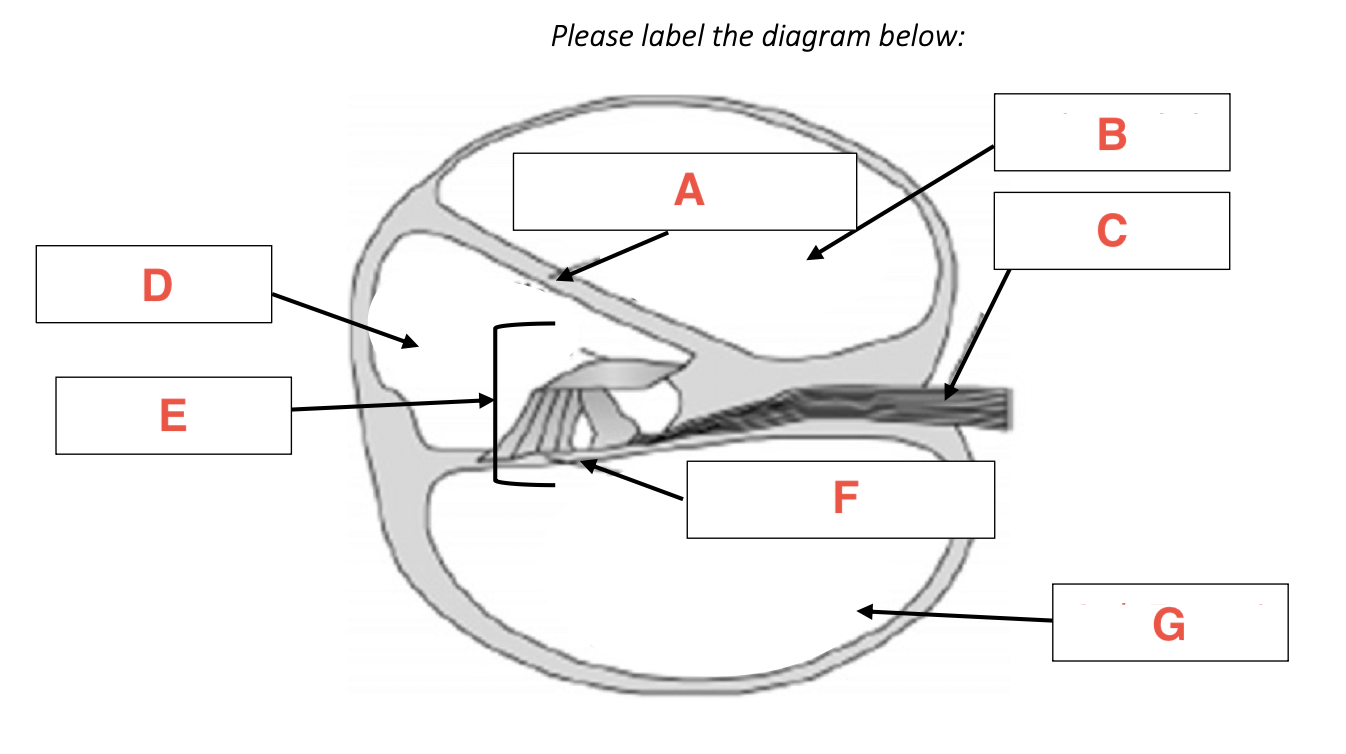
Label D:
Scala Media
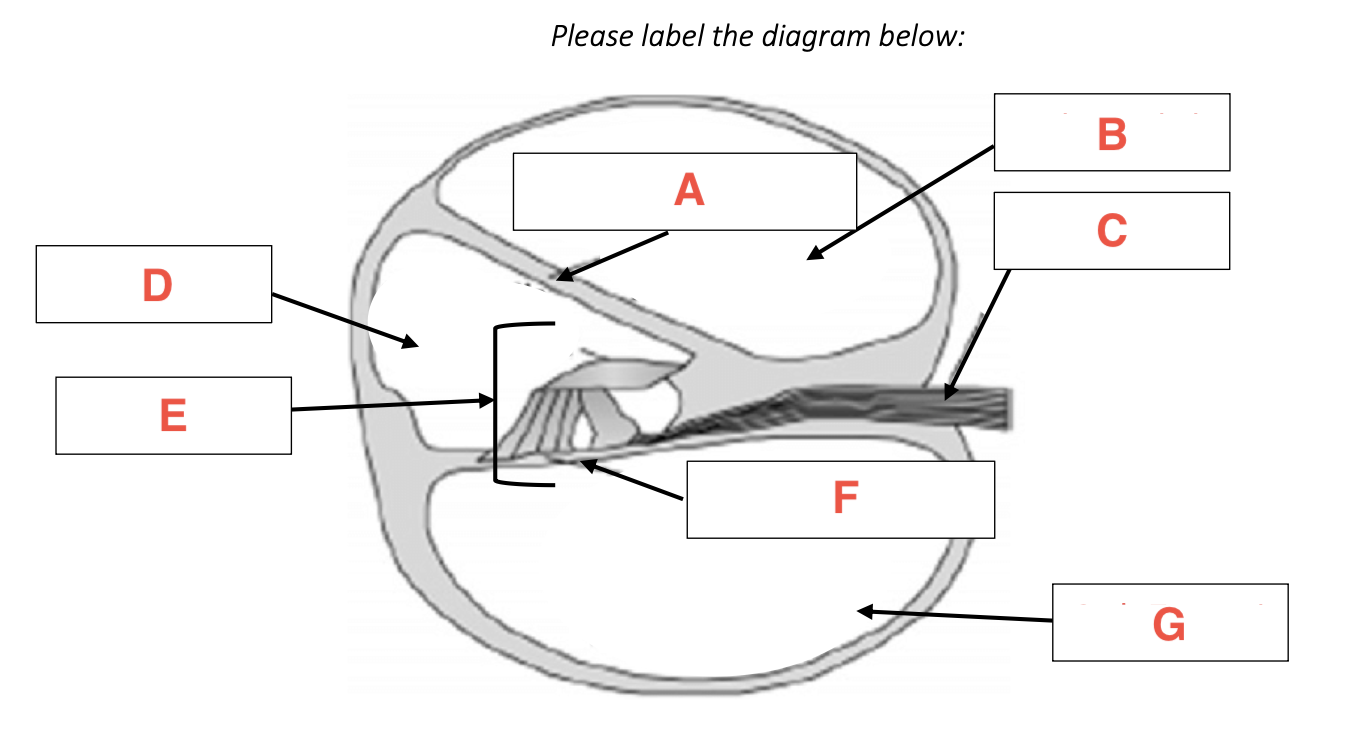
Label E:
Organ of Corti
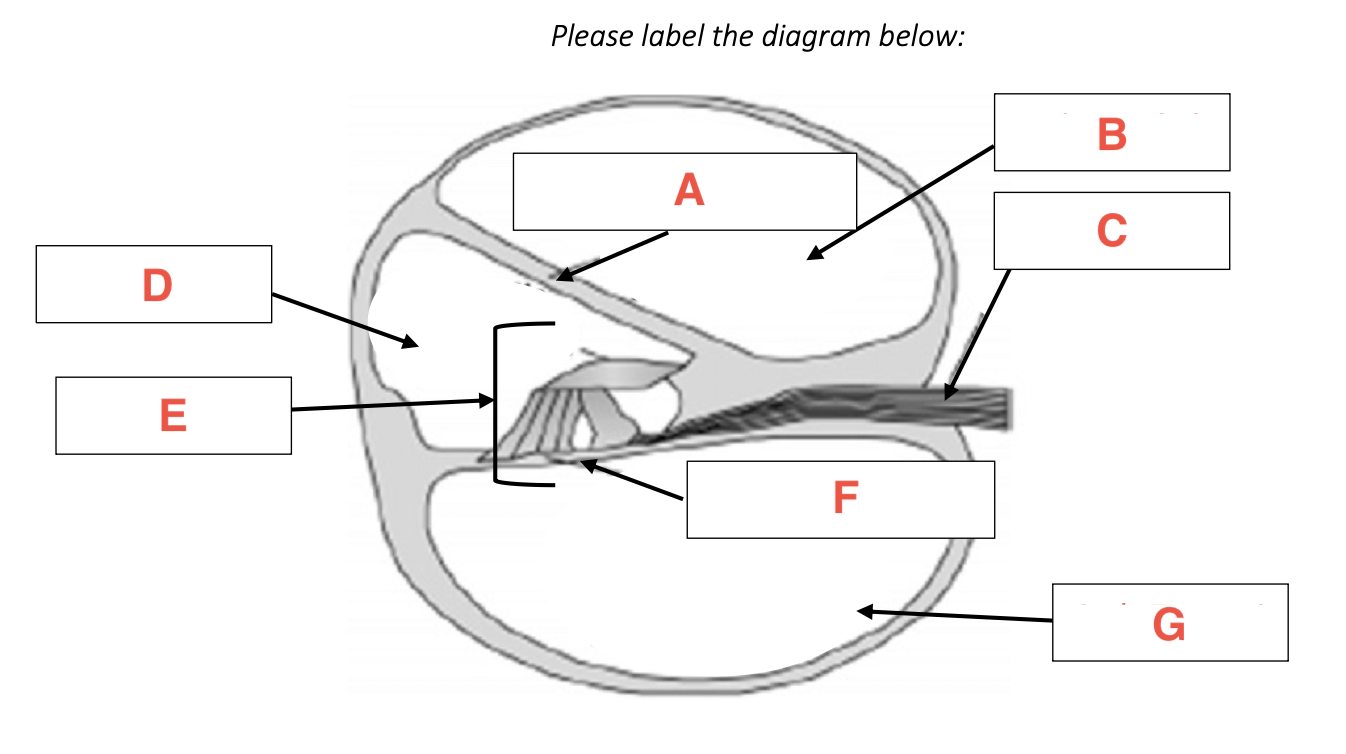
Label F:
Basilar Membrane

Label G:
Scala Tympani
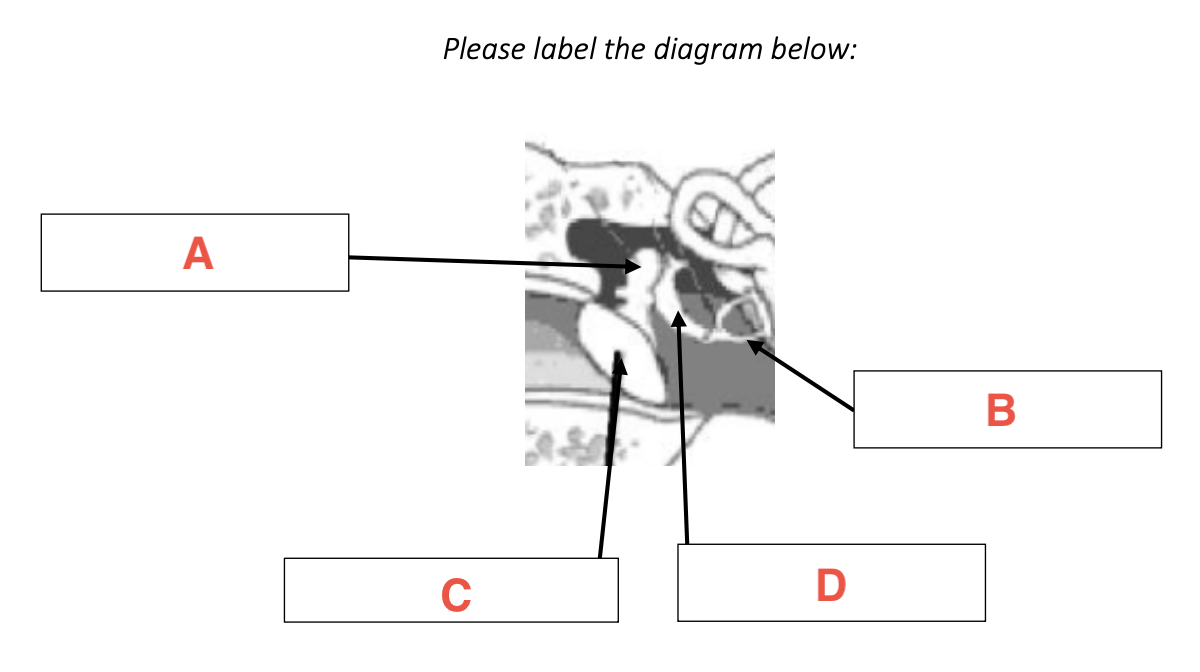
Label A:
Malleus

Label B:
Stapes
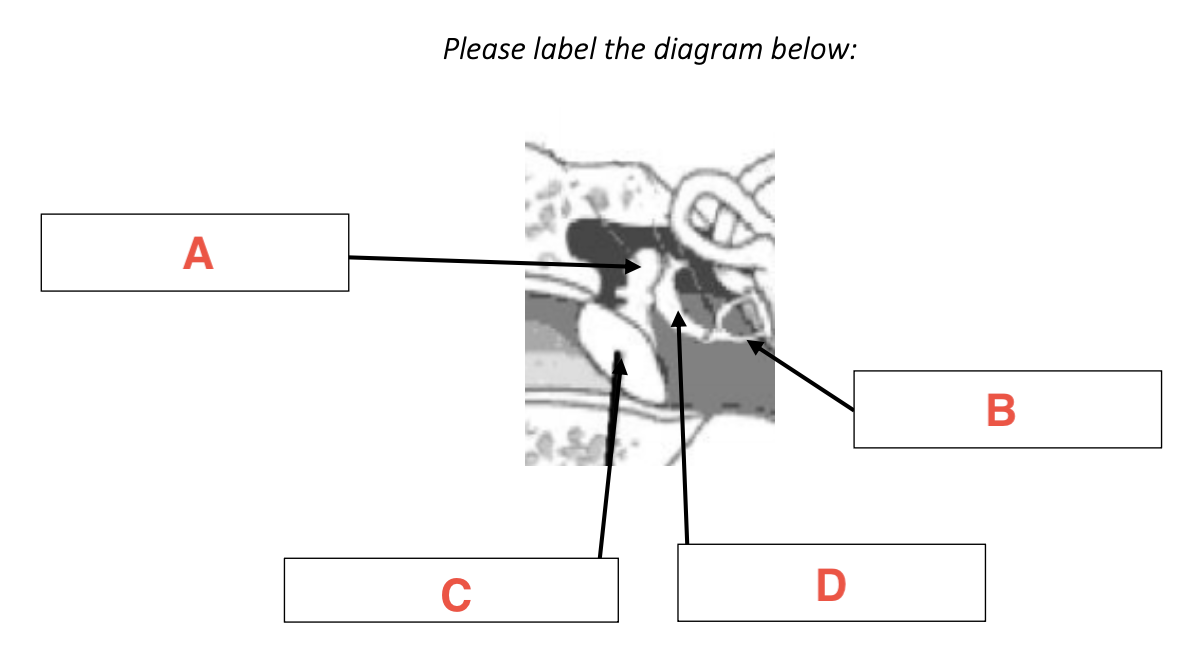
Label C:
Tympanic Membrane

Label D:
Incus
How many rows of inner hair cells in the Organ of Corti?
1 row (shaped like a pear.
How many rows of outer hair cells in the Organ of Corti?
3 rows (shaped like test-tubes)
What type of nerve is innervated by the inner hair cells?
Afferent – peripheral to central (from the ear to brain = down to top). THIS IS HOW WE HEAR, sending information to the brain!!!
What type of nerve is innervated by the outer hair cells?
Efferent – central to peripheral (from the brain to ear = top down).
Stereocilia are embedded in the _________ membrane, and ____ the outer and inner hair cells have it
Tectorial ; Both
How are the hair cells of the Organ of Corti moved and activated?
1. Fluid in the cochlea moves as a result of stapes vibration against oval window.
2. Fluid movement causes basilar membrane to move and as a result, the organ of Corti.
3. Organ of Corti movement causes the hair cells and the stereocilia to shear back and forth.
What happens when the stereocilia shear back-and-forth?
When my hair cells are shearing back and forth, they are activated, depolarization occurs within the inner hair cell.
Define the process of depolarization’s result:
The result creates a chemical, called a neurotransmitter, inside the inner hair cell. Creation of neurotransmitter converts mechanical energy of the middle ear into chemical energy.
What is step 3 of the transduction of sound through the ear?
Creation of neurotransmitter converts mechanical energy of the middle ear into chemical energy.
What is step 4 of the transduction of sound through the ear?
Neurotransmitter deposited into auditory nerve, converting chemical into electrical energy.
What is the purpose of the auditory nerve and how does it accomplish this?
(also known as Vestibulocochlear nerve)the purpose of this is to send sound information to the brain to process. It accomplishes this by the receiving the neurotransmitter and converting chemical energy into electrical energy.
Describe the process of the transduction of sound through the entire ear, including various energy conversions:
1. Sound is collected by the outer ear as acoustic energy.
2. Sound pressure hits the tympanic membrane which is then converted into mechanical energy.
a. (2.5) Mechanical energy travels the length of the ossicular chain to the stapes.
3. The fluids of the cochlea are disturbed causing basilar membrane and the Organ of Corti to move.
a. (3.25) This causes the stereocilia to shear back and forth, creating the process of depolarization.
b. (3.5) Depolarization in the inner hair cell causes the creation of a neurotransmitter converts the mechanical energy into chemical energy.
4. The neurotransmitter is deposited into the auditory nerve (vestibulocochlear nerve) which then converts chemical energy into electrical energy.
Why do I need to know the transduction of sound?
I need to know what sound normally does in order to fix or manage any problem with the auditory system.
What is the energy form and transducer of the first step of the transduction of sound?
Acoustic ; Outer Ear (pinna and ear canal)
What is the energy form and transducer of the second step of the transduction of sound?
Mechanical ; Tympanic Membrane
What is the energy form and transducer of the third step of the transduction of sound?
Chemical ; Inner Hair Cells via Depolarization
What is the energy form and transducer of the fourth step of the transduction of sound?
Electrical ; Auditory Nerve (Vestibulocochlear Nerve)
What is the periodicity theory?
States that pitch is signaled by the rate at which neurons fire. If I have a high pitch, neurons fire faster. If I have a low Pitch, neurons fire slower.
What is the place theory?
States that pitch is signaled by specific vibrations along the basilar membrane. Happens first, almost creating the periodicity theory.
What is problematic about subscribing to just one theory (place OR periodicity theory)?
They happen together, hard to separate the two (unless regarding hearing loss). In a healthy system, they work together.
Define transducer:
An energy converter.
 Note
Note  Flashcards (74)