ECO 202 Module 10: Perfect Competition
 Studied by 0 people
 Call Kai
 Learn
Learn Practice Test
 Spaced Repetition
 Match
Match Flashcards
 Knowt Play
1/17

There's no tags or description
Looks like no tags are added yet.
Name | Mastery | Learn | Test | Matching | Spaced | Call with Kai |
|---|
No analytics yet
Send a link to your students to track their progress
18 Terms
perfect competition
many sellers and buyers
identical products/services
“perfect information” for each customer
no barriers to entry or exit
market structures
models of how the firms in a market will interact with buyers to sell their output
perfectly competitive markets
monopolistically competitive markets
oligopolies
monopolies
ordered from most competitive to least competitive
price takers
buyers or sellers that are unable to affect the market price because they are tiny relative to the market and sell exactly the same product as everyone else
feature in perfectly competitive markets
demand curve is horizontal
actions of one consumer or firm don’t affect the market price, but their collective actions do
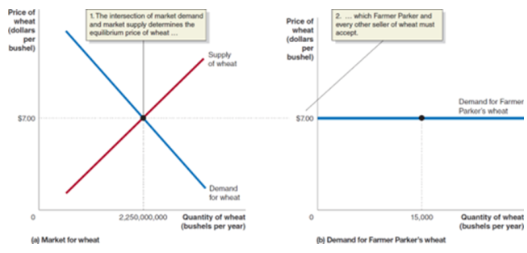
maximizing profit in a perfectly competitive market
profit = total revenue - total costs
in PCM, price = average revenue = marginal revenue
P = TR/Q = change in TR/ change in Q
in PCM, demand curve = marginal revenue curve
average revenue
total revenue divided by the quantity of the product sold TR/Q
marginal revenue
change in total revenue from selling one more unit of a product
deltaTR/deltaQ
rules for profit maximization
the profit-maximizing level of output is where the difference between total revenue and total cost is the greatest
the profit-maximizing level of output is also where marginal revenue = marginal cost
profit is maximized by producing as long as marginal revenue>marginal cost or until MR=MC
the profit-maximizing level of output is also where price = marginal cost
only true for perfectly competitive firms
profit
profit = (price - average total cost) * quantity
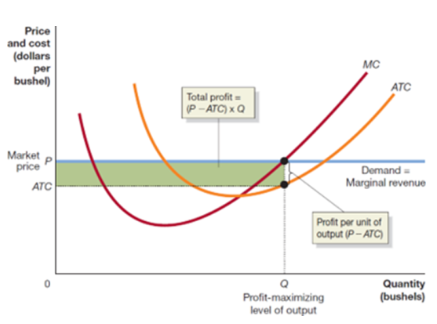
Can the firm make a profit?
at MC = MR, if:
P>ATC, the firm is making a proft
P=ATC, the firm is breaking even
P<ATC, the firm is making a loss
holds true at every level of output
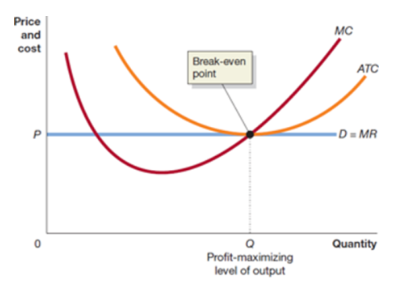
produce or shut down in the short run
if the firm shuts down, it will still need to pay fixed costs, so the firm needs to decide to incur only fixed costs or produce and incur some variable costs but also obtain some revenue
fixed costs should be ignored becuase they are sunk costs, so shut down decision is based on variable costs:
if total revenue < variable costs, firm should shut down
(TR< VC = (P*Q)<VC = P<AVC
if price >/= AVC, then MC=MR rule applies and firm should produce
shutdown point
the minimum point on a firm’s AVC curve. if price falls below this point, the firm shuts down production in the short run
economic profit
a firms’s revenues minus all of its implicit and explicit costs
leads to entry of new firms - supply curve will shift right, decreasing the market price and economic profit
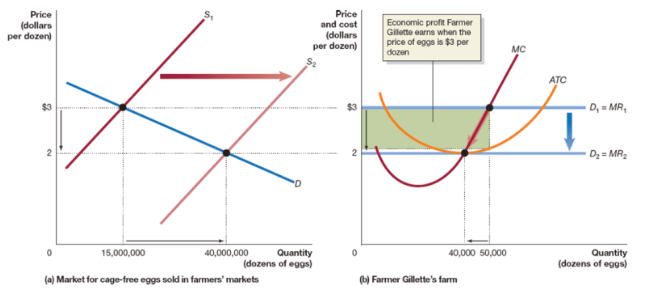
economic loss
firm’s total revenue is less than its total cost, including all implicit costs
causes firms to leave, causing supply curve to shift left, increasing price again
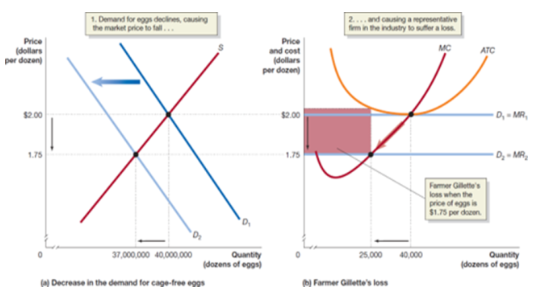
long-run equilibrium in PCM
situation in which the entry and exit of firms has resulted in the typical firm breaking even
in the long run, the market will supply any demand by customers at a price equal to the minimum point on the typical firm’s average cost curve
long-run supply curve is horiztonal at this price
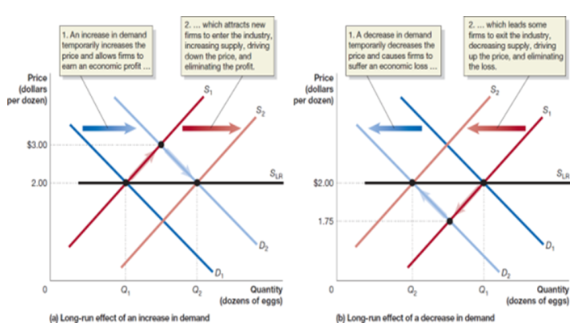
constant cost industries
industries where the production process is infinitely replicable, modeled by the horizontal supply curve
increasing cost industry
cost of inputs rise as industries expand, have an upward-sloping supply curve
decreasing cost industry
costs may fall as industry expands, have downward-sloping supply curve
efficiency in PCM
PCM are productively efficient because goods and services are produced at the lowest possible cost
PCM are allocatively efficient because they produce in line with consumer preferences, to the point where MB=MC
 Note
Note  Flashcards (35)