ECON 3330 ~ Exam 2
 Studied by 0 people
 Call Kai
 Learn
Learn Practice Test
 Spaced Repetition
 Match
Match Flashcards
 Knowt Play
1/81

There's no tags or description
Looks like no tags are added yet.
Name | Mastery | Learn | Test | Matching | Spaced | Call with Kai |
|---|
No analytics yet
Send a link to your students to track their progress
82 Terms
coupon bonds
require coupon payments —> % of the bonds face value
( periodic coupon payments + principal repayment at maturity )
zero-coupon bond yield
promise a single payment on a future date , pays no additional coupon payments
- Ex: Treasury Bill
if coupon rate (%) < interest rate (%)?
bond price < face value
if coupon rate (%) i> interest rate (%)?
bond price > face value?
- you still get a total return that's greater than price!
consol (aka perpetuity)
security that makes annual interest payments forever, principal is never repaid
Consol Price = ?
Annual payment / interest ( i as a decimal )
who is yield to maturity relevant and irrelevant to?
relevant for long term investors and irrelevant for short term investors
current yield = ? —> a percent
(coupon payment / purchase price) x 100
how is yield to maturity different than current yield?
- ytm is used for long term investors bc it calculates total return if bond is held to maturity date (calculates capital gains/losses)
- current yield is used for short term investors and disregards capital gains/losses (return on coupon payments)
holding period return
buying and selling early
- plans change so CY doesn't make sense
Holding Period Return = ?
(Coupon Payment / Purchase Price) + [(Selling Price - Purchase Price) / Purchase Price]
bond ratings
assessing risk of the potential investments (bonds)
Bond Ratings:
Investment Grade
least risky; highest quality borrowers - guaranteed return
- (AAA, AA, A, BBB)
Bond Ratings:
non-investment grade
below BBB
Bond Ratings:
non-investment grade:
speculative
some default risk (missing/late payment) but not immediate concern
- (BB, B)
Bond Ratings:
non-investment grade:
highly speculative
borrowers with clear default risk (missing/late payments)
- (CCC, CC, C, D)
fallen angels
issuers that were once investment grade, but they've been downgraded
rising stars
new issuers w/o a track record of creditworthiness
how does an upgrade affect a bond's price and its yield?
Price rises, Yield falls
how does a downgrade affect a bond's price and its yield?
Price falls, Yield rise
commercial paper
very short term bond, 0% coupon, unsecured —> only most creditworthy issuers can use
- 5 < n < 45 days (average is 30 days)
secured debt
collateral (pay these 1st bc if you don't, they'll take your stuff away)
- house (mortgage), car (car note)
unsecured debt
no collateral (pay these last bc your stuff won't be taken)
- loans, debt
Commercial Paper Ratings:
p-1
90% (of the time commercial paper is P-1)
Commercial Paper Ratings:
p-2
9% (of the time commercial paper is p-2)
Commercial Paper Ratings:
p-3
exist, but cannot be issued (you were p-1 or p-2, but you became a "fallen angel")
municipals
gov't bonds that are tax exempt
after tax yield = ?
taxable yield x (1 - tax rate)
Term Structure of Interest Rates:
How Are Short-Term and Long-Term Yields/Interest Rates Related?:
Short-Term Yields are more volatile (unpredictable/risky)
Long-Term & Short-Term Yields move together
Long term Yields > Short term Yields
expectations hypothesis
says that Bonds with different maturities are perfect substitutes for each other, which can explain the trend of the yields moving together and the trend that short-term yields are more volatile
liquidity premium theory
says that As “n” increases, risk increases, explaining why Long-Term Yields are greater than Short-Term yields. As more time passes, lenders are more uncertain that they will be repaid, so they charge a higher risk premium.
yield curve
relates ytm to time to maturity (N)
what does a normal yield curve show?
- positive (normal) slope
- rates are expected to rise
- lt rates > st term rates
what does a no slope yield curve show?
that for any period of investments they equal
- lt rates = st rates
what does an inverted yield curve show?
- rates expected to fall
- if you're a borrower you might want to wait
- predicts recession within a yr
- st rates > lt rates
- negative slope
what is significant about the inverted yield curve?
the inverted yield curve shows recession
- may be a recession w/o inverted yc, but every time there's an inverted yc there is recession
explain how yield curves might be used as a tool for forecasting recessions?
the different yield curves show how the economy is doing
- normal is good
- 0 slope is questionable
- inverted indicates a recession
stock
share of ownership in a firm
residual claimants
in a liquidation, stockholders are paid last after all other creditors
limited liability
stockholders can lose no more than their initial investment
dow jones industrial average (DJIA)
tracks the performance of the top 30 U.S. firms, Price-weighted index (greater weight to firms with larger share prices), measures the return to owning a typical share of stock
s&p 500 index
value-weighted index ~> firms get more weight if they have larger market capitalization
mirrors changes to economy’s overall wealth and is a good benchmark for investments and investment strategies
Market Capitalization
The value of a firm
total market value of a firm:
market cap equation
share prices x total shares outstanding
what is the difference between the DJIA and the S&P 500?
the S&P 500 relates to the economy
- if S&P 500 is up, the economy is up
DJIA just takes into consideration the share prices
Mutual Funds
Index Mutual Funds: portfolio built to mimic overall market performance
Managed Mutual Funds: portfolio built by an investment manager
Why are Mutual Funds attractive Investments?
Affordability
Liquidity
Diversification
Management (professionals vs. indexes)
Cost (lower index fund fees)
Theory of efficient markets
Price reflects all available information
Implies stock price movements are unpredictable
Impossible to beat the market
What is a “Random Walk”
We don’t know which stocks will increase or decrease in value → no one can beat the market average
% Recovery = ? (increase necessary to recover from a given stock market decline)
[Decline / (100 - Decline)] x 100
what are the 4 categories of mutual funds?
- large cap
- mid cap
- small cap
- international
what is the key difference for ROTH IRA's?
they grow tax free
are stocks risky investments in the short run? In the Long run?
Yes, stocks are volatile in the short run, but stable in the long run
How do stocks compare to bonds in the long run?
stocks are safer and outperform bonds for every 30 yr Time Period
asset bubbles
persistent or expanding gaps between actual asset values and those warranted by fundamentals
what happens to firms inside bubble as asset bubble inflates?
firms inside bubble are linked to the new asset
- find finance easy to obtain
-tend to overinvest in these companies
what happens to firms outside the bubble as asset bubble inflates?
firms outside bubble are not linked to new asset
- firms outside bubble find finance difficult to obtain
-tend to under invest in these companies
what happens when the bubble eventually (and it will eventually) burst?
markets CRASH —> decreased sales, decreased revenue, decreased employment for everyone as households reassess their wealth
asymmetric (imperfect) information
2 parties to a transaction have unequal information
adverse selection
if quality cannot be assessed, then only "bad choices" remain in the market
what's the 1st solution for buyers to find out if it's a peach or lemon?
warranty
- allows buyers to know that they are getting a reliable car
signaling
an action taken by the informed party that reveals important information to an uninformed party
effective signals are _____ , talk is _____
expensive, cheap
whats the 2nd solution to find out if peach or lemon?
screening beforehand (screening afterwards is too late)
Price Discrimination
Charging different rates for different people —> risk must be accounted for in price
moral hazard
occurs when effort cannot be observed so managers can't tell whether bad outcome is intentional or bad luck
sometimes borrower may not act in best interest of lender. What is the solution?
restrictive covenant
- you have to use $ on what you told bank you would use it on
principal agent problem in equity finance
owners (shareholders) (aka principles) hire managers (aka agents) to run firm day to day
- owners are separated from control
- owners goal is to max share price (increase wealth) but managers goal is to not get fired. this creates a problem bc managers take too little risk bc they dont want to get fired
- no risk = no growth
solution to principal agent problem in equity finance
have mgmt invest in company stock
- takes care of moral hazard (now effort can be assessed - if stock value increases, effort has increased) but this doesn’t fix all problems
- Beware of fraud
how are adverse selection and moral hazard problems in financial markets?
when you cannot assess quality (adverse selection) and you cannot assess effort (moral hazard) you create failing situations.
- we need price discrimination (adverse selection) and restrictive covenants (moral hazard)
limited liability/moral hazard problem in debt finance
owners keep all profits in excess of debt payments —> might cause mgmt to take too much risk
solution to limited liability/moral hazard in debt finance
force borrowers into a restrictive covenant
what must you do after implementing your "solutions" to principal agent problem in equity finance and limited liability/moral hazard problem in debt finance?
you must monitor afterwards - you only abide by the rules (restrictive covenant) if you're being monitored
what are some ways you can monitor after implementing your solution?
- check inventories
- membership on board of directors
- stake in ownership
- threat of takeover
financial arbitrage
We try to buy low and sell high
Bond Price = ?
[Coupon Payment / (1 + i)^n] + [Face Value / (1 + i)^n]
Yield to Maturity (i) = ?
[(Coupon Payment + Face Value) / Purchase Price] - 1
Three types of bond risk
Default Risk
Interest Rate Risk
Inflation Risk
Bond Risks —> Default Risk
risk of a missed payment
Bond Risks —> Interest Rate Risk
prices & interest rates are inversely related → interest goes up, bond prices fall = capital loss | interest goes down, bond prices rise = capital gain
Bonds Risks —> Inflation Risk
r = i - π → π goes up, r goes down → Lenders 🙁, Borrowers 🙂
Expectations Hypothesis w/ Interest Rates
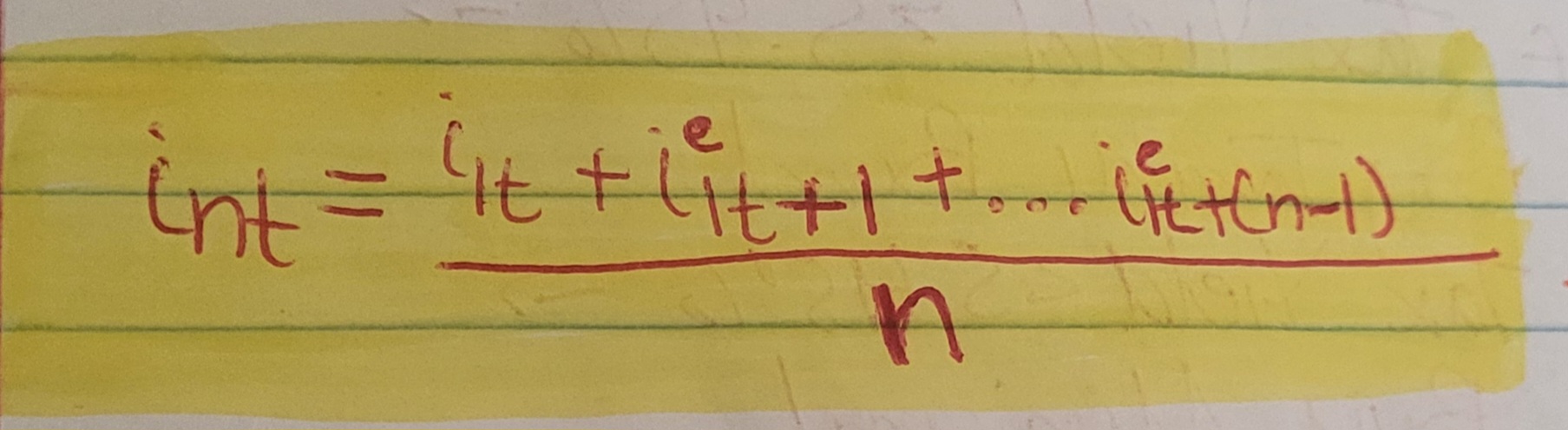
 Note
Note  Flashcards (20)