Ch. 23 Microevolution and Hardy-Weinberg Principles in Population Genetics
 Studied by 0 people
 Call Kai
 Learn
Learn Practice Test
 Spaced Repetition
 Match
Match Flashcards
 Knowt Play
1/34

There's no tags or description
Looks like no tags are added yet.
Name | Mastery | Learn | Test | Matching | Spaced | Call with Kai |
|---|
No analytics yet
Send a link to your students to track their progress
35 Terms
What is microevolution?
The change in allele frequencies in a population over generations.
What are the three mechanisms that cause allele frequency change?
Natural selection, genetic drift, and gene flow.
What is genetic variation?
Differences in genes or other DNA sequences among individuals, necessary for evolution by natural selection.
Who conducted foundational work on genetic inheritance?
Gregor Mendel, through his experiments with pea plants.
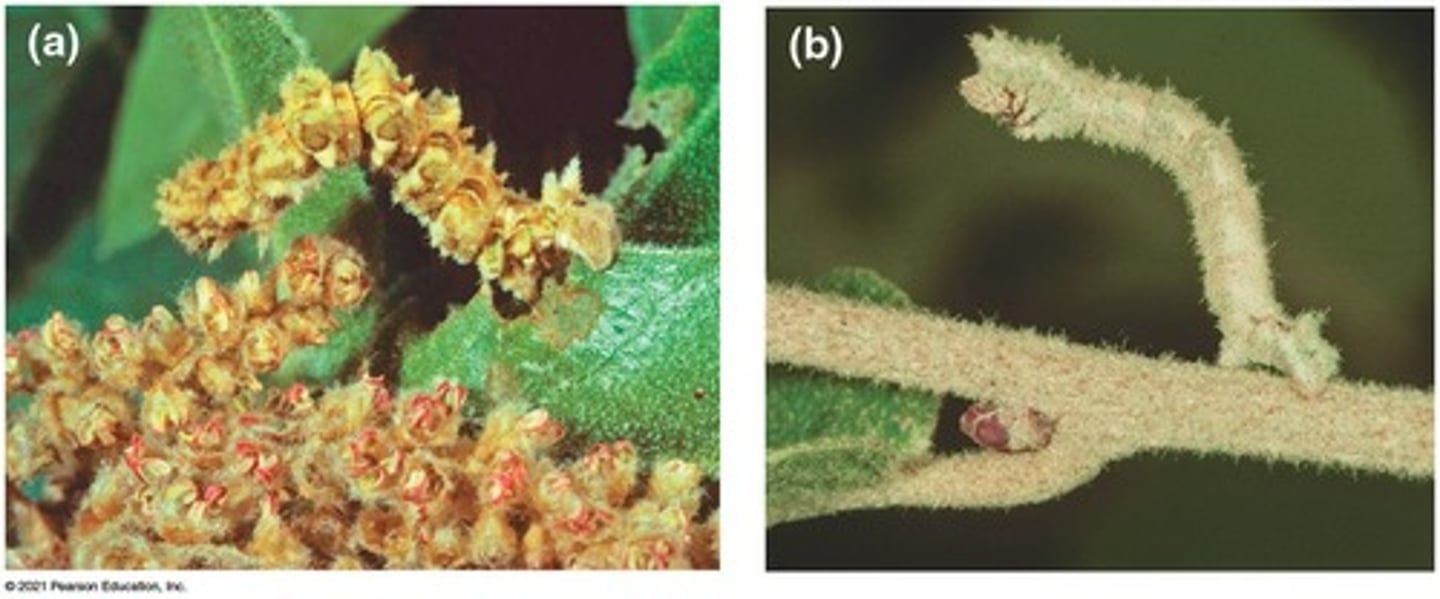
How is phenotypic variation determined?
By the interaction of inherited genotype and environmental influences.
What is the significance of heterozygous loci in a population?
They quantify genetic variation at the gene level.
What is nucleotide variability?
The comparison of nucleotide sequences among individuals, which rarely results in phenotypic variation.
What are mutations?
Changes in the nucleotide sequence of DNA that can create new alleles.
What is the role of sexual reproduction in genetic variation?
It produces genetic variation by recombining existing alleles.
What is the Hardy-Weinberg equation used for?
To test whether a population is evolving by comparing observed genetic makeup to expected frequencies.
What does Hardy-Weinberg equilibrium indicate?
A population that is not evolving, where genotype and allele frequencies remain constant.
What is natural selection?
A process where individuals with traits better suited to the environment produce more offspring.
What is genetic drift?
A process where chance events cause allele frequencies to fluctuate unpredictably from one generation to the next.
What is the founder effect?
When a few individuals become isolated from a larger population, leading to different allele frequencies.
What is the bottleneck effect?
A drastic reduction in population size that alters allele frequencies and reduces genetic variation.
How does gene flow affect populations?
It consists of the movement of alleles among populations, reducing variation over time.
What is adaptive evolution?
A process where traits that enhance survival or reproduction increase in frequency over time.
What is relative fitness?
The contribution an individual makes to the gene pool of the next generation relative to others.
What are the three types of natural selection?
Directional selection, disruptive selection, and stabilizing selection.
What is sexual selection?
A process where individuals with certain heritable traits are more likely to obtain mates.
What is heterozygote advantage?
When heterozygotes have higher fitness than both homozygotes, maintaining multiple alleles at a locus.
Why can't natural selection create perfect organisms?
Because it can only act on existing variations and is limited by historical constraints.
What is the significance of point mutations?
They can cause significant impacts on phenotype, though most are harmful.
What is the role of environmental influences on phenotypic variation?
They can affect the expression of genetic traits, but only genetically determined variation has evolutionary consequences.
What is the impact of rapid reproduction on mutation accumulation?
Short generation times in organisms like prokaryotes and viruses allow mutations to accumulate quickly.
What is the importance of the genetic code redundancy?
It allows for neutral variation in point mutations, as many mutations do not affect the amino acid sequence.
How does gene duplication contribute to evolution?
It can create new genetic material that may acquire new functions over generations.
What is the relationship between mutation rates and population size?
Smaller populations are more affected by genetic drift, while larger populations may have more stable allele frequencies.
What is the significance of the 'good genes' hypothesis in sexual selection?
It suggests females select mates based on traits that indicate genetic quality or health.
How does natural selection differ from genetic drift and gene flow?
Natural selection consistently increases the frequency of beneficial alleles, while the other two can randomly alter allele frequencies.
What is the role of crossing over in genetic variation?
It allows for the exchange of genetic material between homologous chromosomes during meiosis.
What does the term 'gene pool' refer to?
The total collection of alleles in a population at a given time.
What happens to allele frequencies in populations under nonrandom mating?
Genotype frequencies may be affected, but allele frequencies remain unchanged.
What is the significance of the Hardy-Weinberg principle in population genetics?
It provides a baseline to measure evolutionary change in populations.
How can environmental changes impact adaptive evolution?
Changes in the environment can alter which traits are advantageous, leading to shifts in allele frequencies.
 Note
Note  Flashcards (40)