Lecture 10 - Prejudice
 Studied by 0 people
 Call Kai
 Learn
Learn Practice Test
 Spaced Repetition
 Match
Match Flashcards
 Knowt Play
1/54

There's no tags or description
Looks like no tags are added yet.
Name | Mastery | Learn | Test | Matching | Spaced | Call with Kai |
|---|
No analytics yet
Send a link to your students to track their progress
55 Terms
Define prejudice.
A negative pre-judgment of a group and its individual members.
Define stereotype.
A belief about the personal attributes of a group of people (can be positive or negative).
What is bad about stereotypes?
It confines people into defined boxes as it attributes specific characteristics to people just because of their membership to a group.
Define discrimination.
Unjustifiable negative behaviour toward a group or its members (ie. racism, sexism).
Can prejudice be expressed explicitly and implicitly?
Yes.
How is subtle prejudice shown?
It is shown through implicit bias and micro-aggressions.
Where are automatic prejudices from?
They are derived from unconscious associations.
What is a study that showed automatic prejudices?
When both black and white participants were asked to react and shoot the people in the picture they were seeing, depending on if they were holding a gun or harmless object, race influenced people’s perceptions and reactions.
Both the black and white participants were more likely to shoot harmless black people compared to harmless white people.
Define gender stereotypes.
Beliefs regarding how men/women behave.
What are the 2 types of sexism?
benevolent
hostile
What is benevolent sexism?
Attitudes that seem positive but actually reinforce gender stereotypes and inequality by pinning women as weak and in need of protection.
What is hostile sexism?
A form of sexism that involves overt hostility towards women, viewing them as inferior and a threat to male power.
What are the 3 sources of prejudice?
Social sources
socialisation
social inequality
Motivational sources
frustration and aggression
social identity theory
Cognitive sources
categorisation
distinctiveness
How do social inequalities influence our prejudices?
Social inequalities, like differences in status, can breed prejudice because of the social dominance orientation—which is the motivation to have one’s group be dominant over other social groups.
Therefore, when there are discrepancies in people’s status, the social dominance orientation suggests that people will perpetuate the differences because it fuels their groups’ dominance.
What can influence our prejudices under socialisation?
authoritarian personality
ethnocentrism
religion
conformity
institutional supports
Define authoritarian personality. How does it impact our prejudices?
A personality that is disposed to favour obedience to authority and have an intolerance to out-groups and those of lower status.
When people are socialised to have an authoritarian personality, prejudice can arise because it disposes them to favour certain groups over others.
Define ethnocentrism. How does it impact our prejudices?
The belief in superiority of one’s own ethnic and cultural group, and looking down on other groups.
This belief in one’s cultural superiority can cause prejudice because people may begin to treat others in different cultures as inferior.
How does religion affect our prejudices?
Sometimes religion is used as a means to support injustice. Therefore, perpetuating prejudices sometimes.
How does conformity affect our prejudices?
It can be hard not to conform to a certain way of thinking when everyone in the community thinks like that. Hence, perpetuating prejudices sometimes.
How do institutional supports affect our prejudices?
Institutionalised segregation (ie. systematic racism) can influence further prejudices.
What are the 2 ways frustration and aggression influence our prejudices?
Displaced aggression
Realistic group conflict theory
Explain how displaced aggression can influence our prejudices.
Prejudice towards others can arise due to displaced aggression.
ie. Boss told you to re-do your report. As a result you displace aggression which happens to be someone who is a part of a minority.
Define realistic group conflict theory.
When prejudice arises from competition between groups for scarce resources.
Explain a study about realistic group conflict theory.
Boys were put into a camp full of mixed races and during the week they did a lot of different team-bonding games.
However, on the other side of the camp there were a bunch of other boys who were doing the same thing.
At the end of the week, the boys met each other and competed in different games. However, only one team could get first place—thus, the boys were competing over scarce resources.
This resulted in prejudice being generated.
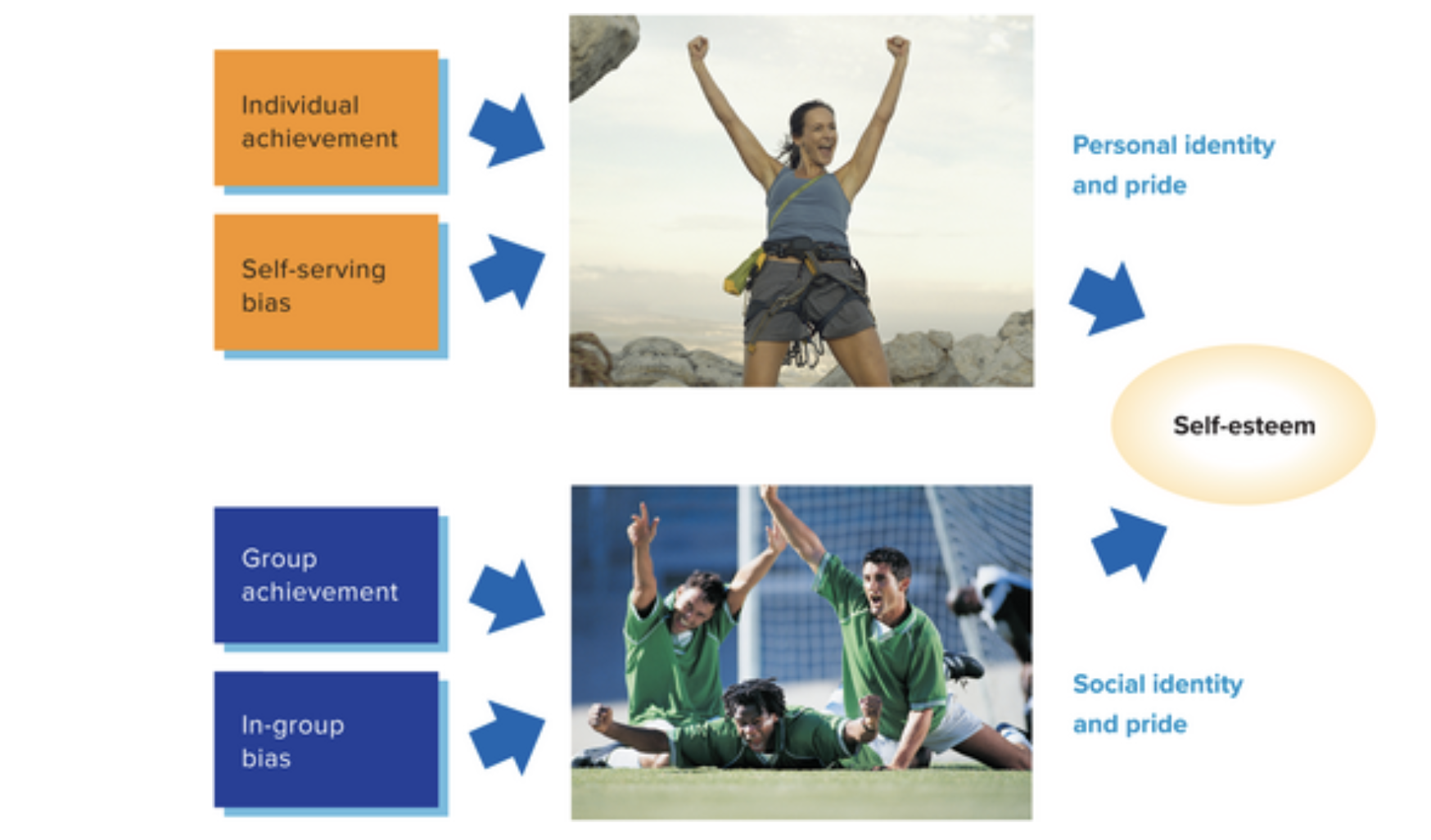
Define social identity theory.
When who we are becomes a mix of our group memberships and our personal identity. Therefore, being the “we” aspect of our self-concept.
How does social identity theory affect our prejudices?
When we begin to combine the people in our in-group and ourselves as a ‘we,’ the boundary between self and group blurs.
Therefore, we begin to separate ourselves and the members of our in-group, with the people in out-groups.
This exaggerates the differences between the groups and fuels further prejudices.
Define in-group bias.
The tendency to favour one’s own group (even if the groups are completely arbitrary—ie. all wearing a blue shirt).
When is in-group bias heightened? Why?
When the group is small and lower in status relative to the out-group.
This is because it makes the in-group rally together and get closer.
How does in-group liking affect how we see other’s in out-groups?
In-group liking usually leads to out-group disliking due to us infrahumanising out-group members.
Therefore, making it easier to be prejudiced against out-group members.
Define infrahumanisation.
The idea that an individual's in-group is perceived as fully human, while out-groups are seen as less human and more animal-like.
Why is it difficult to overcome the ‘habit’ of being prejudiced?
Acting without prejudice can have internal and external rewards.
If there are explicit rewards, then people are not likely to reduce their prejudice because they feel like they are doing it just for the reward. Hence, people need to be intrinsically motivated in order to reduce prejudice and modify their thoughts.
When are we most susceptible to prejudice?
During spontaneous categorisation, which is when we rely on our stereotypes when we are tight on time, preoccupied, tired, and emotionally aroused (can’t think straight).
Define out-group homogeneity effect?
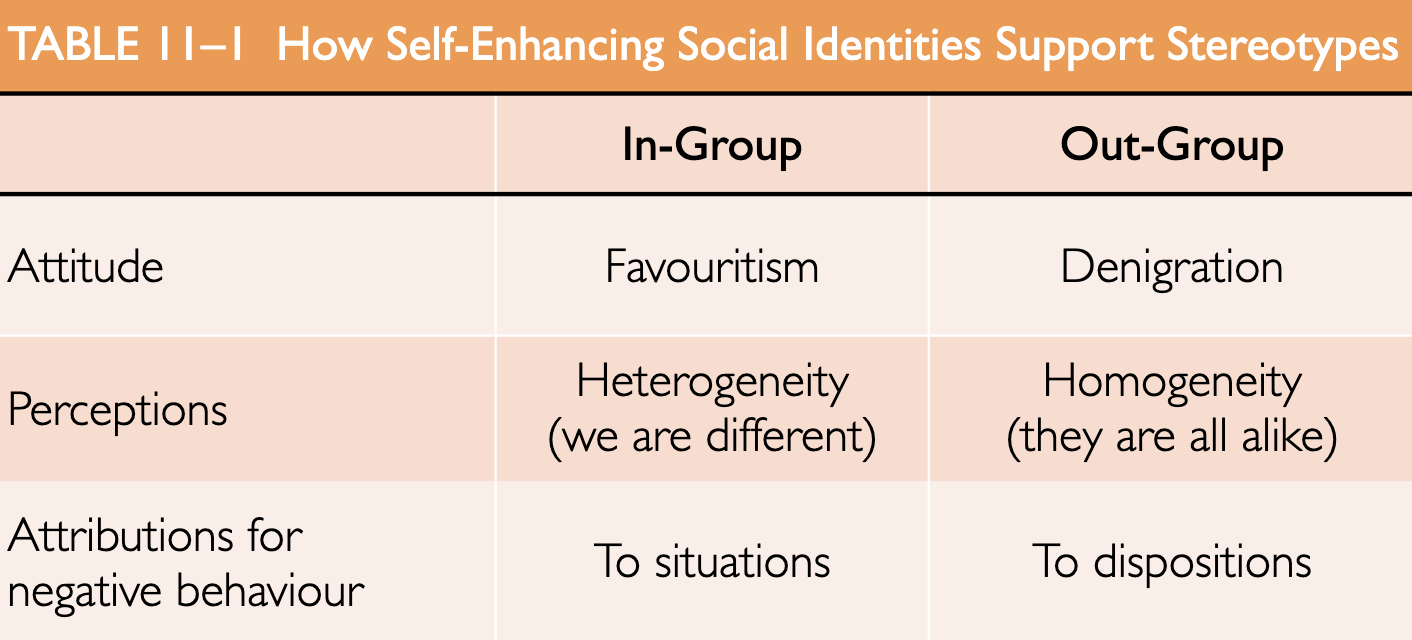
The perception of out-group members as more similar to one another than in group members. Thus, “they are alike; we are diverse.”
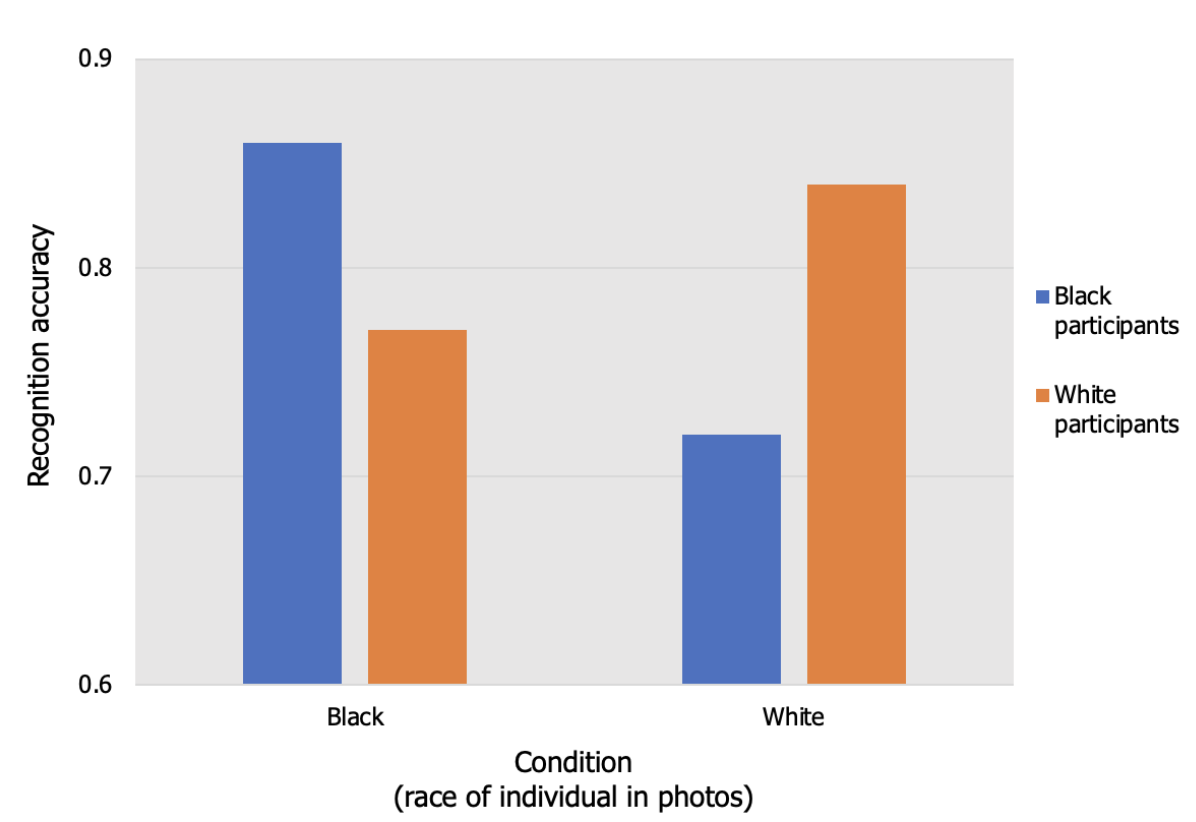
Define own-race bias.
The tendency for people to more accurately recognise faces of their own race.
Explain a study where own-race bias was illustrated.
In a study, black and white participants were asked to identify the race of people in photos. It was found that Black people could recognise other Black people easier than white people, and vice versa.
How does distinctiveness influence prejudice?
When people are distinctive it captures our attention and makes us think that they differ from others more than they really do. Therefore, distorting our perceptions/judgments of the person which can lead to prejudice.
Why does distinctiveness feed self-consciousness?
When people feel distinct it can make us feel like others are paying more attention to us than they really are. Therefore, making us more sensitive to how we are being perceived.
Explain a study about distinctiveness affecting our self-consciousness.
Kleck and Strenta (1980)
A woman was brought into a lab and the experimenters told her that they were going to draw a scar on her face in order to see how other’s would treat her as a result.
However, the experimenters removed the scar without telling the woman. Therefore, she began talking to people and feeling very self-conscious of the scar that was not there.
Her self-consciousness made her come off as more stand-off ish during her interactions with people. As a result, the woman reported that people treated her differently because of the scar.
However, clearly it was not from the scar, but her fear of being distinctive that affected her self-consciousness, and in turn affected her behaviour towards others, which affected how others perceived her.
How do vivid cases affect our prejudices?
If we have limited experience with other people, we may use shortcuts by referring to vivid cases as an experience.
This can lead to prejudices as these vivid cases are not necessarily accurate representations of the person.
How does distinctiveness foster illusory correlations?
Sometimes our attentiveness to unusual occurrences (distinctive things) creates illusory correlations.
Because we are sensitive to distinctive events, the co-occurrence of two such events is especially noticeable—more noticeable than each of the times the unusual events do not occur together.
Therefore, making us think that there is a correlation when there really is not.
Define group-serving bias.
When people dismiss out-group members’ positive behaviours and attribute negative behaviours to their dispositions (while excusing such behaviour by one’s own group).
Define just-world phenomenon.
People’s tendency to believe that the world is just and that, therefore, people get what they deserve and deserve what they get.
Explain the differences in peoples attitudes, perceptions and attributions to negative behaviour for people in in-groups or out-groups.
What can perpetuate prejudices?
self-perpetuating prejudgments
stereotype threat
biasing judgments of individuals
How do self-perpetuating prejudgments affect our prejudices?
If people have negative prejudgments about others, it can make people more sensitive to the bad behaviour people display.
Therefore, perpetuating further prejudices when people notice the bad behaviour.
Define subtype.
When you put people who deviate from your expectations into a different class of people.
Why do we subtype people?
We subtype people in order to maintain our stereotypes.
What’s the difference between sub-typing in low prejudiced people and high prejudiced people?
Low prejudiced people subtype negative out-group members. Meaning, they attribute negative behaviours as the special case, rather than a representation of the group. Hence, generally seeing out-groups members positively.
However, high prejudiced people subtype positive out-group members. Meaning, they attribute positive behaviours of out-groups members as special cases, rather than a representation of the group. Therefore, they generally see out-group members negatively.
How does the self-fulfilling prophecy affect our prejudices?
People might have certain expectations of how others will behave (perhaps through the lingering impacts of systematic discrimination and victimisation), which can impact how people view and treat others.
As a result, people might treat others in a way that makes them fulfill their expectations (self-fulfilling prophecy), which can further perpetuate their prejudices.
What can happen as a result of the self-fulfilling prophecy occuring?
People may begin to blame themselves for their behaviour or blame external influences.
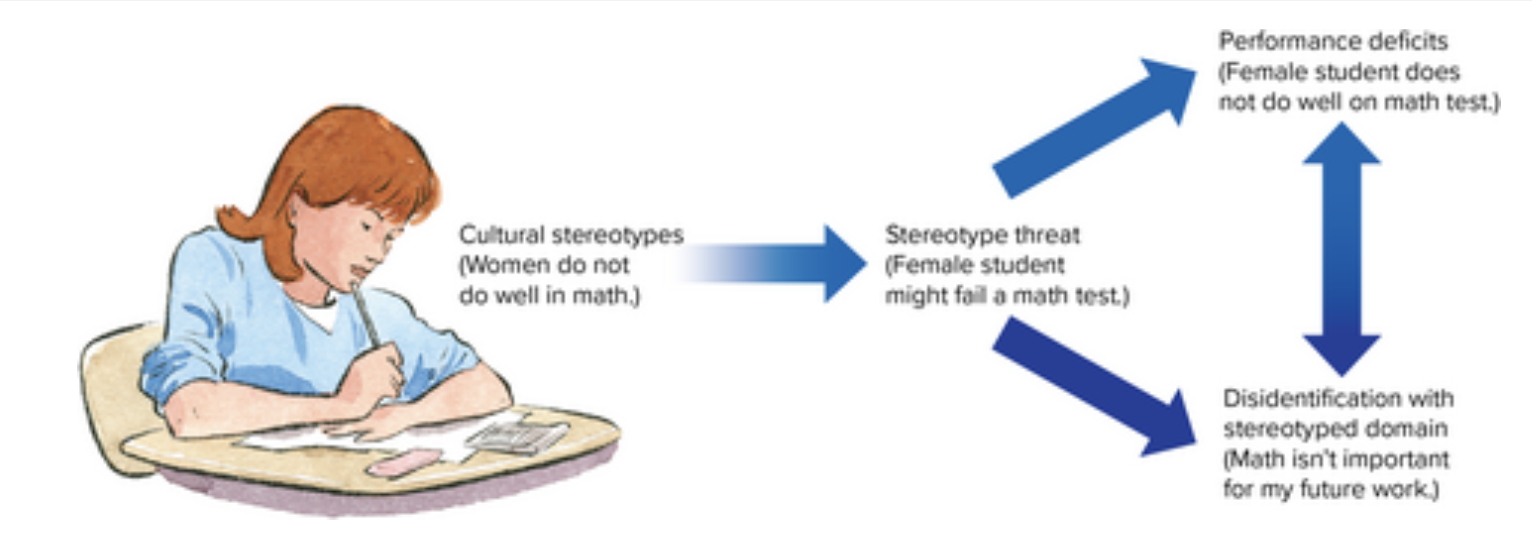
Define stereotype threat. How does it affect our prejudices?
Stereotype threat is the concern that one will be evaluated based on a negative stereotype.
Because of this concern, people may actually start to fulfill that concern by accident and further perpetuate peoples’ stereotypes.
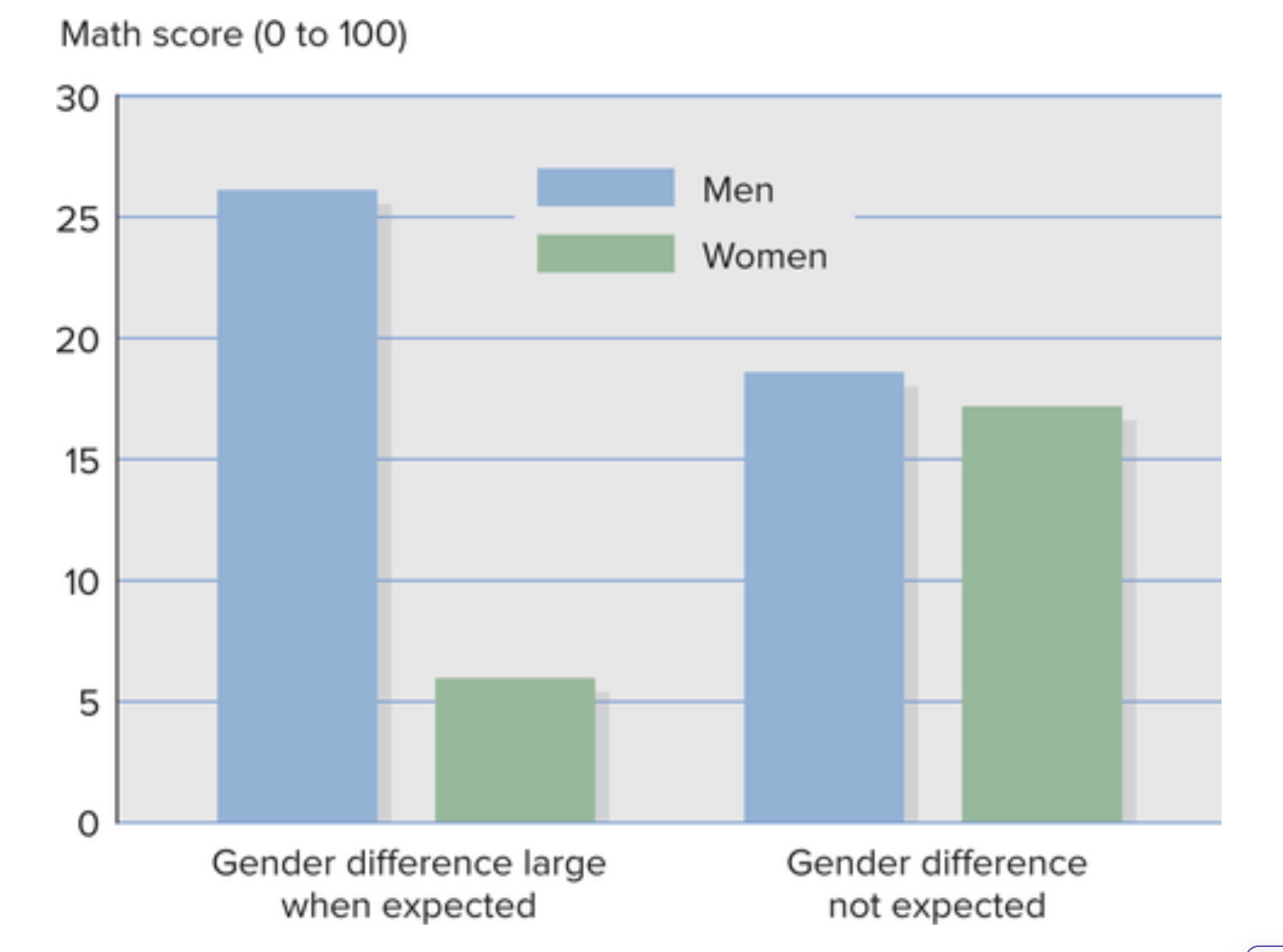
Explain a study stereotype threat and its affect on people’s prejudices.
Spencer et al. (1999)
Male and female participants with similar math backgrounds were given a very difficult math test to complete. There were 2 conditions:
the participants were told that there were no gender differences in test scores
the participants were told that there were gender differences in test scores
When there were no gender differences in test scores, the women’s performance consistently equalled the men’s. However, when told that there were gender differences, the women dramatically confirmed the stereotype.
This is because, when females got frustrated by the difficult questions in the test, the stereotype threat made them worry, which undermined their performance.
What are the impacts of stereotype threat?
When people are faced with stereotype threat, they may fulfill it, due to the added pressure of not fulfilling it hindering their performance.
However, they may also just dissociate from the stereotyped domain in order to avoid the impact of failing and maintain their self-esteem.
Therefore, stereotype threat can lead to stress, self-monitoring and the suppression of unwanted thoughts and emotions.
Define biasing judgements.
Strong stereotypes that affect our judgements of individuals.
How do biasing judgements affect our prejudices?
If we have a biased judgement about people, if someone goes against our stereotypes, it will leave a greater impact on us.
ie. mom’s usually bring their kids to the park. But if people suddenly see a dad bring their kid to the park, they start to praise him a lot for doing so, even though it’s not that big of a deal since mom’s do that all the time.
 Note
Note  Flashcards (40)