Unit 3 - Thorax

0.0(0)
Studied by 0 people
call kaiCall Kai
learnLearn
examPractice Test
spaced repetitionSpaced Repetition
heart puzzleMatch
flashcardsFlashcards
GameKnowt Play
Card Sorting

1/31

encourage image

There's no tags or description

Looks like no tags are added yet.

Last updated 3:25 AM on 3/21/26
Name
Mastery
Learn
Test
Matching
Spaced
Call with Kai

No analytics yet

Send a link to your students to track their progress

32 Terms

1
New cards

Thorax

  • From base of neck (thoracic inlet) to diaphragm muscle

  • Protects heart and lungs

  • Site for attachment of muscles for:

    • Upper limb

    • Back

    • Respiration

2
New cards

Abdomen

  • From diaphragm muscle to pelvic inlet

  • Contains major viscera of digestive system

  • No bony structure; musculature holds viscera in place
3
New cards
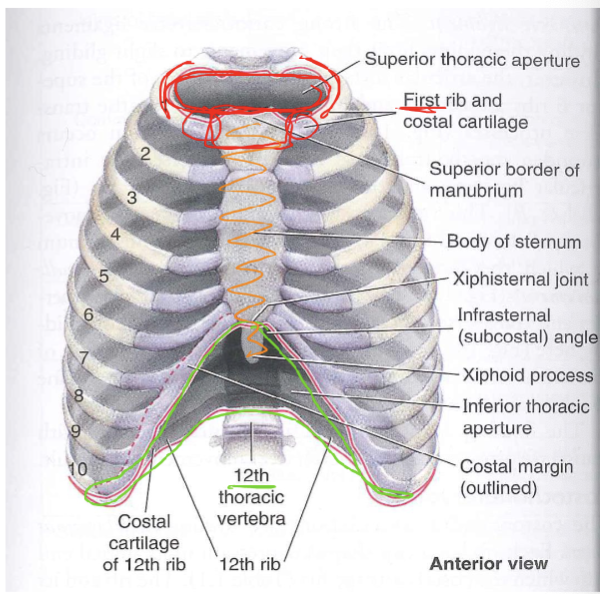
<p><span>Describe the borders of the thorax</span></p>

Describe the borders of the thorax

Superior border: thoracic inlet or superior thoracic
aperture

  • kidney-shaped opening formed by T1
    vertebra, 1st pair ribs & sup. margin of
    manubrium

  • includes:
    • apex of lungs
    • common carotid artery
    • internal jugular vein
    • subclavian artery & vein
    • esophagus & trachea
    • brachial plexus
    • (clavicles close, but not part of it)

Inferior boarder: wide opening formed by T12
vertebra, 12th pair ribs, & costal arch

Anterior boarder: sternum, ribs & costal cartilages

Posterior boarder: thoracic vertebrae & ribs
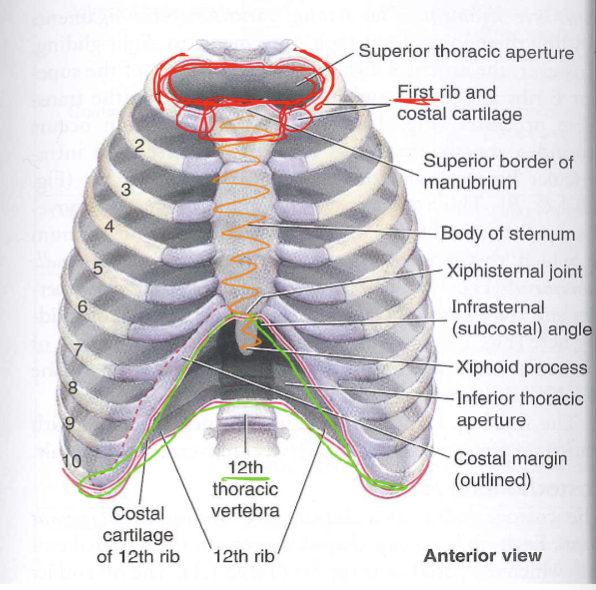
<p><span><strong>Superior border: </strong>thoracic inlet or superior thoracic<br>aperture</span></p><ul><li><p><span>kidney-shaped opening formed by T1<br>vertebra, 1st pair ribs &amp; sup. margin of<br>manubrium</span></p></li><li><p><span>includes:<br>• apex of lungs<br>• common carotid artery<br>• internal jugular vein<br>• subclavian artery &amp; vein<br>• esophagus &amp; trachea<br>• brachial plexus<br>• (clavicles close, but not part of it)</span></p></li></ul><p></p><p><span><strong>Inferior boarder:</strong> wide opening formed by T12<br>vertebra, 12th pair ribs, &amp; costal arch<br></span></p><p><span><strong>Anterior boarder:</strong> sternum, ribs &amp; costal cartilages<br></span></p><p><span><strong>Posterior boarder:</strong> thoracic vertebrae &amp; ribs<br></span></p><p></p>
4
New cards
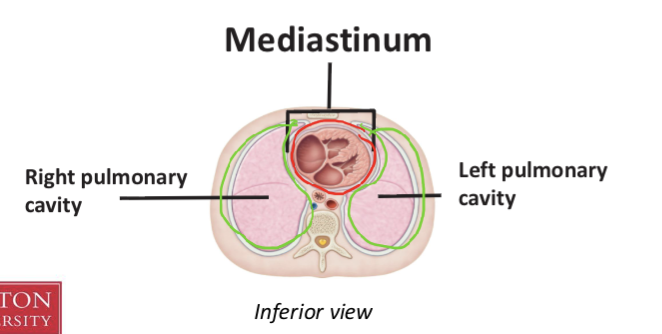
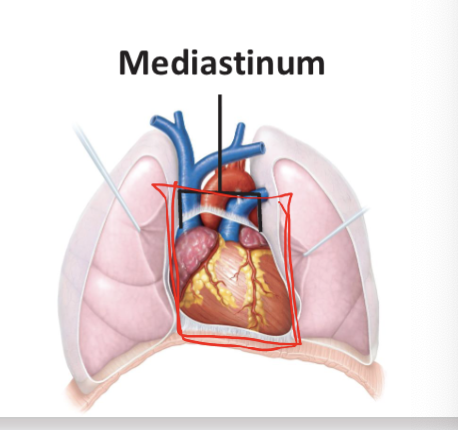
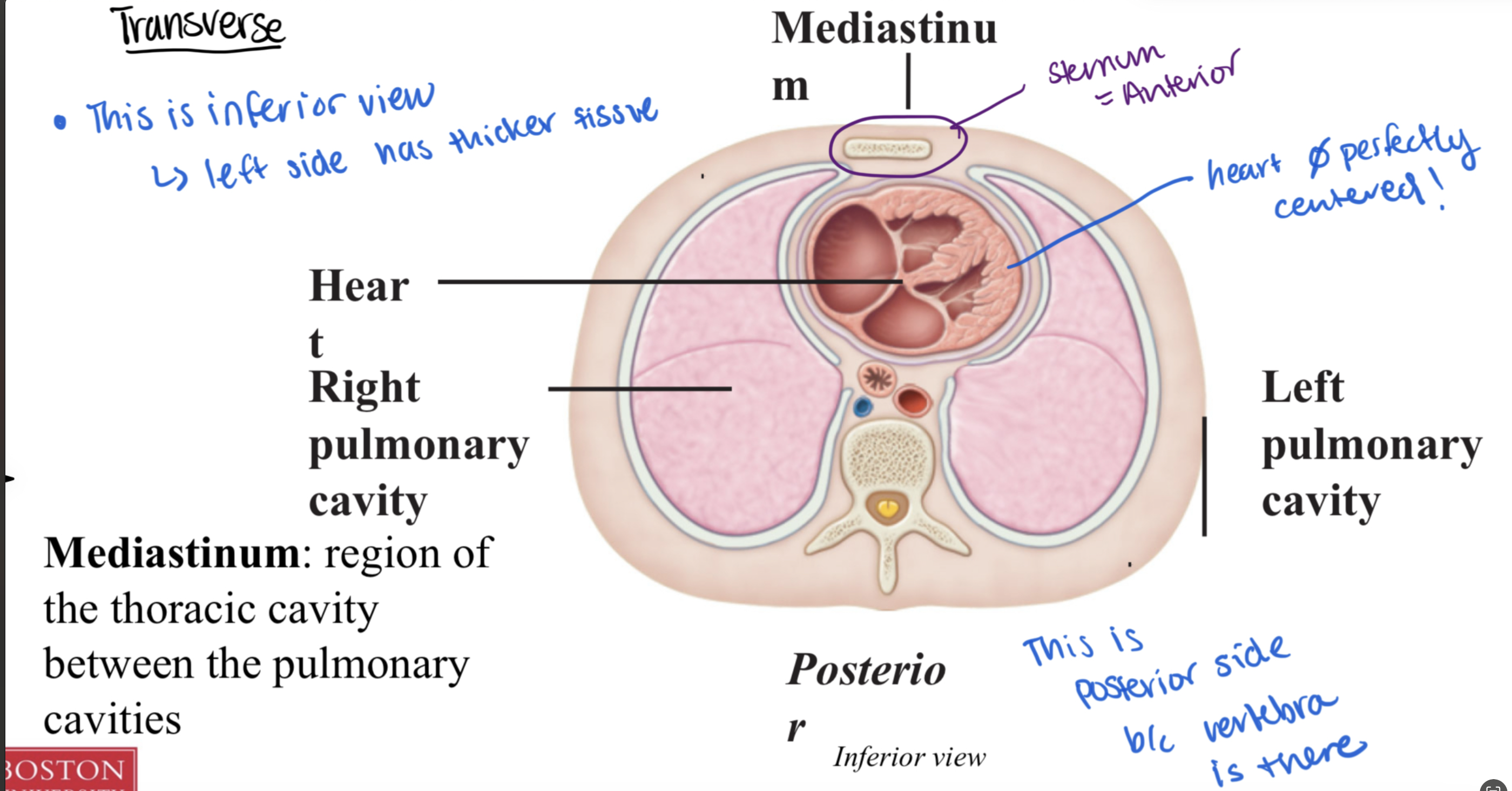
<p><span>Define and describe the borders of the three thoracic spaces</span></p>

Define and describe the borders of the three thoracic spaces

mediastinum and two pleural cavities

Mediastinum:

  • in center and for the heart

  • region of the thoracic cavity between the pulmonary
    cavities

Left and Right pleural cavities:

  • envelope the lungs

<p><strong>mediastinum</strong> and <strong>two pleural cavities</strong></p><p></p><p><strong>Mediastinum:</strong></p><ul><li><p>in center and for the heart </p></li><li><p><span>region of the thoracic cavity between the pulmonary</span><br><span>cavities</span></p></li></ul><p></p><p><strong>Left and Right pleural cavities:</strong></p><ul><li><p>envelope the lungs </p></li></ul><p></p><p></p><p></p>
5
New cards
<p>explain this image</p>

explain this image

6
New cards

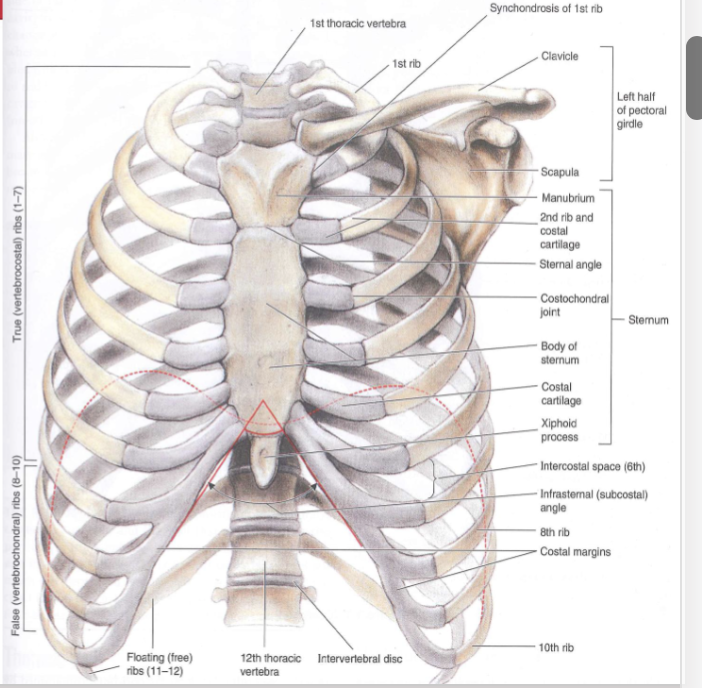
Thoracic Osteology (part 1)

12 thoracic vertebrae


Sternum

  • ManubriumBody
    • Xiphoid process
    • Jugular notch
    • Sternal angle
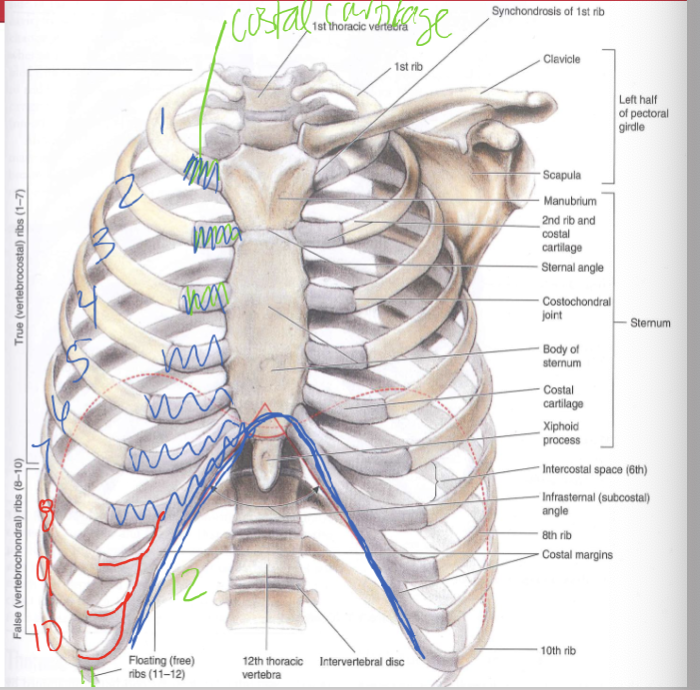
<p><span><strong>12 thoracic vertebrae</strong></span></p><p><span><br>• <strong>Sternum</strong></span></p><ul><li><p><span>ManubriumBody<br>• Xiphoid process<br>• Jugular notch<br>• Sternal angle</span></p></li></ul><p></p>
7
New cards
<p><span style="background-color: transparent;">Compare and contrast true ribs, false ribs and floating ribs</span></p>

Compare and contrast true ribs, false ribs and floating ribs

12 ribs & their costal cartilages

  • True ribs (vertebral costal) attach to the
    sternum —→ ribs 1-7

  • False ribs (vertebral chondral) attach to the
    cartilage ——→ ribs 8-10

  • Floating ribs (free) no anterior attachment ——→ ribs 11-12
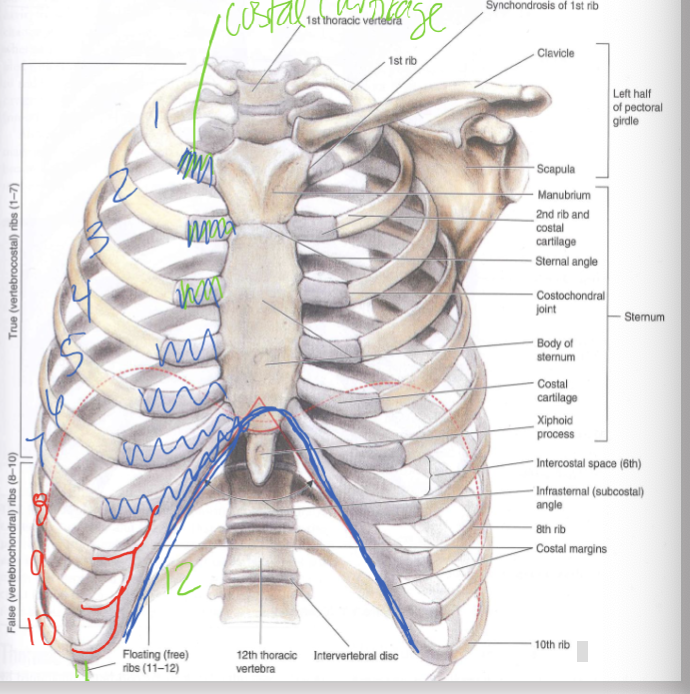
<p><span><strong>12 ribs &amp; their costal cartilages</strong></span></p><ul><li><p><span><strong><mark data-color="blue" style="background-color: blue; color: inherit;">True ribs</mark></strong><mark data-color="blue" style="background-color: blue; color: inherit;"> </mark>(vertebral costal) attach to the<br>sternum —→ <strong>ribs 1-7</strong></span></p></li></ul><p></p><ul><li><p><span><strong><mark data-color="red" style="background-color: red; color: inherit;">False ribs</mark></strong><mark data-color="red" style="background-color: red; color: inherit;"> </mark>(vertebral chondral) attach to the<br>cartilage    ——→<strong> ribs 8-10</strong></span></p></li></ul><p></p><p></p><ul><li><p><span><strong><mark data-color="green" style="background-color: green; color: inherit;">Floating ribs</mark></strong><mark data-color="green" style="background-color: green; color: inherit;"> </mark>(free) no anterior attachment    </span> ——→<strong> ribs 11-12</strong></p></li></ul><p></p><p></p>
8
New cards
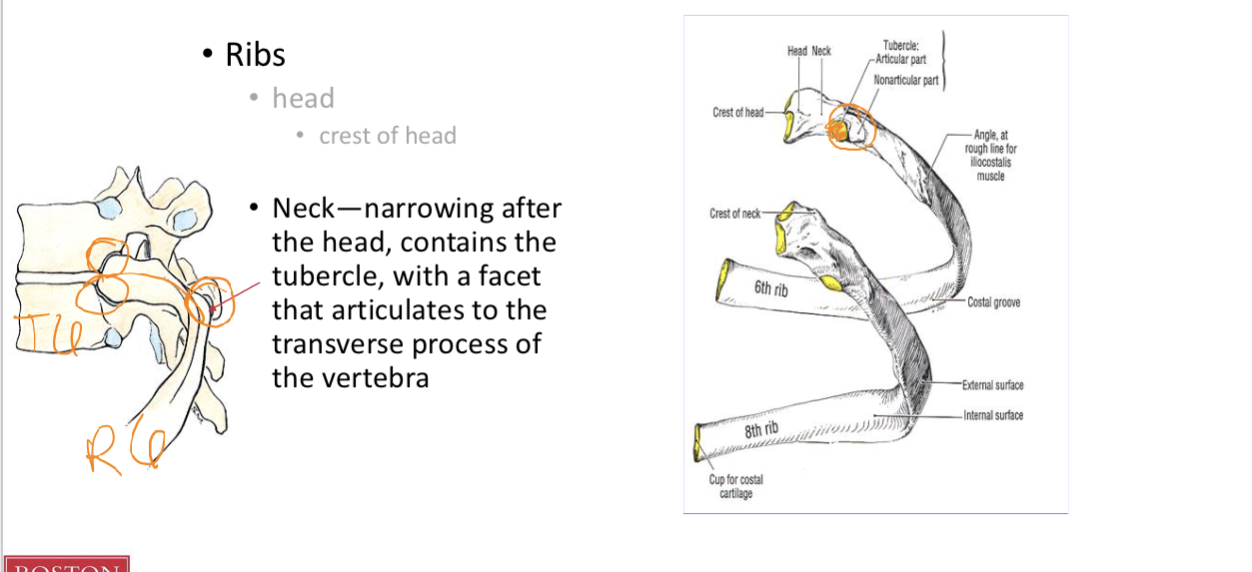
<p><span style="background-color: transparent;">Identify the bony features of an individual rib   <strong>(Neck and Head)</strong></span></p>

Identify the bony features of an individual rib (Neck and Head)


Head

  • has two facets separated by the crest of head

  • has 2 facets - 1 that articulates with T7 and another that articulates with T8

  • is posterior and medial b/c it articulates w/ verterbra

Neck

  • narrowing after the head, contains the tubercle, with a facet
    that articulates to the transverse process of the vertebra

R6 articulates w/ T5
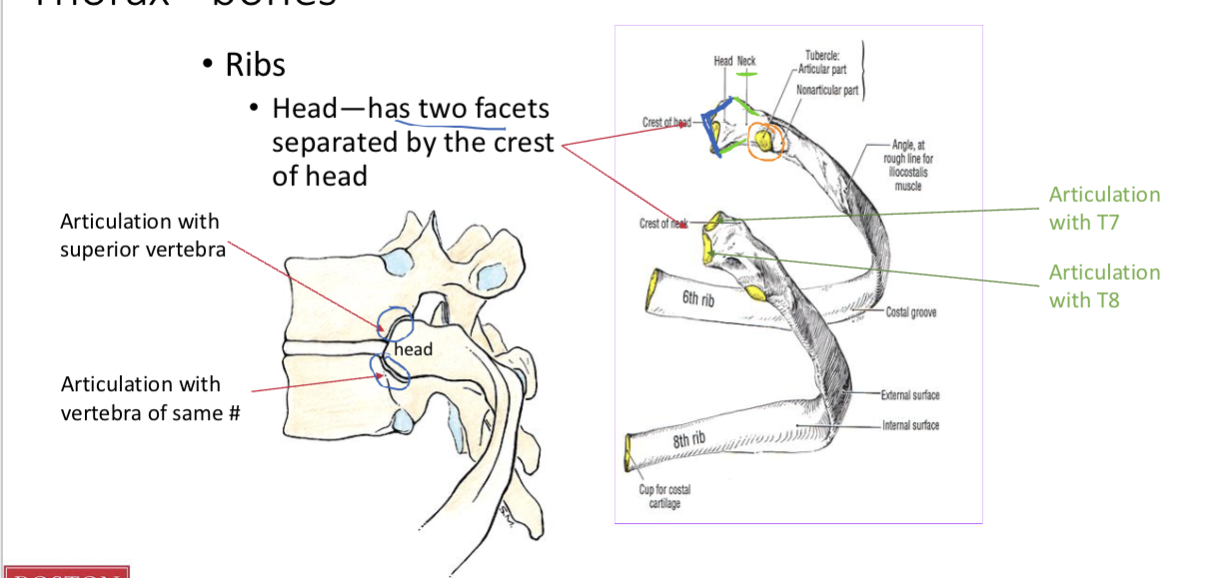
<p><br>Head</p><ul><li><p>has two facets separated by the crest of head</p></li><li><p>has 2 facets - 1 that articulates with T7 and another that articulates with T8</p></li><li><p>is <strong>posterior </strong>and <strong>medial </strong>b/c it articulates w/ verterbra</p></li></ul><p></p><p></p><p>Neck</p><ul><li><p>narrowing after the head, contains the tubercle, with a facet<br>that articulates to the transverse process of the vertebra<br></p></li></ul><p>R6 articulates w/ T5</p><p></p><p></p><p></p><p></p>
9
New cards
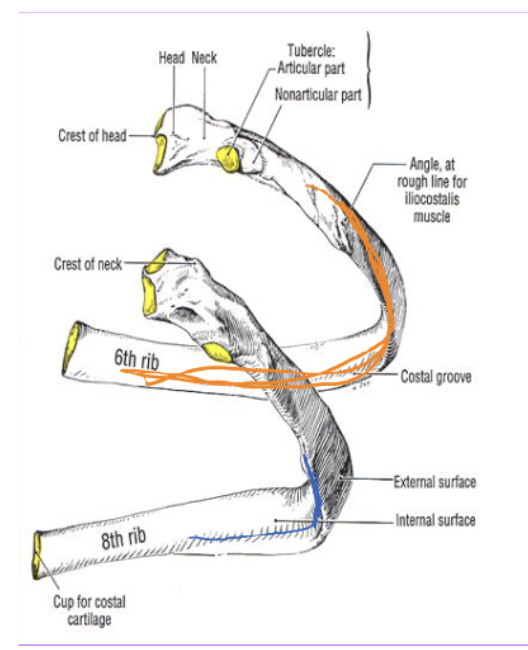
<p><span style="background-color: transparent;">Identify the bony features of an individual rib   <strong>(Body)</strong></span></p>

Identify the bony features of an individual rib (Body)

Body

  • is the rest of the rib

  • Has the costal angle, which is a the sharpest curve (site of attachment for
    iliocostalis) and is lateral to rib’s tubercle

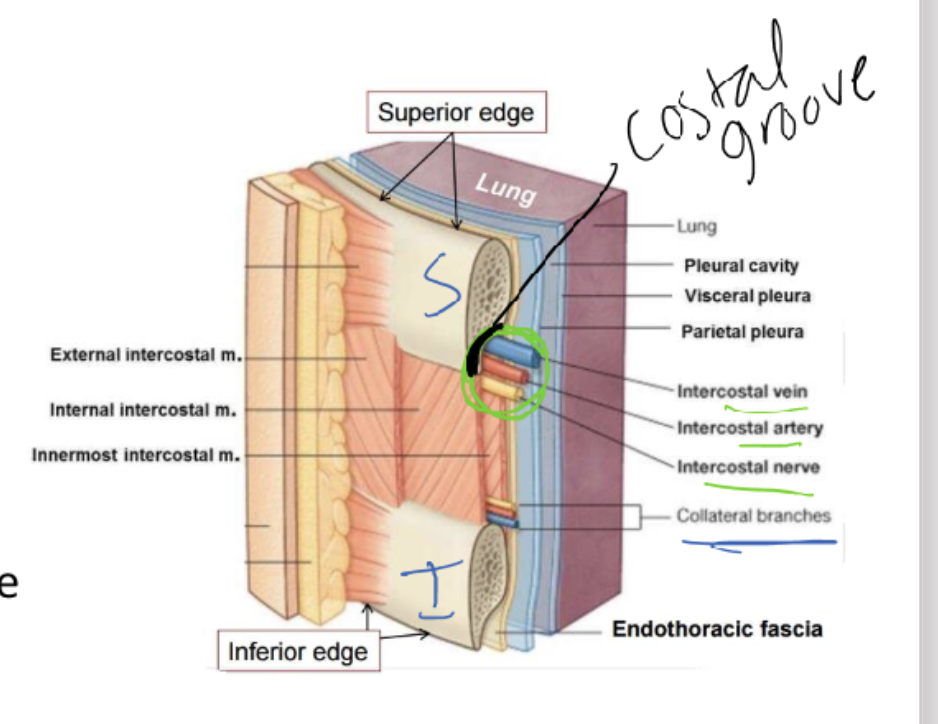
  • has the costal groove, is an indentation on costal angle where the spinal nerve and vessels passes
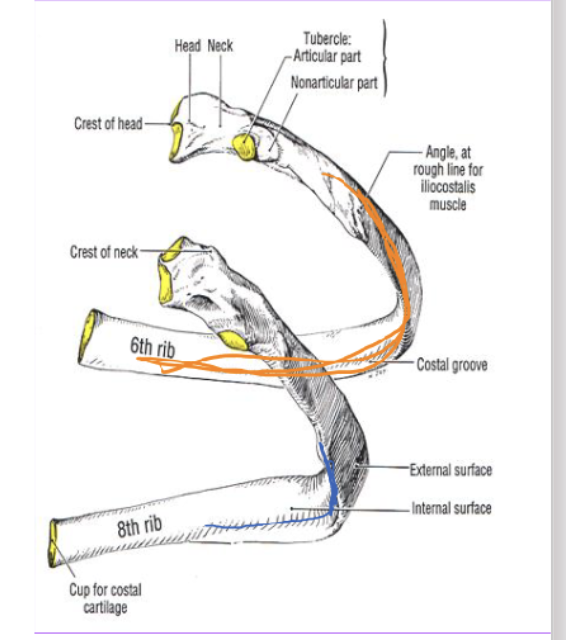
<p>Body</p><ul><li><p>is the rest of the rib</p></li><li><p>Has the <strong>costal angle</strong>, which is a the sharpest curve (site of attachment for<br>iliocostalis) and is lateral to rib’s tubercle </p></li><li><p>has the<strong> costal groove</strong>, is an indentation on costal angle where the spinal nerve and vessels passes<br></p></li></ul><p></p>
10
New cards
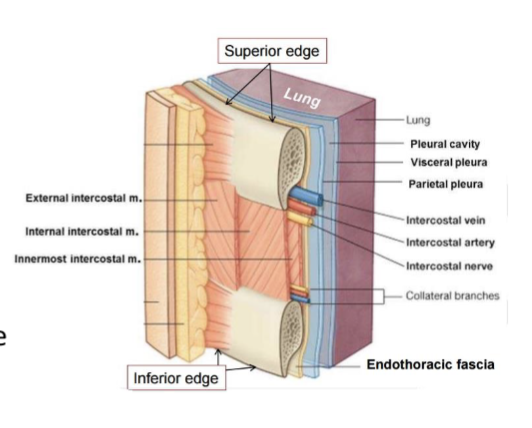
<p><span style="background-color: transparent;">Identify the individual components of the intercostal spaces and understand their positions relative to each other</span></p>

Identify the individual components of the intercostal spaces and understand their positions relative to each other

  • Between the ribs are intercostal spaces
    named for the superior rib

  • Inside are 2 nerves and sets of blood vessels:

    • Main intercostal nerve, artery and vein are found in the
      costal groove of the superior rib

    • Collateral branches are found just above the inferior rib

  • Space below the 12th rib is the subcostal space

Costal groove is on inferior aspect of rib, which gives notch space for vein, artery, and nerve
<ul><li><p><span>Between the ribs are intercostal spaces<br>named for the superior rib</span></p></li><li><p><span> Inside are 2 nerves and sets of blood vessels:</span></p><ul><li><p><span><strong>Main intercostal nerve</strong>, <strong>artery </strong>and <strong>vein</strong> are found in the<br>costal groove of the superior rib</span></p></li><li><p><span><strong>Collateral branches</strong> are found just above the inferior rib</span></p></li></ul><p></p></li><li><p><span>Space below the 12th rib is the subcostal space</span></p></li></ul><p></p><p><strong><mark data-color="#NaNNaNNaN" style="color: inherit;">Costal groove is on inferior aspect of rib, which gives notch space for vein, artery, and nerve</mark></strong></p><p></p>
11
New cards

Thoracic muscles & fascia

Thoracic wall is covered by muscles that belong to upper limb or move vertebral
column: (
People Study To Learn Efficiently)

  • Pectoral muscles

  • Serratus anterior

  • Trapezius

  • Latissimus dorsi

  • Erector spinae


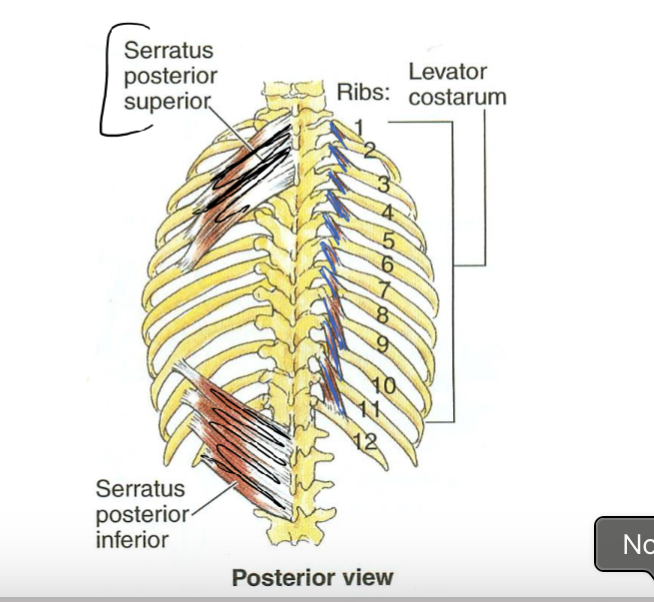
Thoracic muscles concerned exclusively w/ ribs for respiration: (DILS)

  • Diaphragm

  • Intercostals

  • Levator costarum

  • Serratus posterior


***Any muscle w/ attachment to ribs has potential to assist respiration under stress

12
New cards

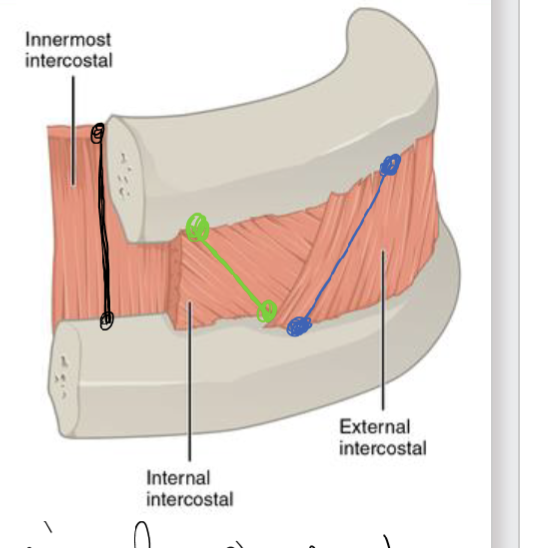
Identify the three layers of intercostal muscles

External

  • most superficial

  • oblique with inferior edge/border = medial and Superior edge/border = lat.

Internal

  • oblique with inferior edge/border = lat and Superior edge/border = med

Innermost

  • most deep

  • vertical ( meaning superior/inferior ) and NO oblique

  • helps in respiration

<p><span><strong>External</strong></span></p><ul><li><p>most superficial </p></li><li><p><span>oblique with <strong><mark data-color="blue" style="background-color: blue; color: inherit;">inferior edge/border = medial </mark></strong>and <mark data-color="blue" style="background-color: blue; color: inherit;"> </mark><strong><mark data-color="blue" style="background-color: blue; color: inherit;">Superior edge/border = lat.</mark></strong></span></p></li><li><p></p></li></ul><p></p><p><span><strong>Internal</strong></span></p><ul><li><p><span>oblique with <strong><mark data-color="green" style="background-color: green; color: inherit;">inferior edge/border = lat </mark></strong></span>and <mark data-color="green" style="background-color: green; color: inherit;"> </mark><strong><mark data-color="green" style="background-color: green; color: inherit;">Superior edge/border = med</mark></strong><span><strong><mark data-color="green" style="background-color: green; color: inherit;"><br></mark></strong></span></p></li></ul><p><span><strong>Innermost</strong></span></p><ul><li><p>most deep</p></li><li><p>vertical ( meaning superior/inferior ) and <strong>NO oblique</strong></p></li><li><p>helps in respiration <span><br></span></p></li></ul><p></p>
13
New cards
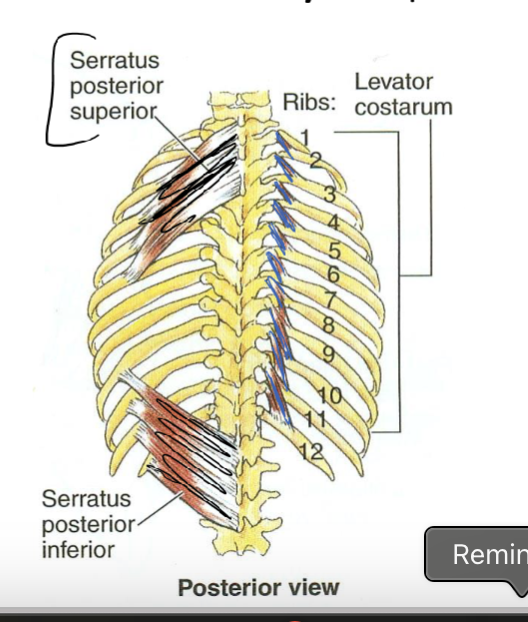
<p><span>Additional muscles with <strong>only</strong> respiration functions</span></p>

Additional muscles with only respiration functions

  • Serratus posterior

    • serrated like blade

  • Levator costarum

    • pulls ribs up for respiration

<ul><li><p><span><strong>Serratus posterior</strong></span></p><ul><li><p>serrated like blade</p></li></ul></li></ul><p></p><ul><li><p><span><strong>Levator costarum</strong></span></p><ul><li><p>pulls ribs up for respiration</p></li></ul></li></ul><p></p>
14
New cards
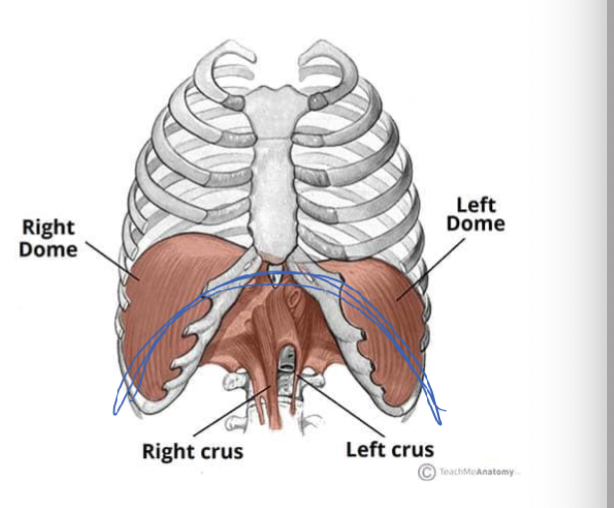
<p><strong>Diaphragm</strong>’s Origin, Insertion, Action, </p>

Diaphragm’s Origin, Insertion, Action,

Origin:

  • Xiphoid process

  • Lower costal cartilages

  • Upper Lumbar vertebrae

  • Medial and lateral arcuate ligaments

Insertion:

  • Central tendon of diaphragm

Action:

  • Expands thorax during inspiration

15
New cards

More about the diaphragm

it is on the inferior aspect of the thorax

  • this helps increase vertical space in thorax to allow air to enter

When flat = contracted

when in upside down U-shape = relaxed, which decreases V. space to expel air

REQUIRED FOR LIFE OR DEATH OCCURS

16
New cards

What does being on ventilator do to your diaphragm

it makes the diaphragm atrophy due to no usage of it, to the point when your off the ventilator it will make it hard to breathe

17
New cards

Thorax— 10 visceral contents

  • Heart

  • Esophagus

  • Pulmonary artery

  • Pulmonary veins

  • Aortic arch

  • Descending thoracic aorta

  • Superior vena cava

  • Inferior vena cava

  • Lungs

  • Trachea

18
New cards
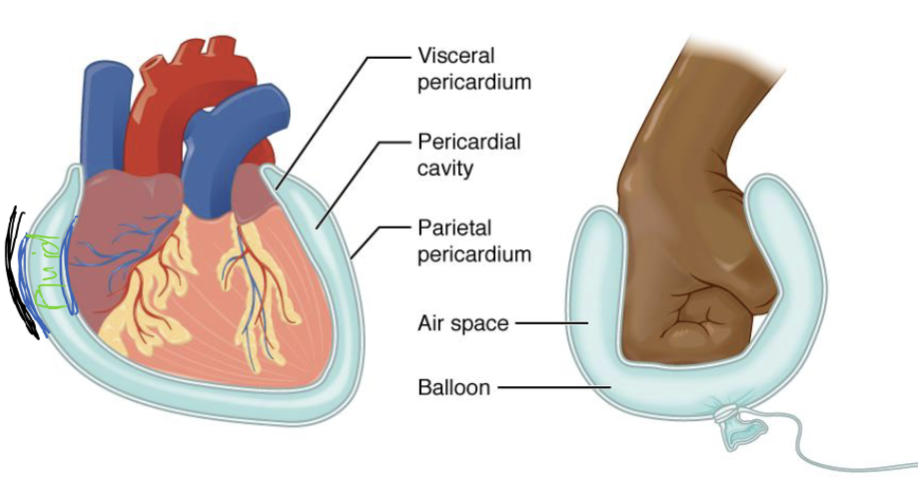
<p><span>Compare and contrast serous and fibrous membranes</span></p>

Compare and contrast serous and fibrous membranes

Most thoracic and abdominal organs are surrounded by a serous membrane and many have fibrous membrane

Serous membrane:

  • Double-sided and Fluid-filled membrane that allows for movement

  • reduces friction w/ lubricating fluids

Fibrous membrane:

  • exterior (superficial) to the serous membrane

  • contains movement

<p>Most thoracic and abdominal organs are surrounded by a serous membrane and many have fibrous membrane<br></p><p><strong>Serous membrane</strong>:</p><ul><li><p>Double-sided and Fluid-filled membrane that<strong> allows </strong>for movement </p></li><li><p><strong>reduces </strong>friction w/ lubricating fluids<br></p></li></ul><p><strong>Fibrous membrane: </strong></p><ul><li><p>exterior (superficial) to the serous membrane</p></li><li><p><strong>contains </strong>movement</p></li></ul><p></p>
19
New cards
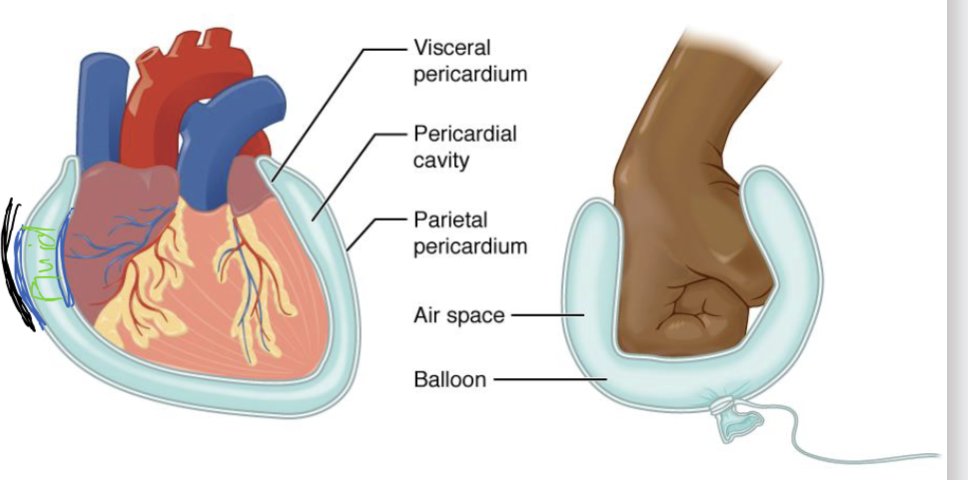
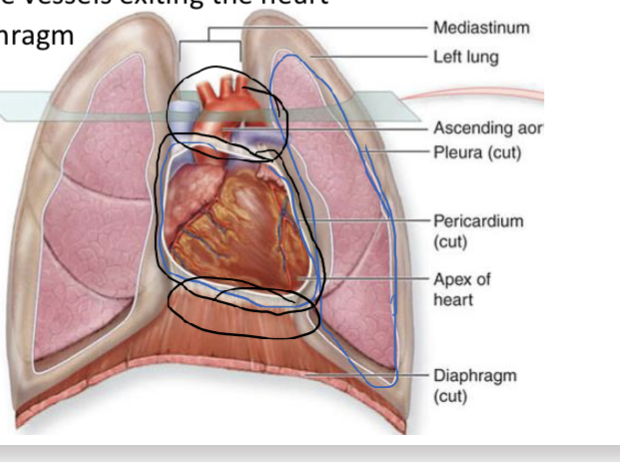
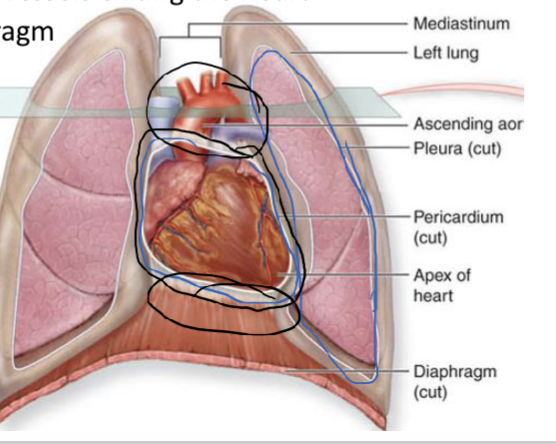
<p>Fibrous pericardium</p>

Fibrous pericardium

Main function: prevent overfilling of the heart

Location (black outline):

  • Superiorly to the large vessels exiting the heart

  • Inferiorly to the diaphragm

<p><strong>Main function: </strong><span>prevent overfilling of the heart</span></p><p></p><p><span><strong>Location (black outline):</strong></span></p><ul><li><p><span><strong>Superiorly</strong> to the large vessels exiting the heart</span></p></li><li><p><span><strong>Inferiorly</strong> to the diaphragm</span></p></li></ul><p></p>
20
New cards

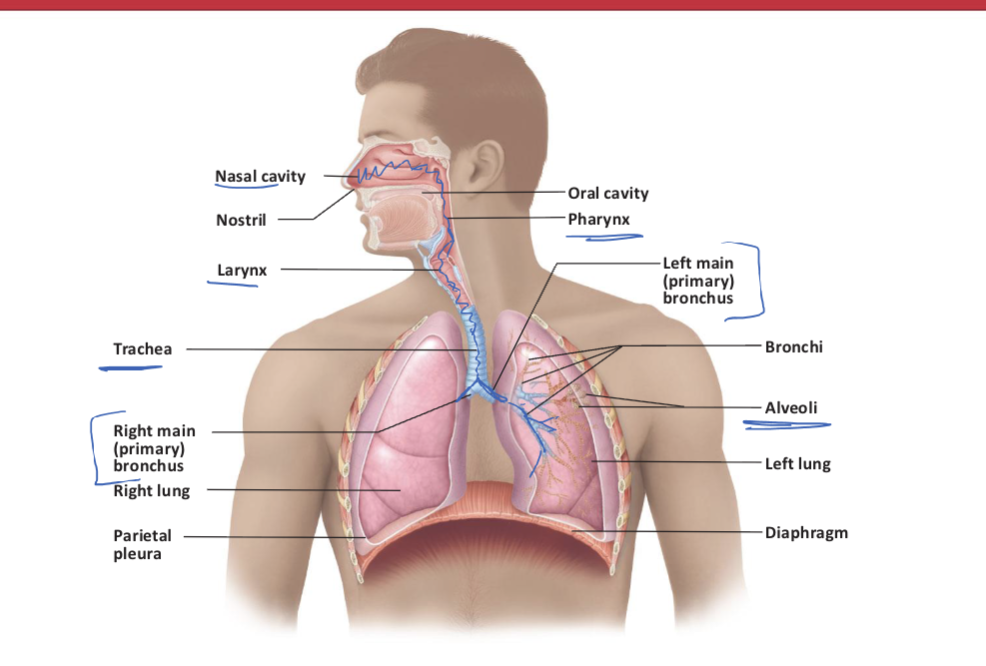
Compare and contrast the general locations and functions of the conducting and respiratory portions of the respiratory tract
21
New cards
<p><span>List, in order, the respiratory structures that air passes through during inhalation and exhalation.</span></p><p></p><p><span>IN 10 steps </span></p>

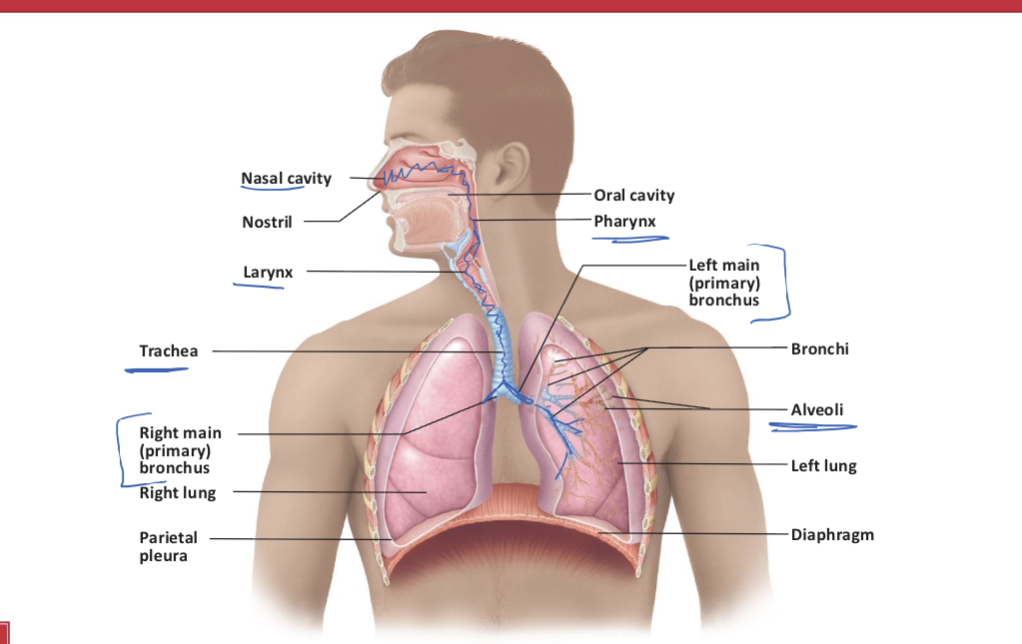
List, in order, the respiratory structures that air passes through during inhalation and exhalation.

IN 10 steps

Inhalation:

  1. air passes via Nasal cavity

  2. air goes down pharynx

  3. air goes down larynx

  4. air goes down trachea

  5. air goes to primary bronchi

  6. air goes to secondary bronchi

  7. air goes to tertiary bronchi

  8. air goes to terminal bronchioles

  9. air goes to respiratory bronchioles

  10. air goes to alveolar duct

  11. air goes to alveolar sacs (bunch of grapes)

  12. air goes to alveoli (single grape)

****exhalation is the reverse of the inhalation***
<p><strong><u>Inhalation:</u></strong></p><ol><li><p>air passes via<strong> Nasal cavity</strong></p></li><li><p>air goes down <strong>pharynx</strong></p></li><li><p>air goes down <strong>larynx</strong></p></li><li><p>air goes down<strong> trachea</strong></p></li><li><p>air goes to <strong>primary bronchi</strong></p></li><li><p>air goes to <strong>secondary bronchi</strong></p></li><li><p>air goes to <strong>tertiary bronchi</strong></p></li><li><p>air goes to <strong>terminal bronchioles</strong></p></li><li><p>air goes to <strong>respiratory bronchioles</strong></p></li><li><p>air goes to <strong>alveolar duct </strong></p></li><li><p>air goes to <strong>alveolar sacs (bunch of grapes)</strong></p></li><li><p>air goes to <strong>alveoli (single grape)</strong></p></li></ol><p></p><p></p><p>****exhalation is the reverse of the inhalation***</p><p></p><p></p><p></p><p></p>
22
New cards
<p><span>Describe the gross anatomical features of the trachea, including its positioning with respect to the esophagus</span></p>

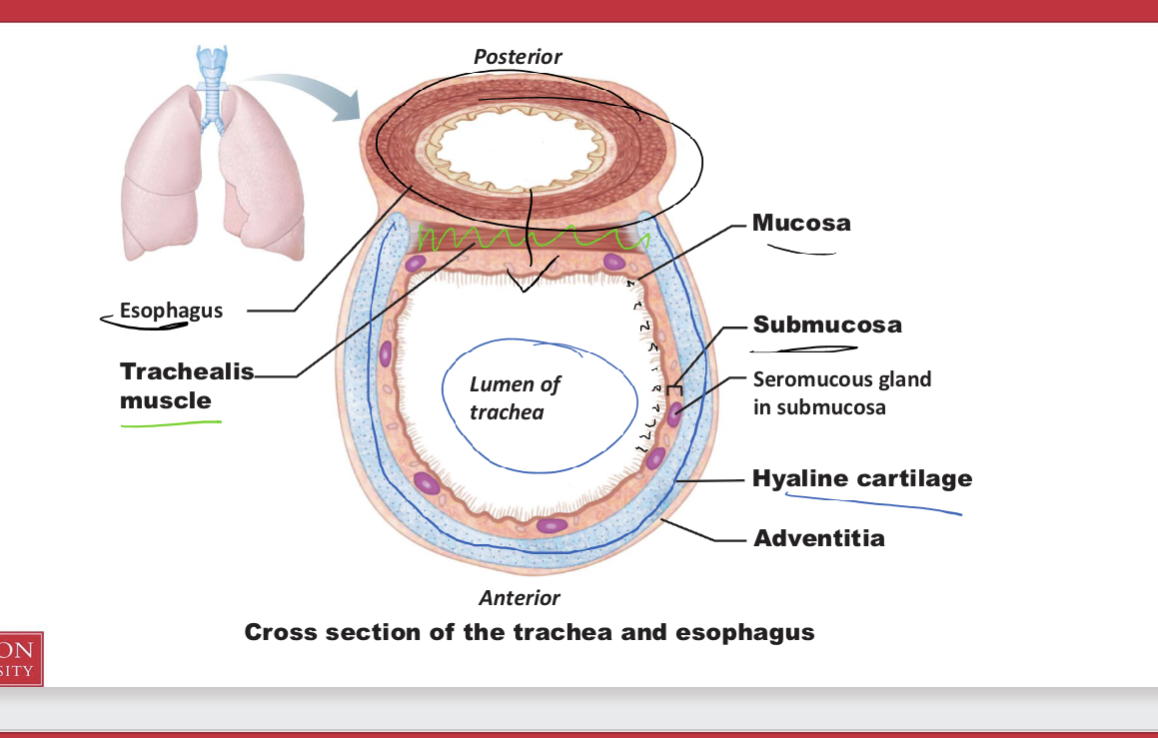
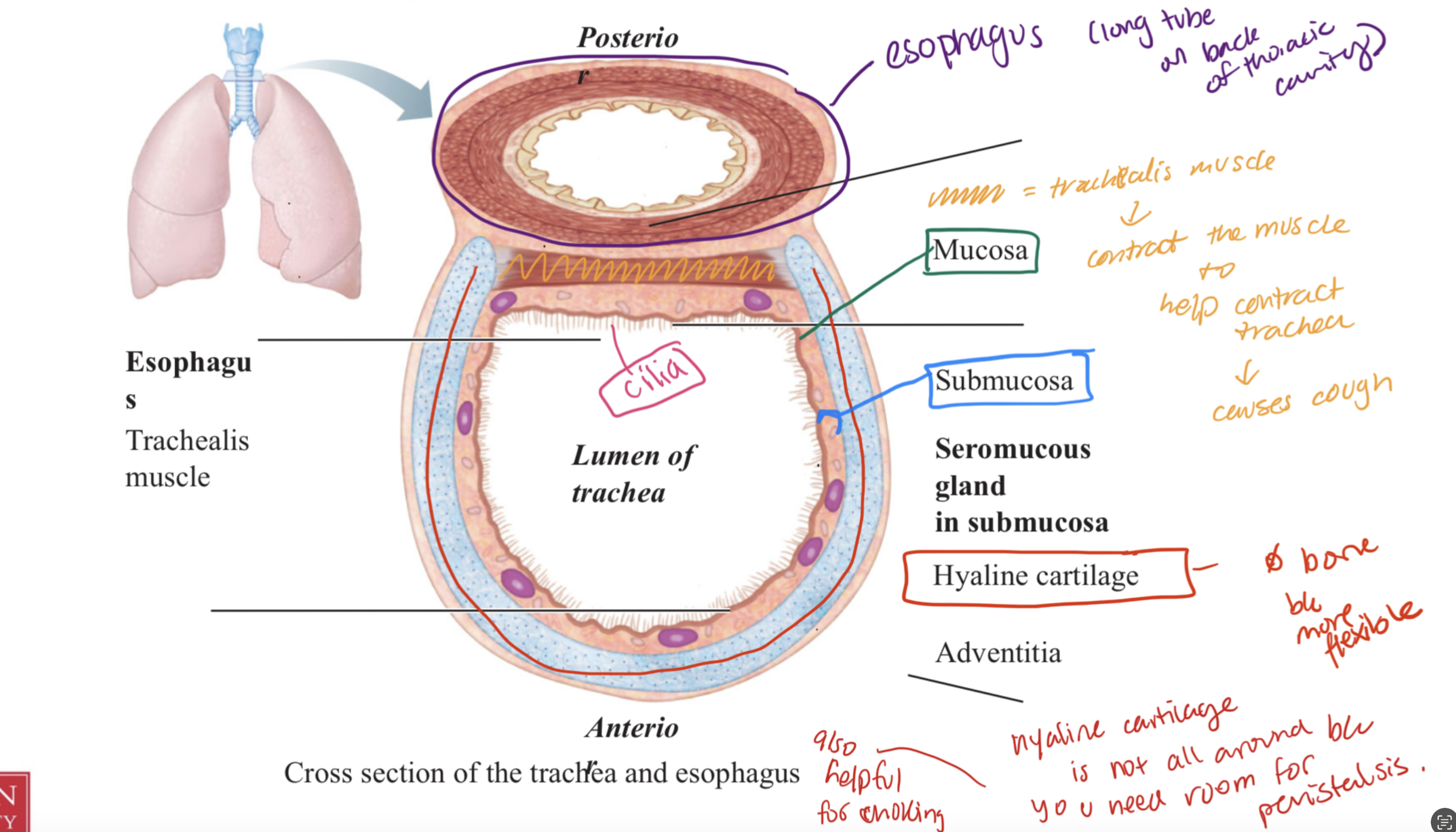
Describe the gross anatomical features of the trachea, including its positioning with respect to the esophagus

Trachea

  • made of hyaline cartilage b/c it provides flexibility to stretch without breaking

  • there is cilia for moving food

  • anterior to the esophagus

<p><strong><u>Trachea</u></strong></p><ul><li><p>made of <strong>hyaline cartilage </strong> b/c it provides flexibility to stretch without breaking</p></li><li><p>there is cilia for moving food</p></li><li><p><strong>anterior </strong>to the esophagus</p></li></ul><p></p><p></p>
23
New cards
24
New cards
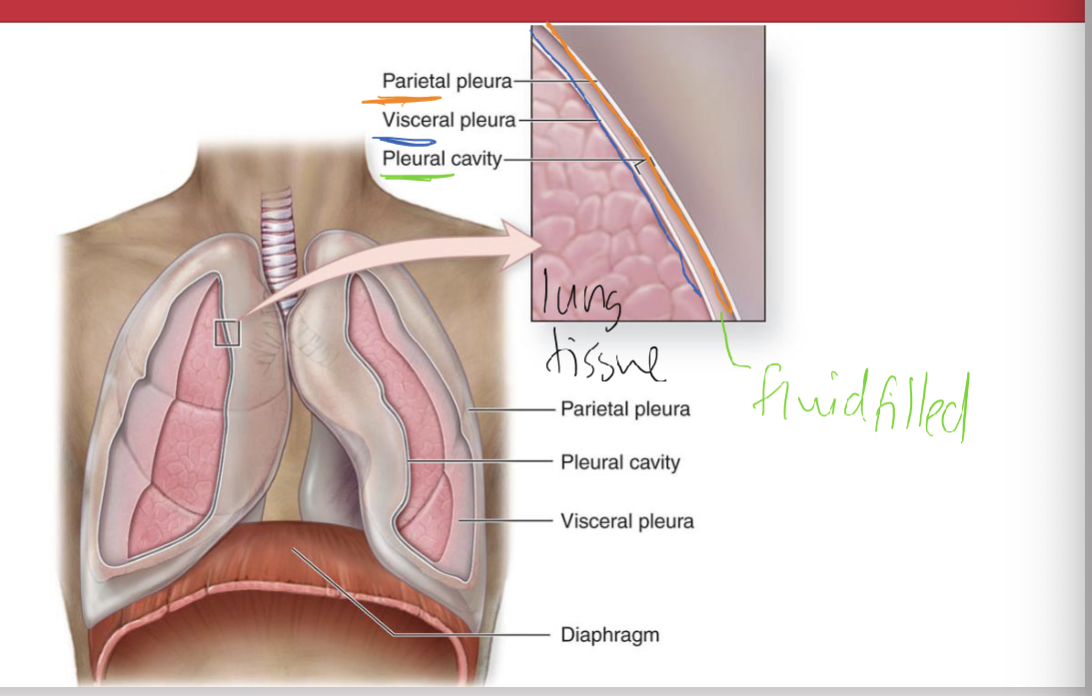
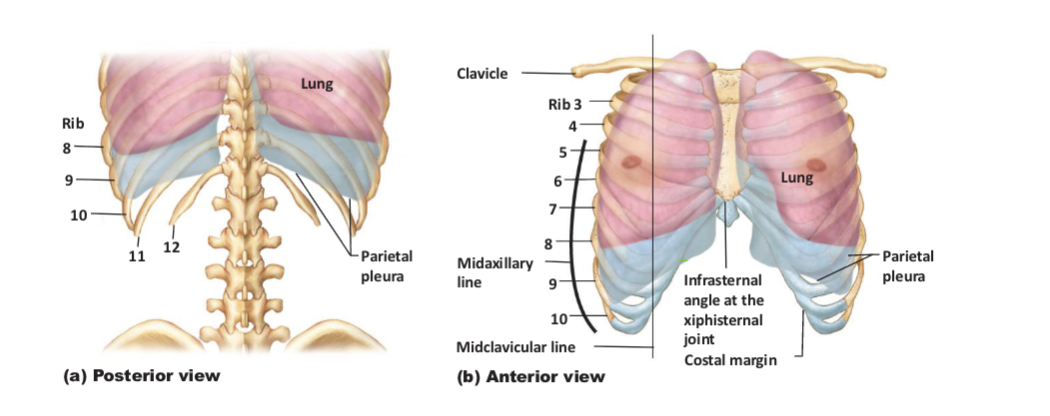
<p>Explain the parietal and visceral pleurae and pleura cavity concept </p>

Explain the parietal and visceral pleurae and pleura cavity concept

parietal pleura

  • most superficial and congruent/inseparable to rib cage (and wall)

Pleural cavity

  • fluid filled in btw V and P pleurae

Visceral pleura

  • inner lining visceral membrane

The purpose:

  • pleural cavity’s fluid acts like glue (surface tension) b/c when parietal pleura moves due to inspiration so does the pleural cavity and visceral pleura and the lungs

  • this allows increasing of thoracic cavity to allow air to enter
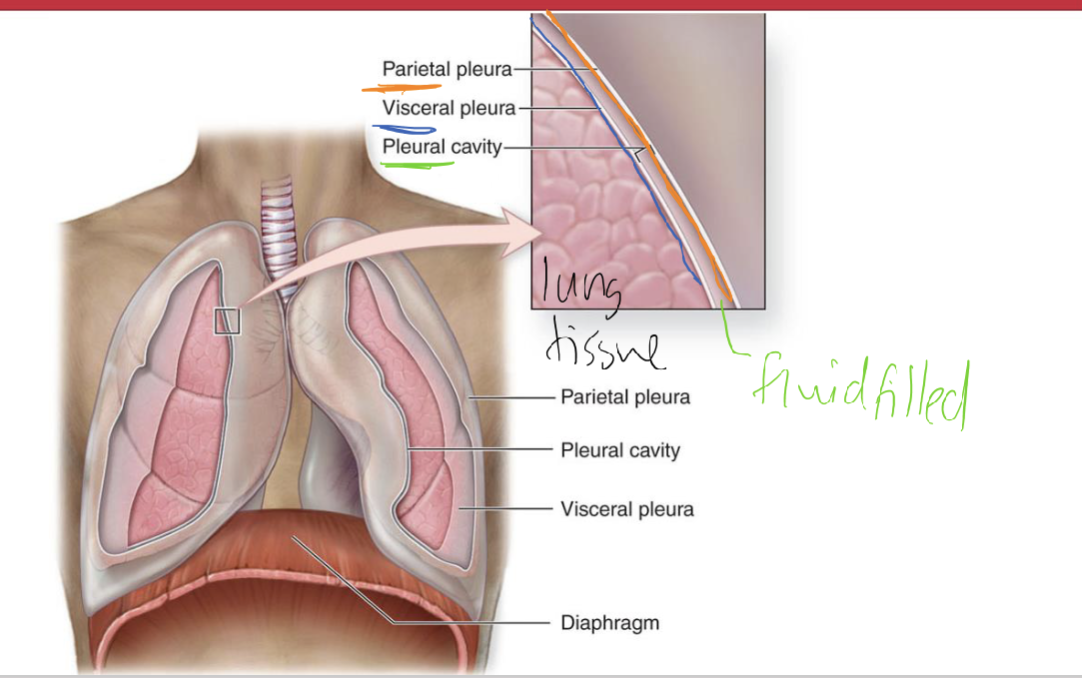
<p><strong><u>parietal pleura </u></strong></p><ul><li><p>most superficial  and congruent/inseparable to rib cage (and wall)</p></li></ul><p></p><p><strong><u>Pleural cavity </u></strong></p><ul><li><p>fluid filled in btw <strong>V </strong>and <strong>P pleurae</strong></p></li></ul><p></p><p></p><p><strong><u>Visceral pleura</u></strong></p><ul><li><p> inner lining visceral membrane</p></li></ul><p></p><p></p><p><strong>The purpose:</strong></p><ul><li><p>pleural cavity’s fluid acts like glue (surface tension) b/c when parietal pleura moves due to inspiration so does the pleural cavity and visceral pleura and the lungs</p></li><li><p>this allows increasing of thoracic cavity to allow air to enter </p></li></ul><p></p><p></p><p></p><p></p>
25
New cards

Collasped lung

something enters pleural cavity and lung recoils —> NO air can enter

26
New cards

Parts of the Left lung

Red = left superior lobe

Green = oblique fissure

Blue = Left inferior lobe
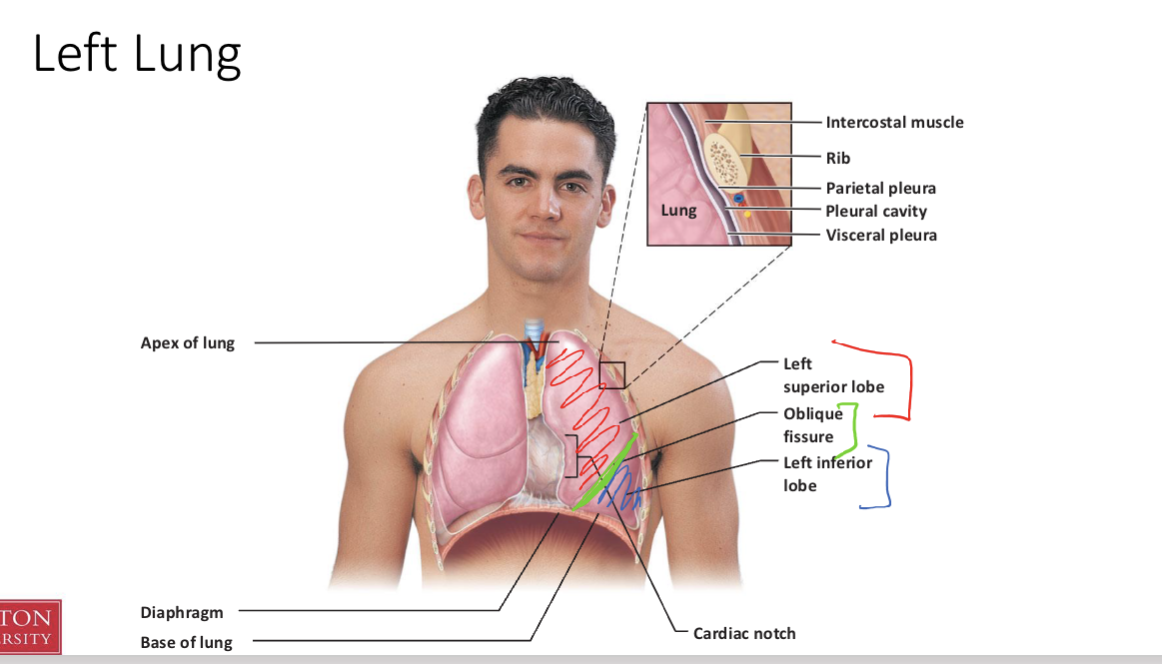
<p>Red = left superior lobe</p><p>Green = oblique fissure </p><p>Blue = Left inferior lobe </p>
27
New cards

Parts of the Right lung

bigger than left and has more lobes b/c heart is placed more to the left

Red = Right superior lobe

Black = Horizontal fissure

Orange = Right middle lobe

Green = Oblique fissure

Blue = Right inferior lobe
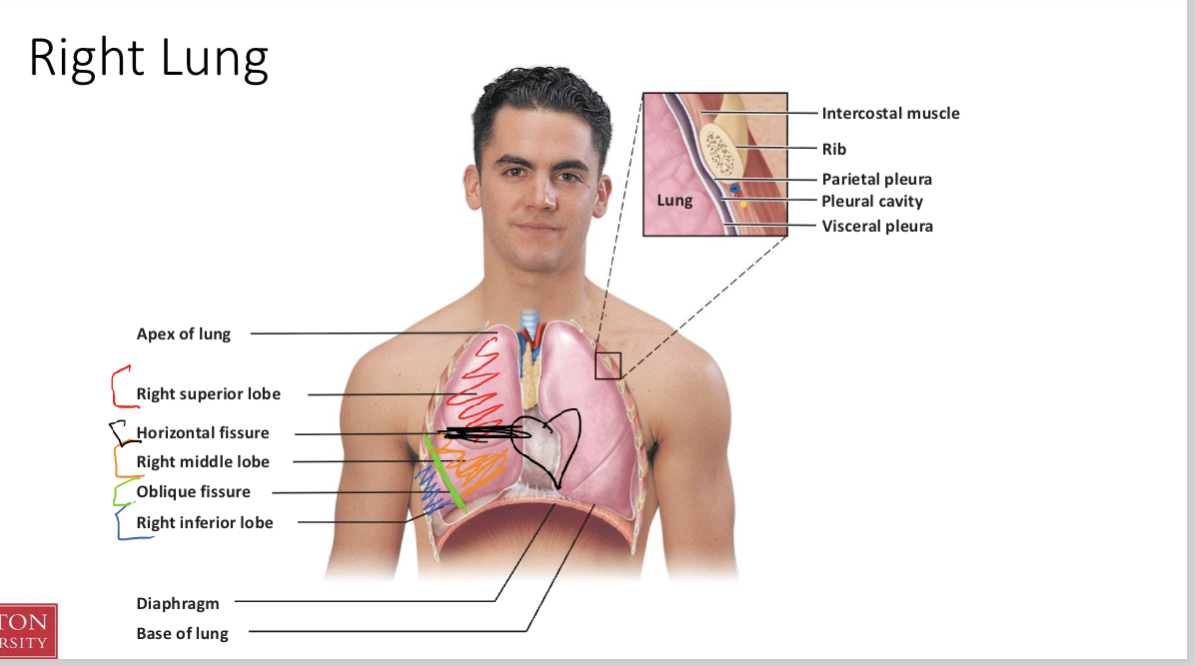
<p><strong>bigger than left  and has more lobes b/c heart is placed more to the left </strong></p><p></p><p></p><p>Red = Right superior lobe</p><p>Black = Horizontal fissure</p><p>Orange = Right middle lobe</p><p>Green = Oblique fissure</p><p>Blue = Right inferior lobe</p>
28
New cards
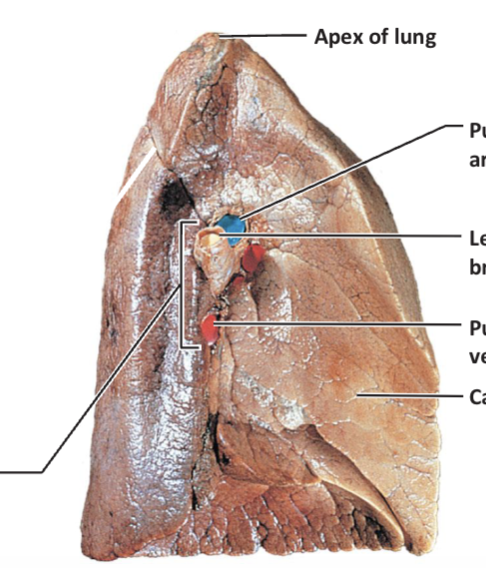
<p>Hilum </p>

Hilum

seen in sagittal view

  • Pulmonary vein

  • pulmonary artery

  • left main bronchus

For posterior

  • it is darker lavitity: blood moves down b/c of gravity
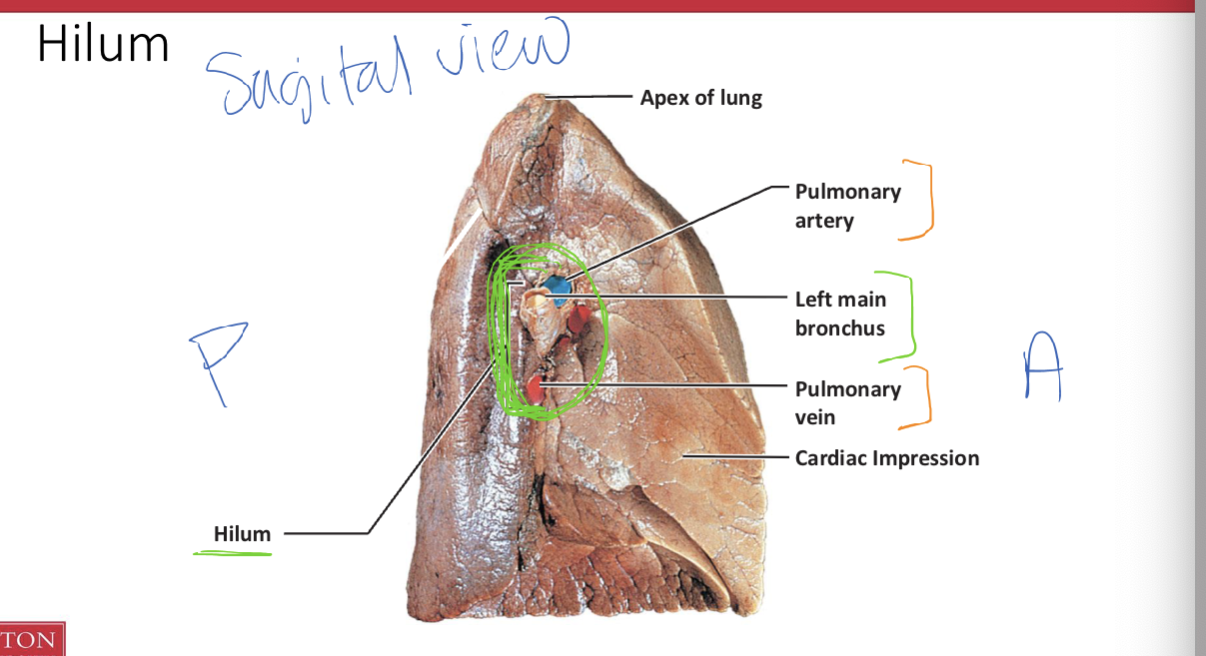
<p>seen in <strong>sagittal </strong>view</p><ul><li><p><strong>Pulmonary vein</strong></p></li><li><p><strong>pulmonary artery</strong> </p></li><li><p><strong>left main bronchus</strong></p></li></ul><p></p><p></p><p>For posterior </p><ul><li><p>it is<strong> darker lavitity:</strong> blood moves down b/c of gravity </p></li></ul><p></p>
29
New cards

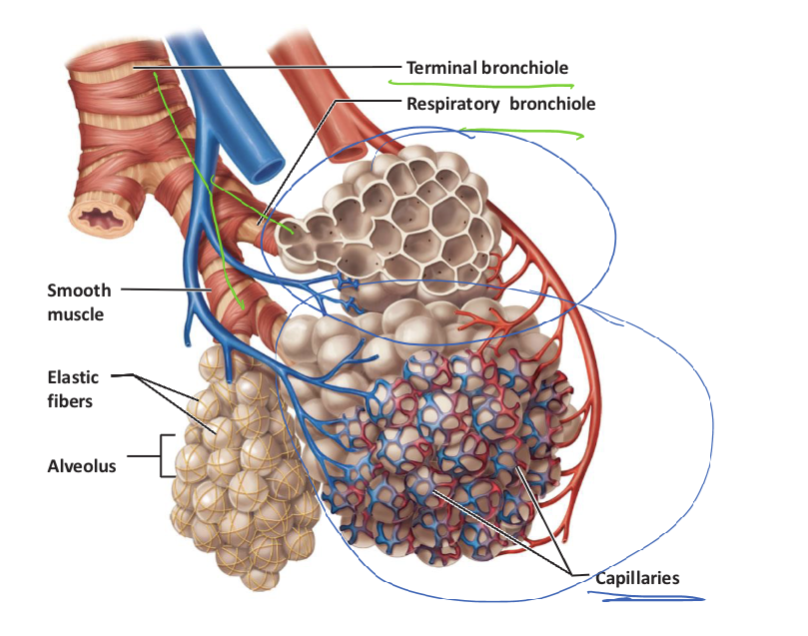
Identify and describe the gross anatomic features of the bronchial tree (e.g., bronchi, bronchioles, alveolar ducts, alveolar sacs and alveoli).

bronchi:

  • have cartilage b/c the trachea splits into bronchi

bronchioles:

  • have smooth muscles in their walls for constriction and dilation

alveolar ducts

  • extend from respiratory bronchioles and their walls are lined w/ alveoli

alveolar sacs

  • clusters of alveoli @ ends of alveolar ducts

alveoli

  • very small sacs

Capillaries

  • surround alveoli

<p><strong>bronchi:</strong></p><ul><li><p>have cartilage b/c the trachea splits into bronchi</p></li></ul><p></p><p><strong>bronchioles:</strong></p><ul><li><p>have smooth muscles in their walls for constriction and dilation</p></li></ul><p></p><p><strong>alveolar ducts</strong></p><ul><li><p>extend from respiratory bronchioles and their walls are lined w/ alveoli</p></li></ul><p></p><p><strong>alveolar sacs</strong></p><ul><li><p>clusters of alveoli @ ends of alveolar ducts</p></li></ul><p></p><p><strong>alveoli</strong></p><ul><li><p>very small sacs</p></li></ul><p></p><p><strong>Capillaries </strong></p><ul><li><p>surround alveoli </p></li></ul><p></p>
30
New cards
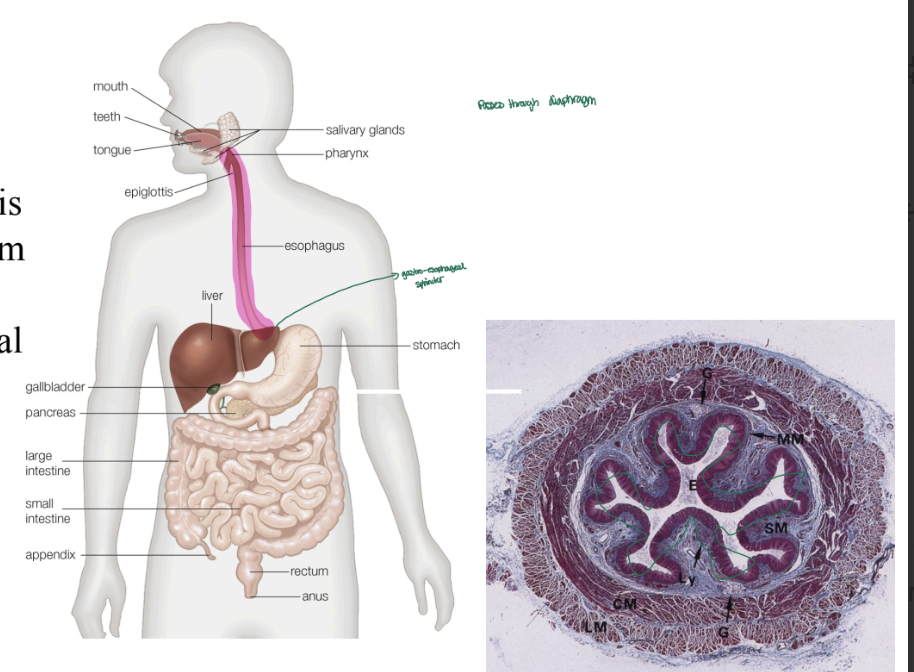
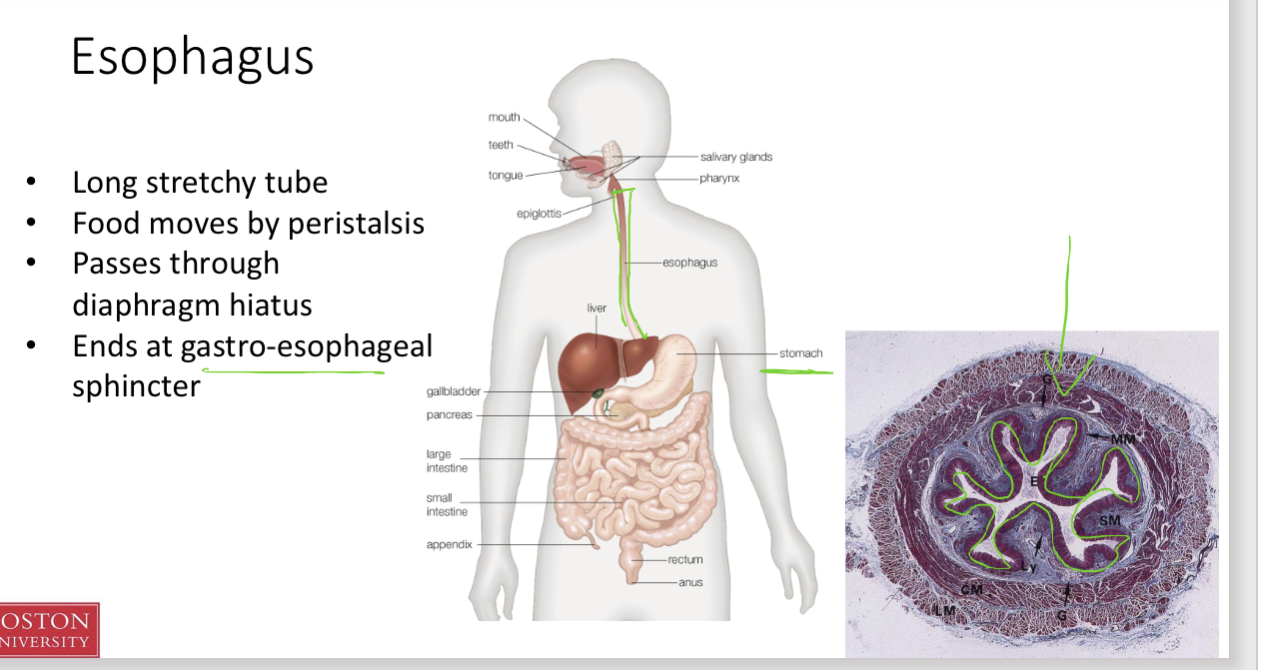
<p><span>Identify the esophagus and describe its location relative to other body structures.</span></p>

Identify the esophagus and describe its location relative to other body structures.

  • Long stretchy tube

  • Food moves by peristalsis

  • Passes through diaphragm hiatus

  • Ends at gastro-esophageal
    sphincter

  • posterior to trachea

<ul><li><p><span>Long stretchy tube</span></p></li><li><p><span>Food moves by peristalsis</span></p></li><li><p><span>Passes through diaphragm hiatus</span></p></li><li><p><span>Ends at gastro-esophageal<br>sphincter </span></p></li><li><p><span><strong>posterior </strong>to trachea </span></p></li></ul><p></p>
31
New cards

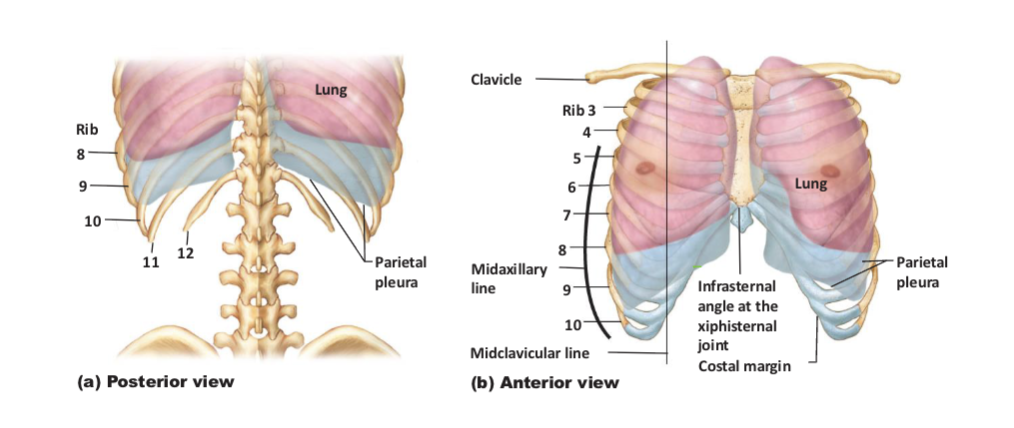
Parietal vs Visceral

Parietal: body wall

Visceral: organ wall
32
New cards
term image
  • Pink = exhaled lung size

  • grey = inhale expansion

<ul><li><p>Pink = exhaled lung size</p></li><li><p>grey = inhale expansion</p></li></ul><p></p>

Explore top notes

note
WHAP - Unit 2 Review
Updated 528d ago
0.0(0)
note
2.1 Physical and Mental Health
Updated 1102d ago
0.0(0)
note
THE NEW NATION
Updated 633d ago
0.0(0)
note
Chapter 13 - Chemical Equilibrium
Updated 1437d ago
0.0(0)
note
WHAP - Unit 2 Review
Updated 528d ago
0.0(0)
note
2.1 Physical and Mental Health
Updated 1102d ago
0.0(0)
note
THE NEW NATION
Updated 633d ago
0.0(0)
note
Chapter 13 - Chemical Equilibrium
Updated 1437d ago
0.0(0)

Explore top flashcards

flashcards
cogni
400
Updated 783d ago
0.0(0)
flashcards
Latin Exam Vocabulary
437
Updated 309d ago
0.0(0)
flashcards
[ 2MID ] MIL - What is Media?
40
Updated 207d ago
0.0(0)
flashcards
LV - Python
20
Updated 1040d ago
0.0(0)
flashcards
Unit 2: Cognition
50
Updated 9d ago
0.0(0)
flashcards
unit 2 vocab
140
Updated 1183d ago
0.0(0)
flashcards
cogni
400
Updated 783d ago
0.0(0)
flashcards
Latin Exam Vocabulary
437
Updated 309d ago
0.0(0)
flashcards
[ 2MID ] MIL - What is Media?
40
Updated 207d ago
0.0(0)
flashcards
LV - Python
20
Updated 1040d ago
0.0(0)
flashcards
Unit 2: Cognition
50
Updated 9d ago
0.0(0)
flashcards
unit 2 vocab
140
Updated 1183d ago
0.0(0)