Exam 1 - Animal Energetics
 Studied by 0 people
 Call Kai
 Learn
Learn Practice Test
 Spaced Repetition
 Match
Match Flashcards
 Knowt Play
1/70

There's no tags or description
Looks like no tags are added yet.
Name | Mastery | Learn | Test | Matching | Spaced | Call with Kai |
|---|
No analytics yet
Send a link to your students to track their progress
71 Terms
What is bioenergetics?
The study of how energy flows through living organisms
Define the responsibility of the IACUC
Set rules for ethical treatment and ensures that animals are performed at the highest standards and follows federal laws.
Who are the members of the IACUC?
Vet, animal researcher, non-affiliated person, and a non-scientific member
What are the 3 “R’s” Principle?
Replacement- Substitute animal trials with alternative methods (cell culture,
data sets, simulations)
Reduction- Use the smallest # of animals as possible
Refinement- Optimizing scientific methods to improve animal welfare (caring for the animal with better alternatives)
Differentiate between the 4 categories of pain and distress used by the IACUC
Category B, C, D, E. Most painful is E, least painful is B
Define euthanasia
Humanely killing animals by methods that induce rapid unconsciousness and death without pain or distress
Identify the groups of animals covered under the IACUC at Georgia Southern
non-human vertebrate animals, including mammals, birds, fish, reptiles, and amphibians
Define “pain”
Adaptive process that protects the organism, increase survival and reproductive success.
Define & differentiate between the two categories/stages of pain
1) nociception: unconscious detection of damage
2) emotional responses: responding to the pain
Generate an argument to discuss the question "Do fish feel pain?”
Yes they do
What are the 3 types of physiological work?
Biosynthesis, Generation of external work, and maintenance
What is metabolism?
Entire set of chemical processes that convert food into energy
What is metabolic rate?
The speed at which an animal consumes energy
Metabolic rates are significant for 3 reasons:
Provides quantitate measurement of total activity of all physiological work ((can also provide insight into cost of changes in environmental conditions)
Determines now much food is needed for survival (supply> demand )
Measures the drain the animal places on its ecosystem
Animals rely on aerobic respiration to fuel physiological work. What is that?
Break down of organic molecules using O2 to produce energy ( atp+ Heat)
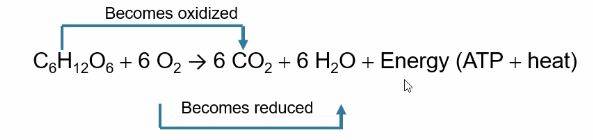
What are 3 important points to remember?
Cells must make their own ATP.
ATP is not stored by cells- its made to order
The rate a cell can conduct physiological work is dependent upon the rate that cell can make ATP
What are ways to determine metabolic rate?
1. Direct Calorimetry: HEAT
2. Indirect calorimetry: O2 and/or CO2
You catch a frog from a pond on a cool summer day. The frog feels cool to the touch. Can you use direct calorimetry to measure this frog’s metabolic
rate? Why or why not?
Yes- All forms of physiological work produce heat but production is low (comparatively). Bodies are poorly insulated so heat is easily exchanged
with environment.
Why is measuring an animal’s rate of oxygen consumption (indirect calorimetry) a good proxy for its overall metabolic rate?
Rate of oxygen use by mitochondria in body tissues, Rate of cell respiration in body tissues, and Indirect estimate of rate of energy production & use at time of measurement
What is direct calorimetry?
the direct measurement of heat production in
the body. Upon oxidation, the energy within our organic fuel
molecules is transferred into:
• ~40% ATP (used for physiological work)
• ~60% metabolic heat (released). Based on 1st law of thermodynamics
What is indirect calorimetry?
estimates energy use by measuring rates
of gas exchange. Rates of O2 use most common measurement (CO2 production can also be tracked).
What are the pros of direct calorimetry?
Highly accurate for resting state
Measures both aerobic and anaerobic metabolism
What are the cons of direct calorimetry?
Expensive, large, long measurement period, not accurate during exercise, and only terrestrial animals
What are the pros of indirect calorimetry?
Measurements under all conditions, short measurement period, less expensive, requires less space, terrestrial and aquatic organisms
What are the cons of indirect calorimetry?
Can only measure aerobic metabolism and equipment can be cumbersome to subject
What is respirometry?
Technique used to measure gas exchange (O2 consumption, CO2 release) to determine the metabolic rate of living things
What is closed / static respirometry?
animal housed in fully sealed container filled with volume of air or water
What is open / flow-through respirometry?
Animal housed in an open container and draws O2 from a stream of air/water
What is intermittent flow through respirometry?
Animal housed in open container
• Flow ”closed” off during measurement phase
• Flow resumed during non-measurement phases
What are some factors that affect metabolic rate?
Activity level & environmental temperature, food, age, gender, time of day, etc
When measuring & comparing metabolic rates its important to:
Standardize for factors that affect metabolic rate
Obtain accurate measurements of baseline metabolic rate
• Animals must maintain minimal metabolic rate for basic functions:
• Cell maintenance, Cell Respiration, Circulation, Ion balance
What are the differences and similarites between BMR and SMR?
BMR:
endotherm, non growing, comfortable temperature range, 1300-1800 kcal/day (expensive!!)
SMR:
Ectotherm, specific to a temperature, 60 kcal/day
Both
at rest, fasting, non-stressed
What is routine metabolic rate (RMR)?
energy used to maintain basic bodily functions during normal, routine activity
What is the effect of activity on Mr?
When considering aerobically fueled activity humans and most animals - metabolic rate will increase with activity
Why does metabolic rate increase with
activity?
ATP production is needed due to muscles needing more
How do the relationships between activity level and metabolic rate differ between terrestrial, aquatic, and flying vertebrates?
Aquatic vertebrates show the smallest increase in metabolic rate with activity (J-shaped), terrestrial vertebrates show an intermediate increase (linear), and flying vertebrates show the steepest increase due to the high energetic cost of flight (U-shaped).
What is main factor driving the differences in the trendlines between the animal groups?
The differences in trendlines are driven by variation in the energetic cost of locomotion imposed by the medium in which animals move (air vs water vs wind)
When do metabolic transitions occur?
At the start and end of vertebrate exercise
What is EPOC?
Excess postexercise oxygen consumption - It’s the extra oxygen your body uses after you finish exercising to recover and return to its normal (resting) state.
What is aerobic metabolic scope (or maximal aerobic capacity)?
It is the peak rate at which an animal can synthesize ATP through aerobic catabolism (cellular respiration).
What does aerobic metabolic scope estimate about an animal?
It estimates how intensely an animal can exercise during the “pay-as-you-go” phase, when ATP demand is met aerobically
How do physiologists commonly use aerobic metabolic scope?
Physiologists often use it as an estimate of an animal’s overall performance capacity.
At what biological levels does aerobic metabolic scope differ?
It differs among phyletic groups (taxa), among species within a phyletic group, and among individuals within a species.
Rough Rule of Thumb:
For vertebrates MMR (or VO2max ) is generally ~4-10x more than resting O2
consumption
How is AMS calculated?
Calculated from the difference between
MMR and baseline MMR
Energy available for processes above &
beyond basic costs of sustaining life:
Locomotion, digestion, growth and reproduction
Why is aerobic scope an important measurement?
it reflects an animal’s capacity to perform energy-demanding activities using aerobic metabolism
What is Tₒpt (Optimal Temperature) on a temperature–performance curve?
The temperature at which an organism has the highest fitness, with the most energy available for non-essential processes (e.g., growth, reproduction, activity).
What is Tcrit (Critical Temperature)?
A high or low temperature where the animal is alive but passive. Survival is time-limited, and energy is only sufficient for essential maintenance processes.
What is Tpejus?
A weakened state where the amount of energy available for activities above basal metabolism is limited, and additional stressors can be fatal.
How does maximal aerobic capacity respond to endurance training?
Maximal aerobic capacity (VO₂max) increases with endurance training, showing that it is a plastic trait that responds to training and selection.
What physiological changes occur with endurance training?
Endurance training increases VO₂max, muscle citrate synthase activity, and muscle cytochrome c oxidase activity, reflecting enhanced mitochondrial and aerobic capacity.
By how much does endurance training typically increase VO₂max in sedentary individuals?
Endurance training typically increases a sedentary person’s VO₂max by ~10–30%.
What does the training protocol in the endurance study involve?
Participants completed 60 minutes/day of vigorous cycling, 5 days per week, for 7 weeks; most before–after changes were statistically significant except testosterone.
1. Compare Basal (Standard) MR between vertebrate groups (of similar sizes). What trend(s) do you observe? Explain
Resting rates of O2 consumption of fish, amphibians, reptiles are typically lower (1/10th to 1/4) than basal rates for mammals
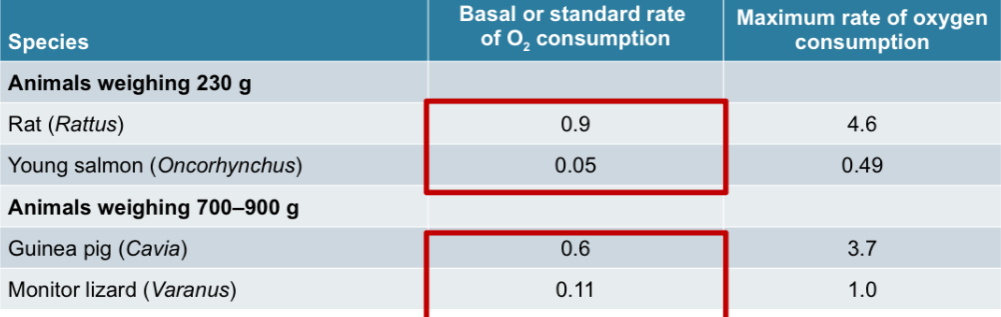
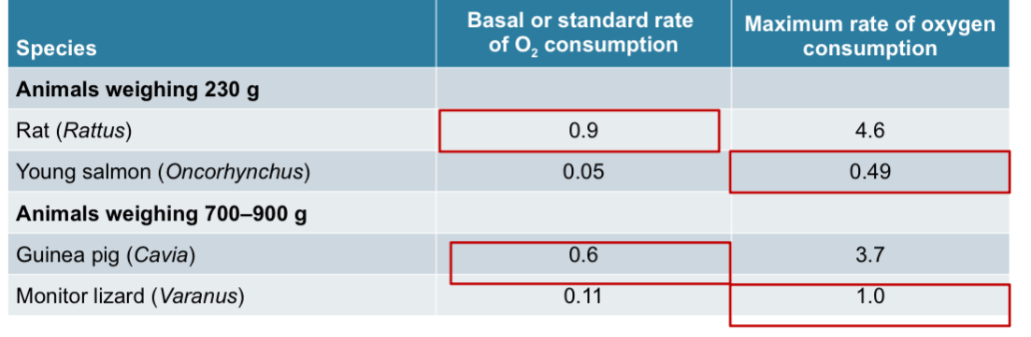
Compare maximal MR of non-mammalian verts to resting MR of mammals. What trend do you observe? Discuss implications
Peak rates of O2 consumption of fish, amphibians, reptiles are at same order of
magnitude as basal rates for mammals
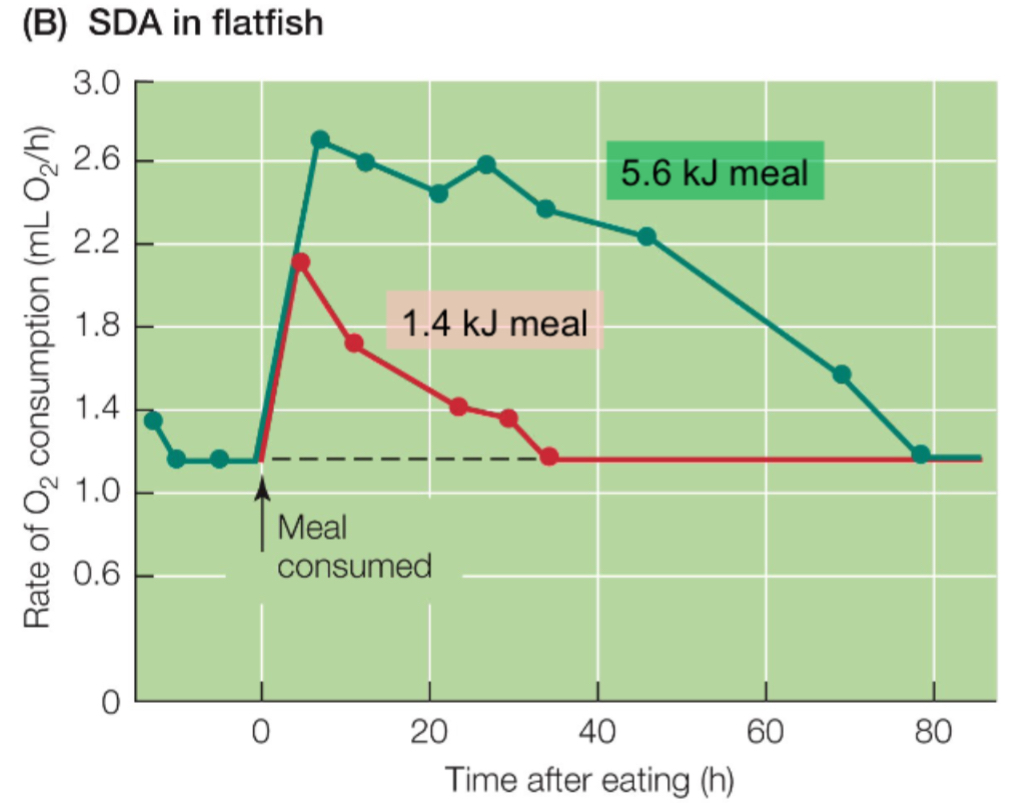
What is specific dynamic action?
increase in metabolic rate after feeding that occurs due to the energy required for digestion, absorption, transport, and assimilation of nutrients.
Discuss the relationship between meal size & composition on post-prandial metabolic rate.
Protein rich meals result in higher SDAs than carbohydrate rich or fatty meals. Cost of digesting a protein rich meal can be 25-30% of the total
energy value of the meal
Describe how animals make ATP when oxygen supply is greater or equal to demand (aerobic conditions).
First, glucose is broken down into pyruvate through glycolysis, producing a small amount of ATP and electron carriers. (Glycolysis)
Next, pyruvate enters the mitochondria and is oxidized in the citric acid (Krebs) cycle, releasing CO₂ and generating NADH and FADH₂. (Pyruvate Oxidation (Link Reaction)
Then, these electron carriers donate electrons to the electron transport chain, where oxygen acts as the final electron acceptor. (Citric Acid Cycle (Krebs Cycle))
Finally, the proton gradient created powers ATP synthase to produce a large amount of ATP through oxidative phosphorylation.(Electron Transport Chain & Oxidative Phosphoryl)
What are the starting point of each phase and the net products?
Glycolysis | Glucose (Starts with) | Cytoplasm (cytosol) | 2 Pyruvate, 2 ATP (net), 2 NADH |
Pyruvate Oxidation | 2 Pyruvate | Mitochondrial matrix | 2 Acetyl-CoA, 2 CO2, 2 NADH |
Citric Acid (Krebs) Cycle | 2 Acetyl-CoA | Mitochondrial matrix | 4 CO2, 6 NADH, 2 FADH2‚, 2 2 ATP |
ETC & Oxidative Phosphorylation | NADH, FADH2 O2 | Inner mitochondrial membrane (cristae) | ~26-28 ATP, H2O, NAD+, FAD |
Define Aerobic vs Anaerobic
Aerobic -Metabolic processes that require oxygen, where oxygen acts as the final electron acceptor in the electron transport chain
Anaerobic -Metabolic processes that occur without oxygen, relying on pathways like fermentation to regenerate NAD⁺, resulting in incomplete oxidation of fuels
What is normoxia?
Normal, healthy level of oxygen in a tissue or environment
What is hypoxia?
Inadequate supply of
What is anoxia?
Complete absence of oxygen supply
What are the Two main strategies for maintaining ATP production in oxygen limited environments?
Anaerobic respiration and fermentation
What is anaerobic respiration via sulfate reduction, and what are its key features?
I
What is alcohol fermentation and what are its key features?
carried out by fungi such as yeast, where pyruvate is converted to ethanol through two reactions: the release of CO₂ and the production of ethanol catalyzed by alcohol dehydrogenase (ADH). This process regenerates NAD⁺, allowing glycolysis to continue. Ethanol typically diffuses out of the cell into the external environment, which prevents toxic buildup in body fluids but results in a large loss of potential energy (up to 90%) to the environment
What is lactic acid fermentation (anaerobic glycolysis) and what are its key features?
Lactic acid fermentation, also called anaerobic glycolysis, occurs in bacteria and some vertebrate tissues, where pyruvate is converted to lactate in a single reaction catalyzed by lactate dehydrogenase (LDH). This process does not release CO₂ and regenerates NAD⁺, allowing glycolysis to continue. Lactate is retained within the cell or body fluids, which allows it to be recycled as an energy source under aerobic conditions, but high lactate levels can be toxic and lead to acidification of the internal environment (lactic acidosis).
Compare the process of dealing with catabolic end-productions between lactic acid fermentation & alcohol fermentation. Discuss the implications to the organism's fitness.
lactic acid fermentation favors energy conservation but risks toxicity, while alcohol fermentation avoids internal toxicity at the cost of losing usable energy, and these trade-offs shape how each strategy affects organismal fitness.
Describe the most commonly conserved strategies used to extend survival time under low oxygen. Discuss the physiological/biochemical reason why this strategy increases the organisms fitness
 Note
Note  Flashcards (105)