MGMT 363 (TAMU) EXAM 2
 Call Kai
 Learn
Learn Practice Test
 Spaced Repetition
 Match
Match Flashcards
 Knowt Play
1/99

There's no tags or description
Looks like no tags are added yet.
Name | Mastery | Learn | Test | Matching | Spaced | Call with Kai |
|---|
No analytics yet
Send a link to your students to track their progress
100 Terms
stress
A psychological response to demands where there is something at stake and where coping with the demands taxes or exceeds a person's capacity or resources.
stressors
the demands that cause people to experience stress
strains
negative consequences that occur when demands tax or exceed a person's capacity or resources
Primary Appraisal
when people first encounter stressors they determine the significance and meaning of stressor and determine if they are stressed by it.
benign job demands
job demands that tend to not be appraised as stressful
ex) a cashier doing their daily routine
hindrance stressors
stressors that prevent people's progress towards goal attainment and trigger negative emotions such as anxiety and anger.
ex) cashier dealing with card machine breakdown and irritated customers
challenge stressors
stressors that people perceive as opportunities for learning, growth, and achievement which usually trigger positive emotions like pride & enthusiasm.
ex) cashier dealing with additional responsibilities such as training others
positive
challenge stressors have a _______________ correlation with job performance
role conflict
conflicting expectations that other people have.
ex) call center speed and responsiveness to customer
-work hinderance stressor
role ambiguity
lack of information about what needs to be done, resources available and when it needs to be done.
ex) professors not being clear to students related to classes and assignments
-work hinderance stressor
role overload
demands are so high that person perceives that they cannot satisfy them all; simply having too many things to do
ex) trying to study for all class finals
-work hinderance stressor
Daily hassles
minor demands that get in the way of accomplishing important tasks.
ex) unnecessary paperwork, office equipment malfunctions, interruptions, etc.
-work hinderance stressor
time pressure
sense that the amount of time available is not sufficient. Is a challenge because is a goal to be achieved.
- work challenge stressor
work complexity
degree to which the requirements of the work in terms of knowledge, skills and abilities that tax or exceed the capabilities of the person.
ex) giving a new employee a big task they don't know how to do yet
- work challenge stressor
work responsibility
importance of the obligations that person has towards others.
ex) Air traffic controllers make sure crashes do not happen
- work challenge stressor
work-family conflict
demands of work hinder the fulfillment of family obligations or vice versa.
-family hindrance stressors
financial uncertainty
concern over potential inability to pay for livelihood.
-family hindrance stressors
negative life events
Events such as a divorce or death of a family member that tend to be appraised as a hindrance
family time demands
time that a person commits to participate in an array of family activities and responsibilities.
-nonwork challenge stressors
Personal development
participation in formal education programs, volunteer work, local government, etc.
-nonwork challenge stressors
positive life events
good things including having a child and getting married create potential for stress.
secondary appraisal
Now that a stressor has been identified the person must determine what they will do in response to the stressor.
coping strategies
behaviors and thoughts that people use to manage both the stressful demands they face and the emotions associated with those stressful demands.
behavioral coping
set of physical activities that are used to deal with stressful situation.
Cognitive coping
thoughts that are involved in trying to deal with the situation.
problem-focused coping
behaviors and cognitions intended to manage the stressful situation itself.
emotion-focused coping
various ways in which people manage their own emotional reactions to stressful demands.
Behavioral Problem-Focused:
Working harder
Seeking assistance
Acquiring additional resources.
Behavioral Emotion-Focused:
Engaging in alternative activities.
Seeking support.
Venting anger.
Cognitive Problem -Focused:
Strategizing
Self-motivation.
Changing priorities
Cognitive Emotion-Focused
Avoidance, distancing, or ignoring.
Looking for the positive in the negative.
Reappraising.
Physiological strain
relate to our physical body.
immune system, cardiovascular, muscular, gastrointestinal
Immune system
stress breaks down our immune systems which make us more susceptible to illness.
Cardiovascular system
stress taxes our heart when causes the heart to race, increase blood pressure, and creates coronary heart disease leading to heart attacks and stroke.
musculoskeletal system
creates tension headaches, body aches and back pain.
gastrointestinal system
stomachaches, indigestion, diarrhea, and constipation.
Psychological strains
relate to our minds
depression, anxiety, irritability, forgetfulness
Burnout
the emotional, mental, and physical exhaustion that results from having to cope with stressful demands on an ongoing basis.
behavioral strains
unhealthy behaviors that result from stress.
ex) drinking or smoking, grinding teeth, over/under eating, compulsive behavior
Social Support
help that people receive when they're confronted with stressful demands from other people.
Instrumental support
help with dealing with the stressor itself.
ex) a coworker taking on some of the paperwork to help you
Emotional support
help people receive in addressing the emotional distress that are created by the stressor.
Recovery
the degree to which energies used for coping with work demands are replenished from a period of rest or relief from work.
ex) RESTING
Type A Behavior Pattern
people have a strong sense of time urgency and tend to be impatient, hard-driving, competitive, controlling, aggressive, and even hostile. Very competitive.
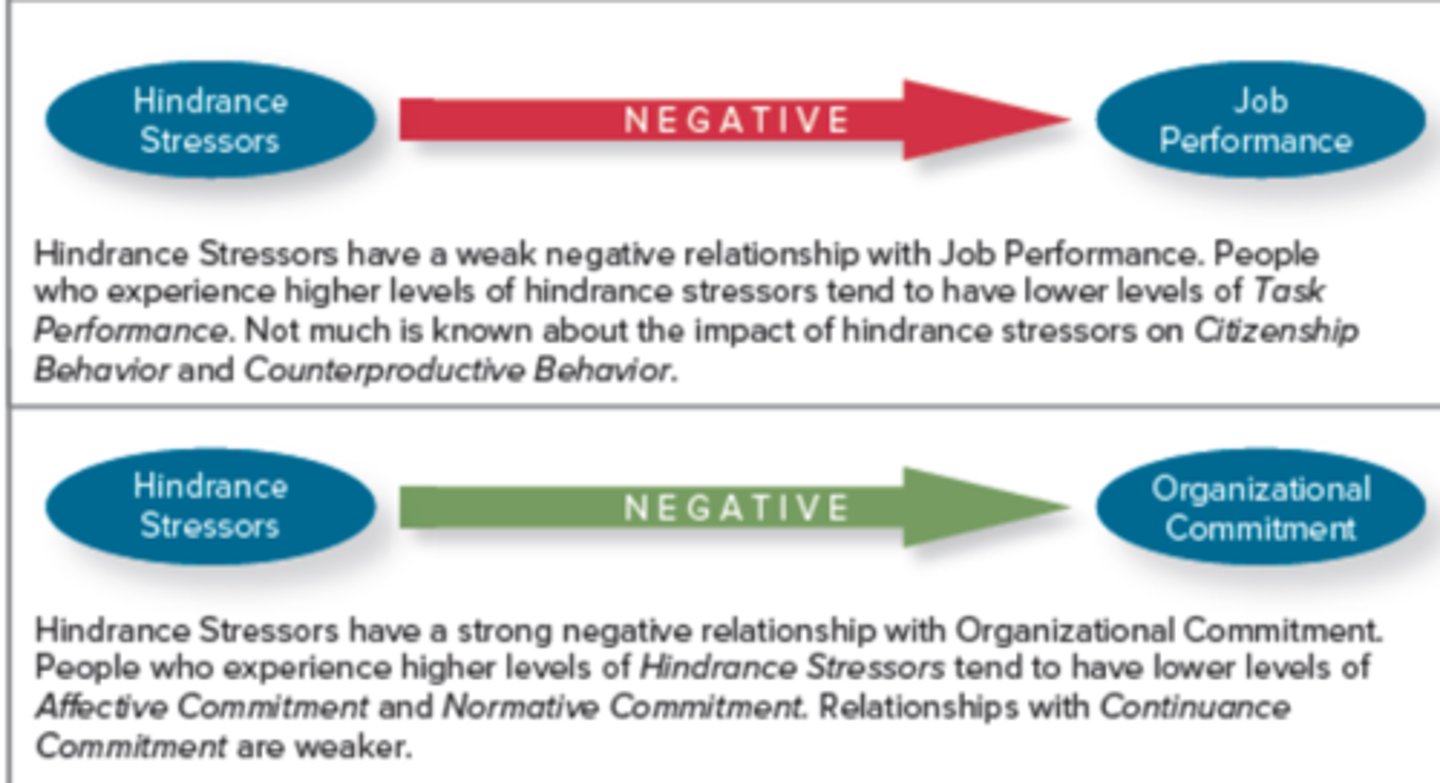
weak negative
hindrance stressors and job performance have what kind of relationship?
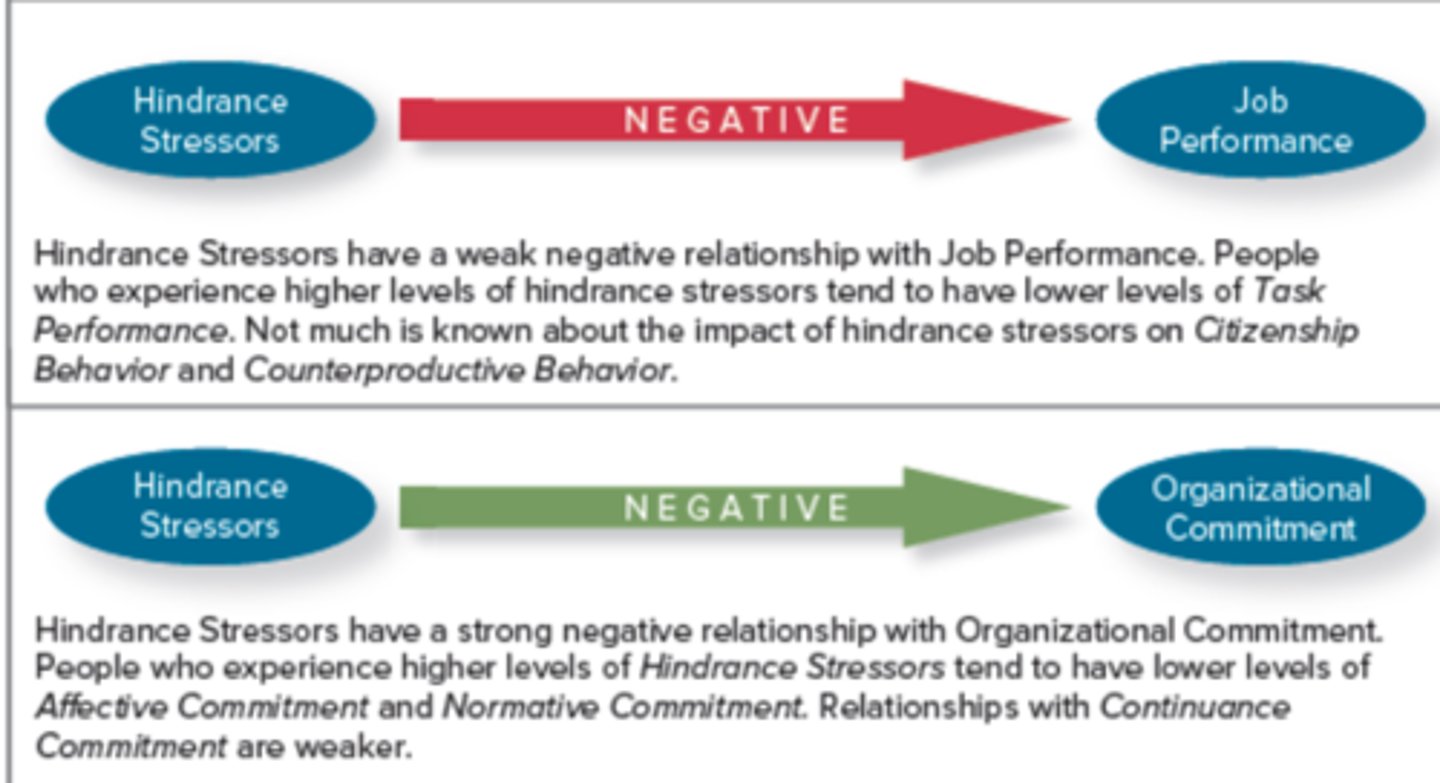
strong negative
hindrance stressors and organizational commitment have what kind of relationship?
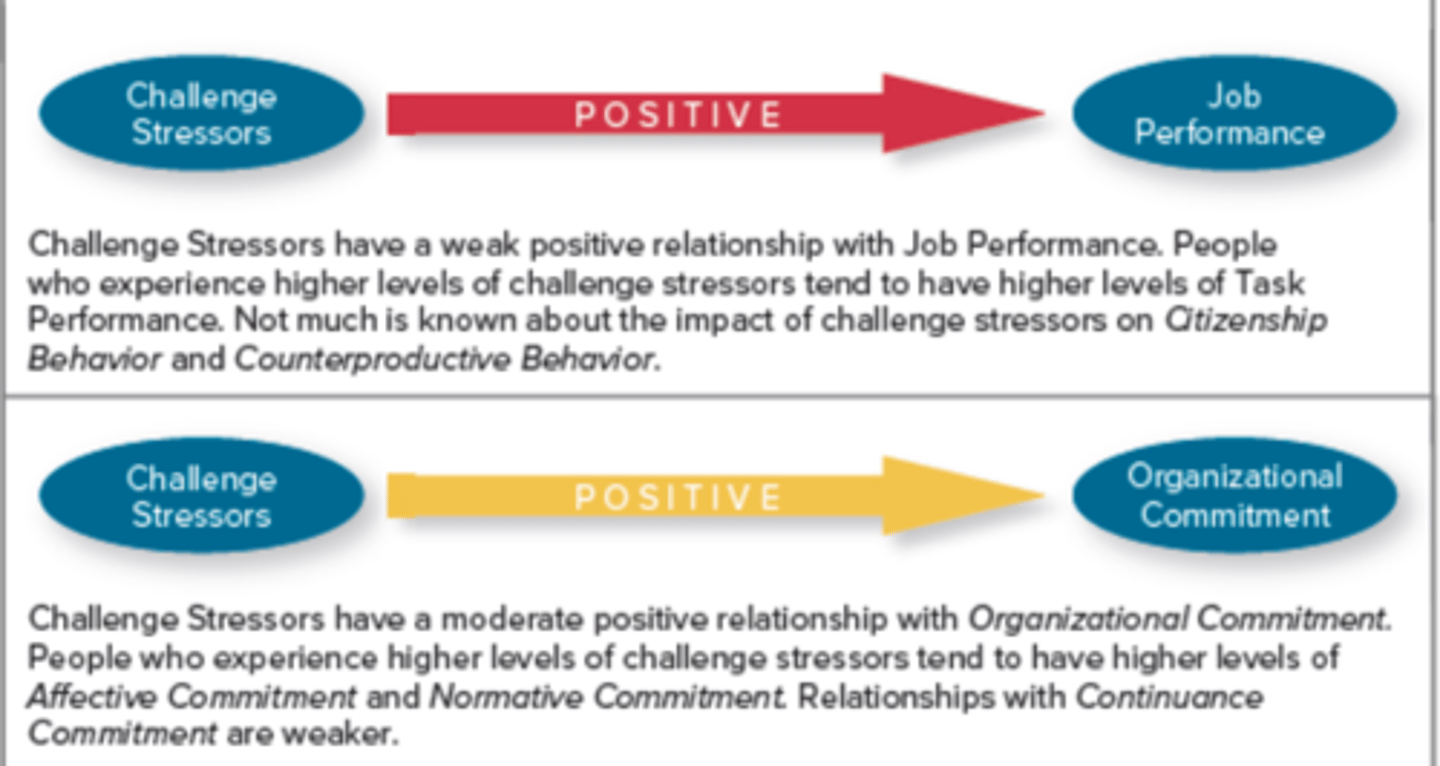
weak positive
challenge stressors and job performance have what kind of relationship?
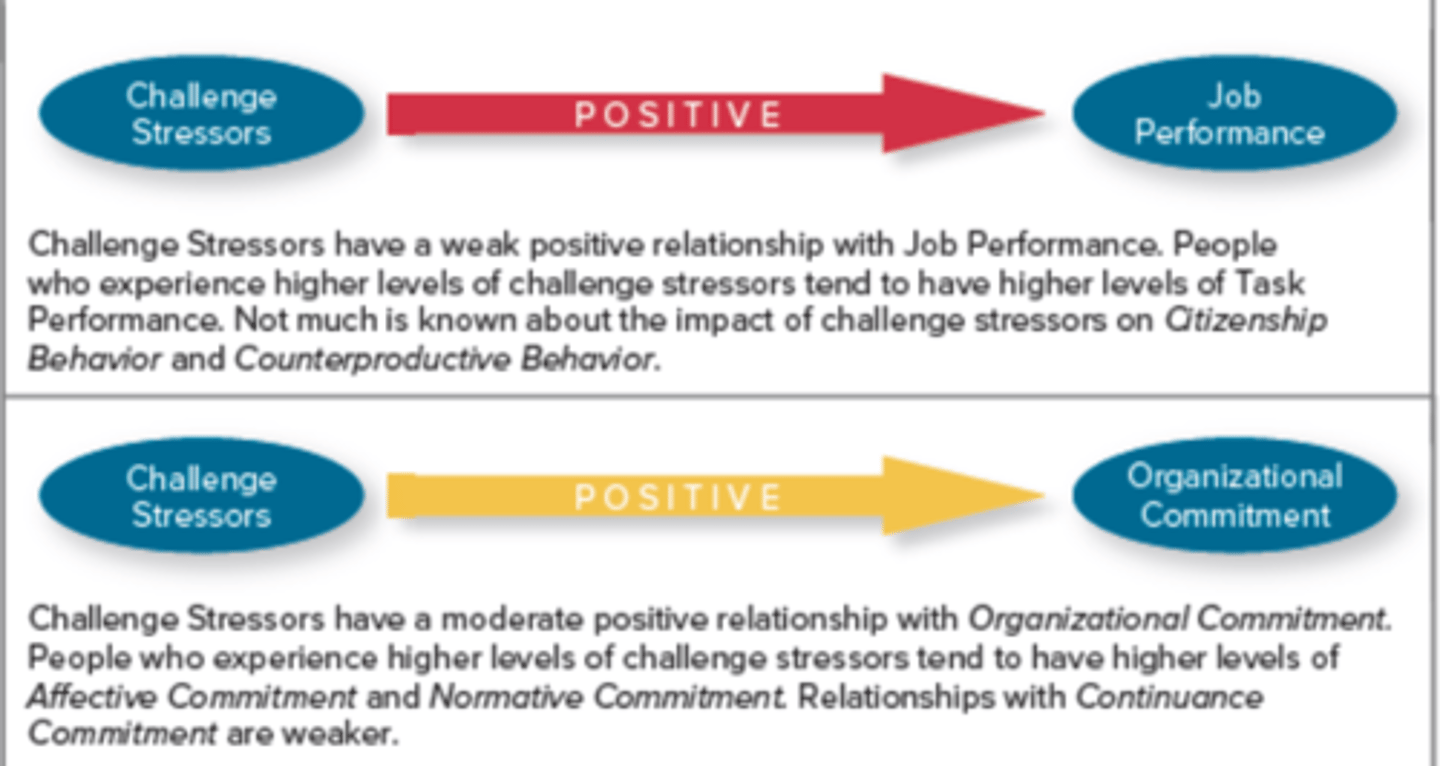
moderate positive
challenge stressors and organizational commitment have what kind of relationship?
Assessment
do a stress audit to find out the level and sources of stress.
Job sharing
split the responsibilities of a single job to two employees.
sabbatical
give employees an extended period of time away from the workplace to pursue other interests or volunteer.
Training and development
increase the job-related competencies which make them better able to deal with work demands.
Flextime
work the normal 8 hours but start and end times aren't set.
Telecommuting
employees work from home or other location rather than coming in to the office.
Compressed Work Week
Work the normal 40 hours but in fewer days.
Relaxation techniques
muscle relaxation, meditation or other activities that slow the heart and breathing rates and lower blood pressure.
Self-talk
boost your own self-efficacy by convincing yourself you have what it takes to succeed.
Presenteeism
when employees show up but are sick or otherwise in no condition to work productively
employee assistance programs
specifically focused on how to reduce certain strains such as smoking cessation.
Wellness/Health programs
comprehensive programs focused on trying to get people healthy.
On-site fitness center
Health screening.
perception, appraisal, and response
transactional theory of stress attempts to explain stress in terms of three components:
motivation
psychological processes that cause the arousal, direction and persistence of voluntary actions that are goal directed.
Intensity:
how hard will person try?
Persistence:
how long will person try?
Direction:
where will person direct their effort?
Motivation X Ability X Opportunity
= Performance
Engagement:
high levels of intensity and persistence in work effort.
extrinsic motivation
motivation that is controlled by some contingency that depends on task performance and is controlled by someone else.
ex) a grade
intrinsic motivation
something about the task performance is rewarding in and of itself.
meaning of money
the degree to which they view money as having symbolic, not just economic, value
Achievement:
symbol of success.($)
Respect:
shows how much people appreciate you. ($)
Freedom:
provides the opportunity to do many things. (S)
expectany theory
a cognitive theory of work motivation that proposes that workers are motivated when the expect their efforts and job performance to result in desired outcomes
self-efficacy
belief that a person has the capabilities needed to execute the behaviors necessary for task success.
Past accomplishments
if you have succeeded/failed in the past you will expect similar results in the current task.
Vicarious experiences
if you see someone who you perceive to be similar to you succeed, it increases your perception that you can succeed.
Verbal persuasion
someone you trust/look up to convinces you that you can be successful.
Emotional cues
fear and anxiety vs. pride & enthusiasm.
Instrumentality
relationship between performance level and outcome. What is the probability performance will lead to outcomes.
performance evaluation
the degree to which people perceive that their performance is evaluated accurately and that performance is connected to outcomes.
valence
importance person puts on outcomes. To what degree does the outcome satisfy a need?
Maslow's Hierarchy of needs
Humans have innate needs that motivate them in a hierarchical manner where lower level needs must be satisfied before higher level needs are activated.
Physiological
basic human needs such as food, water and basic shelter.
Safety & Security
the need to feel unthreatened and free from harm both physically and financially.
Belongingness
the need to feel part of something bigger than oneself.
Esteem
the need to feel like you are worthwhile and can accomplish significant things.
Self-actualization
the need to meet one's full potential.
Prepotency
higher level needs are not activated (motivating) until lower-level needs are satisfied. (they are listed lowest to highest.
Alderfer's ERG theory
builds on Maslow's theory by combining some of the needs and replacing prepotency with frustration-regression.
existence, relatedness, growth
ERG stand for?
Existence
combines physiological and safety/security.
Relatedness
matches up with belongingness.
Growth
combines esteem and self-actualization.
Frustration-regression hypothesis
Alderfer believes that any need can motivate at any time. Also, he suggests that when we are unable to satisfy one of the needs (frustration), you will shift your focus to one of the other two needs that you have already satisfied (regression).
McClelland's Acquired Needs theory
suggests that people are not born with needs but develop them during early life experiences. People can develop needs for all of these but usually one is dominant leading to variances in behavioral tendencies.
Achievement
motivated to achieve difficult challenges.
Power
motivated to be in control.
Affiliation
desire to develop meaningful relationships.
achievement, power, affiliation
3 components of McClelland's Acquired Needs theory

