Sorting algs
 Studied by 0 people
 Call Kai
 Learn
Learn Practice Test
 Spaced Repetition
 Match
Match Flashcards
 Knowt Play
1/21

Earn XP
Description and Tags
Sorting algs for DS use https://visualgo.net/en/sorting
Name | Mastery | Learn | Test | Matching | Spaced |
|---|
No study sessions yet.
22 Terms
In-Place sorting
The algorithm only uses O(1) extra memory beyond the input array
Stable
Equal keys maintain their original order.
Adaptive Sorting
A sorting algorithm is adaptive if it runs faster on nearly sorted input.
Meaning:
It detects order and reduces work.
Bubble Sort Idea:
Repeatedly swap adjacent out-of-order elements until array is sorted.
How it works:
Compare
arr[i]andarr[i+1]If out of order → swap
One full pass “bubbles” the largest element to the end
Repeat until no swaps
Time Complexity:
Worst: O(n²)
Average: O(n²)
Best: O(n) (if the array is already sorted — because we detect no swaps)
Space: O(1) Stable: ✔ Yes In-place: ✔ Yes Adaptive: ✔ Yes (stops early if sorted)
Bubble Sort RT
Best: O(N) - sorted array
Avg: O(N²)
Worst: O(N²)
2⃣ Selection Sort
Idea:
Repeatedly find min element and place it at the front.
How it works:
Find smallest element in the unsorted part
Swap it into the first unsorted position
Move boundary forward
Doesn’t matter if array is partially sorted — still scans entire unsorted part
Time Complexity:
Worst / Avg / Best: O(n²)
(because it always scans remaining elements)
Space: O(1) Stable: ❌ No (because selecting + swapping breaks order) In-place: ✔ Yes Adaptive: ❌ No
Selection Sort RT
O(N²) for all
3⃣ Insertion Sort
Idea:
Build the sorted array one element at a time by "inserting" each element into the correct spot.
How it works:
Take element
arr[i]Shift elements right until you find where it belongs
Insert it there
Time Complexity:
Worst: O(n²)
Avg: O(n²)
Best: O(n) when already sorted
Space: O(1) Stable: ✔ Yes In-place: ✔ Yes Adaptive: ✔ Yes
(very fast on nearly-sorted data)
Insertion Sort RT
Same as bubble sort
Best: O(N) - sorted array
Avg: O(N²)
Worst: O(N²) - Reverse sorted array
4⃣ Shell Sort
Idea:
Generalized insertion sort using gaps > 1 so elements move long distances efficiently.
How it works:
Pick a gap sequence (e.g., n/2, n/4, … 1)
Perform “gapped insertion sort”
Reduce gap until gap = 1
Final pass is a standard insertion sort on a mostly-sorted array → fast
Time Complexity:
Depends on gap sequence:
Worst: ~O(n²)
Good sequences: O(n^(3/2)), O(n^(4/3)), or even O(n log² n)
Space: O(1) Stable: ❌ No (because of gaps) In-place: ✔ Yes Adaptive: ❌ Not necessarily, depends on sequence
Shell sort RT
Best: O(N^(3/2)) - sorted array
Avg: O(N²)
Worst: O(N²)
5⃣ Quick Sort
Idea:
Divide-and-conquer: choose a pivot, partition into < pivot and > pivot, recurse.
How it works:
Pick a pivot
Partition array into:
left: elements < pivot
right: elements > pivot
Recursively sort left and right
Pivot choices:
First element
Last element
Random
Median-of-three
Time Complexity:
Worst: O(n²) (e.g., sorted input with bad pivot)
Average: O(n log n)
Best: O(n log n)
Space: O(log n) for recursion Stable: ❌ No In-place: ✔ Yes Adaptive: ❌ No Notes:
Most efficient average-case sort in practice
Quick Sort RT
Best: O(nlogn )
Avg: O(nlogn)
Worst: O(N²) - sorted array with a bad pivot
6⃣ Merge Sort
Idea:
Divide-and-conquer: split array in half, sort each half, merge sorted halves.
How it works:
Divide array in the middle
Recursively sort left & right
Merge the two sorted halves using a temp array
Time Complexity:
Best / Avg / Worst: O(n log n)
Space: O(n) (requires temp array) Stable: ✔ Yes In-place: ❌ No Adaptive: ❌ No Notes: Best guaranteed worst-case behavior.
Merge sort RT
O(nlogn) for everything
7⃣ Radix Sort
Idea:
Sort by digits (least significant first) using buckets or stable counting sort.
How it works:
For base-10 numbers:
Sort by 1s digit
Sort by 10s digit
Sort by 100s digit
…
Must use a stable sub-sort.
Time Complexity:
If numbers have k digits:
O(k·n)
If k = constant → linear time O(n)
Space: O(n + k) Stable: ✔ Yes In-place: ❌ No (needs buckets) Adaptive: ❌ No Notes: Good when keys are numeric and digits small.
Radix RT
O(N) for everything
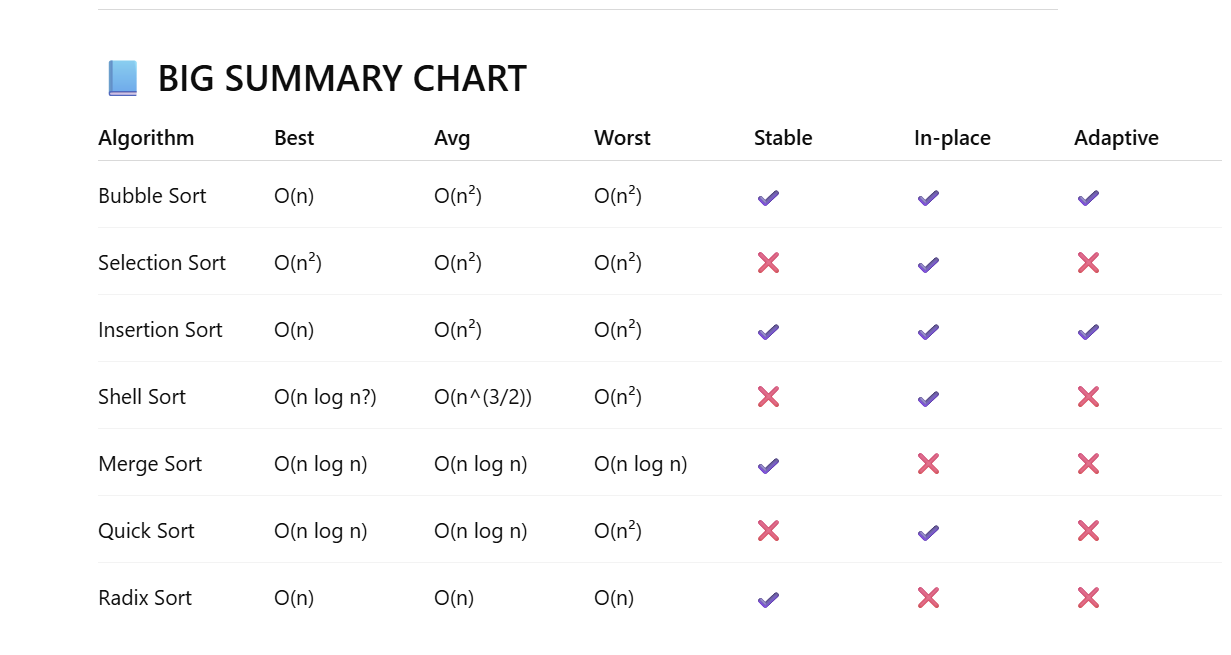
Which two have the same for every case
Merge and selection
Merge - O(nlogn)
Selection - O(n²)
Induction
Prove that if T = n something for 1 step, it’ll equal the same thing for T= n+1
State base case and verify numerically
State hypothesis- Assume true for n = k
Algebra - start from n = k+1 (or n=2k for recurrences on powers of two) and substitute hypothesis where needed
Conclude true for all n
Insertion and bubble sort have the same runtimes and properties
True
Stable
Bubble insertion merge radix
 Note
Note  Flashcards (74)