unit 4 ap psych
 Call Kai
 Learn
Learn Practice Test
 Spaced Repetition
 Match
Match Flashcards
 Knowt Play
1/118

There's no tags or description
Looks like no tags are added yet.
Name | Mastery | Learn | Test | Matching | Spaced | Call with Kai |
|---|
No analytics yet
Send a link to your students to track their progress
119 Terms
Conformity
The act of matching attitudes, beliefs, and behaviors to group norms.
Normative Social Influence
Influence that leads to conformity in order to be liked or accepted by the group.
Social Norms
Expected standards of behavior and beliefs established by a group.
Relative Deprivation
The perception that one is worse off relative to those with whom one compares oneself.
Upward Social Comparison
Comparing oneself to others who are perceived to be better off.
Downward Social Comparison
Comparing oneself to others who are perceived to be worse off.
Informational Social Influence
Influence that leads to conformity because a person believes the group is competent and has the correct information.
Obedience
Changing one's behavior in response to a direct order from an authority figure.
Social Facilitation
The tendency for people to perform differently when in the presence of others than when alone.
Group Polarization
The tendency for group discussion to enhance the group's prevailing attitudes.
Groupthink
A mode of thinking that occurs when the desire for harmony in a decision-making group overrides a realistic appraisal of alternatives.
Bystander Effect
The phenomenon where individuals are less likely to offer help to a victim when other people are present.
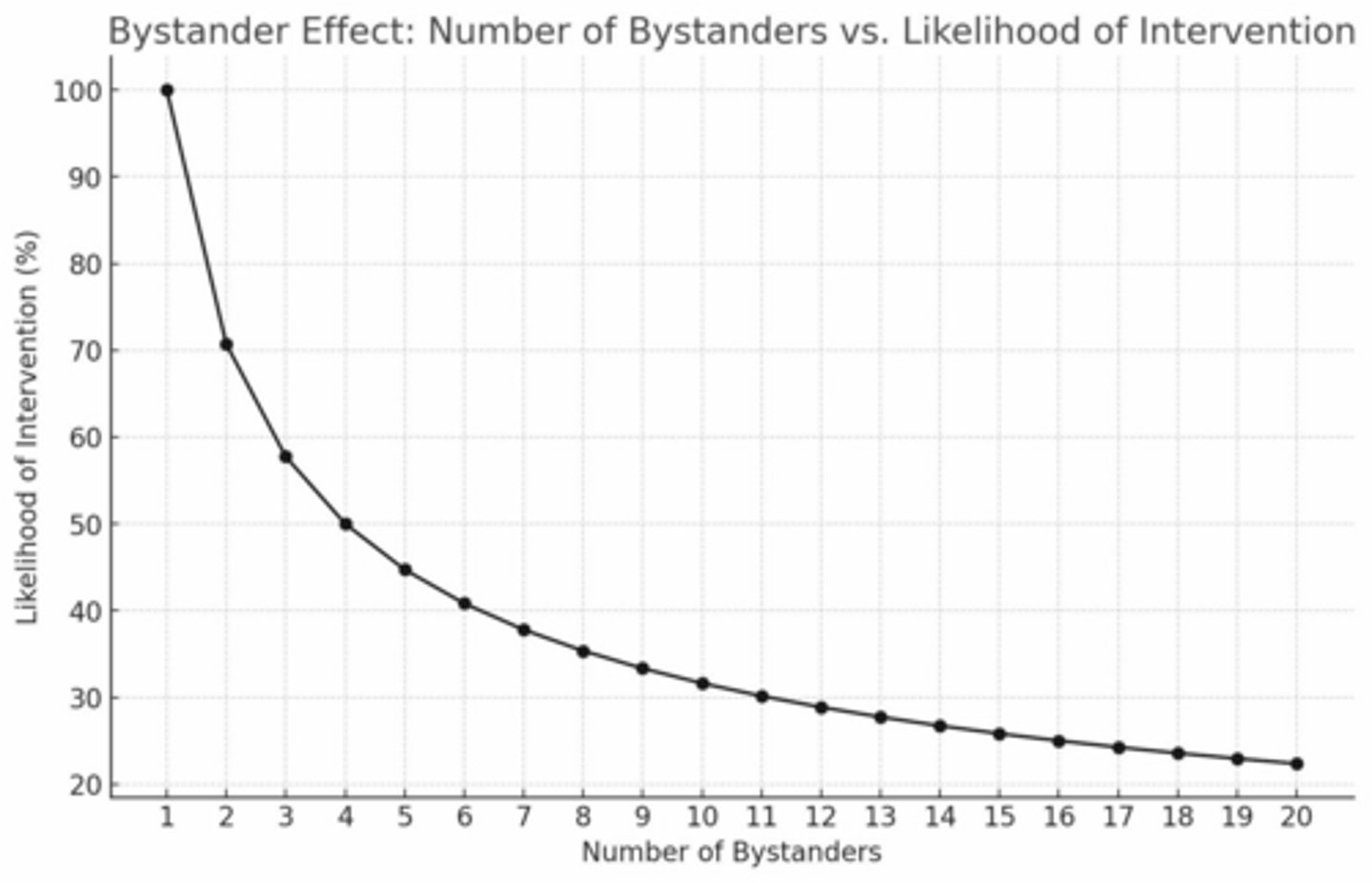
Diffusion of Responsibility
A social phenomenon wherein individuals feel less compelled to take action when others are present.
Social Loafing
The tendency for individuals to put in less effort when working in a group than when working alone.
Deindividuation
The loss of self-awareness and individual accountability in groups.
Attribution Theory
A theory that explains how individuals determine the causes of behavior and events.
Dispositional Attributions
Attributions that assign the cause of behavior to internal characteristics of the actor.
Situational Attributions
Attributions that assign the cause of behavior to external factors or situations.
Explanatory Style
The way in which individuals explain the events in their lives, which can be optimistic or pessimistic.
Optimistic Explanatory Style
A way of explaining events that focuses on positive outcomes and sees setbacks as temporary.
Pessimistic Explanatory Style
A way of explaining events that focuses on negative outcomes and sees setbacks as permanent.
Fundamental Attribution Error
The tendency to overemphasize personal characteristics and ignore situational factors in judging others' behavior.
Actor-Observer Bias
The tendency to attribute one's own actions to situational factors while attributing others' actions to dispositional factors.
Self-Serving Bias
The tendency to attribute positive events to one's own character but attribute negative events to external factors.
Internal Locus of Control
The belief that one can control their own life and outcomes through their actions.
External Locus of Control
The belief that outside forces, such as fate or luck, control one's life.
Altruism
The selfless concern for the well-being of others.
Social Responsibility Norm
The expectation that people will help those needing help.
Stereotype
A widely held but oversimplified and generalized belief about a particular group of people.
Confirmation Bias
The tendency to search for, interpret, and remember information in a way that confirms one's preconceptions.
Belief Perseverance
The tendency to cling to one's initial beliefs even in the face of contrary evidence.
Self-Fulfilling Prophecy
A belief that leads to its own fulfillment due to the influence of that belief on behavior.
Prejudice
A preconceived opinion that is not based on reason or actual experience.
Discrimination
The unjust or prejudicial treatment of different categories of people.
Implicit Attitudes
Attitudes that are automatically activated and may not be consciously recognized.
Just-World Phenomenon
The belief that the world is fair and people get what they deserve.
Out-Group Homogeneity Bias
The perception that members of a different group are more similar to each other than they really are.
In-Group Bias
The tendency to favor one's own group over others.
Mere Exposure Effect
The phenomenon whereby people tend to develop a preference for things merely because they are familiar with them.
Ethnocentrism
The belief in the superiority of one's own ethnic group.
Collectivism
A cultural value that emphasizes the importance of groups and the well-being of the group over individual interests.
Multiculturalism
A perspective that recognizes and values the diversity of cultures within a society.
Superordinate Goals
Goals that require the cooperation of two or more groups to achieve, leading to reduced intergroup conflict.
Social Traps
Situations in which individuals or groups act in their own self-interest and ultimately harm the collective interest.
Persuasion
The process of convincing someone to change their beliefs, attitudes, or behaviors.
Central Route of Persuasion
A method of persuasion that involves careful and thoughtful consideration of the arguments presented.
Peripheral Route of Persuasion
A method of persuasion that relies on superficial cues rather than the content of the message.
Halo Effect
The tendency for an impression created in one area to influence opinion in another area.
Foot-in-the-Door Technique
A persuasion strategy that involves getting a person to agree to a large request by first setting them up with a smaller request.
Door-in-the-Face Technique
A persuasion strategy that involves making a large request that is expected to be refused, followed by a smaller request.
False Consensus Effect
The tendency to overestimate the extent to which others share our beliefs and behaviors.
Cognitive Dissonance
The mental discomfort experienced by a person who holds two or more contradictory beliefs, values, or ideas.
Industrial-Organizational (I/O) Psychologists
Psychologists who study human behavior in organizations and the workplace.
Instincts
Innate behaviors that are biologically programmed and occur in response to specific stimuli.
Drive-Reduction Theory
A theory suggesting that motivation arises from the desire to reduce internal tension caused by unmet biological needs.
Ghrelin
A hormone that stimulates appetite and is produced in the stomach.
Leptin
A hormone that helps to regulate energy balance by inhibiting hunger, produced by adipose (fat) tissue.
Belongingness
The human emotional need to be an accepted member of a group.
Arousal Theory
The theory that individuals are motivated to maintain an optimal level of arousal, which varies from person to person.
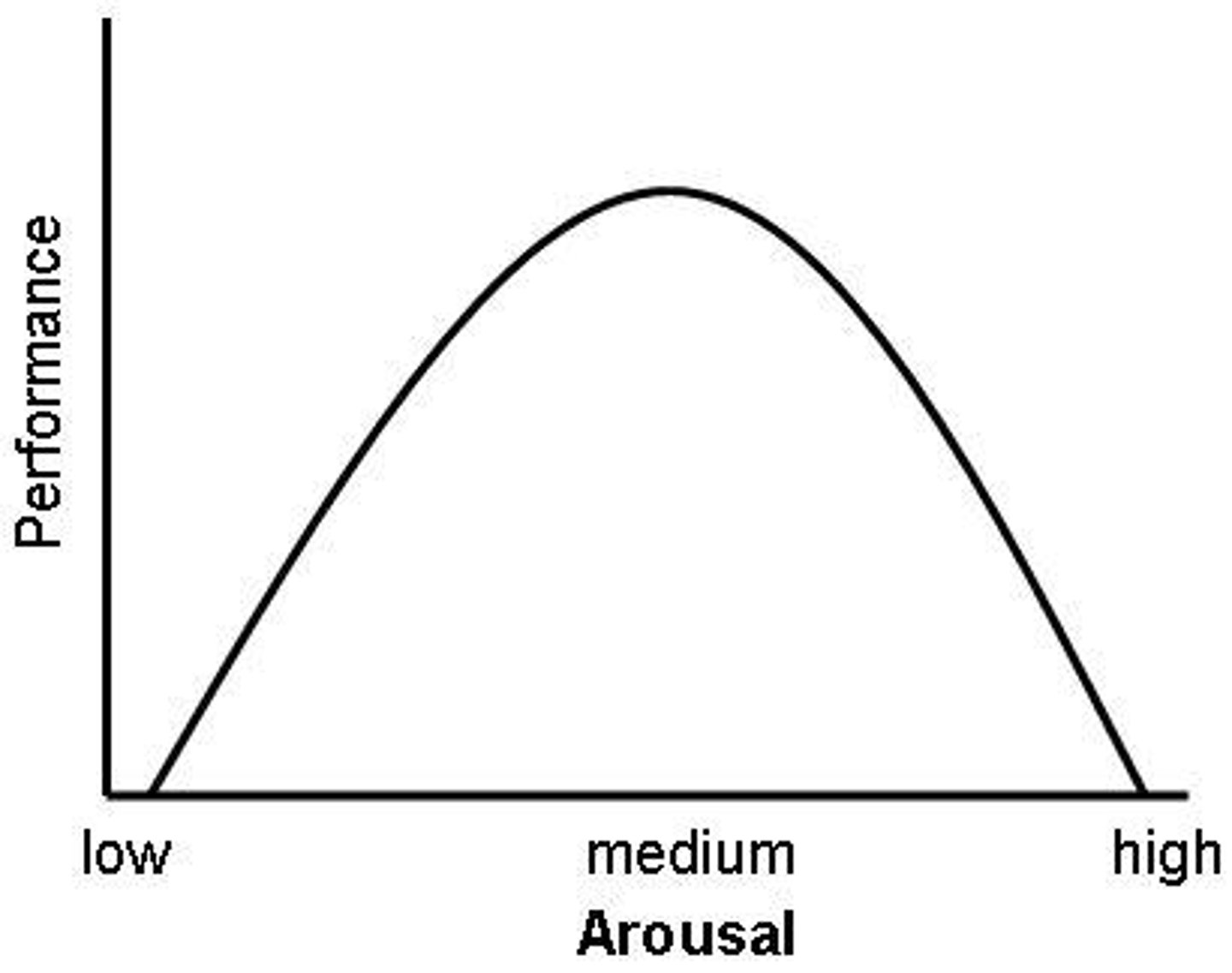
Yerkes-Dodson Law
A principle that suggests there is an optimal level of arousal for performance, with too little or too much arousal leading to poorer performance.
Sensation-Seeking Theory
A theory that posits individuals have varying levels of desire for novel and intense experiences.
Adventure Seeking
A type of sensation-seeking characterized by a desire for thrilling and risky activities.
Disinhibition
The tendency to act impulsively without considering the consequences, often associated with increased arousal.
Boredom Susceptibility
A trait associated with a low tolerance for boredom, leading to a desire for novel experiences.
Incentive Theory
A theory suggesting that behavior is motivated by external rewards or incentives.
Self-Determination Theory
A theory of motivation that emphasizes the role of intrinsic and extrinsic factors in driving human behavior.
Intrinsic Motivation
The motivation to engage in a behavior because it is inherently interesting or enjoyable.
Extrinsic Motivation
The motivation to engage in a behavior for external rewards or to avoid negative outcomes.
Approach-Approach Conflicts
A type of conflict that occurs when a person must choose between two desirable options.
Avoidance-Avoidance Conflicts
A type of conflict that occurs when a person must choose between two undesirable options.
Approach-Avoidance Conflicts
A type of conflict that occurs when a person is faced with a single choice that has both positive and negative aspects.
Emotion
A complex psychological state that involves a subjective experience, a physiological response, and a behavioral or expressive response.
Elicitors
Stimuli or events that trigger emotional responses.
Arousal Comes Before Emotion
The idea that physiological arousal occurs before the experience of emotion.
Facial-Feedback Hypothesis
The theory that facial expressions can influence emotional experiences.
Arousal and Emotion Occur Simultaneously
The idea that emotional experiences and physiological responses happen at the same time.
Arousal + Cognitive Label = Emotion
The theory that an emotional experience is determined by the combination of physiological arousal and the cognitive interpretation of that arousal.
Broaden-and-Build Theory of Emotion
A theory suggesting that positive emotions broaden an individual's awareness and encourage novel, varied, and exploratory thoughts and actions.
Universal Emotions
Emotions that are recognized and expressed similarly across different cultures, such as happiness, sadness, fear, anger, surprise, and disgust.
Display Rules
Cultural norms that dictate the appropriate expressions of emotions in various situations.
Psychodynamic Theory
A psychological perspective that emphasizes the influence of the unconscious mind and childhood experiences on behavior.
Preconscious Mind
The part of the mind that contains thoughts and feelings that are not currently in awareness but can be easily brought to consciousness.
Unconscious Mind
The part of the mind that contains thoughts, memories, and desires that are not accessible to conscious awareness.
Ego Defense Mechanism
Psychological strategies used by the ego to protect itself from anxiety and to maintain a sense of self.
Denial
A defense mechanism where an individual refuses to accept reality or facts.
Displacement
A defense mechanism that involves redirecting emotions from a threatening target to a safer one.
Projection
A defense mechanism where individuals attribute their own unacceptable thoughts or feelings to others.
Rationalization
A defense mechanism that involves providing logical reasons or excuses for behaviors that are actually motivated by irrational factors.
Reaction Formation
A defense mechanism characterized by expressing the opposite of one's true feelings.
Regression
A defense mechanism where an individual reverts to behaviors characteristic of an earlier stage of development.
Repression
A defense mechanism that involves unconsciously blocking unacceptable thoughts or feelings from awareness.
Sublimation
A defense mechanism that involves channeling unacceptable impulses into socially acceptable activities.
Humanistic Psychology
A psychological perspective that emphasizes personal growth, self-actualization, and the inherent goodness of people.
Unconditional Regard
An attitude of total acceptance toward another person, regardless of their behavior.
Homeostasis
The tendency of biological systems to maintain stability while adjusting to conditions that are optimal for survival.
Hypothalamus
A region of the brain that regulates various bodily functions, including hunger, thirst, and temperature.
Pituitary Gland
A small gland located at the base of the brain that produces hormones regulating various bodily functions.
Standard Deviation
Measure of spread or variability from the mean
Normal Distribution
Bell curve
Data Spread
Shows how spread out data points are

