CSC3B CH1 Past Papers
 Studied by 0 people
 Call Kai
 Learn
Learn Practice Test
 Spaced Repetition
 Match
Match Flashcards
 Knowt Play
1/28

There's no tags or description
Looks like no tags are added yet.
Name | Mastery | Learn | Test | Matching | Spaced | Call with Kai |
|---|
No analytics yet
Send a link to your students to track their progress
29 Terms
Describe three challenges that mobile operating system designers must consider that typically do not have to be considered when designing desktop operating systems. (6)
Name and briefly describe the hardware components involved when you save a file. (8)
Briefly describe Interrupt Vector. (2)
Briefly describe cache memory. (2)
Briefly describe volatile memory. (2)
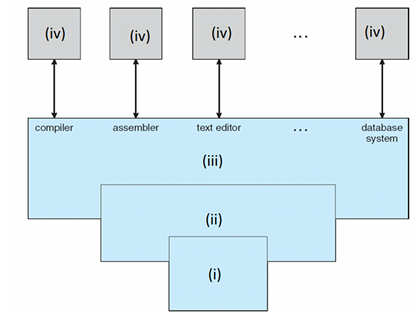
Identify components i-iv depicted in the diagram below. (4)
State which of the following memory is either volatile or nonvolatile. (4)
Main memory
Hard disk
USB Memory stick
Cache Memory
Briefly describe the differences between symmetric multiprocessing and asymmetric multiprocessing. (2)
Discuss the role each of the four storage-devices play when a program is executed. The four storage-devices are part of the storage-device hierarchy. (8)
One of the activities performed by operating systems is memory management. Briefly describe two memory management activities. (4)
Discuss the role of the operating system as a resource manager, specifically in context of the processor and main memory as resources. (5)
Consider the following assembly command, as it is displayed in a debugger.
00401072| add ecx,0x1
The processor is just about to execute the instruction in memory 00401072.
Discuss what happens during the fetch, decode and execute phase of the processor while executing the above instruction. Include in your discussion the following aspects:
Describe what happens with the program counter and ecx registers in the various phases.
The role of the Control Unit (CU) and Arithmetic Logic Unit (ALU) in each of the phases.
Make sure to group your discussion according to the three phases. (8)
Handling I/O can be done in three (3) different ways. One of the ways is through Direct Memory Access (DMA). Briefly describe the other two (2) ways of handling I/O. (4)
Discuss system calls. Include in your discussion the following aspects: (8)
The use of the stack in system calls.
The use of operating system provided libraries during system calls.
The difference between a normal function call and a system calls with regards to the processor’s mode.
The relationship between a system call, system call number and system call handler.
Describe what is meant by an operating system as a control program. (4)
List four operating system activities related to process management. (4)
Describe solid-state disks. (2)
A computer system may contain many components. Three (3) of the components are the main memory, cache memory and the central processing unit (CPU). On a high level, describe the interplay between these components when a spreadsheet process calculates a class list’s final marks. (6)
How would you visually identify the difference between a dual-core motherboard and a dual processor motherboard? (2)
Kernel mode and a virtual machine manager can be logically organized as separate layers in relation to hardware. How are these layers organized? (2)
An operating system is responsible for allocating resources. Discuss four (4) different resources and state how the operating system will allocate the resources. (8)
Why are the smallest memory units in computers related to bytes instead of bits? (2)
List four storage devices, in order of slowest to fastest, that can be found on a typical desktop computer. (4)
Name and briefly describe the two types of multiprocessing. (4)
Name the two modes used by a computer to protect the operating system and system components. (2)
Describe two reasons why it is normally not possible to have programs and data to reside in main memory permanently. (4)
What is the purpose of an interrupt? (2)
What is the difference between an interrupt and a trap? (2)
Name two other terms used for kernel mode. (2)
 Note
Note  Flashcards (260)