Reflection
When waves arrive at a boundary between two different materials, three things can happen:
- The waves are absorbed by the material the wave is trying to cross into-this transfers energy to the material’s energy stores
- The waves are transmitted-the waves carry on travelling through the new material, which often leads to refraction
- The waves are reflected
What actually happens depends on the wavelength of the wave and the properties if the materials involved
- There’s one simple rule to learn for all reflected waves:
Angle of incidence = Angle of reflection
- The angle of incidence is the angle between the incoming wave and normal
- The angle of reflection is the angle between the reflected wave and the normal
- The normal is an imaginary line that’s perpendicular to the surface at the point of incidence
The normal is usually shown as a dotted line 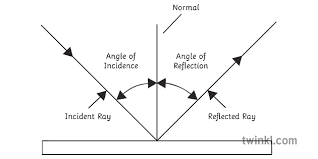
- Waves are reflected at different boundaries in different ways
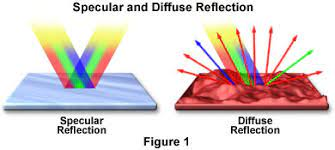
- Specular reflection happens when a wave is reflected in a single direction by a smooth surface
- Diffuse reflection us when a wave is reflected by a rough surface and the reflected rays are scattered in lots of different directions
- This happens because the normal is different for each incoming ray, which means that the angle of incidence for each ray. The rule of angle of incidence = angle of reflection still applies
- When light is reflected by a rough surface, the surface appears matte and you don’t get a clear refection of objects