pluarlism all
 Call Kai
 Learn
Learn Practice Test
 Spaced Repetition
 Match
Match Flashcards
 Knowt Play
1/142

There's no tags or description
Looks like no tags are added yet.
Name | Mastery | Learn | Test | Matching | Spaced | Call with Kai |
|---|
No analytics yet
Send a link to your students to track their progress
143 Terms
what is a multi faith society?
many different religions living together in one society
what are some reasons for the increase in multifaith societies?
technological developments
- cultural influences
- globalisation
- people moving away
- modern abilities to communicate + travel
- tolerance to other religions
what are some reasons for migration?
- safety
- economic development
- family
what has migration led to?
christianity seeing new influences + denominations
what is inter-faith dialogue?
conversation between different faiths
what are the three main causes of interfaith dialogue?
migration
the holocaust
modern tensions with islam
migration
may be due to safety, economic development or family
exposed more people in the west to eastern beliefs
holocaust
forced christians to think about its relationship with judaism - jews seen as those who have failed to become christian
modern tensions w islam
importance of seeking common ground + loving your neighbour
aims of interfaith dialogue: exclusivists
- open conversation so people from other faiths can be converted
- understand where those from other faiths are coming from + find common ground to point toward the christian message
aims of interfaith dialogue: inclusivists
- create dialogue between both institutions (anon christianity) + individuals (anon christians)
aims of interfaith dialogue: pluralists
- discover diff understandings of the truth + enhance own understanding of the real
- stop conflicts between diff religions + lead to peace
catholic church: redemptoris missio (1990)
- papal encyclical
- pope john paul II
- foccused on the missionary work of the church in a multi faith world
- catholics must remember they have a mission to non catholics, remain open + honest and respectful and never shy away from the truth of the gospel
key points in the redemptoris missio
- no conflict between belief in christ + IFD
- IFD is an opportunity to give a full account of christian belief
- all religions hold aspects of the truth + are led by the HS (dialogue needs to be respetful without the motive of conversion)
- dialogue helps the church find out which aspects of the truth are held by other individuals/institutions
- key aim is to build a happy society
- mission is for all members of the church not just priests
- missionaries need to be persistent in their work
CofE: sharing the gospel of salvation (2005)
- acknowledges that modern britain is a multi faith society which everyone shares
- affirms that salvation has been achieved through the christ event + christians must proclaim this
key points of the stgos
role of christians:
- be sensitive to those around them - do not try to make a sale
- develop good relationships with people in the spirit of welcoming in the hope they will be baptised in the future
- live a good christian lifestyle as distinct + authentic christians
- work for the common good of society
- rememeber they could be a missionary in a number of contexts not just more obvious ones + to do this through being proud of your tradition
four aspects to dialogue
- daily life
- common good
- mutual understanding
- spiritual life
what is the scriptual reasoning movement?
- began in the US + has been adapted by the cambridge interfaith programme
- tool to help with IFD
- purpose is not to convert but to help those form diff faith backgrounds to understand where + why they disagree about different truth claims + discuss them in a safe place
- movement started w jews, christians + muslims
methods in the scriptural reasoning movement
- sessions focus on one text from each tradition + look at the text in the common language
- facilitator leads + people will read the texts and discuss their messages
- some of the context of the passages will be explored try to understand where the text is coming from
texts are understood in two ways:
- as texts themselves: language, themes, historical contexts, structure
- being read: how the text is read + understood in the modern life of the faith
if the participants are academics, texts will be approach in one way, if they are scholars it will be different
one of the rules of a session is that the focus must remain on the texts and should not become a general discussion of the religion
participants are encouraged not to speak for their faith
aims of the scriptural reasoning movement
- maintain a spirit of dialogue
- no conversion
- wisdom (everyone is united in their desire for wisdom)
- collegiality (everyone is an equal participant)
- hospitality (non judgemental)
Michael Barnes
"In the middle of such a chaos of human religiosity, the mainstream Christian churches can be forgiven for feeling overwhelmed."
Church of England, The Mystery of Salvation
"Because ultimate salvation is found in Christ, mission remains the central task of the Christian Church..."
Redemptoris Missio
"... the Church sees no conflict between proclaiming Christ and engaging in inter-religious dialogue."
Church of England, Sharing the Gospel of Salvation
"Proclamation is not the same as selling a product in the market place... this is not incompatible with inter-faith dialogue."
if christ is the truth, can there be any other means of salvation?
no: exclusivist view
- the claim god became human is too different from other truth claims of other faiths + is not to be taken seriously
- disagreement does not call for compromise - this is the trend toward relativism
- whether someone deserves eternity in heaven/hell requires definite answers
- pluralism is nice in question but moves away from the possibility of there being truth
- approaches evidence from a natural theology standpoint but fails to notice essential + revealed christian truths eg effect of the fall
if christ is the truth, can there be any other means of salvation?
yes: inclusivist + pluralist view
- christ's truth is for all of humanity - incarnation took place out of love, this love is for everyone not just christians
- pluralism rejects christ as the truth - bible may not be literally true
- if god doesnt save others he is not worthy of our worship
- different worldviews can work together
would a loving god deny a human salvation?
pluralist - it is possible that god is present in different ways + different cultures for people to understand salvation
- original sin has made too great an impact on the world
- innocent suffering - sending those to hell who are not christians
- salvation is linked to our actions + intentions behind these actions
christ is the only way to salvation
- exclusivism is coherent - if jesus was god incarnate, this uniqueness suggests jesus is the only way to achieve salvation
- biblical evidence seems clear that god's plan in jesus was to save the world
christ is the only way to salvation
- to say christ is the only way to salvation is not the same as saying christianity is the only way to access salvation. jesus' death may have saved all people, regardless of religion, or even no religion
- church is a mediator between god + humans and the church's work is required for salvation - church was founded by jesus - only members can go to heaven
christ is not the only way to salvation
- omnibenevolent god would not exclude salvation from so many of his creation
- undermines the role of the holy spirit - trinity is another foundational belief for christians + exclusivism ignores the concept of the trinity
- parable of sheep + goats - good ppl from all nations not just christianity - will be saved
- if other religions have rays of truth, what is stopping members from those religions being saved?
anonymous christians can receive salvation
- maintains the central belief of jesus as the saviour of the world but rejects belief in a god who allows the majority of ppl to be condeemned
- inclusivism clarifies how other aspects of human experience can be said to come from god - naive to think god only speaks to ppl through christian practises
- inclusivism acknowledges aspects of the reality of our world as a multi-faith enviroment
- accepts that humans will fall short of perfection through their life + nobody should be punished for trying to seek truth
anonymous christians cannot receive salvation
- inclusivism is patronising to other religions - other religions are not seen as having any benefits of their own
- little biblical evidence for this approach - evidence couldve been misinterpreted
- undermines the importance of jesus' incarnation + death on the cross - only by someone directly accepting this can salvation be found
- some catholics reject rahner's approach bc he gives too little importance to the work of the church as a mediiator of god (eg sacraments)
pluralism does undermine central christian belief
- christian belief is christocentic but they should be theocentric bc christians do not worship jesus over god
- accepts other religious experience of the divine + other religions claims ab miracles are all equally likely to be valid - no reason christian claims should be better than the others
- concept of the real allows christians to accept that god is greater than any human institution
pluralism does not undermine central christian beliefs
- christian message through the bible + tradition is clear; christ event was unique and eternally significant + makes the christian religion the true faith - pluralism questions this but this does not make it wrong
- idea of the christian story being a myth does not explain why the early christians founded a religion on the absurd ideas of god becoming human + then rising from the dead
- hick's pluralism does not explain why certain religions are valid + others are not
all good people will be saved
- sheep and goats - we will be judged based on our actions + rich man + lazarus suggests those who are not charitable will not be saved
- god loves all people, made in his image + would not leave those who have tried to pursue truth behind from any background in life
- earliest traditions put more emphasis on actions rather than faith - this suggests the emphasis on jesus' message has been lost
all good people will not be saved
- if people are to be saved according to christian faith, they need to have both faith + good works in their lives
- also may be used as an excuse to not live a good christian life - those who have end up in the same place as everyone else and feel as if their faith has been undermined
- arguably nobody is truly good unless you follow the right spiritual/religious way of life
- nobody deserves to be saved (romans: 'all have sinned and fall short') either due to the fall or free will - god's love is tough love and doesnt neccesarily mean we will be saved
a loving god would deny people salvation
- god's love isnt the same as our love - benevolence is ab justice and tough love
- a true relationship w god comes from the free choice to enter into the relationship - a truly loving god would never deny people that freedom of choice
- if salvation is for all people, it is not logical to have religion or even life on earth - what is the purpose of life if we dont choose god/he doesn't choose us
- if salvation is only for those elected, god's love will not save everyone else
a loving god would not deny people salvation
- the claim that all people are made in god's image is fundamental to the bible + god loves all people and wants to treat them equally
- hick + pluralists wouldnt accept that god would deny ppl salvation based on being brought up in a diff culture
- if god denies people salvation, the problem of evil would be made worse as god would be condeming his creation to infinite suffering
- god of love may offer ppl the chance to turn to him after death in ways ppl on earth cannot currently understand
define exclusivism
- only christianity holds the truth + can offer salvation
define restricted access exclusivism
salvation comes from hearing the christian message and accepting it into your life
- humans are sinful + no one deserves to be saved - how some have never heard the christian message
define universal access exclusivism
god wishes everyone to be saved
- jesus' salvation restored all of humanity
- can be at the moment of death or after death: everyone has the opportunity to become christian
exclusivism
- calvinists - the bible is clear that fallen humanity was restored by the unique sacrifice of jesus'
'i am the way, the truth and the life. no one comes through the father except through me'
catholic views on exclusivism
- there is no salvation outside the church
- a person must be baptised + live a faithful catholic life to go to heaven
- excludes all other denominations
- acknowledges other denominations hold aspects of the truth, but the full aspect of the truth + salvation can only be found in the catholic church
weaknesses of exclusivism
- leads to war + conflict and treating others as less valuable
- god cannot be loving if he condemns people who havent heard the christian message
- god cannot be fully understood - it is not possible to say anyone can have full control of the truth
- bible suggests people are judged on their actions and not beliefs
- not fair that the catholic church says other religions are a preparation for the gospel but people cannot be saved if they are not part of the church
strengths of exclusivism
- jesus as the son of god - christianity holds the truth in a way others don't
- universal access exclusivism is respectful of other faiths - allows for people to seek the truth
- catholic approach is respectful of other faiths - allows for some truth to be found in other religions
christianity as the normative way to salvation
- christianity is the usual/ideal way to be saved
but not the only one
what is inclusivism?
it is possible for non-christians including anonymous christians to be saved
- all people have a spiritual aspect to themselves which makes them search for the truth
inclusivist views
christianity is the one true faith and normative means to salvation
some non-christians will be saved if they have lived good lifestyles
what is an anonymous christian?
someone who is open to god's grace but is not christian
karl rahner - german catholic thinker
- christianity is the one true religion (bc of jesus) but even before jesus, christianity had a history + people in the OT must have been able to be saved
- other religions can help people to salvation but only until a person encounters the christian message - choice to accept/reject
- christian missionaries mustn't assume non-christians have no experience of the truth
- church needs to be the visible expression of what other institutions have in an invisible way
rahner - quote
'all men must be capable of being members of the church'
rahner - acts 17
- paul making a speech in athens
- commends his listeners for an altar he found marked to an unknown god
they'd been worshipping the christian god without knowing
- his role is to explain who this god is
it is valid for those of other religions to worship god in their own way until they encounter fully the christian message
rahner - beliefs
- institutions can be a form of anonymous christianity - they have structures that explore truth + salvation and can be a means of grace
- individuals can be anonymous christians - people who do not identify as members of a religious institution are good and moral and search for the truth
inclusivism - strengths
- acknowledges the sensus divinitas
- balances the unique christ event + idea of a loving god saving humans
- conforms to biblical ideas of jewish people chosen by god + saved without knowing
inclusvism - weaknesses
- patronising to other religions - a christian could be an anonymous hindu
- decentralises christ from salvation + undermines the role of the church in the world
- the same thing as universal access exclusivism - christianity remains inferior to others - rahner is trying to make christianity look more accesible
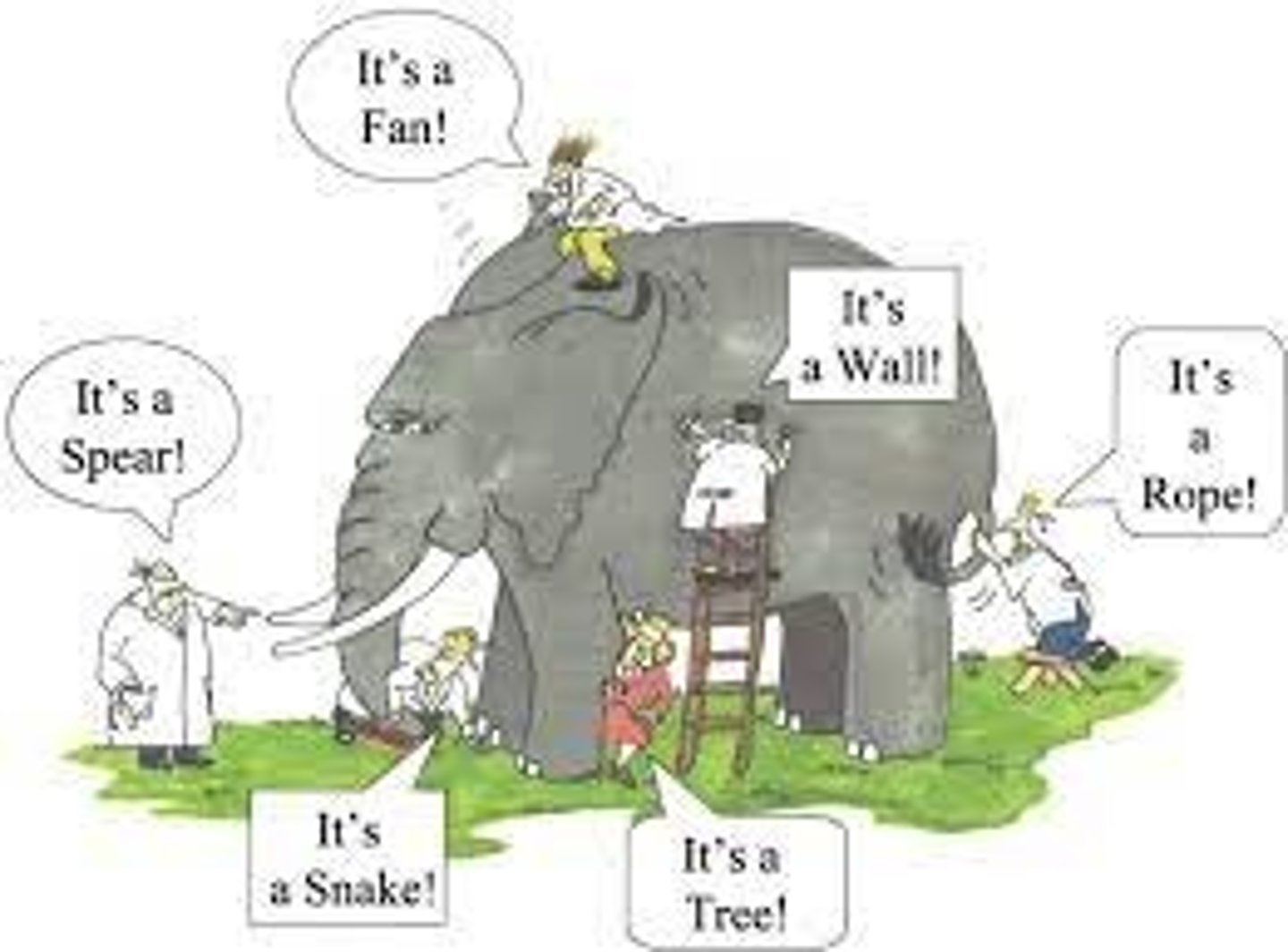
pluralism - blind men + elephant analogy
if a group of blind men come across an elephant + each touch a different part they will each gain a different understanding of what the elephant is
each is equally valid + limited
an exclusivist view is only one part of the elephant - not the full picture
what is pluralism?
the view that there are many ways to salvation, christianity is only one
john hick - pluaralist
- inspired by the multi-cultural city of birmingham
- natural theologian - all that needed to be known should be able to be deduced from this world
- religious experience is common to all faiths - interpreted through individual faith traditions
- different people experience + interpret reality in diff ways
- cultural differences provide different lenses to experience the divine through
hick: influence from kant
- noumena (what a thing actually is)
- phenomena (how we individually experience it)
- the noumena of the divine (real/eternal one) is one thing, but experienced through different phenomena (religions)
all of these phenomenal ways are equally valid
hick on theocentrism
- christianiy is christocentric
- hick - the central point shouldn't be christ/christianity but god
- theology of religion should be theocentric (centered on god)
- christianity's claims on truth (incarnation, resurrection) need to be interpreted as mythical (some truth elements) not factual ones
- hick: other religions produce equally good people as christianity, why would christianity be superior?
weaknesses of pluralism
- assumes kant's philosophical approach is correct
- assumes there is a 'real' of a divinity
- if christianity is simply a myth, any aspect of truth becomes lost because there is nothing to believe in
- christians - the christ event is a unique thing that other religions do not have
- atheists - it is an assumption that there is any reality behind it at all - we should reject it altogether
strengths of pluralism
- recognises the foundation of many religious beliefs are outdated + narrow - need to be reconsidered
- more accepting view of other religions
catholic church: redemptoris missio
- 1990
- papal encylical (letter from pope to church)
- pope john paul II
- focused on the missionary work of the church in a multi faith world
- catholics have a mission to non-catholics
- must remain open, honest + respectful but remember not to shy away from the truth of the gospel
'dialogue with our brothers and sisters of other religions' - redemptoris missio
- no conflict between belief in christ + interfaith dialogue
- interfaith dialogue is an opportunity to give a full account of christian belief
- all religions hold aspects of the truth + are led by the holy spirit
Theology of Religion
The branch of theology that examines the status of different religions in relation to each other
Restricted Access Exclusivism
Salvation comes from hearing the Christian message and accepting it into your life
Universal Access Exclusivism
The idea that God wishes everyone to be saved
Normative way to salvation
The usual or ideal way to be saved, but not necessarily the only one
Anonymous Christian
Someone who is open to God's grace but is not a Christian
Social cohesion
A society that works well together - has a sense of identity and community
Evangelism
Spreading the Christian message
Rahner
"Somehow all men must be capable of being members of the Church."
Catechism
"The Catholic Church recognises in other religions that search... for the God who wants all men to be saved."
Pope Paul VI
"The Catholic Church rejects nothing of what is true and holy in these religions..."
Dominus Iesus
"If it is true that the followers of other religions can receive divine grace, it is also certain... they are in a gravely deficient situation with those... in the Church."
Redemptoris Missio
"Dialogue is a path toward the Kingdom."
Matthew 28
"... go and make disciples of all nations."
Karl Barth
"Revelation singles out the Church as the locus of true religion."
Karl Barth
"There is no condemnation - literally none - for those that are in Christ Jesus."
Barmen Declaration
"...deliver all people, through preaching and sacrament, the message of the free grace of God.'
John Hick
"What we are picturing here as a future possibility is not a single world religion, but a situation in which the different traditions no longer see themselves as each other as rival ideological communities.
heim
- hick is not a true pluralist
- hick is an inclusivist in disguise as he considers the major world religions as authentic but not satanism
- hick argues certain types of ethical behaviour leads to salvation + true pluralism wouldnt do this
knitter
Developed a separate pluralism to Hick. All religions have a soteriological aim of liberating humanity from suffering & injustice. They all have the same primary aim, which is concern & justice for others. Theology provides a means by which different religions can share & discuss their differing perspectives of justice.
barth
Christ is essential for salvation. Jesus was the living Word of God. The Word consists of 3 forms, Jesus, the Bible & the Church. The Bible & the Church become the Word of God when God chooses to use them to reveal himself. Jesus is the only totally reliable way to gain knowledge of God.
russell
Since religions disagree, not more than one can be true.
calvin + augustine
God elects through his grace a small number of Christians for heaven. So simply belonging to Christianity & adopting Christian beliefs is not a guarantee of salvation.
race
Identified 3 broad perspectives that Christians might adopt when understanding their relationship to believers of other faiths. Race called them exclusivism, inclusivism & pluralism.
kraemer (exclusivist)
Non-Christians cannot achieve salvation & need to convert to Christianity. It doesn’t make sense to look at religions & pick out beliefs & practices that seem the most Christian & use them as points of contact. Religions are whole belief systems, so have to be viewed in their entirety.
origen + gregory of nyssa
Supported universalism, that everyone would eventually be reconciled with God after death.
hans urs von balthasar
Jesus’ crucifixion & resurrection are central to human salvation. The Church shouldn’t hide in a modern secular society, but should be courageous in its claims that salvation is to be only found in Christ.
ward
Sometimes we have to conclude that beliefs between religions are different & conflicting, but can be equally valid.
rahner - structural inclusivism
Viewing Christianity as absolute seems to exclude anyone who lived before Jesus or is unable to hear God’s message from salvation.
Humans desire grace & salvation.
Other religions must have a means of aiding their followers to the saving grace offered by God. There could be a partial truth in other world religions, whose followers don’t know of Jesus. People who don’t know Christ can have genuine faith in God, these are ‘anonymous Christians’.
He develops Aquinas’ notion of votum ecclesia , which means wanting to be a part of the Church, to argue that wanting grace by faithfully following a non-Christian religion is sufficient to receive God’s grace. He believes the Church can’t be an exclusive community, rather it has an important role in bringing Christian teachings into the wider world.
hick - pluralism
suggested there was a need for a Copernican revolution in philosophy. Copernicus had suggested that the earth wasn’t at the centre of the universe, but that the earth was just 1 of many planets orbiting the sun:
Instead of seeing Christianity as a normative absolute, Hick thought people should place God at the centre. Hick became aware that not all religions are theistic. Hick used Kant’s ideas to argue that religion is a phenomenal, human attempt to understand God.
Every religion falls short of the truth because none are capable of a noumenal understanding of God. Hick argues that authentic religions are those that uphold Kant’s Categorical Imperative & the commandment to treat one’s neighbour as you wish to be treated. Christianity needs to be theocentric (God focused), not Christocentric (Christ centred).
THEOCENTRIC > CHRISTOCENTRIC
d'costa
divided exclusivism into 2 groups; restrictive-access & universal-access:
Restrictive-access is similar to Calvin, it is the view that salvation is only for those who hear & respond to the gospel in their earthly lives.
Universal-access hold that Christ’s salvation is offered to all & it is the will of God that everyone should come to love him.
spilt inclusivism into 2 groups:
structural inclusivism is that any religion who has an openness to God’s grace as revealed in Jesus may receive God’s salvation
restrictive inclusivism is that while God makes provision for those who haven’t heard the gospel, a non-Christian religion cannot be salvific.
panikkar
Emphasised the mystery of the divine. We need to discover truth by living it, choosing actions & words with a vision of harmony between people. He spoke of Christophanny, meaning Christ made plain to human consciousness. Christ isn’t a specific individual, but a name for God showing himself to people. He viewed religious pluralism as a spiritual, rather than intellectual position.
Barnes
Interfaith dialogue is a risky option for Christians because it necessarily means that those involved will have to question the teachings of the Church.
Prince Charles
Has said that when he becomes King, he wishes to be known as ‘Defender of Faith’, not ‘Defender of the Faith’. This shows that Prince Charles is recognising the diversity & the rights of people to hold their own faith.
Vaughn
Under the romantic images conjured by a multifaith, plural society, people have deep worries about their identity & beliefs.
Steger
Globalisation refers to the way human lifestyles, consciousness & professions can influence each other from opposite sides of the globe.

