Quiz 9 infancy
 Call Kai
 Learn
Learn Practice Test
 Spaced Repetition
 Match
Match Flashcards
 Knowt Play
1/42

There's no tags or description
Looks like no tags are added yet.
Name | Mastery | Learn | Test | Matching | Spaced | Call with Kai |
|---|
No analytics yet
Send a link to your students to track their progress
43 Terms
Distinguish between language and communication. How are they the same and how are they different from each other?
Language- a formal system of communication, or a process by which we share information with others, that is structured and comprises grammar and vocabulary
Communication- the process by which we share information with others
Language is a form of communication.
Newborns communicate even though they do not realize they are communicating when they are crying to get a need met.
Explain how proto-conversations, gaze following, and pointing are communicative.
Proto conversations: back-and-forth interactions (like “talking” before words) an early form of social exchange characterized by vocalizations by infants and speech by a caregiver
Gaze following: Infants looks where another person looks, shared attention
Pointing: directs attention to objects shows intention to communicate
All show infants are actively engaging socially before speaking because they are wanting to talk to others and engage in a conversation even if they do not have language yet. Want to communicate with others but do not have the language to do so yet.
List the components of a formal language, and give an example of each.
Phonemes- smallest sound unit
Example: /b/, /a/, /t/ in “bat”
Morphemes – smallest meaning units
Example: “dogs” = dog + s
Syntax- rules of combining words
Example: “The dog runs” vs. “Dog the runs”
Pragmatics- social use of language
Example: speaking differently to a teacher vs. a friend

What is meant by a critical period for language development?
A biological based window when language is easiest to learn
Early childhood is the most sensitive time to learn a language before perceptual narrowing. Able to understand all the different phonemes.
Without exposure, language development is much harder later
Learning language, particularly a first language, has been argued to have a critical period. Specifically, learning a language is much easier at younger ages than older ages, and it may be impossible to learn a first language during adolescence or adulthood.
Can infants acquire more than one language? Explain why or why not
Yes. Infants can easily become bilingual
Their brains are flexible and can separate language systems
Early exposure actually strengthens language skills
Newborn infants from bilingual families discriminate between two languages that differ from each other in their rhythms , similar to newborn infants from monolingual families. Infants and young children who are regularly exposed to two languages acquire words in both of their languages.
What is the language acquisition device, and what is universal grammar?
Language acquisition device – Innate brain systems for learning language an instinctive mental capacity that is argued to allow for the acquisition of language with minimal input
Universal grammar – a set of structures or rules that govern all world languages
all languages share underlying rules
Suggest humans are biologically prepared for language.
Which theories of language development emphasize innate grammar? Which ones instead emphasize experience with language?
Innate grammar-
Nativist theory (Chomsky) built-in grammar system
Experience-
Behaviorist
Connectionism
Statistical learning
Social interactions
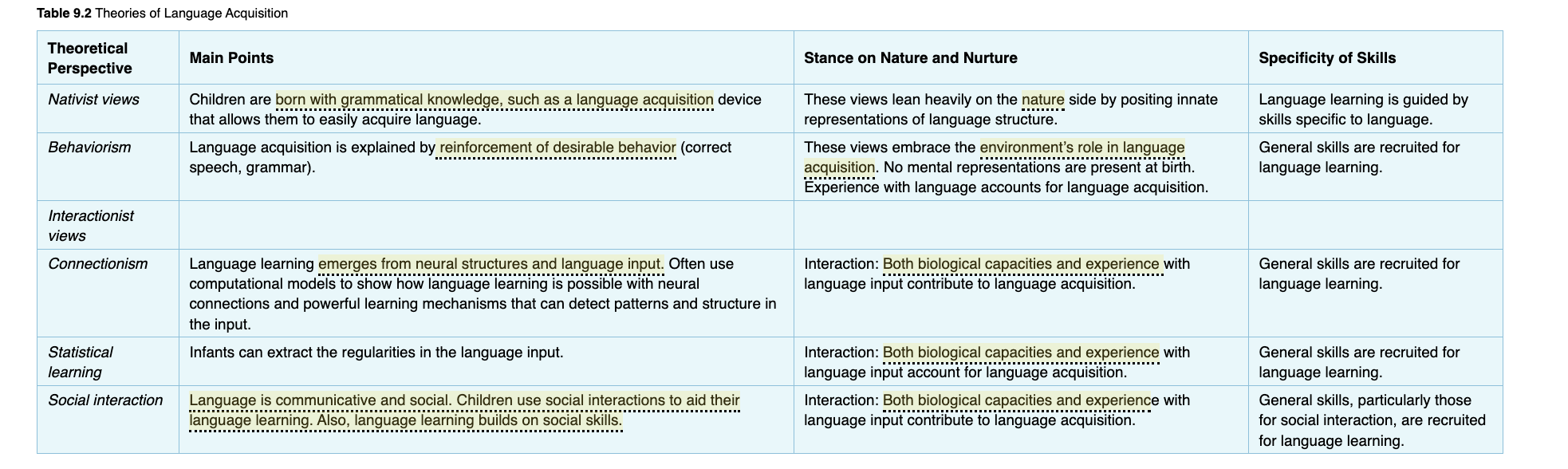
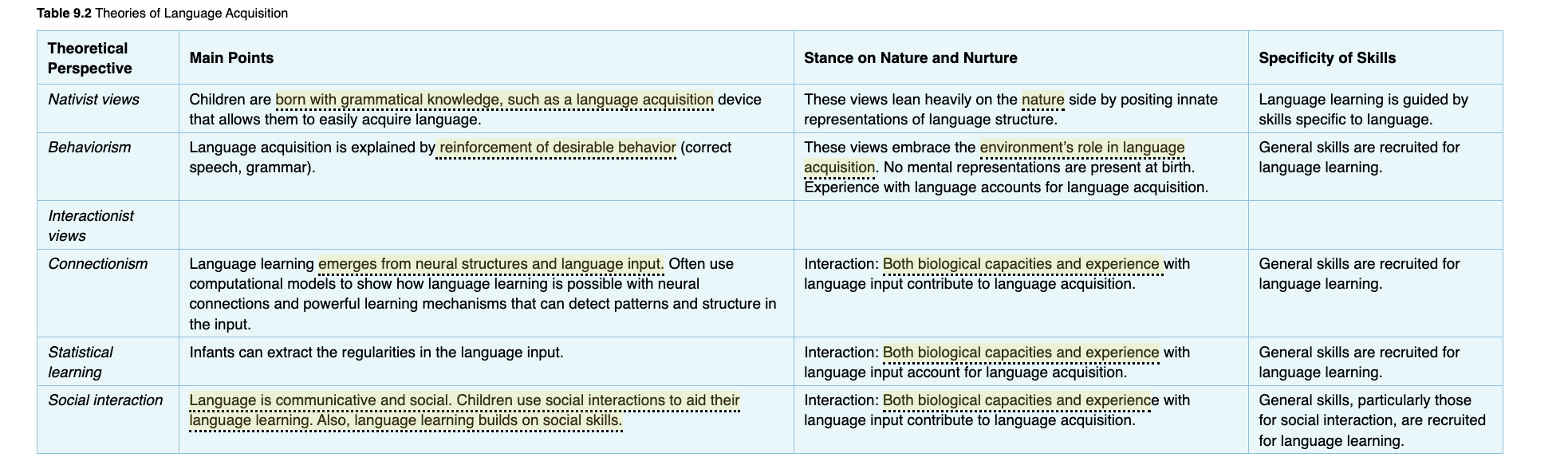
What is meant by domain-specific versus domain-general learning? Which theories argue for domain-specific processes for language acquisition, and which argue for domain-specific processes in language acquisition?
DOMAIN-SPECIFIC-
Nativist theory (Chomsky) built-in grammar system
DOMAIN-GENERAL-
Behaviorist
Connectionism
Statistical learning
Social interactions
Communication
The process by which we share information with others
Connectionism
a theory of cognitive development that proposes that children use general-purpose learning mechanisms to quickly learn all aspects of cognition and language from the input they receive
expressive language
the ability to produce words in a language
gaze following
the ability to align one’s gaze with another person’s
Generative
the feature of language that makes it possible to combine words in an infinite number of ways to express an equally infinite number of ideas
home signs
system of gestures that deaf children develop to communicate when exposed to only spoken language
Infant-directed speech (IDS)
a type of speech used to address infants that is simpler and more variable in its pitch than speech directed to adults
interactionist views
theories that recognize that development reflects both biological and innate influences as well as experience
Intersubjectivity
the understanding that thoughts and feelings are shared with other people.
joint engagement
coordinating attention so both the caregiver and child are attending to the same object at the same time. Coordinating attention to the same object at the same time.
Language
a formal system of communication, or a process by which we share information with others, that is structured and comprises grammar and vocabulary
language acquisition device
an instinctive mental capacity that is argued to allow for the acquisition of language with minimal input
looking-while-listening
a procedure used to test infants’ language comprehension that uses infants looking at images on a screen while hearing speech
Morphemes
the smallest unit of a word that denotes meaning
non-reduplicated babbling
also known as variegated babbling, a type of babbling that includes a combination of two or more constant-vowel combination (e.g. “mabu”)
Overextensions
a type of error children produce when they apply words to a broader array of referents than the meaning of the word (using the word dog to refer to horses)
Phonemes
the most basic units of a language that convey meaning; in spoken languages, phonemes are the individual sounds
poverty of the stimulus
Chomsky's argument that the language children heat is insufficient for learning
Pragmatics
understanding when and how to use language, as well as appreciating the intent of a speaker’s words
Proto-conversation
an early form of social exchange characterized by vocalizations by infants and speech by a caregiver
receptive language
understanding and recognizing language
reduplicated babbling
lso known as canonical babbling, a type of babbling that includes true syllables in the infants’ vocal productions; a single consonant-vowel combination is repeated in this types of babbling (mamama or gagagag)
Statistical Learning
theory that proposes that infants are sensitive to regularities in their environment that reflect that structure and that they use this information to acquire language
Syntax
the rules of how the categories of words, such as nouns and verbs, combine to create sentences
Underextensions
an expressive language error in which children apply a word too narrowly
universal grammar
a set of structures or rules that govern all world languages
word segmentation
the ability to parse words from a continuous stream of fluent speech
Why is communication distinct from language? What are the components of language?
Communication is broader because there are many different ways to communicate with others and language is a form/ a way to communicate
In what way do children contribute to their acquisition of language? In what ways might the environment (i.e., experience with language) contribute to their acquisition of language?
Children contribute to their acquisition of language through joint attention because they want to join together with an adult to learn more about the world around them. The language that you hear is what language you will learn.
Pointing, gaze following, babbling.
Enviornmental contributes:
Infant-directed speech is based on if the family uses it ot not
Social interaction how much or how little
Exposure to language
What is prosody, speech perception, word segmentation, and receptive language?
Prosody- Rhythm and tone of speech. The rhyming and intonation of a language
Speech perception – The ability to hear differences in sounds
Word segmentation – the ability to parse words from a continuous stream of fluent speech (analyze the words in a sentence).
Receptive language – recognizing and understanding language
One infant often points to objects to direct attention. Another infant does not try to communicate with their gaze or point. Which infant is more likely to begin to understand and say words earlier in development? Explain your answer.
The infant who points and follows gaze is more likely to begin understanding and saying words earlier in development because they are using joint attention which allows them to know how important it is to communicate.
Word learning happens in joint attention.
Compare how infants learn to perceive and produce speech sounds.
Infants can perceive and understand/recognize language much earlier than they can produce their own speech sounds and start talking on their own.
Experience shapes language development in many ways. Describe one way that caregivers can shape their infants’ language development in their interactions.
Use infant-directed speech to help infants learn words.
Use high vocabulary to increase infant vocabulary.
Which activity is better suited for helping infants learn new words, reading a book or playing with an electronic toy that plays a recording of the new word? Why?
Reading a book
Encourages triadic interactions which lead to more language learning.
Provides richer language exposure
Supports joint attention
Describe some of the ways that infants learn to link words to their referents.
Joint attention
Repetition
Context clues
Caregiver labeling objects

