Cell Bio Exam 2
 Call Kai
 Learn
Learn Practice Test
 Spaced Repetition
 Match
Match Flashcards
 Knowt Play
1/314

There's no tags or description
Looks like no tags are added yet.
Name | Mastery | Learn | Test | Matching | Spaced | Call with Kai | Chat |
|---|
No analytics yet
Send a link to your students to track their progress
315 Terms
Cell membranes
Act as selective barriers
_______ separates the cell from its surroundings
Plasma membrane
What is the plasma membrane involved in?
A. Cell communication
B. Import and export of molecules
C. Cell growth and mobility
D. All of the above
D. All of the above
List some functions of the internal membranes in eukaryotic cells
Compartmentation
Selective transport
Protein and lipid synthesis
Energy transduction
T/F: All cell membranes are composed of lipids and proteins
True
Lipids are arranged in two closely apposed sheets, forming a ______
lipid bilayer
The most abundant lipids in cell membranes are
A. Sterols
B. Phospholipids
C. Glycolipids
B. Phospholipids
T/F: Phospholipids are diglycerides
True
What is the shape of a diglyceride?
Two fatty acids linked to glycerol; phosphate group on 3rd position
T/F: Phospholipids are amphipathic
True
T/F: The other membrane lipids (sterols and glycolipids) are not amphipathic
False
Pure phospholipids form _____
liposomes (synthetic membranes)
Liposomes can vary in size from ____ to ____ in diameter
A. 50 nm to 1 um
B. 25 nm to 1 um
C. 50 um to 100 um
D. 25 um to 100 um
B. 25 nm; 1 um
Liquid droplets
Unique intracellular organelles surrounded by a phospholipid monolayer
What is the purpose of a liquid droplet?
Store energy in the form of hydrophobic lipids (triacylglycerols and cholesterol esters)
Where does the formation of liquid droplets occur?
Endoplasmic reticulum
Which of the following is NOT a function of plasma membrane?
A. Protecting the integrity of the interior cell
B. Providing support and maintaining the shape of the cell
C. Regulating the transport of substances in and out of the cell
D. Serving as a major site for protein synthesis
E. Involving in cell signaling and communication
D. Serving as a major site for protein synthesis
T/F: Lipid bilayers are rigid
False
Which form of motility rarely occurs in membrane phospholipids
A. Lateral diffusion
B. Flexion
C. Rotation
D. Flipping
D. Flipping
Which of the following factors affect fluidity?
A. Temperature
B. Fatty acid chain length
C. Number of double bonds
D. Cholesterol content
E. All of the above
E. All of the above
____ randomly transfer phospholipids from one monolayer to the other
Scramblases
T/F: The membrane grows symmetrically as a bilayer
True
What produces and inserts new phospholipids when creating the cell membrane
Biosynthetic enzymes
T/F: Most cell membranes are symmetrical
False
Flippases
Selectively removes specific phospholipids from the non-cytosolic monolayer and flips them to the cytosolic side
Floppases
Move specific lipids from the cytosolic side to non-cytosolic side
T/F: Both Flippases and Floppases need energy from ATP hydrolysis
True
Where do Floppases and Flippases occur?
Golgi apparatus
T/F: Membranes don’t retain asymmetry/orientation during transport between cell compartments
False
What is the molecular composition of a phospholipid?
Glycerol backbone; two hydrophobic fatty acid tails; hydrophilic phosphate group head
T/F: Sugar chains of glycolipids are typically exposed to the outside of the cell.
True
Imagine two lipid bilayers. In one, all the hydrocarbon chains are saturated (no double bonds). In the other, all the hydrocarbon chains are unsaturated (with cis-double bonds). Which one of the following predictions about their fluidity and permeability to water-soluble molecules would be most accurate?
Choose one:
A. The bilayer with saturated chains would be more fluid and more permeable.
B. The bilayer with unsaturated chains would be less fluid and more permeable.
C. The bilayer with saturated chains would be less fluid and less permeable.
D. The bilayer with unsaturated chains would be more fluid and less permeable.
C. The bilayer with saturated chains would be less fluid and less permeable.
Which phospholipids are confined to the non-cytosolic monolayer
Glycolipids, phosphatidylcholine, and sphingomyelin
What phospholipids are confined to the cytosolic side of the membrane
Phosphatidylserine, phosphatidylethanolamine, and phosphatidylinositol
T/F: Biological membranes consist of proteins embedded in a fluid phospholipid bilayer
True
In animals, proteins constitute about ____ of the mass of most plasma membranes
A. 25%
B. 80%
C. 72%
D. 50%
D. 50%
What are the major components of a plasma membrane?
Lipids (phospholipids and cholesterol), proteins, and carbohydrates
Example transporter protein
Na+ pump
Example ion channel protein
K+ leak channel
Example anchor protein
integrins
Example receptor protein
Platelet derived growth factor (PDGF) receptor
Example enzyme protein
Adenylyl cyclase
T/F: Peripheral proteins are easier to detach from the cell membrane than integral proteins.
True
How does a protein helix interact with the lipid bilayer?
Through hydrophobic interactions
How many non-polar amino acids are required to completely traverse a cell membrane?
A. 20
B. 32
C. 200
D. 50
A. 20
Hydropathy plots
Graphical representation used to predict the hydrophobic or hydrophilic regions of a protein based on its amino acid sequence
Can help identify possible transmembrane domains
Beta-barrel
Structure composed of beta sheets curved into a barrel to form a water filled channel
Found in outer membranes of bacteria, mitochondria, and chloroplasts
e.g. porin proteins
Membrane proteins can be solubilized in ____
A. Water
B. Oil
C. Detergent
D. Fat
C. Detergent
Strong ionic detergents (e.g. SDS)
A. dissolve membranes and unfold proteins
B. dissolve membranes without unfolding proteins
A. dissolve membranes and unfold proteins
Mild non-ionic detergents (e.g. Triton X-100)
A. dissolve membranes and unfold proteins
B. dissolve membranes without unfolding proteins
B. dissolve membranes without unfolding proteins
T/F: Detergents form micelles and “dissolve” membrane lipids and proteins
True
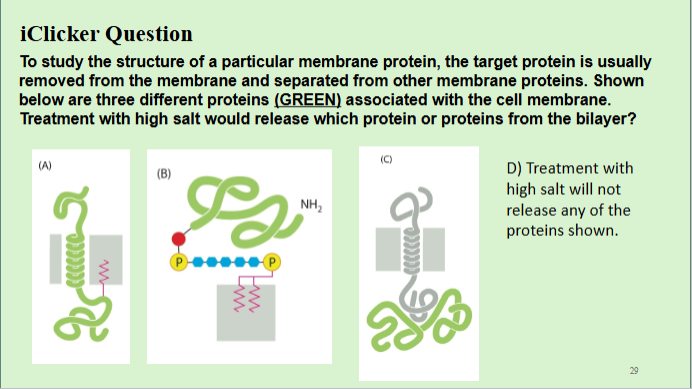
Which is correct?
C
The plasma membrane is reinforced by the underlying _____
cell cortex
What is the cell cortex?
A meshwork of fibrous proteins attached to the cytosolic side of the plasma membrane
How can the lateral mobility of membrane proteins be restricted?
Tethering proteins or diffusion barriers
FRAP
Fluorescence recovery after photobleaching
What is FRAP used for?
To measure the rate of lateral diffusion
____ cells are coated with carbohydrates
Eukaryotic
_____ and ____ are proteins covalently attached to sugars on the extracellular side
Glycoproteins; proteoglycans
What is the carbohydrate layer of the cell membrane called?
Glycocalyx
What is the function of cell-surface carbohydrates?
Protection from mechanical damage, immune response and cell signaling, cell-cell recognition and adhesion
T/F: Protein-free, artificial lipid bilayers are permeable to most water-soluble molecules
False
What do specialized membrane transport proteins do?
Facilitate passage of certain small water-soluble molecules across the cell membrane
T/F: Small molecules always cross the lipid bilayer of a liposome more easily than larger molecules.
True
Rank the permeability of the solutes across an artificial lipid bilayer.
1. Ions
2. Small Uncharged polar molecules
3. Small Nonpolar molecules
4. Large uncharged polar molecules
A. 1, 2, 3, 4
B. 2, 4, 3, 1
C. 2, 3, 4, 1
D. 3, 2, 4, 1
D. 3, 2, 4, 1
Ion concentrations generate _____
Membrane potential
What are the two types of membrane transport proteins?
Transporters and Channels
Channel
Proteins pores that extend through the membrane
Water and ions typically transported
Rely on pore size/electric charge for specificity
Transporter
Span the membrane
Directly bind to the solute
Binding induces a conformational change, moving solute to other side of membrane
Releasing solute reverts transporter to original conformation
T/F: Transport mediated by transporters involves conformational changes in the transport protein to move molecules across the membrane.
True
A liposome is a synthetic membrane that does not contain any protein components. Some uncharged, polar molecules are found to diffuse across these membranes, to varying degrees. Which of the following has the lowest rate of diffusion across the artificial membrane?
A. water
B. glucose
C. glycerol
D. ethanol
B. Glucose
Simple diffusion
Small nonpolar molecules move down concentration gradient without a membrane transporter
Passive transport
Solutes spontaneously move down their concentration gradients with the help of a membrane transporter/channel
Active transport
Solutes move against the concentration gradient with the help of a transporter and energy
Electrochemical gradient
Sum of the force from the concentration gradient of the solute and the force from membrane potential
What does electrochemical gradient determine?
Direction a charged solute will flow by passive transport
T/F: In passive transport, ions always move down their concentration gradient.
True
Aquaporin
Specialized membrane protein for transporting water
Work as a tetramer
Osmosis
The process by which water moves passively down its concentration gradient
Osmolarity
Total concentration of solutes in a solution
T/F: Generally the solute outside the cell is greater than the solute inside the cell
False
Isotonic
Solute concentration is the same inside and outside the cell
Hypotonic
Solute concentration outside the cell is lower than inside the cell (Hypo is low)
Hypertonic
Solute concentration outside the cell is higher than inside the cell (Hyper is high)
What happens if an animal cell is placed in a hypertonic solution?
It will shrivel
How do protozoans resist osmotic swelling?
Special water collecting vacuoles that periodically remove excess water
How do plant cells resist osmotic swelling?
Cell wall prevents cell from expanding excessively and vacuoles
How do animal cells resist osmotic swelling?
Na+/K+ pump
How do transporters and channels select which solutes they help move across the membrane?
A. Both channels and transporters discriminate between solutes mainly on the basis of size and electric charge.
B. Transporters discriminate between solutes mainly on the basis of size and electric charge; channels bind their solutes with great specificity in the same way an enzyme binds its substrate.
C. Channels allow the passage of solutes that are electrically charged; transporters facilitate the passage of molecules that are uncharged.
D. Channels will allow the passage of any solute as long as it has an electrical charge; transporters bind their solutes with great specificity in the same way an enzyme binds its substrate.
E. Channels discriminate between solutes mainly on the basis of size and electric charge; transporters bind their solutes with great specificity in the same way an enzyme binds its substrate.
E. Channels discriminate between solutes mainly on the basis of size and electric charge; transporters bind their solutes with great specificity in the same way an enzyme binds its substrate.
Passive Transporters
Move solute along electrochemical gradient
Can adopt several conformations; switch reversibly and randomly btwn them
Highly selective
Active transporters (Pumps)
Move solute against electrochemical gradient
Always coupled to an energy source
Na+ pump
Accounts for 30%+ of ATP consumption
Carries 3 Na+ out, 2 K+ in
NOKIA
(3) Na+ out; (2) K+ in, ATP used
What is the function of the Na+ pump
To create a concentration gradeitn
Ca2+ pump
Located in plasma and ER membrane
Important for muscle contraction, fertilization, and nerve cell communication
Maintain extremely low Ca2+ in cytosol
requires ATP
What is the transport direction of Ca2+ pumps?
Against concentration gradient (low con → high con)
T/F: Gradient driven pumps can be a symport or antiport
True
Symport
transports both solutes in same direction
Antiport
Transports both solutes in opposite directions (one goes up, other goes down)
T/F: Uniports are pumps
False