Art history- Late roman empire, late imperal art
 Studied by 0 people
 Call Kai
 Learn
Learn Practice Test
 Spaced Repetition
 Match
Match Flashcards
 Knowt Play
1/9

There's no tags or description
Looks like no tags are added yet.
Name | Mastery | Learn | Test | Matching | Spaced | Call with Kai |
|---|
No analytics yet
Send a link to your students to track their progress
10 Terms
Overview- Decline, crisis and transformation
Political instability, short reigns, and assassinations
severe economic decline, inflation
Rise of Christianity and changing social order
increasing militarization of leadership
Stylistic shift from naturalism to abstract and symbolism
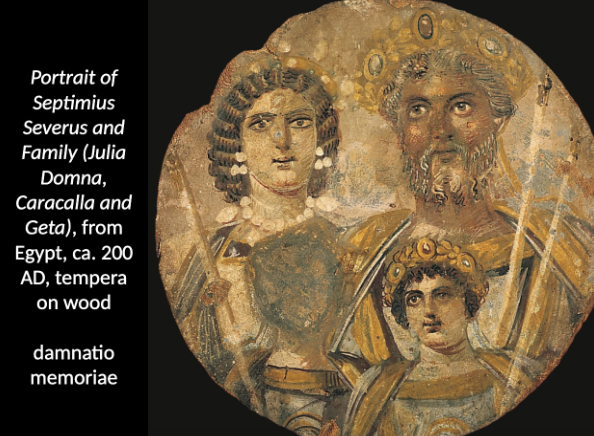
Portrait of Septimius Severus and Family (Julia Domna, Caracalla and Geta)—wood
Emperor Septimus Severus, his wife, and their sons, Caracalla and Geta
Painted family portrait on wood; unique survival from antiquity
After Geta's assassination, his face was removed.
Found in Egypt in the Severan Dynasty
Demonstrates dynastic propaganda
shows the rise of provincial elites
Damnatio memoriae is a visible piece of evidence of political instability
Wearing jewelry and crowns: wealth
egg paste on wood- special creation
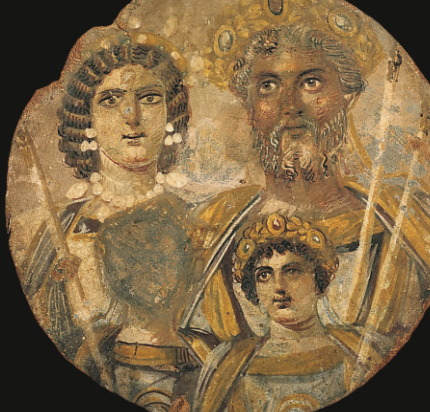
Who were the members of the Severan Dynasty? What were some of the accomplishments of their reigns?
Septimius Severus: Expansion of the empire
Julia Domna: Legal reforms
Caracalla and Geta: Strengthening of military
Getas’ face was erased after the murder → Damnatio memoriae
What is damnatio memoriae? Which emperors suffered damnatio memoriae, and how can this be seen in art? What purpose did the practice serve in Roman society?
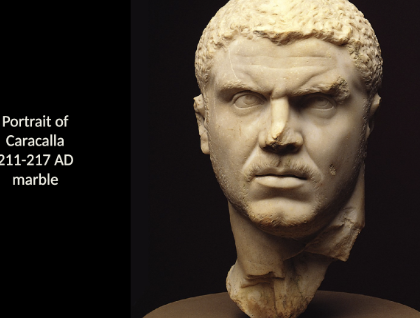
Portrait of Caracalla- marble
Built under Emperor Caracalla
Gigantic imperial bath complex
Included: different rooms like natatio (pool), gardens, lecture halls, libraries
South Rome
Significance:
Shows imperial generosity, propaganda through public works.
Engineering marvel- concrete vaulting
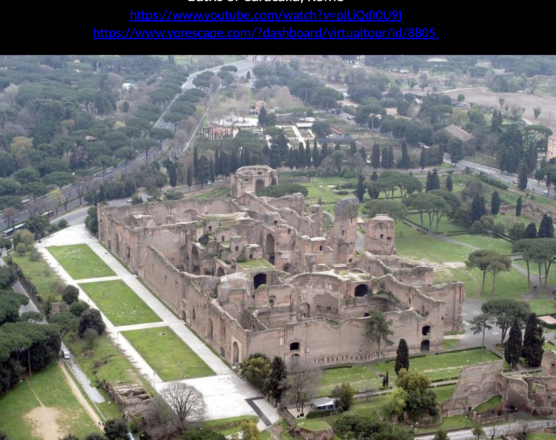
Baths of Caracalla, Rome
Describe the Baths of Caracalla. What types of rooms and spaces were included in the complex? What was the role of bathing in Roman society?
Several different types of baths at different temperatures
Spaces and social role → Community, hygien,e and imperial benefaction
Made out of brick-based concrete and covered with fancy stone
Inspired neoclassical construction- big arches
Included different rooms: frigidarium, tepidarium, caldarium, natatio (pool), gardens, lecture halls and library
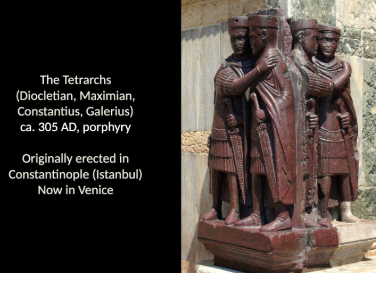
Portraits of the Tetrarchs
How are the Tetrarchs represented in their portrait that is now in Venice? What was the Tetrarchy, and how is the organization of the Tetrarchy visible in the sculpture?
Who? 4 rules: two augustus and two ceaser
What? Highly stylized, blocky forms, large eyes, ZERO INDIVIDUALITY, showing rulers embracing- shared power
Where? Venice and created near the end of Diocletian's reign.
Why? Visualizes political ideology: unity, equality and stability
Stylistic break from classical naturalism- Abstract reflects political transformation
Represents collective rule—suppressing individuality.

Colossal Statue of Constantine, from the Basilica of Maxentius and Constantine
Describe the Colossal Statue of Constantine. Where was this statue located? How does his portrait compare to that of earlier emperors?
What?
Massive marble fragments of a seated statue—head, hand, and feet
brick core with marble outer
Enlarged eyes: divine inspiration
Where?
Located in the Roman Forum
Made after victory at Milvian Bridge
Contrast?
Contract with naturalistic early emperors
Why?
Abstract, symbolic portraiture—spiritual authority
Marks a shift to Christian imperial imagery
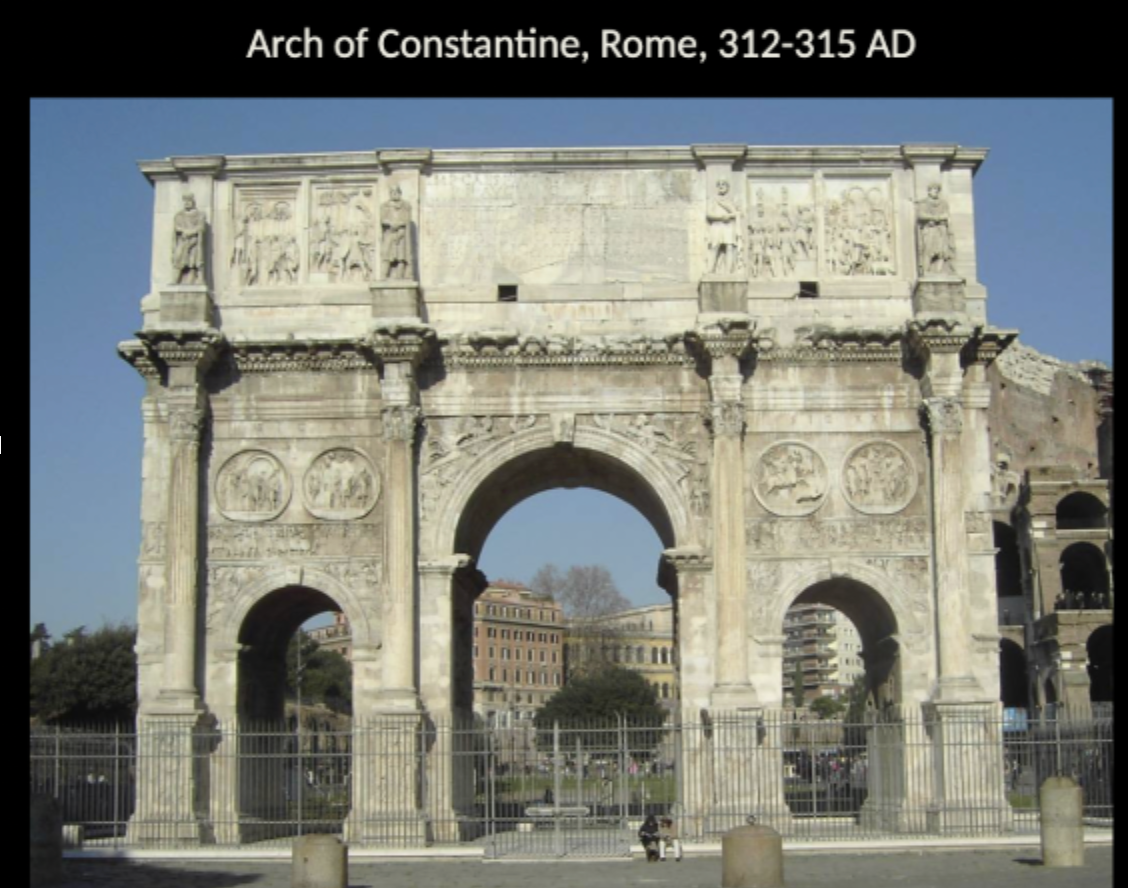
Arch of Constantine
Who? Paid by Senate to honor Constantine
What? - Triumphal arch celebrating Constantine’s victory over Maxentius
- Incorperates spolia from earlier emperors (Trajan, Hadrian, Marcus Aurelius)
Where? Near Colosseum, Rome
Why important?
Political propaganda frames Constantine as heir to great emperors.
Use of spolia (use of earlier imperial scultures)
Blends classical reliefs with new abstract transitions in Roman art sculptures
What victory was commemorated in the Arch of Constantine? What is spolia, and how was it used on the arch? How is Constantine portrayed on the arch? How does the arch and its decoration serve Constantine’s propagandistic agenda?
Celebrates Milvian Bridge
Spolia—reuse of earlier imperial sculptures
COnstaine appears as a generous and divinely sanctioned ruler.
 Note
Note  Flashcards (64)