BILD 2: Exam 1
 Studied by 0 people
 Call Kai
 Learn
Learn Practice Test
 Spaced Repetition
 Match
Match Flashcards
 Knowt Play
1/136

Earn XP
Name | Mastery | Learn | Test | Matching | Spaced | Call with Kai |
|---|
No analytics yet
Send a link to your students to track their progress
137 Terms
Which of the following is a characteristic of nervous system signals
A.) They allow gradual changes to take place in the body
B.) They usually impact the entire body
C.) They travel in the blood stream
D.) They travel quickly throughout the body
E.) They require a change in ion concentrations to be transmitted
D.) they travel quickly throughout the body
What tissue lines most exchange surfaces of multicellular animals?
A.) Smooth muscle
B.) Neural tissue
C.) Connective tissue
D.) Epithelial tissue
E.) Neural and Epithelial tissue
D.) Epithelial tissue
Which is the name of the epithelial cell surface that faces the outside of the body?
A.) Apical
B.) Interstitial
C.) Botton
D.) Lumen
E.) Basal
A.) Apical
A nerve is a collection of _________.
A.) Nerve cell bodies
B.) Axons
C.) Dendrites
D.) Synapses
E.) Nerve cell nuclei
B.) Axons
The activity of the sodium-potassium pump results in the movement of which ions across the plasma membrane
A.) It pumps sodium and potassium ions into the cell
B.) It pumps sodium ions out of the cell and potassium ions into the cell
C.) It pumps sodium and potassium ions out of the cell
D.) It pumps sodium ions into the cell and potassium ions out of the cell
B.) It pumps sodium ions out of the cell and potassium ions into the cell
Which of these ions is more abundant in the interior of a neuron than in the fluid surrounding the neuron?
A.) Cl-
B.) Ca++
C.) Na+
D.) K+
D.) K+
Which of the following describes the ion channels of a resting neuron
A.) The channels are always open, irrespective of their type
B.) The channels are always closed, but ions move closer to the channels during excitation
C.) The channels are open or closed depending on their type, and are specific as to which ion can traverse them
D.) The channels are open in response to stimuli, and then they close simultaneously
E.) The channels are always open, but the concentration gradients of ions frequently change
C.) The channels are open or closed depending on their type, and are specific as to which ion can traverse them
The Nernst equation specifies the equilibrium potential for a particular ion. This equilibrium potential is a function of ______.
A.) The osmotic gradient
B.) Hydrostatic pressure
C.) The ion concentration gradient
D.) The temperature (thermal) gradient
E.) The electrical gradient
C.) The ion concentration gradient
Action potentials move along axons _________.
A.) By reversing the concentration gradients for sodium and potassium ions
B.) By activating the sodium-potassium “pump” at each point along the axonal membrane
C.) More rapidly in myelinated than in unmyelinated axons
D.) More slowly in axons of large diameter than in axons of small diameter
C.) More rapidly in myelinated than in unmyelinated axons
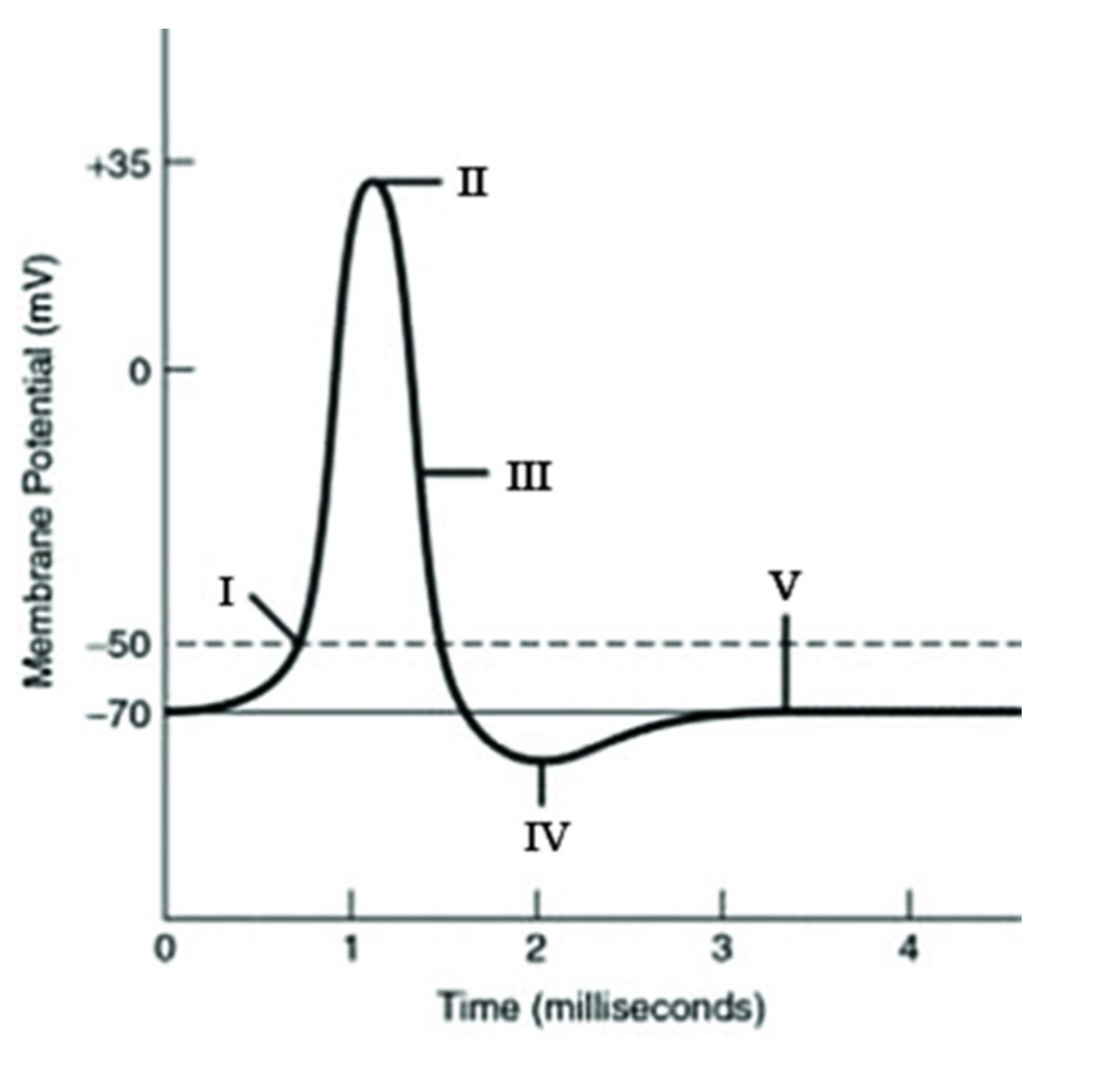
Which Roman numeral in the graph indicated the point when the membrane potential is closest to the equilibrium potential for potassium?
A.) I
B.) III
C.) V
D.) IV
E.) II
D.) IV
Excitatory postsynaptic potentials (EPSPs) occurring at multiple synapses on the same postsynaptic neuron can add together through ______.
A.) Spatial Summation
B.) Action potentials
C.) Highly branches dendrites
D.) Temporal Summation
A.) Spatial Summation
An inhibitory postsynaptic potential (IPSP) will occur if a membrane is made more permeable to _______.
A.) Potassium ions
B.) cAMP
C.) Acetylcholine
D.) Sodium Ions
A.) Potassium ions
Which of the following is an amino acid that functions as a neurotransmitter at most inhibitory synapses in the brain?
A.) Acetylcholine
B.) Nitric Oxide
C.) GABA
D.) Endorphin
C.) GABA
Where are neurotransmitters released in a synapse?
A.) The presynaptic membrane
B.) The smooth endoplasmic reticulum
C.) Axon hillocks
D.) Cell bodies
A.) The presynaptic membrane
Which of the following structures contains an abundance of axons?
A.) The white matter of the brain and the white matter of the spinal cord
B.) The white matter of the brain and the gray matter of the spinal cord
C.) The gray matter of the brain and the gray matter of the spinal cord
D.) The gray matter of the brain and the white matter of the spinal cord
A.) The white matter of the brain and the white matter of the spinal cord
Which part of the nervous system activates the flight-or-flight response?
A.) Sympathetic
B.) Somatic
C.) Parasympathetic
D.) Enteric
A.) Sympathetic
Which of the following controls balance and coordinates movements in humans?
A.) Hypothalamus
B.) Spinal cord
C.) Cerebrum
D.) Cerebellum
D.) Cerebellum
Which of the following regions arose developmentally from the hindbrain?
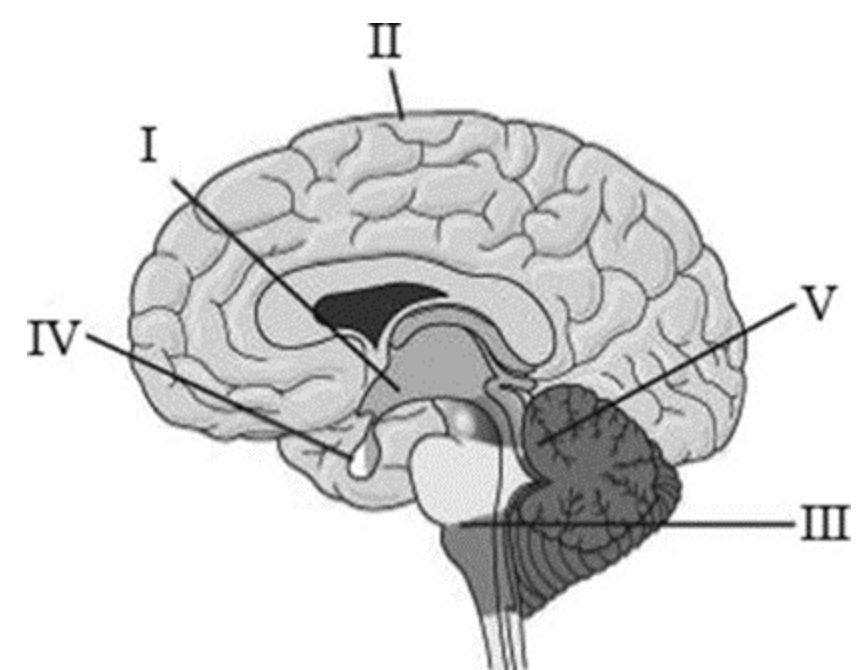
III
Which part of the brain are sleep and arousal regulated?
A.) The reticular formation
B.) The cerebral cortex
C.) The limbic system
D.) The basal nuclei
A.) The reticular formation
Which of the following functions is associated with Broca’s region?
A.) Vision
B.) Balance
C.) Speech
D.) Olfaction
E.) Hearing
C.) Speech
How does a neuron transmit information?
A neuron receives information, transmits it along an axon, and transmits the information to other cells via synapses
Inactivated Na+ channels and open voltage-gated K+ channels behind the zone of depolarization prevent the action potential from traveling backwards
After initiation at the axon hillock, action potentials travel in only one direction: toward the synaptic terminals
Synapse vs. Synaptic Terminal
Synapse is junction between an axon and other cell and a synaptic terminal is the part of the axon that forms this junction
What is an electrical synapse and a chemical synapse?
Electrical synapse is when an electrical current flows from one neuron to another through gap junctions. Chemical synapses use chemical messengers called neurotransmitters to pass information
In a chemical synapse how is the generation of a postsynaptic potential created?
At many chemical synapses, the receptor that binds and responds to neurotransmitters is a ligand-gated ion channel, often an ionotropic receptor. Neurotransmitter binding causes ion channels to open, generating a postsynaptic potential
What are the two types of postsynaptic potentials?
Excitatory postsynaptic potentials (EPSPs) are depolarizations that bind the membrane potential toward threshold
Inhibitory postsynaptic potentials (IPSPs) move the membrane potential farther from the threshold or keep the membrane potential from reaching threshold
What happens if two EPSPs are produced in rapid succession? What about if EPSPs are produced nearly simultaneously by different synapses on the same postsynaptic neuron
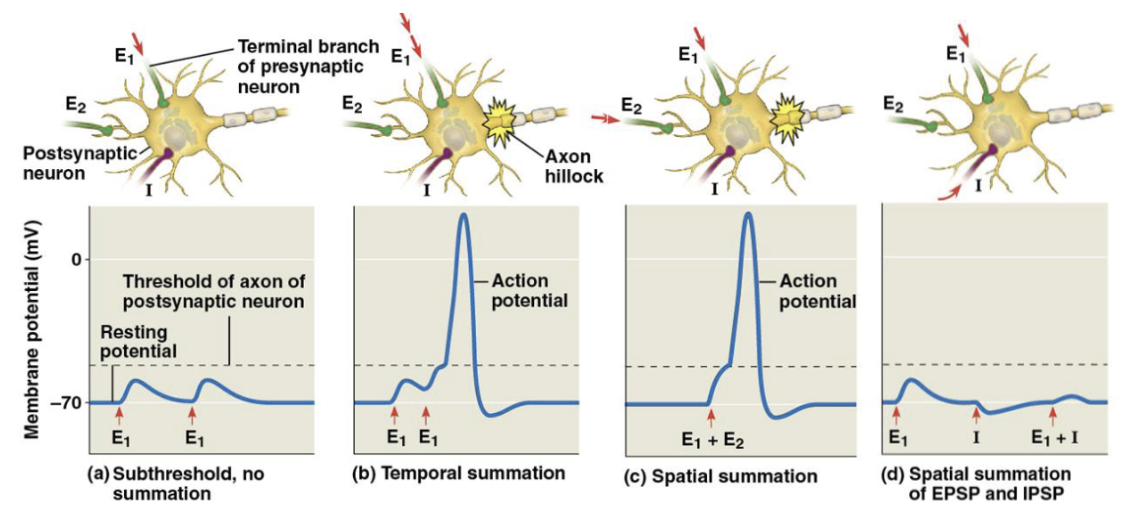
Individual postsynaptic potentials can combine to produce a larger potentials in a process called summation, when two EPSPs come together temporal summation occurs. In spatial summation, EPSPs produced nearly simultaneously by different synapses on the same postsynaptic neuron add together. Through summation, and IPSP can counter the effect of an EPSP. The summed effect of EPSPs and IPSPs determines whether an axon hillock will reach threshold and generate an action potential
What are the five major classes of neurotransmitters?
Acetylcholine
Involved in muscle stimulation, memory formation, and learning
Biogenic Amines
Include norepinephrine, epinephrine, dopamine, and serotonin; active in CNS and PNS. Dopamine, norepinephrine, epinephrine are made from tyrosine
Central role in a number of nervous system disorders
Amino Acids
Glutamate: acts as a neurotransmitter
Glycine: inhibitory synapses
Gamma-aminobutyric acid (GABA): neurotransmitter at more inhibitory synapses in the brain
Neuropeptides
Short chains of amino acids that also function as neurotransmitters
Include substance P and endorphins which affect our perception of pain
Gases
Nitric oxide (NO) and carbon. monoxide (CO) are local regulators
What are the three types of adaptations in mammals?
Form, function, and behavior
Since structure and function are correlated, what clue does anatomy often provide
Clues to physiology or also known as biological function
What do physical laws govern.
Governs strength, diffusion, movement, and heat exchange limit the range of animal forms
Rate of exchange is proportional to what
The rate of exchange is proportional to surface area, while the amount of material that must be exchanged is proportional to volume.
What do larger animals need since they have larger volumes
They need specialized systems to move materials internally
What is the hierarchal organization of the body
Single cells → Tissues → Organs → Organ Systems
What are the four types of animal tissues
Epithelial, connective, muscle, and nervous
Define epithelial tissue
Covers the outside of the body and lines the organs and cavities within the body
In epithelial tissue what is the part the faces the outside
Apical surface
Function of connective tissue
Holds may tissues and organs together in place
Type of cells found in connective tissue
Fibroblasts: secrete fiber proteins
Macrophages: which engulf foreign particles and cell debris by phagocytosis
What are the six types of connective tissue
Fibrous connective tissue is found in tendons, which attack muscles to bones, and ligaments, which connect bones at joints
Bone is mineralized and forms the skeleton
Adipose tissue stores fat for insulation and fuel
Blood is composed of blood cells and cell fragments in blood plasma
Cartilage is strong and flexible support material
Function of muscle tissue
muscle cells consists of filaments of the protein actin and myosin, which together enable muscles to contract
Three types of muscle tissue
Skeletal Muscle: Striated muscle is responsible for voluntary movement
Smooth Muscle: Responsible for involuntary body activities
Cardiac Muscle: Responsible for contraction of the heart
Function of nervous tissue
functions in receipt, processing, and transmission of information
What does nervous tissue contain
Neurons, or nerve cells, which transmit nerve impulses
Glia cells, or glia, which support cells
What are the functions of glia in the central nervous system (5 Types)
Ependymal cells promote circulation of cerebrospinal fluid
Microglia protect the nervous system from microorganisms
Oligodendrocytes and Schwann cells from the myelin sheaths around axons
Astrocytes provide structural support for neurons, regulate extracellular ions and neurotransmitters, and induce the formation of blood-brain barrier that regulates the chemical environment of the CNS
Radial glia play a role in the embryonic development of the nervous system
What are the two major systems of coordination and control in animals
Endocrine and nervous system
What is ganglia?
Clusters of neurons
How are electrical signals created
By the movements of ions across the cell’s plasma membrane
What is membrane potential
the voltage the cell has across its plasma membrane
What is the model of the resting potential
The concentration of K+ is higher in the inner chamber and lower in the outer chamber
K+ diffuses down its gradient to the outer chamber
Negative charge builds up in the inner chamber
What is the resting potential of a typical neuron
-60 to -80 mV
What is hyperpolarization?
A change in a cell's membrane potential that makes the inside of the cell more negative (further from zero) than its resting state, making it harder for the neuron to fire an action potential by increasing the stimulus needed to reach the firing threshold
What is depolarization?
Reduction in the magnitude of the membrane potential. There is Na+ going in
What is repolarization?
Repolarization is the process where a cell, like a nerve or heart muscle cell, returns to its resting, negatively charged state after being excited (depolarized). There is K+ going out
Describe the generation of action potentials
Voltage-gated Na+ and K+ channels respond to a change in membrane potential. When a stimulus depolarizes the membrane voltage-gated Na+ channels open, allowing Na+ to diffuse into the cell. The movement of Na+ into the cell increases the depolarization that causes even more voltage-gated Na+ channels. Voltage-gated K+ channels also open, but slower. Therefore, a stimulus that causes the membrane voltage to cross threshold results in a massive change in membrane voltage called an action potential
What is a refractory period
The refractory period is the result of temporary inactivation of voltage-gated Na+ channels
What causes an action potential’s speed to increase
Myelin sheaths made by glia
oligodendrocytes in the CNA and Schwann cells in the PNS
Where are action potentials formed
At nodes of Ranvier which are gaps in the myelin sheath where voltage-gates Na+ channels are found
What is saltatory conduction?
Where actions potentials in myelinated axons jump between the nodes of Ranvier
What are mechanisms of terminating neurotransmission
May diffuse out of the synaptic cleft
May be degraded by enzymes
May be taken up by the presynaptic terminal/surrounding cells
How can synapses be strengthened or weakened
Amount of neurotransmitter released
Number of receptors in postsynaptic cell
What are the three stages the nervous system goes through to process information
Sensory input, integration, and motor output
Function of sensory neurons
Transmit information about external stimuli such as light, tough, or smell
Function of interneurons
Integrate (analyze and interpret) the information
Function of motor neurons
transit signals to muscle cells, causing them to contract
What makes up gray matter
neuron cell bodies, dendrites, and unmyelinated axons
What makes up white matter
Bundles of myelinated axons
What is the function of the peripheral nervous system (PNS)
transmits information to and from the CNS and regulates movement and internal environment. Afferent neurons transmit information to the CNS, and efferent neurons transmit information away from the CNS
Where are the cranial nerves
go in/out of the brain, mostly connected to the head and upper body
Where are the spinal nerves
go in/out of the spinal cord and extend to parts of the body below the head
What are the two efferent components of the PNS
The Motor system
Carries signals to skeletal muscles and can be voluntary or involuntary
Autonomic nervous system
Regulates smooth and cardiac muscles and is generally involuntary
Function of the enteric nervous system
exerts direct, partially independent, control over the digestive tract, pancreas and gallbladder
What are the divisions of the autonomic nervous system
The sympathetic division regulates arousal and energy generation (“fight-or-flight” response)
The parasympathetic division has antagonistic effects on target organs and promotes calming and a return to “rest and digest” functions
In both sympathetic and parasympathetic systems, the pathway for information flow involves which types of neurons
Preganglionic neurons have cell bodies in the CNS and release acetylcholine as a neurotransmitter
Postganglionic neurons of the parasympathetic division release acetylcholine
The brainstem is made up of what parts
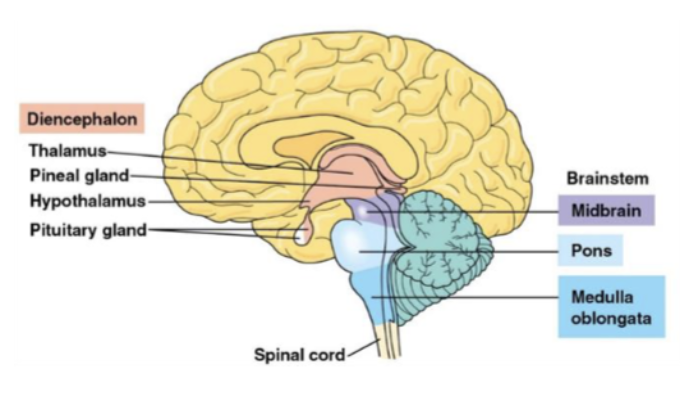
Midbrain and hindbrain
In the brainstem what is the function of the midbrain, pons, and medulla oblongata
The midbrain contains centers for receipt and integration of sensory information, arousal
The pons regulates breathing centers in the medulla
The medulla oblongata contains centers that control several functions including breathing, cardiovascular activity, swallowing, vomiting, and digestion
What part of the brain controls arousal and sleep. What is the diffuse network of neurons that control this called
Brainstem and cerebrum control arousal and sleep. The network of neurons is the reticular formation
How does reticular formation work
Acts as filter of sensory input, blocking familiar and repetitive information. It controls the timing of sleep periods characterized by rapid eye movements and vivid dreams
Functions of the cerebellum
Important for coordination and error checking during motor, perceptual, and cognitive functions. Also coordinates balance
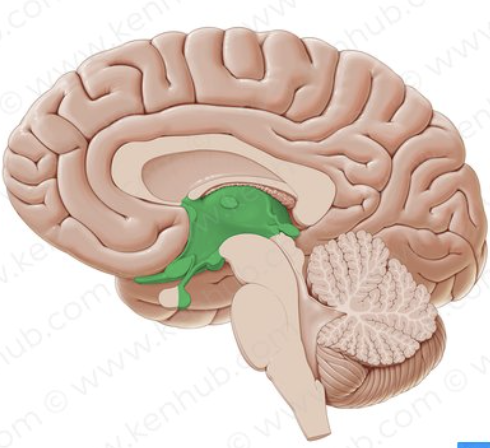
What are the three regions of the diencephalon
Epithalamus
Includes the pineal gland (sources of melatonin) and generates cerebrospinal fluid from blood
Thalamus
The main input center for sensory information to the cerebrum and the main output center for motor information leaving the cerebrum
Hypothalamus
Regulates homeostasis and basic survival behaviors such as feeding, fighting, fleeing, and reproducing
Includes the body’s thermostat and central biological clock (suprachiasmatic nucleus)
Function of the cerebrum
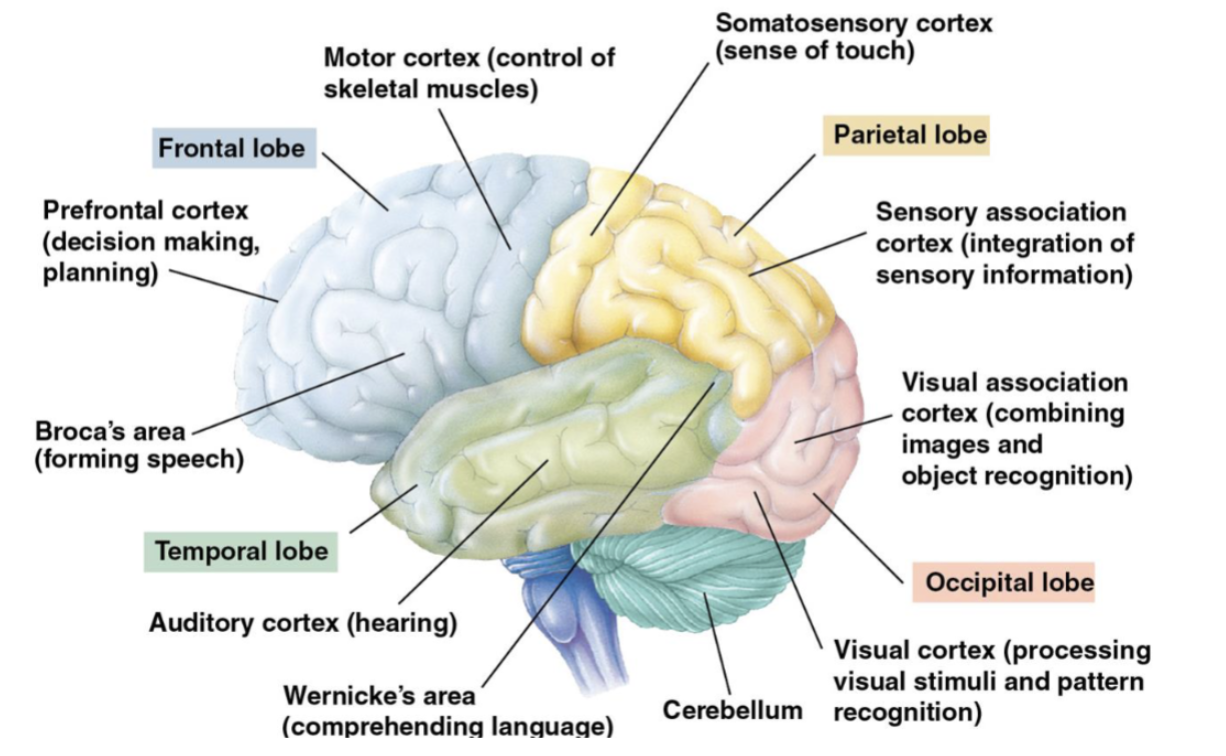
The cerebrum, the largest structure in the human brain, is essential for language, cognition, memory, consciousness, and awareness of our surroundings. The cerebrum controls skeletal muscle contractions and is the center for learning, emotion, memory, and perception. Each lobe of the cerebral cortex (frontal, temporal, occipital, and parietal) is the focus of the specific brain activities. The outer layer of the cerebrum is called the cerebral cortex
Function of somatosensory receptors
Provide information about touch, pain, pressure, temperature, and the position of muscles and limbs
What are the functions of the two hemispheres in the brain
The left hemisphere is more adept at language, math and logical operations
The right hemisphere is stronger at facial and pattern recognition, spatial relations, and nonverbal thinking
What is Broca’s area
Patients could understand language and not speak. Frontal lobe is active when speech is generated
What is Wernicke’s area
Patients could speak, but not comprehend speech. Temporal lobe is active when speech is heard
What are the functions for each lobe in the brain
What is the limbic system and what are its functions
Generation and experience of emotions involve many brain structures, including the amygdala, hippocampus, and parts of the thalamus. These structures are grouped as the limbic system. Storage and recall of emotional memory are dependent on the amygdala, an almond-shaped brain structure near the base of the cerebrum
What is schizophrenia
Schizophrenia is typically characterized by hallucinations and delusions. Research suggests that schizophrenia affects neuronal pathways that use dopamine as a neurotransmitter. Many drugs that alleviate the symptoms of schizophrenia block dopamine receptors
What are the two broad forms of depressive illness
major depressive disorder, patients have a persistent lack of interest or pleasure in most activities
Bipolar disorder is characterized by manic (high mood) and depressive (low-mood) phases
Treatments for these types of depression include drugs that increase the activity of biogenic amines in the brain
What is Alzheimer’s Disease
Mental deterioration (dementia) characterized by confusion and memory loss. There is also massive shrinkage of brain tissue, reflecting the death of neurons in many areas of the brain. The neurofibrillary tangles observed in Alzheimer’s Disease are primarily made up of tau protein
What is Parkinson’s Disease
Motor disorder caused by death of dopamine-secreting neurons in the midbrain. It is characterized by muscle tremors, flexed posture, and a shuffling gait
What are the four basic functions sensory pathways have in common
Sensory reception, transduction, transmission, and perception
Function of sensory reception
A sensory receptor converts stimulus energy into a change in the membrane potential. Sensory receptors are sensory cells (sensory neurons or non-neironal receptors/organs). They interact with stimuli, both inside and outside the body
What happens during transduction
Conversion of stimulus energy into a change in the membrane potential of a sensory receptor/sensory neuron
What occurs during transmission
Sensory cells without axons release neurotransmitters at synapses with sensory neurons through the nervous system as action potentials
What occurs during perception
Stimuli from different sensory receptors travel as action potentials along dedicated neural pathways. The brain distinguishes stimuli from different receptors based on the path by which the action potentials arrive
What is amplification and sensory adaption
Amplification is strengthening of a sensory signal during transduction
Sensory adaptation is a decrease in responsiveness to continued stimulation
What are the 5 types of sensory receptors
Mechanoreceptors, chemoreceptors, electromagnetic receptors, thermoreceptors, and pain receptors (nociceptors)
Function of mechanoreceptors
Sense physical deformation caused by formed of mechanical energy
They typically have mechanical gated ion channels, can be linked to structures that end outside the cell, such as “hairs” (cilia)
Bending or stretching of the structure generates tension and alters the permeability of the ion channels and this results in changes to the membrane potential
The mammalian sense of touch relies on mechanoreceptors that are dendrites of sensory neurons
Function of chemoreceptors
Transmit information about the total solute concentration of a solution
Others respond to specific molecules in body fluids
When a stimulus molecule binds to a chemoreceptor the chemoreceptor become either more or less permeable ions
Function of electromagnetic receptors
Detect electromagnetic energy such as light, electricity, and magnetism
The platypus has electroreceptors on its bill that can detect the electric field generated by prey
Many animals can migrate using Earth’s magnetic field to orient themselves
 Note
Note  Flashcards (31)