emt 1-2
 Call Kai
 Learn
Learn Practice Test
 Spaced Repetition
 Match
Match Flashcards
 Knowt Play
1/57

There's no tags or description
Looks like no tags are added yet.
Name | Mastery | Learn | Test | Matching | Spaced | Call with Kai |
|---|
No analytics yet
Send a link to your students to track their progress
58 Terms
what is important when building patient rapport
make/keep eye contact; provide ur name and use patient’s name; be honest; use simple language; be careful abt what u say abt patients to others; body language; speak slowly, clearly, distinctly
how to obtain a better Hx (history)
facilitation - asking additional follow up questions so patient speaks more
patience
reflection - restate patient’s statement to confirm
clarification - ask patient what they mean by their answer
confrontation - help patients in denial/shock
interpretation - reword it to make sure understand
interview techniques to AVOID
avoid…
giving FALSE reassurance
giving unsolicited advice
asking leading/biased questions
talking too much
interrupting
using authoritative language
speaking in professional jargon
what to do if family, friends, bystanders present
ensure it is still patients themselves that are answering questions
it is OK to ask patients to step aside for a bit
if treating elderly patient… make sure to ____
give them time to pack a few personal items before go to hospital (bc might have glasses, dentures, etc)
what to take into account with children
(get scared more easily) let child keep favorite toy, security blanket, etc —> if allows, can also allow parent/guardian to stay nearby
what to take into account if patient has hearing impairment
position urself where patient can see ur lips; ask patient or caregiver if patient uses hearing aids
what to take into account when visual impairment
ask patient abt visual ability / explain everything u do / stay in physical contact w patient as begin care / if patient can walk over to ambulance, place their hand on ur arm
if patients w service animals…
transport patient WITH service animal OR arrange for care of the dog/horse
ambulance has _______ (fixed location radio)
one base station w two way radios (transmitter and receiver = FIXED in place)
ambulance has ____ (portable radio)
handheld radios —> communicate w dispatch hospitals, medical control, other units, additional resources, and btwn crewmembers if separated
although portable radios are ___, portable radios have a smaller ____ in comparison to fixed radios
effective / range
why is radio communication split btwn different channels?
to allow for reduced radio traffic (split between ems (dispatch, diff hospitals, etc channels) and police/fire)
the vast majority of radio communication for EMTs is ___
simplex — cannot transmit and receive data @ same time
(not used as much) duplex communication
can receive and transmit @ same time
multiplex systems
additional data transmission (ALS)
____ help to expand the effective range of communication
repeaters
what is the purpose of a GPS on an ambulance?
allows ambulance to get to location / tracks ur location
ALS monitors and communications equipment are set up to transmit ___
vital signs from the monitor, EKG information, demographics to receiving facility so they can prepare
ex) STEMI finding —> sent to physician @ receiving hospital
radio etiquette
always monitor radio (listen for dispatch to call ur unit)
BE AWARE that if u speak on the radio, no one else can —> avoid overusage (think abt what u want to say before u speak and keep message clear/concise)
so… if want to transmit message, make sure there is no ongoing conversation or dispatch
what is “stepping on someone” ?
when u start ur transmission during another conversation —> can delay critical info and lead to confusion
what to do for transmission…
state designation (unit # and recipient’s call sign) — “unit xxx to dispatch”
wait for acknowledgement from recipient
deliver message
recipient should acknowledge they receive message correctly (may ask clarification questions)
radio reports (not for medical control)
(CONCISE + BRIEF) only contain most important info
state designation
wait for response
deliver message
wait for confirmation from them
give priority of response (code 2 or 3) + ETA + specialty activations
patient demographics, chief complaint, brief history, any noticeable findings, GCS, vital signs, interventions
repeat of ETA
what to do when contacting medical control
ask for med control or physician for base contact
start w request
report… (like for radio report)
state original request again —> ask if any questions
if they give advice/orders, REPEAT orders back to them to verify heard it correctly
NATO phonetic alphabet
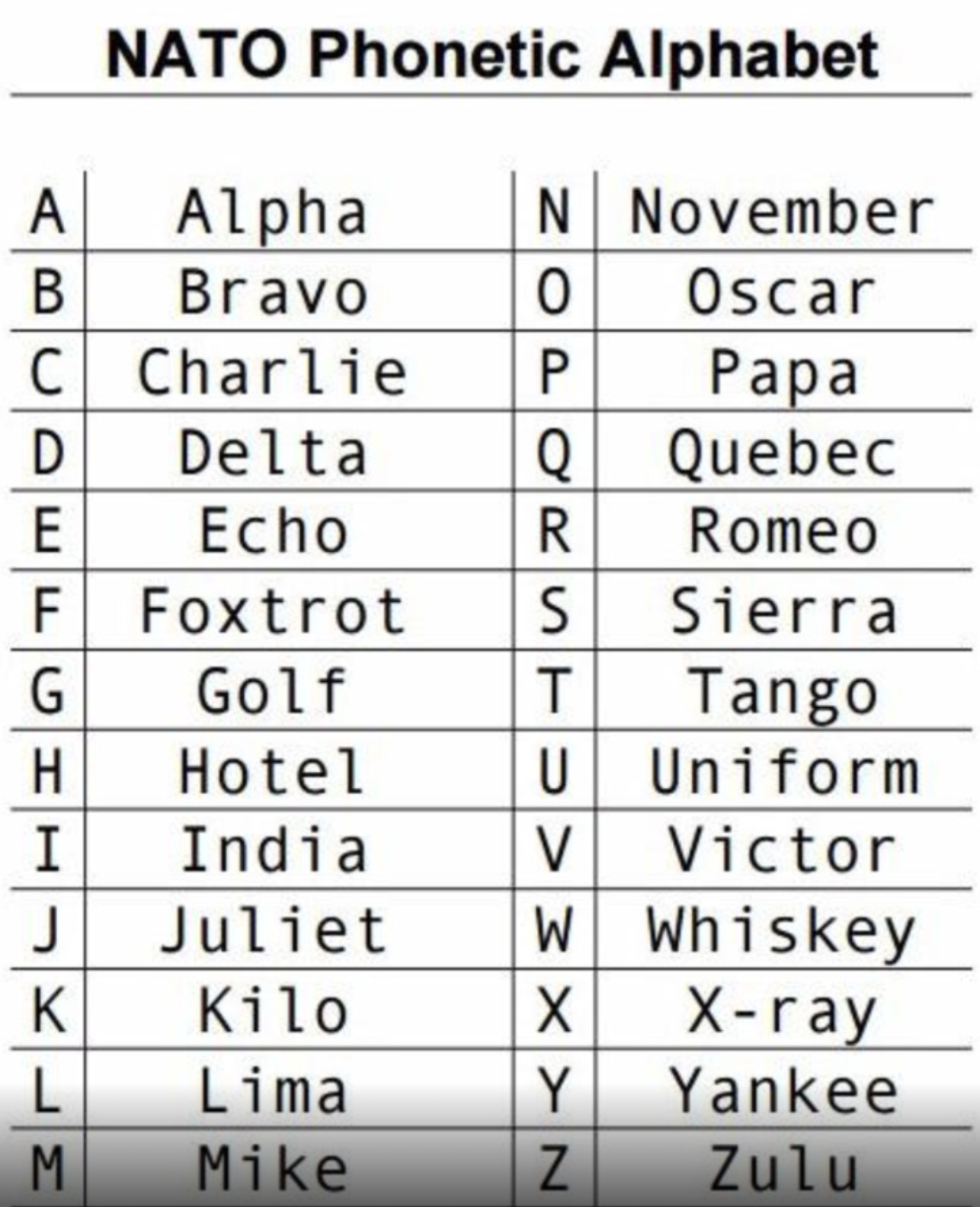
documentation includes…
demographics, history of present illness, history of present injury, objective findings, subjective findings, assessment findings, treatments provided, what handover occurred, relevant times to patient care, mandated reporting data, any other relevant info
why do we document care?
continuity of care (shared goal of high quality care)
legal purposes (PCR = legal document)
administrative (use data for billing purposes)
research
quality improvement
how do you write a prehospital care report (PCR)? — DCHART
(D)CHART —
Dispatch (time, location, complaint)
Chief complaint
History (SAMPLE, PASTMEDS, OPQRST, pertinent negatives, info from bystanders)
Assessment (from environmental & physical assessment
Rx/Treatment
Transport (how got patient to ambulance, patient’s position during transport)
how do you write a prehospital care report (PCR)? — SOAP
SOAP —
Subjective (subjective findings, patient’s complaint, history, allergies, medications, info from bystanders)
Objective (vitals, level of consciousness, pulse ox)
Assessment (wrap up subjective and objective findings —> provide clear idea of what is wrong w patient)
Plan (treatment provided / transport data — how got patient to ambulance, patient’s position during transport)
if want to correct data on an ELECTRONIC document…
submit an addendum
if want to correct data on a PHYSICAL document…
draw single horizontal line through error, initial it, & write correct info next to it
what to do if patient refuses care…
document interaction thoroughly, have them and witnesses sign a refusal of care form
special reporting situations include…
gunshot wounds
dog bites
infectious diseases
physical abuse
sexual abuse
mass casualty incidents
child abuse
elder abuse
today, ambulances are designed according to ___ regulations
governmental
3 types of ambulance designs
uses a truck cab-chassis —> can even transport ambulance body to newer chassis if needed
standard van
specialty van
ambulance and fire districts must maintain response times at a compliance of at least ___ % in each of the five zones for paramedic response vehicles (and emergency ambulances)
90%
six branches on the medical star represent _____
6 main tasks executed by rescuers
detection (identify issue, keep safe)
reporting (call for professional help and dispatches)
response (first rescuers provide first aid)
care (EMS personnel arrive)
care and transit (transport to hospital, etc while providing care on the way)
transfer to definitive care (hospital, specialized care)
1st phase of an ambulance call
preparation — have all equipment & PPE & always at least ONE EMT in patient compartment during transport
place things for life-threatening conditions @ head of primary stretcher
cardiac care, external bleeding, BP @ side of stretcher
phase of ambulance call after preparation
dispatch — dispatcher should note:
nature of call
name, present location, call-back number
location of patient
# of patients & severity of conditions
other pertinent info
what is the most dangerous phase for EMTs?
en route to the scene —> collisions — fasten seatbelts & shoulder harnesses
phase of ambulance call after dispatch
arrival at the scene — ENAMES
park SAFELY
leave warning lights/sirens on
park 100’ before/past crash scene
stay away from fires/explosive hazards / unstable structures
set the parking brake
traffic control —> place warning signs on both sides of crash
if mass casualty incident:
estimate/communicate # of patients to incident commander
request additional units through dispatch
incident command system will be established
phase of ambulance call after arrival on scene
transport —
secure patient to backboard, stretchers
lift patient into compartment
make sure patient is secure with AT LEAST 3 straps
excessive speed is UNNECESSARY and DANGEROUS
when ready to leave, tell dispatch:
# of patients
name of receiving hospital
code 2 or 3 transport
if additional crew/resources is also coming
when en route
monitor patients (recheck stable patient every 15 min & unstable patient every 5 min)
contact receiving hospital (provide ring down if required OR patient’s condition changes)
do not abandon the patient emotionally
phase of ambulance call after transport
delivery phase —
notify dispatch that arrived to hospital
report arrival to triage nurse
physically transfer patient
give complete verbal report to RN or MD
restock if necessary
what to do during postrun phase
complete/file PCR
inform dispatch of status, location, and availability
perform routine inspections
refuel vehicle
disinfect all non-disposable equipment used for patient care
clean stretcher w germicidal/virucidal solution or 1:100 bleach solution
clean spillage or other contamination w one of those solutions
cleaning is _____
removing dust/dirt, blood, other visible contaminants from surface/equipment
disinfection is _____
applying a chemical to kill pathogens
sterilization is ____
uses heat to remove all microbial contamination
which lane to stay on for ambulance when on multilane highways (when code 3)
extreme left-hand lane
what does excessive speed when driving ambulance do
dangerous and does NOT increase patient’s likelihood of surviving
makes patient care in patient compartment hard
hinder driver’s reaction time
increases time and distance needed to stop the ambulance
siren syndrome
drivers drive faster bc of increased anxiety from the sirens
when making a turn in ambulance, enter ___ in the lane and exit ___
high / low
ambulances have a ___ braking time and stopping distance
longer
what u are allowed to do if on emergency call and using lights/sirens
park/stand in illegal location
proceed through red light / stop sign
driver faster than speed limit (EXCEPT in school zones)
drive against flow of traffic
travel left of center to make illegal pass
an emergency vehicle is NEVER allowed to pass ____
a school bus that stopped to load/unload kids
__ crashes are the most common and dangerous
intersection crashes
when getting on/off highway, ______ until reach far left lane
shut down emergency lights and sirens
why call for medivac (air medical transporot)
ground transportation takes too long
road, traffic, environmental conditions prohibit ground transport
patient needs advanced care
multiple patients will overwhelm hospital reachable by ground transport
auto launch
if any 911 call has a medical component, helicopter is automatically dispatched

