Psychological thought in Greek Tradition, Plato and Aristotle
 Studied by 0 people
 Call Kai
 Learn
Learn Practice Test
 Spaced Repetition
 Match
Match Flashcards
 Knowt Play
1/7

There's no tags or description
Looks like no tags are added yet.
Name | Mastery | Learn | Test | Matching | Spaced | Call with Kai |
|---|
No analytics yet
Send a link to your students to track their progress
8 Terms
Greek Religiosity
Olympian religion can be characterised as both anthropomorphic and rational in nature, aiming to provide a comprehensible and human-centric interpretation of events.
In contrast, the Orphic religion, which bore similarities to Buddhism, adopted a divergent approach. The Orphic religion emphasised the transmigration of souls. According to their belief system, the soul, deemed culpable for an original transgres. sion, was incarcerated within a physical form and subjected to a perpetual "cycle of rebirths". The objective of religion was to liberate the soul from the confines (sema) of the body (soma) through a process of purification, known as katharsis.
Pre-Socratic philosophical reflection: They sought the principle (or arché) that constitutes the ultimate reason for all things, identifying it with diferent realities (the four elements, the homeomeres, the atoms, etc.). These realities have since been superseded, yet in the history of philos-ophy and humanity, they represented a significant step forward by being the first to question the origin of everything in an exclusively rational way.
The emergence of medicine
Another significant development in Greek medicine was the establishment of scientific medicine.
foundation for future advancements. A notable figure in this transition was Alemeon of Crotona (c. 500 BC), a pre-Socratic Pythagorean philoso-pher. He developed the concept of health as a balance between principles pioneered scientific dissections.
Proposed that the functions of the mind were in the brain.
Who was the father of modern medicine? (c. 460-377 BC),
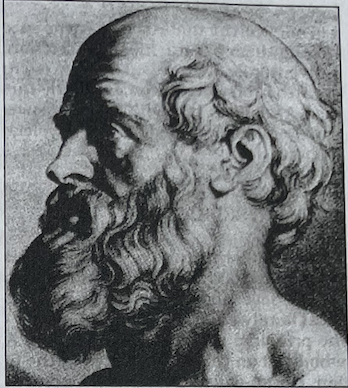
The most important is undoubtedly Hippocrates (c. 460-377 BC), considered the father of modern medicine because he developed and systematised much knowledge and was the basic reference for many centuries. He is also rightly famous for his humanistic approach to medicine.
Plato’s (427-347 BC) most important contributions to the history of psychology
His idealistic conception of reality:
According to Plato, the physical world is not the ultimate reality, but a pale reflection of the true, unchanging world of forms or ideas, which are spiritual and eternal.
He posits that individuals must strive to liberate themselves from the constraints of the senses and ascend to the realm of ideas, though few achieve this feat.
A first structured vision of man:
For Plato, knowledge has a soteriological value (Sóter in Greek = salvation), since it serves to achieve the liberation from the body to which every human being aspires or should aspire.
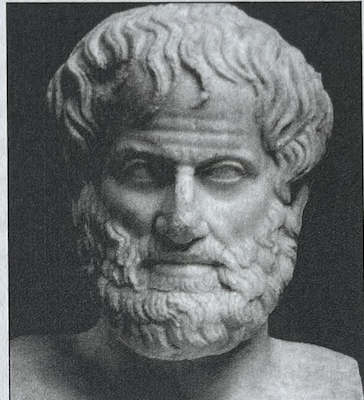
Aristotle (384-322 BC)
He was the first to deal extensively with many central issues, including memory, sensation, sleep, dreams, geriatrics, learning, and so on.
Aristotelian realism
All living beings, including animals and plants, possess souls, as they are endowed with an organising principle that, upon its cessation, results in their demise.
The 3 types of souls:
Plant: performs the function of nutrition, assimilation and reproduction.
Sensitive: encompasses not only the functions of the plant itself but also its capacity for sensitive perception, desire, and local movement,
Rational: are further developed by the possession of a mind noûs) that can engage in science and moral life.
The rational soul (Aristotle)
All knowledge is derived from the senses and experience,
rather than from Platonic innate ideas.
This experiential knowledge commences with the five basic senses that facilitate our interaction with reality: sight, hearing, smell, touch and taste.
Learning (Aristotle)
Aristotle is widely regarded as the first theorist to develop a theory of learning based essentially on three points:
The human being begins from the most basic level. He is a tabula rasa. This perspective aligns with his empiricist and anti-innatist tenets.
Learning is achieved through memory and the utilisation of rules of association. "similarity", "contrast", "contiguity" and "frequency"
The repetition of actions has been shown to engender habits
Motivation (Aristotle)
Aristotle also developed a renowned theory of motivation that was founded on the concept of end, which is referred to as the teleological theory (from telos, end).
For Aristotle, the goal of human existence is the eudaimonic life, defined as the pursuit of happiness.
 Note
Note  Flashcards (21)