KIN 223 Anatomy and Kinesiology Exam 3 Review Questions
 Call Kai
 Learn
Learn Practice Test
 Spaced Repetition
 Match
Match Flashcards
 Knowt Play
1/49

There's no tags or description
Looks like no tags are added yet.
Name | Mastery | Learn | Test | Matching | Spaced | Call with Kai |
|---|
No analytics yet
Send a link to your students to track their progress
50 Terms
The zones found in an epiphyseal plate are
a: Calcified cartilage
b: Hypertrophic cartilage
c: Ossification
d: Resting cartilage
e: Proliferating cartilage
The correct order for these zones, beginning with the edge closest to the epiphysis and proceeding toward the diaphysis, is
D,B,E,A,C
E,D,A,C,B
C,D,E,A,B
D,E,B,A,C
C,A,B,E,D
D,E,B,A,C
Mechanical stress applied to bone ____ osteoblast activity in bone tissue, and the removal of mechanical stress ___ osteoblast activity.
Decreases; increases
Increases; decreases
Decreases, maintains
Increases, maintains
Increases; decreases
The knobby region of a long bone at the end that is farthest from the trunk is the
Superior diaphysis
Distal epiphysis
Distal diaphysis
Proximal epiphysis
Distal epiphysis
Interstitial growth of cartilage increases its ____ and occurs in the ___ region of the cartilage.
Length; peripheral
Length; internal
Width; internal
Width; peripheral
Length; internal
Bine cells that become surrounded by bone matrix and are located in cavities called lacunae are
Osteogenic cells
Osteoblasts
Osteoclasts
Osteocytes
Osteocytes
Calcitonin____ osteoclast activity, which will _____ blood calcium levels.
Inhibits; decreases
Stimulates; decrease
Stimulates; increase
Inhibits; increase
Inhibits; decrease
What explains the dramatic acceleration in lengthwise bone growth at puberty?
Increased absorption of dietary vitamins and minerals strengthens the matrix.
Increased physical activity causes lengthwise growth in response to bone stress.
Increased secretion of sex hormones promotes epiphyseal plate growth.
Increased activity of osteoclasts occurs in response to parathyroid hormone stimulation.
Increased rate of calcium deposition occurs due to high blood calcium levels.
Increased secretion of sex hormones promotes epiphyseal plate growth.
Bone cells called __________ break down bone by secreting hydrochloric acid and enzymes that dissolve the matrix.
Osteocytes
Osteoprogenitor cells
Osteoblasts
Osteoid cells
Osteoclasts
Osteoclasts
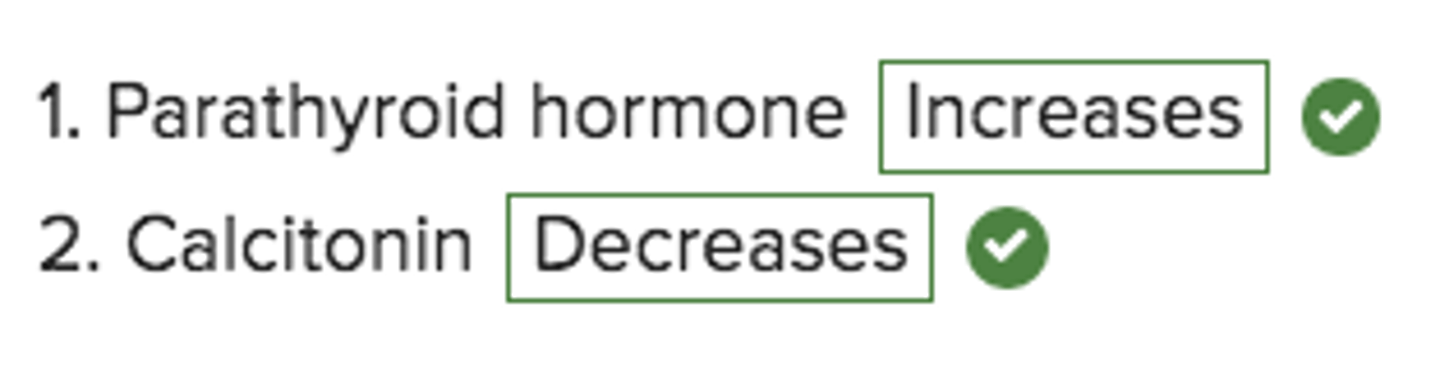
Indicate if the listed hormone increases or decreases blood calcium levels.
As the bone matrix calcifies and the secreting cells become walled in,
Osteoblasts become osteoclasts
Osteogenic progenitors become osteoclasts
Osteoclasts become osteocytes
Osteoblasts become osteocytes
Osteoblasts become osteocytes
Endochondral ossification begins with a(n) ____ model.
Membranous
Dense connective tissue
Hyaline cartilage
Mesenchyme
Osteoid
Hyaline cartilage
Consider the classifications of bone, and examples of each. Which classification comprises bones used primarily for movement rather than protection?
Irregular bones
Regular bones
Short bones
Long bones
Flat bones
Long bones
Which is false regarding the periosteum?
It provides stem cells for bone growth and repair.
It is anchored to the bone by collagen fibers.
It includes two layers: outer fibrous and inner cellular.
It covers the entire bone surface, with the exception of articular areas.
It is composed of dense regular connective tissue.
It is composed of dense regular connective tissue
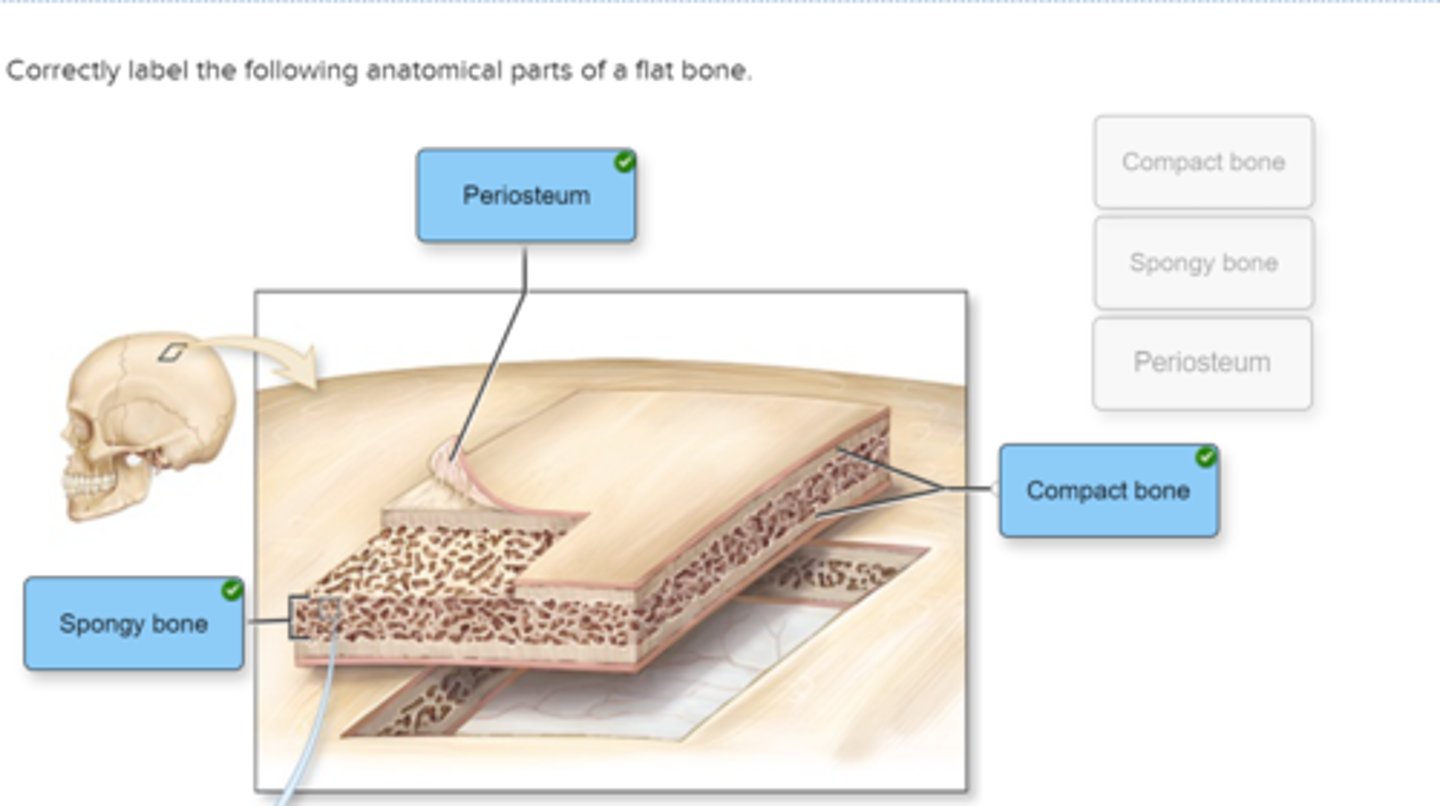
Correctly label the following anatomical parts of a flat bone.
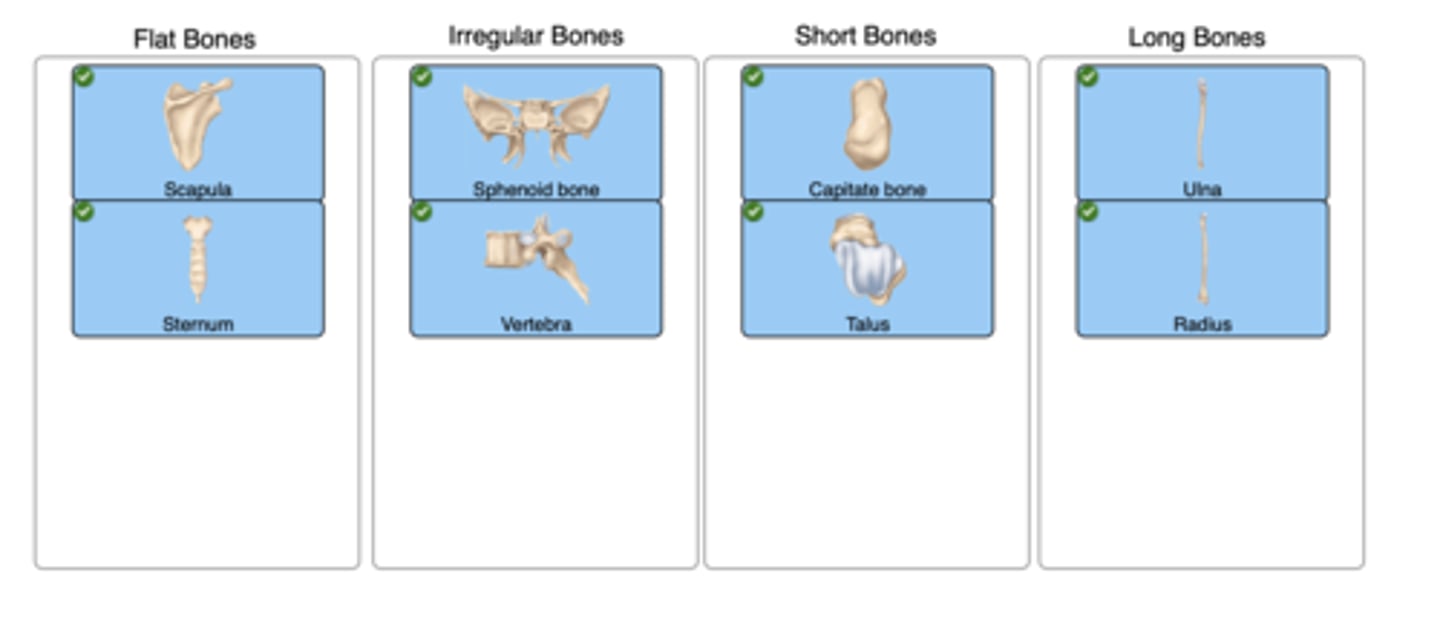
Classify the following images of bone into the correct category they represent.
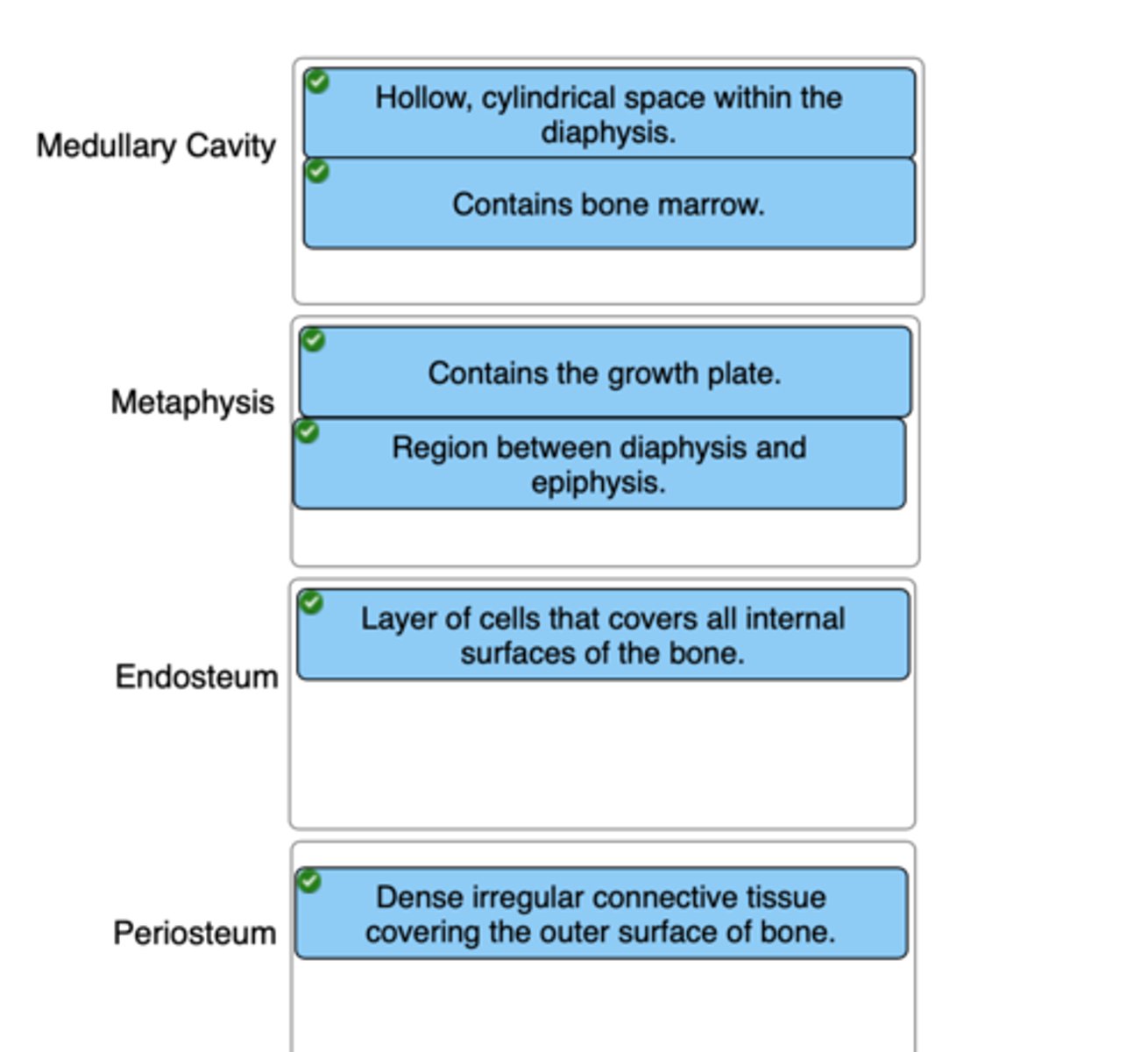
Match the part of a long bone with its description.
What is the function of the nuchal lines?
Attachment for muscles and ligaments
Grooves for dural sinuses
Passageway for jugular vein
Attachment for dura mater
Passageway for cranial nerves
Attachment for muscles and ligaments
Which is not a correct pairing of a bone and its common name?
Patella-knee cap
Clavicle- collar bone
Tibia-shin
Talus-heel
Scapula-shoulder blade
Talus-heel
The occipital condyles articulate with
Odontoid process
Dens
Axis
Atlas
Vertebra prominens
Atlas
Transverse foramina are found in ___ vertebrae.
Thoracic
Lumbar
Cervical
Sacral
All
Cervical
The talus, calcaneus, navicular, cuboid, and lateral, intermediate, and cuneiform bones are all part of the
Hand
Skull
Foot
Sternum
Pelvis
Foot
Which statement accurately compares the hand and the foot?
Each hand has 14 phalanges, but each foot has 15 phalanges.
The hand and the foot each have 15 phalanges.
Each hand has 15 phalanges, but each foot has 14 phalanges.
The hand and the foot each have 14 phalanges.
The hand and the foot each have 14 phalanges
Which statement accurately describes the articulations between ribs and vertebrae?
Three of the cervical and ten of the thoracic vertebrae articulate with ribs.
Twelve thoracic vertebrae articulate with the ribs.
Two cervical, two lumbar and eight thoracic vertebrae articulate with the ribs.
Nine thoracic and three lumbar vertebrae articulate with the ribs.
Two lumbar and ten thoracic vertebrae articulate with the ribs.
Twelve thoracic vertebrae articulates with the ribs
Which bone does not belong to the appendicular skeleton?
Calcaneus
Sacrum
Femur
Clavicle
Ulna
Sacrum
The skull consists of ____ cranial bones and ____ facial bones.
5,7
10,12
8,14
9,11
7,12
8,14
The expanded distal end of the fibula is called the
Neck
Shaft
Lateral malleolus
Head
Medial malleolus
Lateral malleolus
What is the inner, gelatinous region of each intervertebral disc called?
Articular ring
Chondral ring
Lamella
Annulus fibrosus
Nucleus pulposus
Nucleus pulposus
The hard palate is composed of the
Nasal conchae and vomer bones
Maxillary and palatine bones
Zygomatic and lacrimal bones
Sphenoid and ethmoid bones
Nasal conchae and palatine bones
Maxillary and palatine bones
Which of these skull bones cannot be easily palpated?
Occipital
Frontal
Parietal
Temporal
Ethmoid
Ethmoid
Rami, trochanters, tubercles, and tuberosities are bone markings that serve as
Pits or depressions to hold cartilage.
Attachments for ligaments or tendons.
Articulating surfaces.
Passageways for blood vessels.
Passageways for nerves.
Attachments for ligaments or tendons
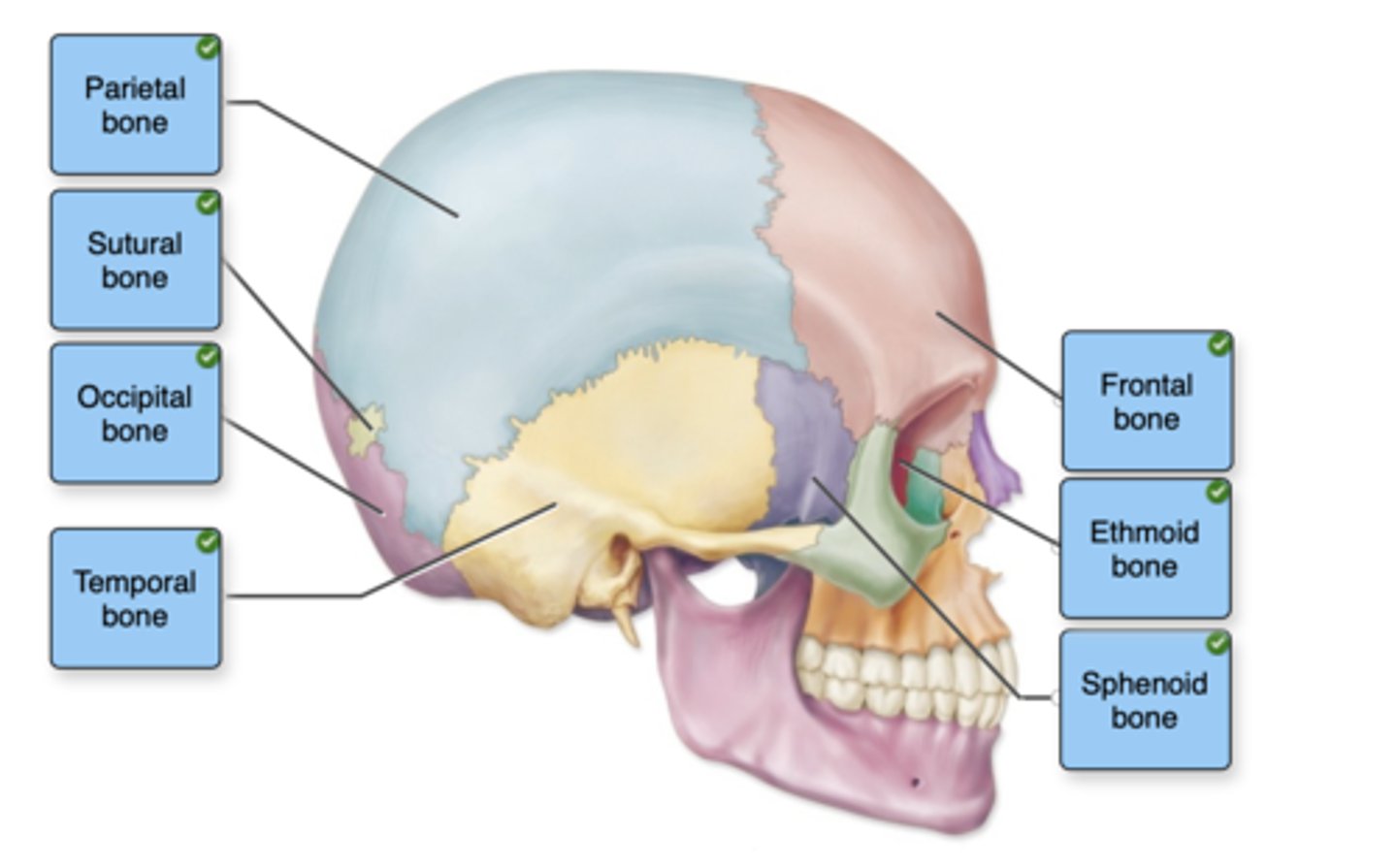
Identify the cranial bones in the figure. Not every answer will be used.
Drag each label into the proper position to identify whether the indicated structure is located on the femur, humerus, or both.
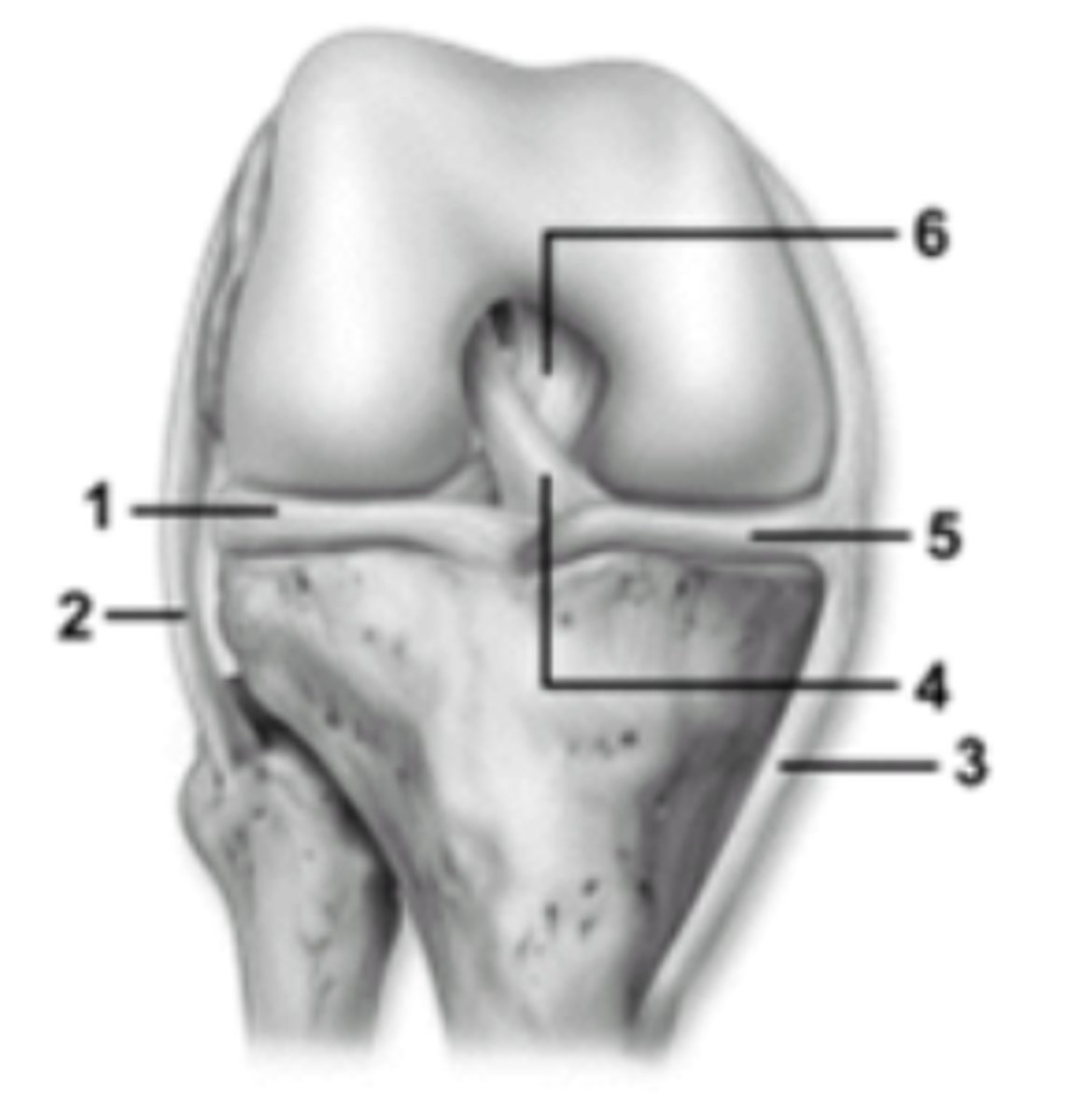
This figure shows the knee joint. Which number indicates the tibial collateral ligament?
2
6
5
3
1
3
If a joint moves in all three planes of space, it is classified as
Multiaxial
Nonaxial
Biaxial
Uniaxial
Multiaxial
When the angle between articulating bones increases beyond the anatomic position, the movement is referred to as
Dislocation
Hypertrophy
Hyperflexion
Hyperextension
Supination
Hyperextension
When compared to the shoulder, the hip joint has
a shallower bony socket and weaker supporting ligaments.
a deeper bony socket and stronger supporting ligaments.
a deeper bony socket but weaker supporting ligaments.
a shallower bony socket but stronger supporting ligaments.
A deeper bony socket and stronger supporting ligaments.
The fixed point around which a lever rotates in the
Multiaxis
Condyle
Effort arm
Resistance node
Fulcrum
Fulcrum
Fluid-filled sacs containing synovial fluid are called
Articular discs
Bursae
Menisci
Diarthroses
Fat pads
Bursae
Which is not a function of synovial fluid?
Nourishes osteocytes
Distributes stress forces across articular surfaces
Removes wastes
Lubricates articulating surfaces
Serves as shock absorber
Nourishes osteocytes
Structurally, a syndesmosis is a _________ joint; functionally, it is a __________.
FIbrous; synarthrosis
Cartilagenous; amphiarthrosis
Fibrous; amphiarthrosis
Cartilagenous; diarthrosis
Ball and socket; pivot
Fibrous; amphiarthrosis
Movement of a body part toward the main axis of the body is called
Adduction.
Abduction.
Retraction.
Flexion.
Inversion.
Adduction
In fibrous joints, the articulation surfaces are held together by
Dense irregular connective tissue.
Dense regular connective tissue.
Areolar connective tissue.
Articular cartilage.
Fibrocartilage.
Dense regular connective tissue
When considering leverage, the part of the bone from the muscle attachment to the joint would be the
Fulcrum
Effort arm
Resistance arm
Effort arm
The pubic symphysis is classified as a
Cartilaginous joint and a synarthrosis.
Cartilaginous joint and an amphiarthrosis.
Fibrous joint and a synarthrosis.
Synovial joint and a diarthrosis.
Fibrous joint and an amphiarthrosis.
Cartilaginous joint and an amphiarthrosis
Based on its range of motion, the elbow is classified as a(n) __________ joint.
Gliding
Ellipsoid
Uniaxial
Biaxial
Multiaxial
Uniaxial
Which is not correct regarding articulations?
Arthrology is the scientific study of articulations.
There are three structural categories of articulations.
Articulations can range in motion from freely mobile to immobile.
An articulation is a joint between a bone and another bone, cartilage, or tooth.
All articulations contain some type of cartilage.
All articulation contain some type of cartilage.
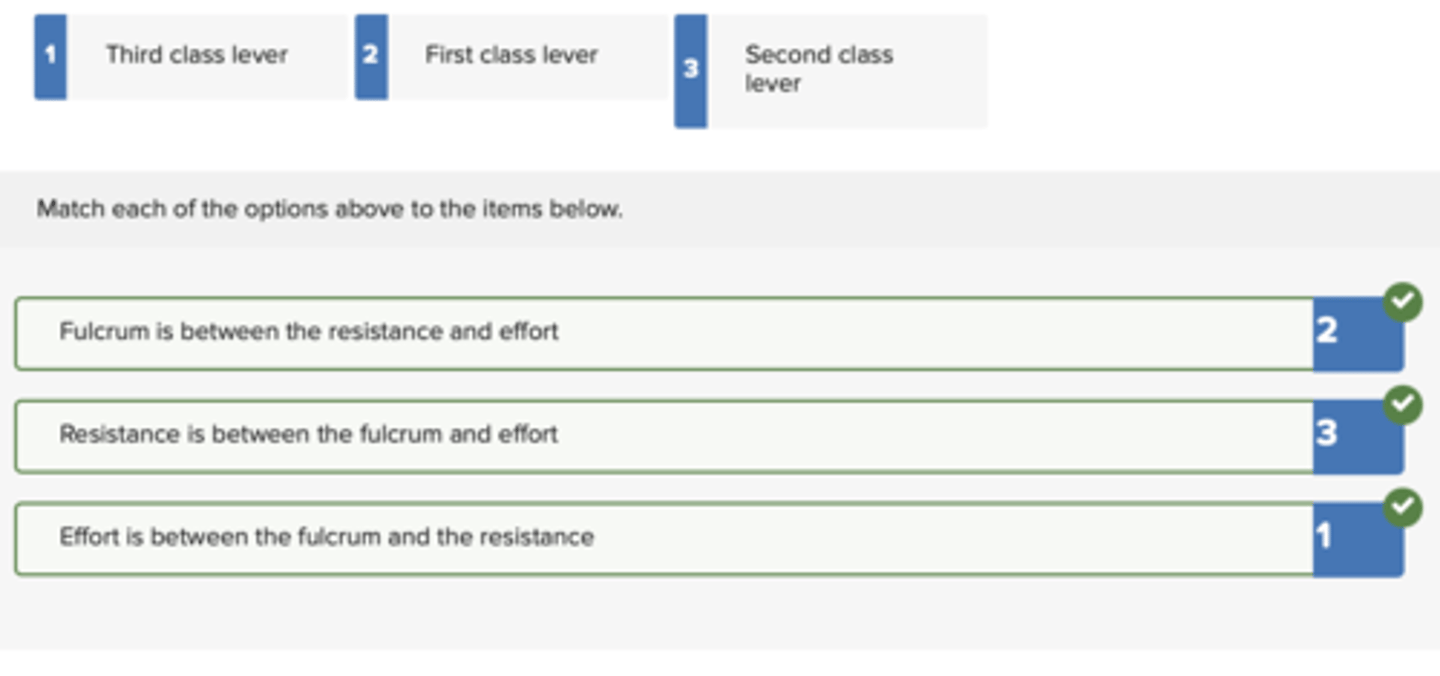
Match each lever with the location of its effort, resistance, and fulcrum.
When kicking a ball forward, the knee is
Circumducted
Abducted
Rotated
Extended
Extended
Fill in the blanks with the terms provided.
Three classes of levers are found in the human body: first-class, second-class, and third-class.A first-class lever has a (fulcrum) in the middle, between the effort and the resistance. In the body, an example of a first-class lever is the (atlanto-occipital joint of the neck.)In a second-class lever, the (resistance) is between the fulcrum and the applied effort. A (small) force can balance a (large) weight in this type of lever because the effort is always farther from the fulcrum than the resistance. In the body, one example of activity at a second-class lever is the (calcaneal tendon attachment to the heel).A third-class lever is observed when the (effort) is applied between the resistance and the fulcrum. A third-class lever is found at the (joint between the humerus and ulna.)
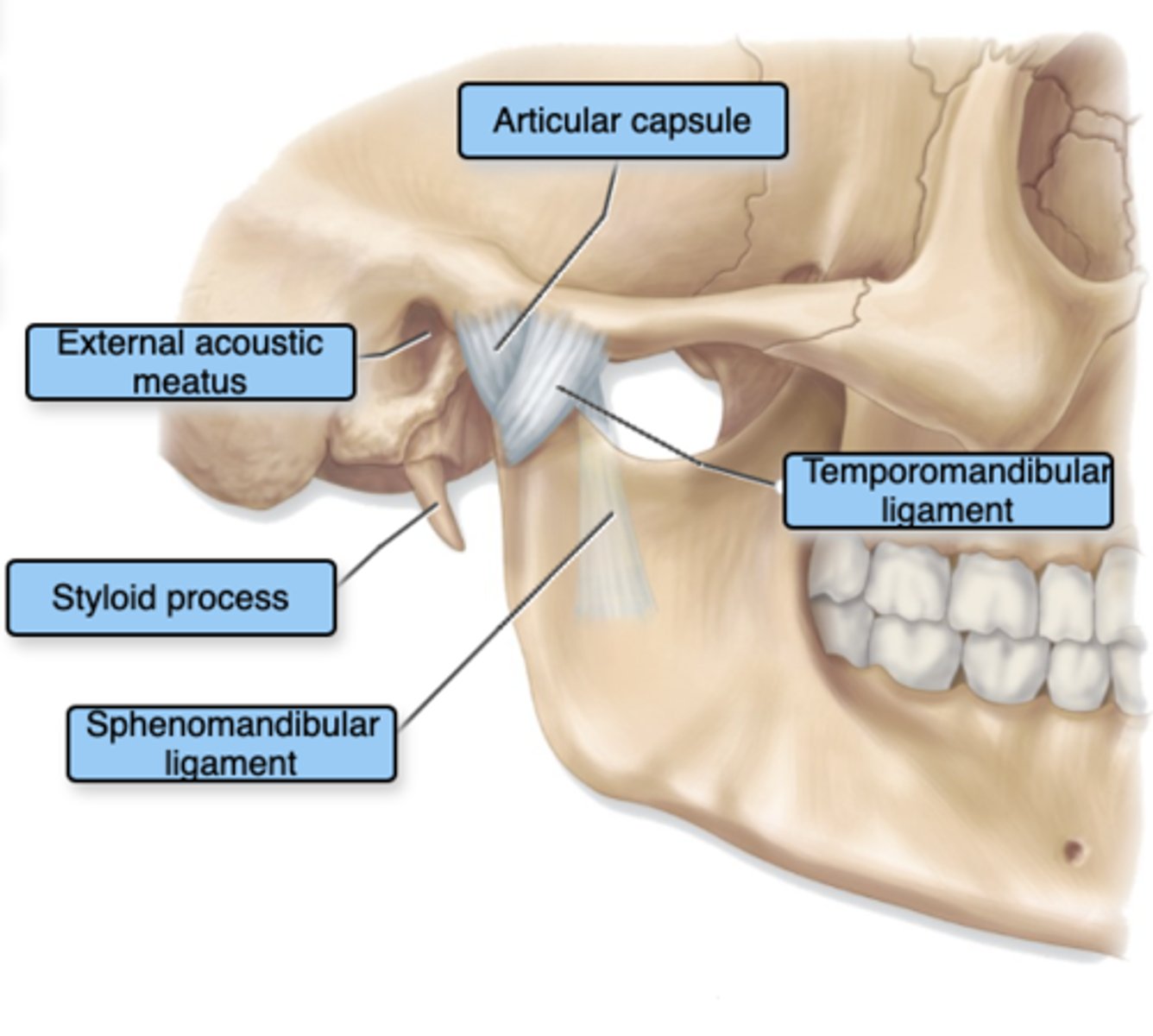
Correctly identify the following anatomical parts of the temporomandibular joint.