GAS EXCHANGE AND TRANSPORT IN PLANTS
 Studied by 0 people
 Call Kai
 Learn
Learn Practice Test
 Spaced Repetition
 Match
Match Flashcards
 Knowt Play
1/33

There's no tags or description
Looks like no tags are added yet.
Name | Mastery | Learn | Test | Matching | Spaced | Call with Kai |
|---|
No analytics yet
Send a link to your students to track their progress
34 Terms
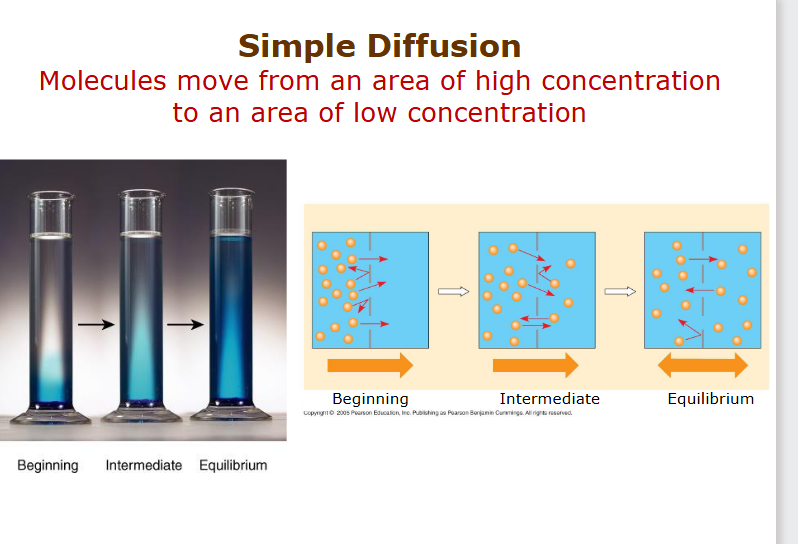
Describe simple diffusion and why it's passive.
Movement of molecules from high to low concentration.
Passive because it requires no cellular energy (ATP).
Driven by the molecule's own kinetic energy
Where do O₂ and CO₂ cross the membrane?
Via simple diffusion.
Directly through the phospholipid bilayer.
Because they are small and nonpolar.
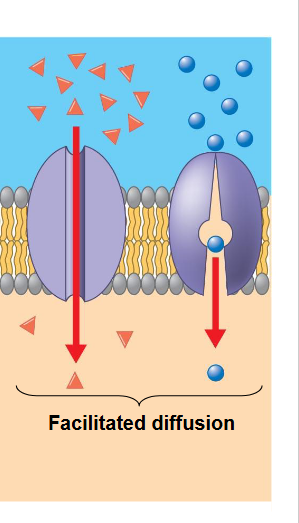
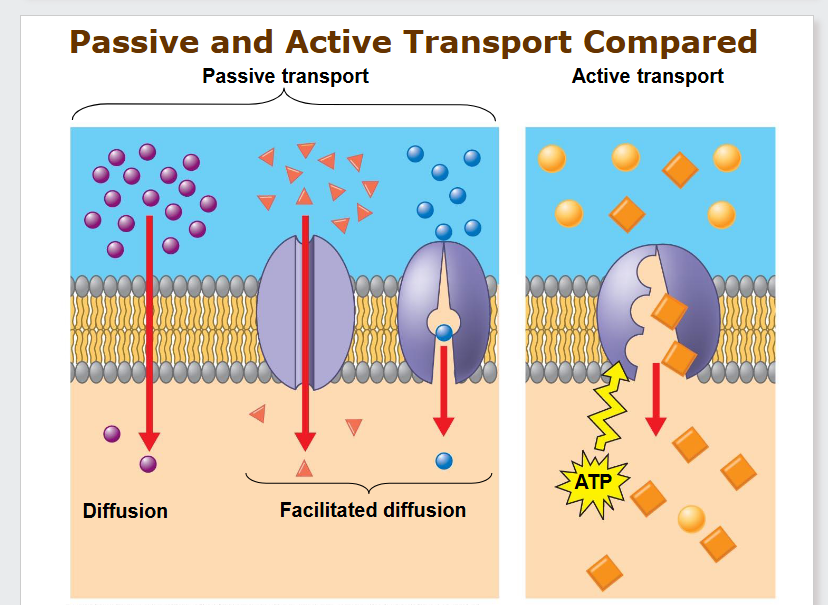
What is facilitated diffusion and how does it differ from simple diffusion?
Passive movement down a concentration gradient.
Requires specific transport proteins (channels or carriers).
Differs from simple diffusion because it is for molecules that can't cross the lipid bilayer alone (e.g., ions, large polar molecules).
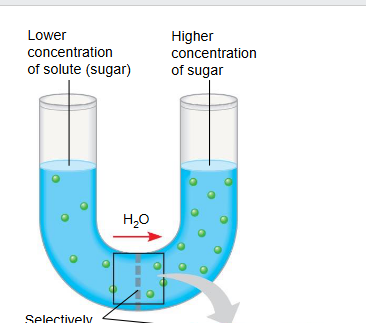
What is osmosis and how do cells regulate it?
Osmosis: Diffusion of water across a membrane from low solute to high solute concentration.
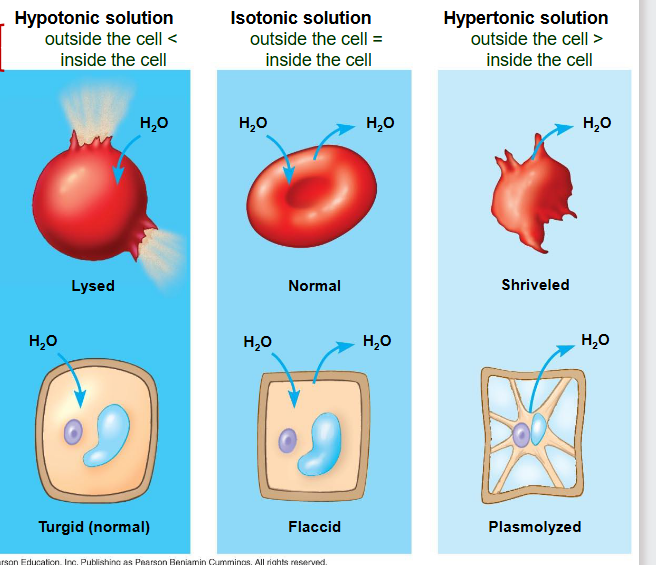
Define hypertonic, hypotonic, and isotonic.
Hypertonic: Higher solute concentration (less water) than the cell.
Hypotonic: Lower solute concentration (more water) than the cell.
Isotonic: Equal solute concentration to the cell.
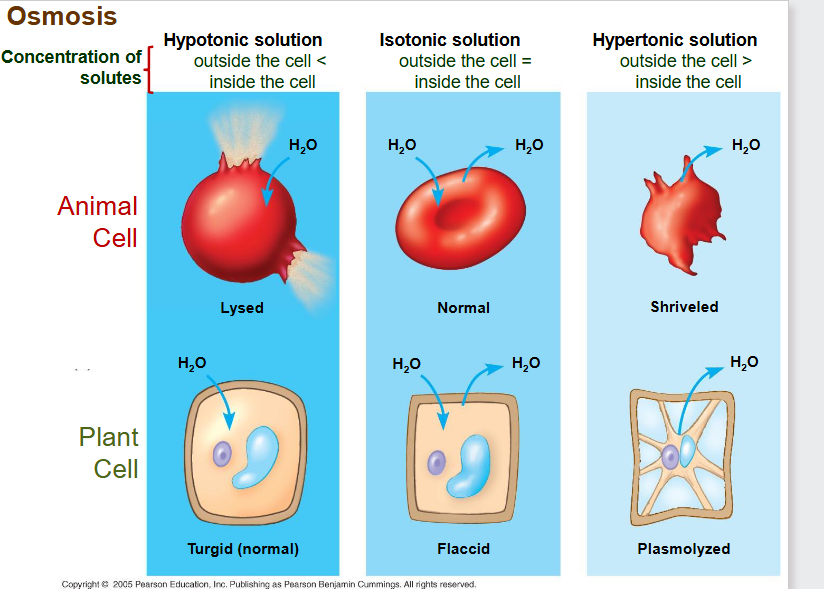
How do plant and animal cells respond to different tonicities?
Animal Cell:
Hypotonic: Swells/lyses (bursts).
Hypertonic: Shrivels (crenates).
Plant Cell:
Hypotonic: Becomes turgid (firm).
Hypertonic: Undergoes plasmolysis (membrane pulls away from wall).
Using Na⁺, K⁺, CO₂, and O₂, describe active transport and how it differs from passive
Active Transport (e.g., Na⁺, K⁺):
Requires energy (ATP).
Moves solutes against their gradient.
Example: Sodium-Potassium Pump.
Passive Transport (e.g., CO₂, O₂):
No energy required.
Moves solutes down their gradient (diffusion).
Key Difference: Energy use and direction of movement relative to the gradient.
Structures for gas exchange in roots, stems, and leaves?
Back:
Roots: Epidermis and root hairs.
Stems: Lenticels (pores in bark).
Leaves: Stomata (pores controlled by guard cells) - primary site.
Why does root branching help uptake?
Increases surface area.
Maximizes contact with soil water and minerals.
Leads to more efficient absorption.
How did mycorrhizae help plants colonize land?
Mutualistic relationship (fungus + plant roots).
Fungal hyphae dramatically increase absorption surface area for water/minerals.
Provided early plants with a more effective "root system" to access scarce resources.
What is the function of the leaf cuticle?
A waxy, waterproof coating on the leaf epidermis.
Primary function: Prevents water loss (desiccation) from the leaf surface.
What are stomata, where are they found, and what is their function?
What: Pores in the epidermis.
Where: Typically more on the lower (abaxial) surface of the leaf.
Function:
Allow gas exchange (CO₂ in for photosynthesis, O₂ out).
Enable transpiration (water vapour loss).
How does mesophyll structure facilitate photosynthesis and gas exchange?
Palisade Mesophyll: Tightly packed, columnar cells for efficient light capture.
Spongy Mesophyll: Loosely packed cells with air spaces; creates a large internal surface area for gas exchange with the atmosphere via stomata.
If a leaf is vertical, would its mesophyll be divided? Explain.
No, not distinctly.
Reason: Both sides receive similar light exposure, so there is no need for a dedicated upper (palisade) layer for light capture. The mesophyll is often more uniform.
What is the location and role of vascular tissue (veins) in leaves?
Location: Embedded within the mesophyll.
Roles:
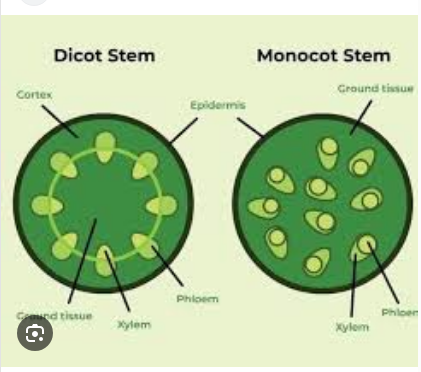
Xylem: Delivers water and minerals to the leaf cells.
Phloem: Exports sugars (photosynthates) from the leaf to the rest of the plant.
How does vascular tissue arrangement differ between monocot and eudicot leaves?
Monocots: Parallel veins (veins run in parallel lines along the leaf length).
Eudicots: Branching (reticulate) veins (veins form a branched, net-like pattern).
What are three structural adaptations of guard cells for their function?
Thick Inner Wall: The wall facing the stoma is thicker, so when the cell swells, it bends and opens the pore.
Cellulose Microfibrils: Radiate around the cell, forcing it to lengthen and bend rather than expand widthwise when turgid.
Presence of Chloroplasts: Allows them to perform photosynthesis and sense light cues.
Describe the mechanism of stomatal opening and closing.
Opening:
Guard cells actively pump K⁺ ions in.
Solute concentration increases.
Water enters by osmosis.
Guard cells become turgid and bend apart, opening the stoma.
Closing:
K⁺ ions leave the guard cells.
Solute concentration decreases.
Water leaves by osmosis.
Guard cells become flaccid and collapse together, closing the stoma.
Name three cues for daily stomatal opening.
Blue Light: Activates proton pumps to start K⁺ uptake.
Depletion of CO₂ in the leaf air spaces (from photosynthesis).
An internal "circadian rhythm" that anticipates dawn.
How do temperature, humidity, and drought affect stomata?
High Temperature / Low Humidity: Increase transpiration rate, triggering stomatal closure to conserve water.
Drought: Triggers the production of the hormone ABA (abscisic acid), which forces stomatal closure.
Consequence: Prevents water loss but limits CO₂ intake, reducing photosynthesis.
What are some xerophyte adaptations to reduce water loss?
Thick cuticle and sunken stomata (traps moist air near the pore).
Reduced leaf area (e.g., spines in cacti).
Stomata that open only at night (CAM metabolism).
Which vascular cells are alive and which are dead at functional maturity?
Alive: Phloem cells (Sieve-tube elements, companion cells).
Dead: Xylem cells (Tracheids, vessel elements). Their cytoplasm disintegrates, leaving hollow tubes for water flow.
Describe the direction of xylem and phloem sap flow.
Xylem Sap: Unidirectional, upward from roots → stems → leaves.
Phloem Sap: Bidirectional; flows from sources (e.g., sugar-producing leaves) to sinks (e.g., sugar-storing roots or fruits).
How does the vascular system enable leaves and roots to function together?
Xylem: Roots supply water/minerals to leaves for photosynthesis.
Phloem: Leaves supply sugars (food) to roots for energy and growth.
This interdependence is enabled by the continuous vascular system connecting all plant parts.
Describe the apoplastic and symplastic routes to the root xylem.
Apoplastic Route:
Water/solutes move through the non-living spaces between cell walls and extracellular spaces.
Fast, passive movement.
Symplastic Route:
Water/solutes move through the cytoplasm of cells, connected by plasmodesmata.
Movement is regulated by the cell membranes.
Describe the endodermis and Casparian strip.
Location: A single layer of cells surrounding the vascular cylinder (stele) in the root.
Composition/Structure: Contains the Casparian strip—a waterproof band of suberin (wax) in its cell walls.
Function: The Casparian strip blocks the apoplastic pathway, forcing all water and solutes to pass through the selective endodermal cell membranes. This allows the plant to control which substances enter the vascular system.
What is root pressure, and how important is it for moving sap upwards?
What: The pushing of xylem sap upward due to the active pumping of minerals into the root xylem, which draws in water by osmosis.
Importance: Minor role. It can cause guttation (water droplets on leaves) in small plants at night but is not strong enough to account for sap movement to the top of tall trees.
Define transpiration and explain how it creates a pulling force.
Transpiration: The evaporation of water from the leaf surfaces (primarily through stomata).
The Pull:
Water evaporates from the walls of mesophyll cells into the leaf's air spaces.
This creates a negative pressure (tension) in the mesophyll cells.
This tension pulls water from the xylem, which in turn pulls water from the roots.
How do cohesion and adhesion facilitate water movement in xylem?
Cohesion: Water molecules stick to each other via hydrogen bonds, forming a continuous "chain" that can be pulled up.
Adhesion: Water molecules stick to the hydrophilic walls of the xylem cells, helping to hold the water column against the force of gravity.
Together, they allow the Cohesion-Tension Theory to work: transpiration pulls a continuous column of water from leaves to roots.
Provide examples of sugar sources and sugar sinks.
Sources: Organs that produce or release sugar.
Examples: Mature leaves, storage tissue (like a tuber in spring).
Sinks: Organs that consume or store sugar.
Examples: Growing roots, stems, fruits, seeds, and storage organs (like a tuber in fall).
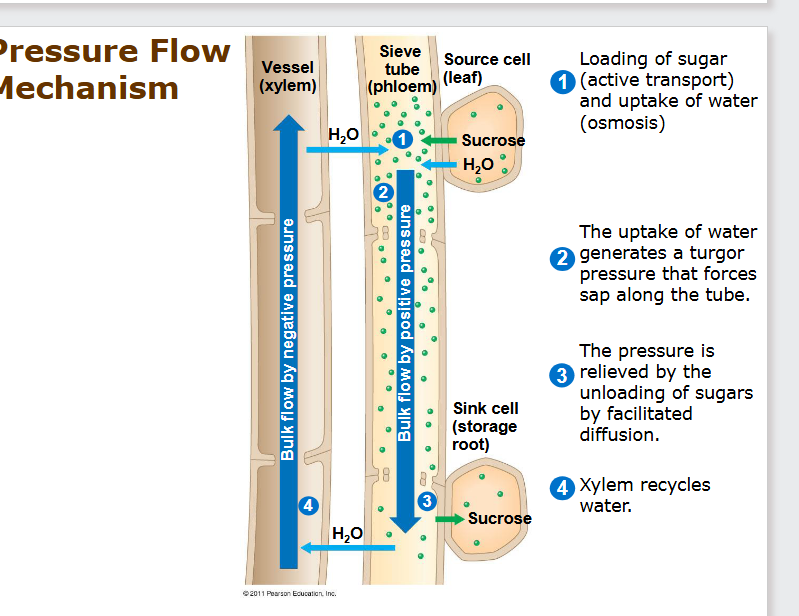
Describe the mechanism of pressure flow in phloem.
At the Source: Sucrose is actively loaded into sieve-tube elements.
This high solute concentration causes water to enter from the xylem by osmosis, creating high pressure.
At the Sink: Sucrose is unloaded for use or storage.
This low solute concentration causes water to leave the phloem by osmosis, creating low pressure.
Sap flows bulk flow from the high-pressure area (source) to the low-pressure area (sink).
How is sucrose loaded into sieve-tube elements at the source?
Sucrose is actively transported from source cells into the companion cells and sieve-tube elements.
This often requires ATP and specific membrane proteins to move sucrose against its concentration gradient.
Why does pressure flow require living cells?
Back:
Sieve-tube elements must be alive to power the active transport of sucrose.
Their plasma membranes must be intact to maintain the solute concentration gradients necessary for osmosis and pressure buildup.
What is evidence for the pressure flow theory?
Evidence from Aphids: When an aphid's stylet (mouthpart) is severed, phloem sap continues to flow out of the stylet due to the positive pressure inside the sieve tube.
Concentration Gradients: Sucrose concentration is highest near sources and lowest near sinks, matching the theory's prediction.
Radioactive Tracer Studies: Tracking labeled carbon shows the speed and direction of sap flow matches pressure flow.
 Note
Note  Flashcards (44)