Class 12 (February 2nd)
 Studied by 0 people
 Call with Kai
 Learn
Learn Practice Test
 Spaced Repetition
 Match
Match Flashcards
 Knowt Play
1/34

There's no tags or description
Looks like no tags are added yet.
Name | Mastery | Learn | Test | Matching | Spaced | Call with Kai |
|---|
No analytics yet
Send a link to your students to track their progress
35 Terms
Rational (rationalism)
Operating based on reason, logic and thinking
The capacity to reason (i.e., being a rational, thinking human being)
Known through the intellect, not from experience or empirical observation
Rationale (debate)
A set of reasons
Basic or underlying fundamental principles
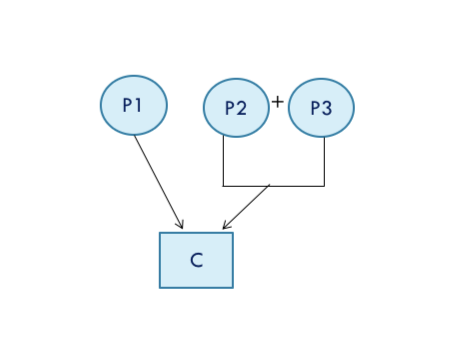
Representing Arguments Visually
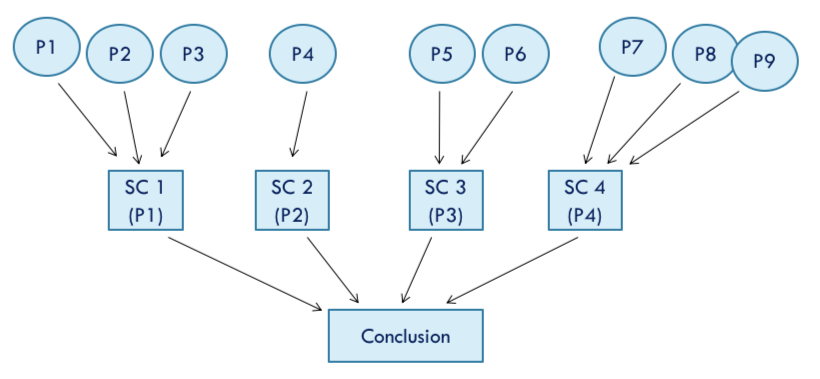
More complex arguments
Why Cogency?
Why Acceptability?
Why not simply truth?
Why not simply probability?
Why Acceptability?
Need for a general practical term
Why not simply truth?
Often too strong a condition (one counterexample negates; postmodern concerns about truth)
Why not simply probability?
Often too time consuming or technical to determine
Is Cogency Cogent?
Acceptable for whom?
Acceptability is relative to:
an individual
a group of individuals
members of a community
members of a culture or society
Infinite Regress?
Is A acceptable? Yes, because of B. But is B acceptable? Yes, because of C. But is C acceptable? And so on, ad infinitum!
On this view it would be impossible to justify the acceptability of any statement
Wittgenstein’s solution:
Wittgenstein’s solution:
‘If I have exhausted the justifications I have reached bedrock, and my spade is turned. Then I am inclined to say: “This is simply what I do.”’ Wittgenstein, Philosophical Investigations, 1951
Next Step in Evaluating Arguments
Steps to evaluate the strength of an argument:
1. Determine if there is an argument
2. Put the argument in standard form
3. Assess cogency using the ARG conditions
New:
4. Check for fallacies
What is a fallacy?
A mistake in reasoning or arguing
A misleading or unsound argument
Deceptive and persuasive communication
Intentional or unintentional endorsement of false beliefs
Errors in reasoning
Fallacy =
Poor Reasoning
Flaws in an argument’s form, structure or content
We Are Fallacy Detectives
Describe the problem
Name the problem
Fix the problem
Origins of Fallacies in Reasoning
Includes erroneous, deceptive, and misleading reasoning
AKA sophistry
sophistry
Erroneous reasoning = sophistry
Sophists were unconcerned with correct reasoning or logic
Sold tips on how to master the art of persuasion and rhetoric
Aristotle: On Sophistical Refutations
= 13 forms of flawed reasoning
Causes of Fallacious Reasoning
Vagueness and ambiguity
Errors in an argument
Errors in reasoning
False beliefs
Rhetorical techniques / persuasion
Dowden
“a violation of the norms of good reasoning, the rules of critical discussion, dispute resolution, and adequate communication”
Why Study Fallacies?
To spot poor reasoning
Academic self-defense!
To provide language to describe why premises are unacceptable, irrelevant, or insufficient ….
1) Begging the Question
Involves circular reasoning
A premise assumes the conclusion
X is true. The evidence for this claim is … that X is true
Example: If such actions were not illegal, then they would not be prohibited by the law.
"Your resume looks impressive but I need another reference." "Jill can give me a good reference." "Good. But how do I know that Jill is trustworthy?" “I can vouch for her."
2) Post-Hoc Fallacy
= Inaccurate attribution of cause and effect
Assumption that if event one preceded event two, then event one caused event two
A occurs before B. Therefore, A is the cause of B
Post hoc, ergo propter hoc
= After this, therefore because of this
Joan is bitten by a dog while visiting her friend. Two days later she comes down with a fever. Joan concludes that the dog’s bite must be the cause of her fever.
3) Amphiboly Fallacy
Ambiguous word choice or sentence structure that leads to multiple understandings
From amphibian – more than one meaning
e.g., “Duck!”
One morning I shot an elephant in my pajamas… How he got into my pajamas I'll never know.” Groucho Marx in Animal Crackers.
amphibian
more than one meaning
4) Equivocation
Using one word in two or more senses in the same argument
Shift in meaning from one use to another
Example: The sign said, "fine for parking here", and since it was fine, I parked there.
My philosophy is that philosophy is very important
5) Ad hominem
Arguments that attack the person making the argument rather than the argument
Can involve prejudice and discrimination
Sometimes the person is relevant
Ad hominem (translation)
To the man
6) Appeal to Inappropriate Authority
A premise involving support of the conclusion by a well-known person who does not have expertise in the area
Prevalent in advertising testimonials
Argumentum ad verecundiam
7) Appeal to Ignorance
Appeal to a lack of evidence to conclude something is false because it has not been shown to be true
Attempt to use inability to disprove a conclusion as proof of conclusion
Example: No one has ever proven that UFOs don’t exist. Therefore, they exist.
= Argumentum ad ignorantium
8) Appeal to Pity
Implies someone should accept a conclusion because something unfortunate will happen otherwise
Example: He is an old, dying man. It is wrong to make him stand trial for alleged offenses
= Argumentum ad misericordiam
9) Appeal to Force
Using force or pressure to justify a conclusion
= Argumentum ad baculum
10) Appeal to Popularity
Implies that truth or acceptability is assured from popularity
= Argumentum ad populum
Summary
Flawed reasoning can fool some people sometimes
Fallacies involve mistakes in reasoning and argumentation
Identifying fallacies in reasoning is a step in explaining why an argument is not cogent
 Note
Note  Flashcards (124)