respiration
 Call Kai
 Learn
Learn Practice Test
 Spaced Repetition
 Match
Match Flashcards
 Knowt Play
1/20

There's no tags or description
Looks like no tags are added yet.
Name | Mastery | Learn | Test | Matching | Spaced | Call with Kai |
|---|
No analytics yet
Send a link to your students to track their progress
21 Terms
4 stages aerobic respration and where do they occur
glycolysis → cytoplasm
link reaction → mitochondrial matrix
Krebs cycle → mitochondrial matrix
oxidative phosphorylation → mitochondrial inner membrane cristae
what stage happens in both aerobic and anaerobic respiration
glycolysis → bc doesn’t require oxygen
glycolysis steps
glucose phosphorylated to glucose phosphate → using 2 inorganic phosphates from 2 ATPs
glucose phosphate hydrolysed to 2 molecules triose phosphate
triose phosphate molecules oxidised to 2 pyruvate molecules → done by 2 ADP molecules → 2 ATP (2 for each triode phosphate so overall 4) and NAD → reduced NAD (NADH)
products of glycolysis
2 molecules pyruvate
2 reduced NAD (NADH)
net gain of 2 ATP
what happens after glycolysis
pyruvate actively transported from cytoplasm to mitochondrial matrix for link reaction
link reaction
pyruvate (3 C) oxidised to acetate (2 C)
NAD picks up H → produce reduced NAD (NADPH)
CO2 produced
acetate combines w coenzyme A → produce acetylcoenzyme A (enters Krebs cycle)
for every glucose molecule, there r 2 pyruvates created → link reaction occurs twice for every glucose molecule
what are the products of link reaction per glucose molecule
2x acetyle coeznyme A
2x CO2
2x reduced NAD
Krebs cycle
acetyl coenzyme A (2 C) reacts w 4 carbon molecule
→ releases coenzyme A
→ produces 6 carbon molecule that enters Krebs cycle
in a series of oxidation-reduction reactions (redox reactions) → 4C molecule regenerated
and :
2x CO2 lost
ATP produced by substrate level phosphorylation
3 reduced coenzyme NAD (NADH)
1 reduced coenzyme FAD (FADH)
the products per Krebs cycle
2x CO2
1 ATP
3 reduced NAD coenzyme
1 reduced FAD coenzyme
the products of Krebs cycle per glucose ( 2 acetyl coenzyme A)
4x CO2
2x ATP
6x reduced NAD coenzyme
2x reduced FAD coenzyme
oxidative phosphorylation
reduced coenzymes NAD and FAD release H atoms (oxidised) → splits into protons (H+) and electrons (e-)
electrons transferred down electron transfer chain → releases energy
energy released by electrons used actively transport protons from mitochondria matrix to intermembrane space
creates electrochemical gradient → protons move by facillitated diffusion down electrohemical gradient (from intermembrane space to mitochondrial matrix) via ATP synthase (embedded into membrane)
ATP synthase phosphorylate ADP to ATP (produce ATP from ADP + Pi)
at the end of the electron transport chain, electrons are picked up by oxygen (oxygen is final electron acceptor) -> electrons cant pass along otherwise
oxygen also picks up protons
so oxygen, electrons and protons combine to form water
2H + 2e- + ½ O2 → H2O
what happens after glycolysis if respiration anaerobic (absence of oxygen)
pyruvate remains cytoplasm
pyruvate produced in glycolysis is reduced (gains hydrogen from reduced NAD)
→ form ethanol (+CO2) in plants and microbes
→ or form lactate in animals and some bacteria
oxidising reduced NAD (NADH) → NAD regenerated (2x)
so NAD can be reused in glycolysis (glycolysis can continue) → allowing production of ATP to be continued
lactic acid = acidic = can denture enzymes and other proteins → cant respire anaerobically bc build up of lactic acid will eventually denature enzymes involved in glycolysis
suggest why anaerobic respiration produces less ATP per molecule of glucose than aerobic respiration
in anaerobic respiration → only glycolysis involved which produces little ATP (2 molecules)
→ there’s no oxidative phosphorylation (unlike aerobic respiration) → which forms majority of ATP (around 34 molecules)
Respiration produces more ATP per molecule of glucose in the presence of oxygen than it does when oxygen is absent. Explain why.
(2)
Oxygen is the final electron acceptor in the electron transport chain,
allowing oxidative phosphorylation to continue + produce large amounts of ATP.
In the absence of oxygen, the electron transport chain stops, so only glycolysis occurs and much less ATP is produced.
(Oxygen is final / terminal (electron) acceptor / oxygen combines with electrons and protons;
Oxidative phosphorylation / electron transport chain provides (most) ATP / only glycolysis occurs without oxygen / no Krebs / no link reaction)
no oxygen → no NAD regeneration → link + Krebs stop
what other respiratory substrates are there
breakdown of lipids and amino acids → enter Krebs cycle
fatty acids from hydrolysis of lipids → converted to acetyl coenzyme A
amino acids from hydrolysis of proteins → converted to intermediates in Krebs cycle
importance of Krebs cycle
Krebs cycle produces reduced NAD and reduced FAD
which pass electrons to electron transfer chain → allowing oxidative phosphorylation
process that occurs in anaerobic respiration but does not occur in aerobic respiration.
Reduction of pyruvate to lactate/ ethanol + CO2→ anaerobic respiration
oxidation of pyruvate to acetate→ aerobic respiration
Explain why converting pyruvate to lactate allows the continued production of ATP during anaerobic respiration
Regenerates / produces NAD / oxidises reduced NAD;
(NAD used) in glycolysis.
In muscles, some of the lactate is converted back to pyruvate when they are well supplied with oxygen. Suggest one advantage of this.
(Pyruvate used) in aerobic respiration / (lactate / lactic acid) is toxic / harmful / causes cramp / (muscle) fatigue.
Accept: (pyruvate) can enter link reaction Accept: reduces cramp / (muscle) fatigue
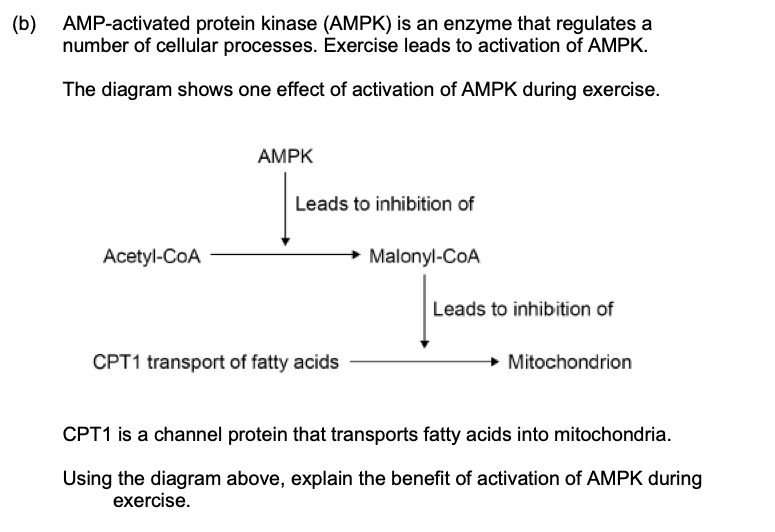
Less / no malonyl-CoA
(More) fatty acids transported / moved into mitochondria;
Respiration / oxidation of fatty acids provides ATP;
‘Inhibition of malonyl-CoA’ on its own is not enough but accept production of malonyl-CoA is inhibited.
Accept: ‘transport of fatty acids into mitochondria is not inhibited’.
Ignore: method of entry.
Accept: for respiration any stage of aerobic respiration e.g. Krebs (cycle), link (reaction) etc.
3. Reject: production of energy, but accept production of energy in the form of ATP.
3. Accept: acetyl CoA can enter Krebs cycle / mitochondria to provide ATP.
Describe the advantage of the Bohr effect during intense exercise.
Increases dissociation of oxygen;
Accept unloading/ release/reduced affinity for dissociation
2. For aerobic respiration at the tissues/muscles/cells

