1.5 Nucleic acids are important information-carrying molecules
 Call Kai
 Learn
Learn Practice Test
 Spaced Repetition
 Match
Match Flashcards
 Knowt Play
1/31

There's no tags or description
Looks like no tags are added yet.
Name | Mastery | Learn | Test | Matching | Spaced | Call with Kai |
|---|
No analytics yet
Send a link to your students to track their progress
32 Terms
What is the function of DNA in all living cells?
Holds genetic information which codes for the amino acid sequences of polypeptides.
What is the function of RNA in all living cells?
Transfers genetic information from DNA to ribosomes.
What two types of molecule are ribosomes made from?
RNA and proteins.
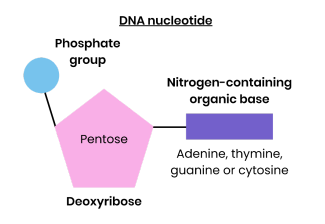
What pentose sugar is found in a DNA nucleotide?
Deoxyribose pentose sugar.
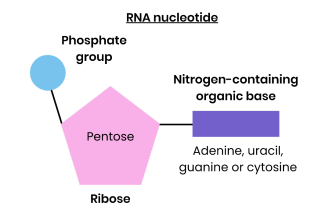
What pentose sugar is found in an RNA nucleotide?
Ribose pentose sugar.
What nitrogen-containing organic bases are found in DNA?
Adenine, thymine, guanine, or cytosine.
What nitrogen-containing organic bases are found in RNA?
Adenine, uracil, guanine, or cytosine.
What type of reaction joins nucleotides together to form polynucleotides?
Condensation reactions, removing water molecules.
Which groups react when two nucleotides join?
The phosphate group of one nucleotide reacts with the deoxyribose or ribose pentose sugar of another.
What bonds are formed when nucleotides join?
Phosphodiester bonds.
Why did many scientists initially doubt that DNA carried the genetic code?
The relative simplicity of DNA, as it is a chemically simple molecule with few components.
What type of molecule is DNA?
A polymer of nucleotides, known as a polynucleotide.
What three components make up a DNA nucleotide?
Deoxyribose, a phosphate group, and a nitrogen-containing organic base.
What bonds join adjacent nucleotides in a DNA strand?
Phosphodiester bonds.
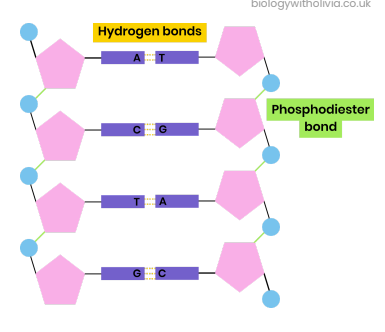
What holds the two polynucleotide chains together?
Two polynucleotide chains held together with hydrogen bonds between complementary base pairs.
Which bases pair together in DNA?
Adenine pairs with thymine, and cytosine pairs with guanine.
What is the overall shape of DNA?
A double helix.
What type of molecule is messenger RNA?
A polymer of nucleotides, known as a polynucleotide.
What three components make up an RNA nucleotide?
Ribose, a phosphate group, and a nitrogen-containing organic base.
What nitrogen-containing organic bases are found in RNA?
Uracil, adenine, cytosine, and guanine.
What bonds join adjacent nucleotides in an RNA strand?
Phosphodiester bonds.
What is the overall shape of messenger RNA?
A single helix.
What is the advantage of DNA having two strands?
Both strands can act as templates for semi-conservative replication.
Why is it beneficial that hydrogen bonds between bases are weak?
Strands can be separated for replication.
How does complementary base pairing aid replication?
It allows for accurate replication.
Why is the presence of many hydrogen bonds between bases important?
It makes the molecule stable and strong.
What is the function of the sugar phosphate backbone?
Sugar phosphate backbone protects the bases and hydrogen bonds.
What is the advantage of DNA being a long molecule?
It can store lots of genetic information that codes for amino acid sequences of polypeptides.
What is the advantage of DNA being coiled into a double helix?
It is compact.
How does the percentage of adenine in one strand relate to the percentage of thymine in the other strand?
The percentage of adenine in strand 1 equals the percentage of thymine in strand 2, and vice versa.
How does the percentage of guanine in one strand relate to the percentage of cytosine in the other strand?
The percentage of guanine in strand 1 equals the percentage of cytosine in strand 2, and vice versa.
Why do these relationships between bases exist?
Because of complementary base pairing between the two strands.

