Infant and child development midterm 2 study guide
 Call Kai
 Learn
Learn Practice Test
 Spaced Repetition
 Match
Match Flashcards
 Knowt Play
1/50

There's no tags or description
Looks like no tags are added yet.
Name | Mastery | Learn | Test | Matching | Spaced | Call with Kai |
|---|
No analytics yet
Send a link to your students to track their progress
51 Terms
Occipital lobe
Part of the brain responsible for visual processing.
Parietal lobe
Part of the brain that processes sensory information.
Temporal lobe
Part of the brain involved in auditory processing and memory.
Frontal lobe
Part of the brain responsible for executive functions and decision making.
Corpus Callosum
Structure that connects the two hemispheres of the brain.
Plasticity
The brain's ability to change and adapt as a result of experience.
Experience-expectant development
Biologically prepared development that expects certain environmental information, refers to the brain's "pre-wired" neural systems that require common, species-typical environmental inputs (ex. light, sound, and social interaction) to develop normally
Experience-dependent development
The process by which unique, individual experiences across the lifespan shape brain structure and function (ex. learning to play a sport or instrument)
Serve and return
Interaction between adult and child that fosters neural connections.
Neuron Proliferation
Rapid increase of neurons during prenatal neurogenesis.
Neural pruning
Process where unnecessary neurons die off to streamline brain function.
Infant reflexes
Patterned, involuntary motor responses controlled by lower brain centers. Missing reflexes may indicate a neurological problem for the infant. Many are vestigial and fall away as we grow and develop our brains further (stepping reflex may be used to help develop motor skills, not to actually help us walk)
Cephalocaudal development
Physical growth and motor control that progresses from head to toe (ex. controlling the head before learning to walk)
Proximodistal development
Physical growth that proceeds from the center of the body outward (ex. infant gaining control over their shoulders and arms before mastering fine motor skills with their fingers and hands)
Canalization
Degree to which gene expression is influenced by the environment.
Sensorimotor stage
Piaget's stage from birth to 2 years focusing on reflexes turning into goal-oriented activity. Key milestone is object permanence/development of working memory. Starting to pass the A-not-B task (baby sees researcher hid toy in location A, but looks for it in location B).
Object permanence
Understanding that objects continue to exist even when not visible.
Preoperational stage
Piaget's stage from 2 to 7 years characterized by egocentrism and lack of conservation. Imagination starts to increase, might believe some inanimate objects are alive, playing pretend (ex. Teddy bear). Learning to speak. Starting to be able to pass theory of mind/Sally Anne test.
Concrete operational stage
Piaget's stage from 7 to 12 years where children understand conservation. Concrete cognitive operations are achieved (able to put objects in shape order, group objects together, understand how quantity remains the same after form changes). Egocentricism fades, we start to understand that other people think differently from us, can put ourselves in other people’s shoes.
Formal operational stage
Final stage of cognitive development at 12+ yrs old characterized by abstract thought. Have ability to think more rationally about abstract/hypothetical concepts and events. Better understanding of success vs failure, love vs hate, etc. Capable of deductive reasoning (can compare two concepts and reach logical generalization). Some aspects of egocentrism still remain (might feel like there is an imaginary audience watching us, might act hypocritically, think that we are very unique and special).
Theory of Mind
Understanding that others have beliefs, desires, and intentions different from one's own.
Violation of Expectation
Research technique measuring infant cognition by looking time at unexpected events. (drawbridge study and train going through object study)
Habituation Paradigms
Process where infants decrease looking time to familiar stimuli and increase to novel ones (drawbridge study and train going through object study)
Theory of Core Knowledge
Concept that infants have innate knowledge about 4 core domains (agents, objects, spatial relations, numbers), agentic understandings (relations between things)
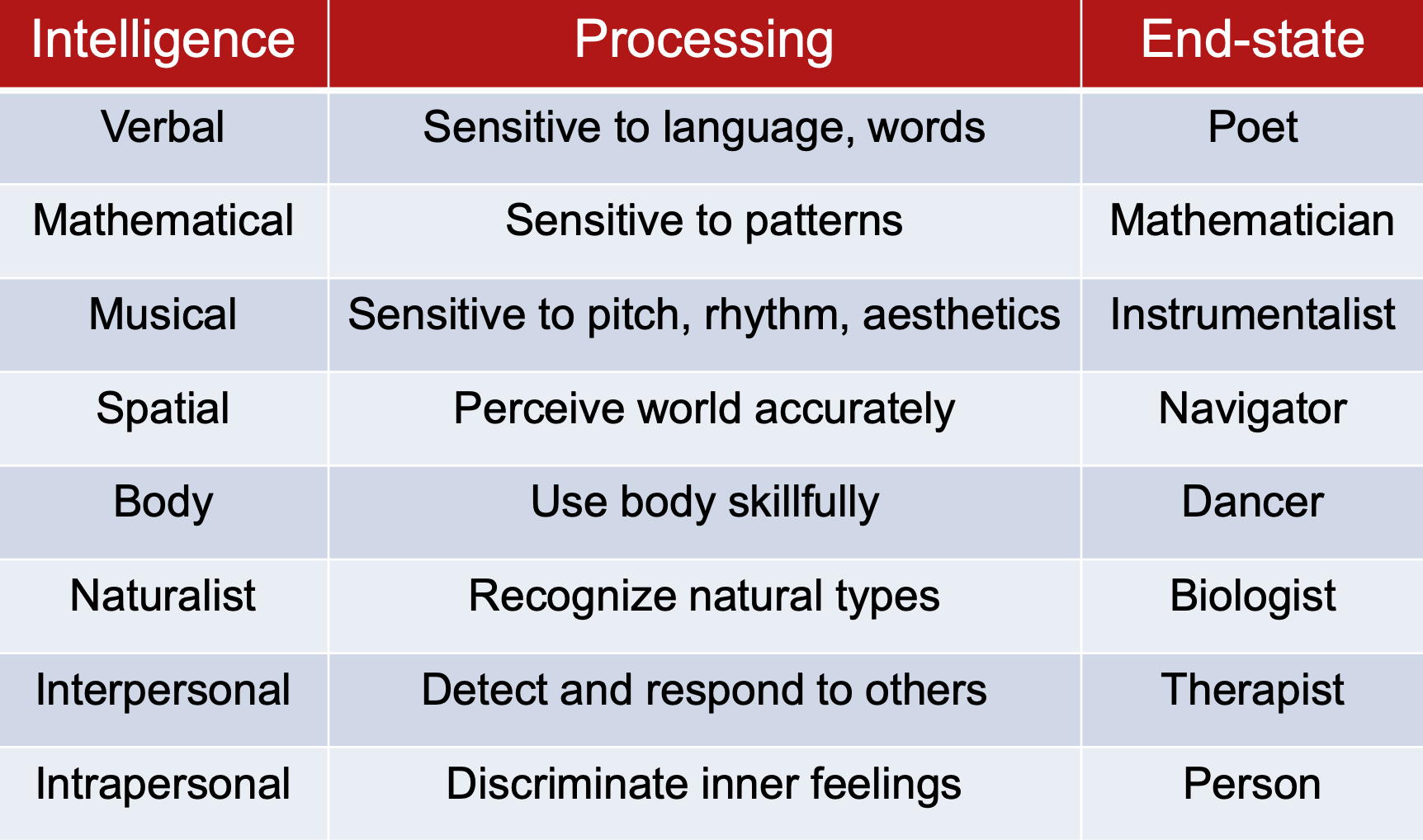
Gardner's Theory of Multiple Intelligences
Theory proposing eight distinct intelligences, each using a different processing method to result in a different end state
Triarchic Theory of Intelligence
Theory that identifies three forms of intelligence:
analytical (Information processing capacities, included in traditional IQ tests),
creative (Insight and the ability to deal with novelty)
applied (how people deal with their surroundings)
Fluid intelligence
Ability to solve new problems and think logically, peaking in early adulthood.
Crystallized intelligence
Accumulation of knowledge and skills that remains stable or increases throughout adulthood.
Creativity
The ability to produce original ideas and solutions.
Nativist theory of language
Theory that language acquisition is an innate process occurring in an appropriate environment.
Interactionist theory of language
Theory that language is acquired through a combination of innate abilities and social interaction.
Child-directed speech
Speech that is louder, slower, and more exaggerated to help children learn language.
Phonemes
Smallest distinct sounds in a particular language.
Morphemes
Basic units of meaning in a language.
Theory of Core Knowledge
Early understanding of agents, objects, spatial relations, numbers (Spelke)
analytical intelligence
Information processing capacities
Included in traditional IQ
creativity intelligence
Insight and the ability to deal with novelty
applied intelligence
How people deal with surroundings
cognitive creativity
problem finding, divergent & convergent thinking, insight, knowledge
motivational/environment creativity
Rich in simulation emphasis on intellectual curiosity, building talent, time to reflect, encourage originality, intrinsic motivation
How are infants "citizens of the world"?
they are born with the universal ability to distinguish and produce all sounds and phonetic contrasts of all human languages, regardless of their environment.
Equilibrium
the continuous process of balancing new information with existing mental frameworks (schemas) (assimilation + association)

