14 - The Origin & Evolution of Early Life Study Guide
 Call Kai
 Learn
Learn Practice Test
 Spaced Repetition
 Match
Match Flashcards
 Knowt Play
1/74

There's no tags or description
Looks like no tags are added yet.
Name | Mastery | Learn | Test | Matching | Spaced | Call with Kai |
|---|
No analytics yet
Send a link to your students to track their progress
75 Terms
Inquiry into the origin of life is not really about biological evolution
Why is that?
- (This should be kind of obvious...)
· Biological evolution refers to the evolution of life that is already present, not the beginning/first emergence of life as a whole
- The origin of life occurs before the existence of life & instead refers to simple organic compounds
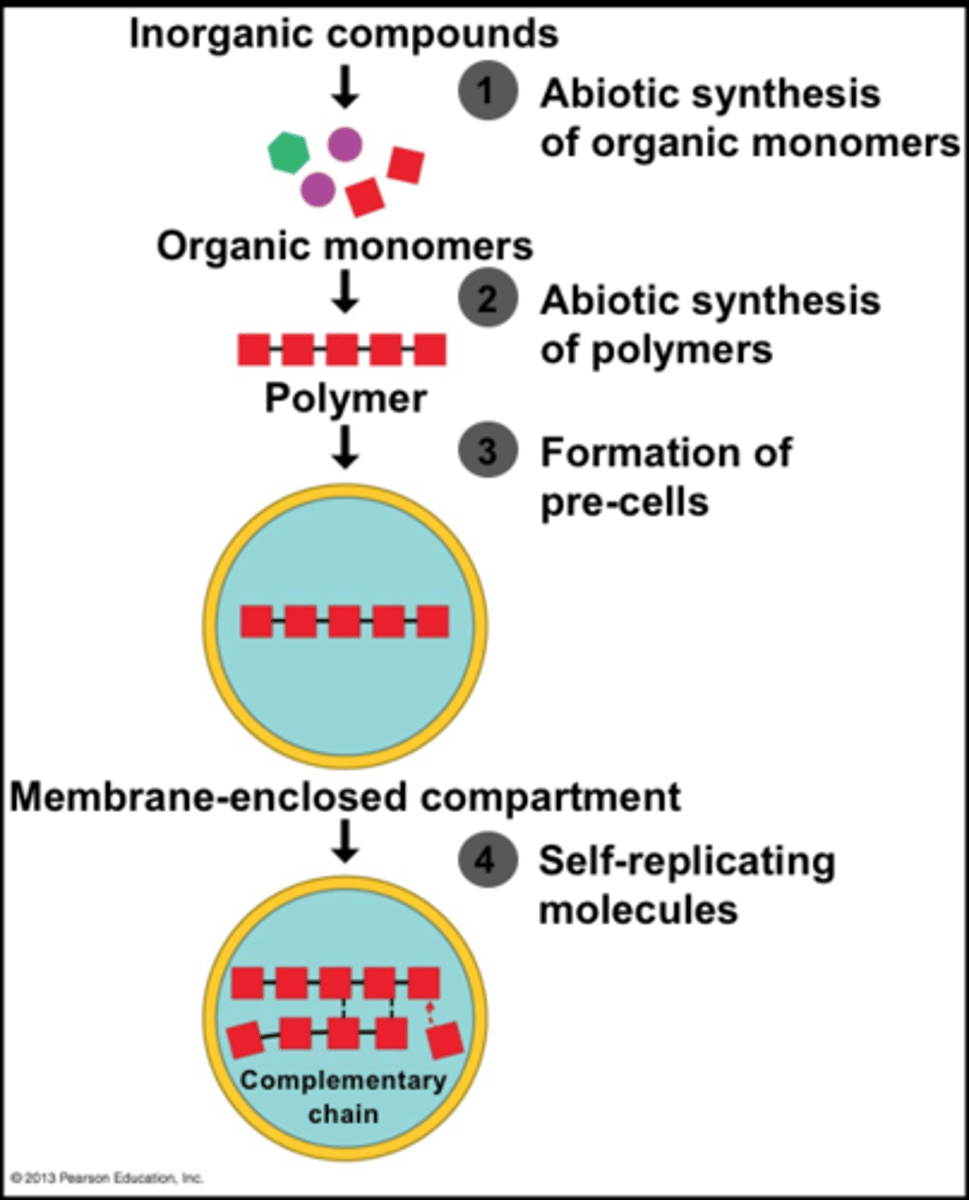
What terms might be used for describing evolution towards life before there was actual "life"?
· Prebiotic/organic evolution
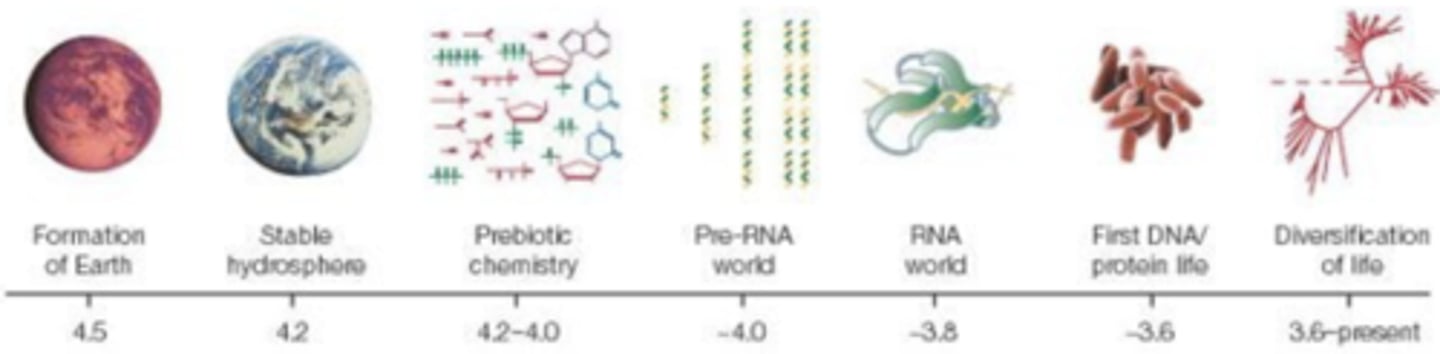
The oldest likely fossil cells are about 3.4 billion years old
How is it that we know this is not a record of the origin of life?
· For there to be fossilized bacterial remains, life had to have been around long before that bacterium
- Indicates that life began much earlier
- Life creates life
Contrast historic inquiry from a-historic inquiry
· Historic inquiry depends on having a complete record of history
· Ahistoric inquiry focuses on the clues, principles, & concepts of a historical event without using a historic record
- We don't have a geological record of the origin of life
o Rocks of ancient seafloors from around billions of yrs ago are needed
o They're gone bc of subduction/plate tectonics
- We do have chemistry, which we can experiment with
o Reveals that it's very easy to start life in its earlier stages
o Life is a process that readily begins
LUCA stands for ...................................................
Was LUCA the 1st life form?
· Last Universal Common Ancestor
· No, it is the hypothetical recent common ancestor shared by all of today's life
- There are genetic & molecular similarities shared betw all present life
o The traits this ancestor had were passed on vertically thru time to the diversity of today's life
o Such traits are known as deep homologies
- There was other life before & alongside this individual
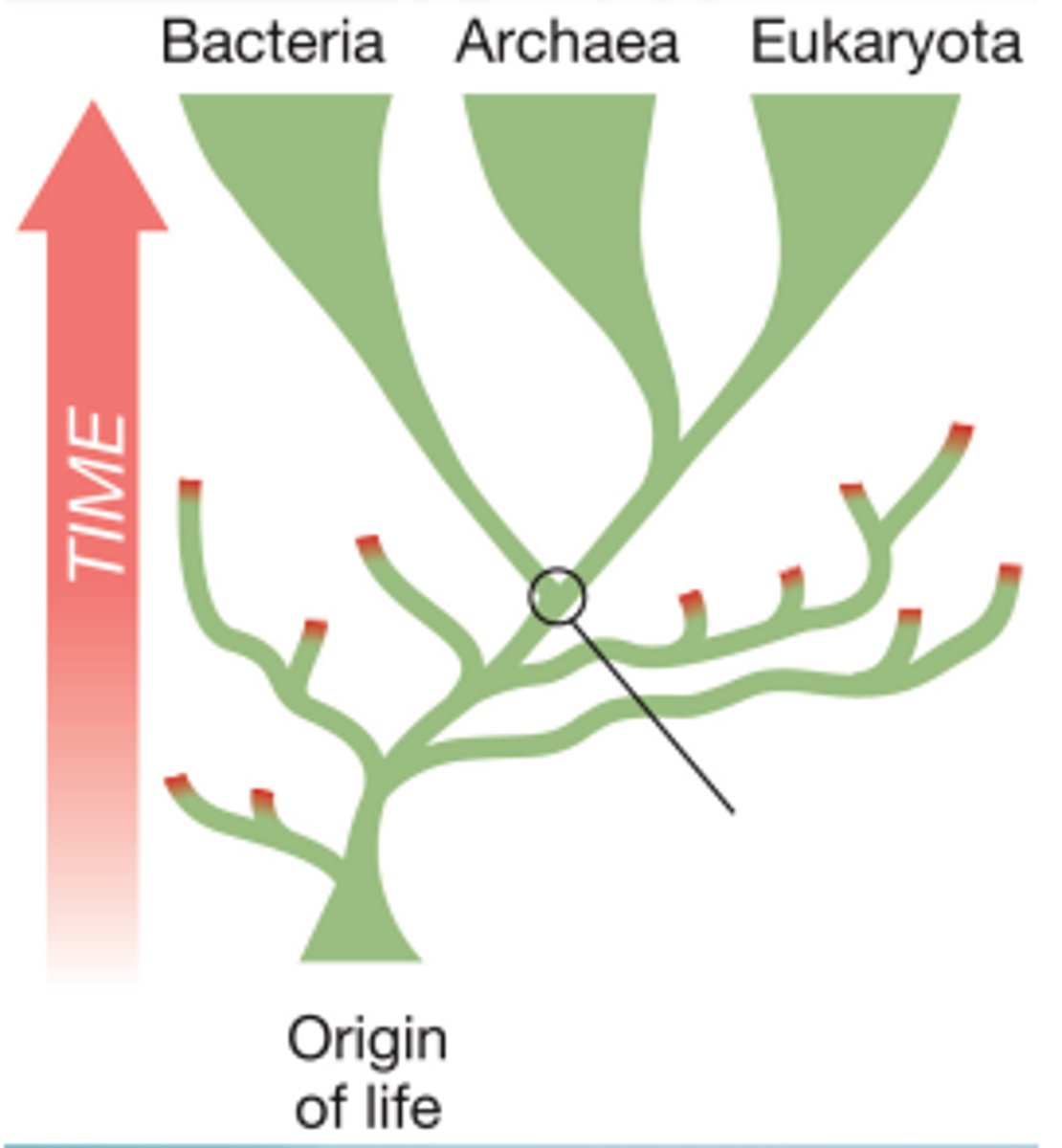
Looking for LUCA, the last universal common ancestor:
The article establishes that the main branches Eubacteria and Archaea are early descendants of LUCA
The third branch that came later is...
· Eukarya
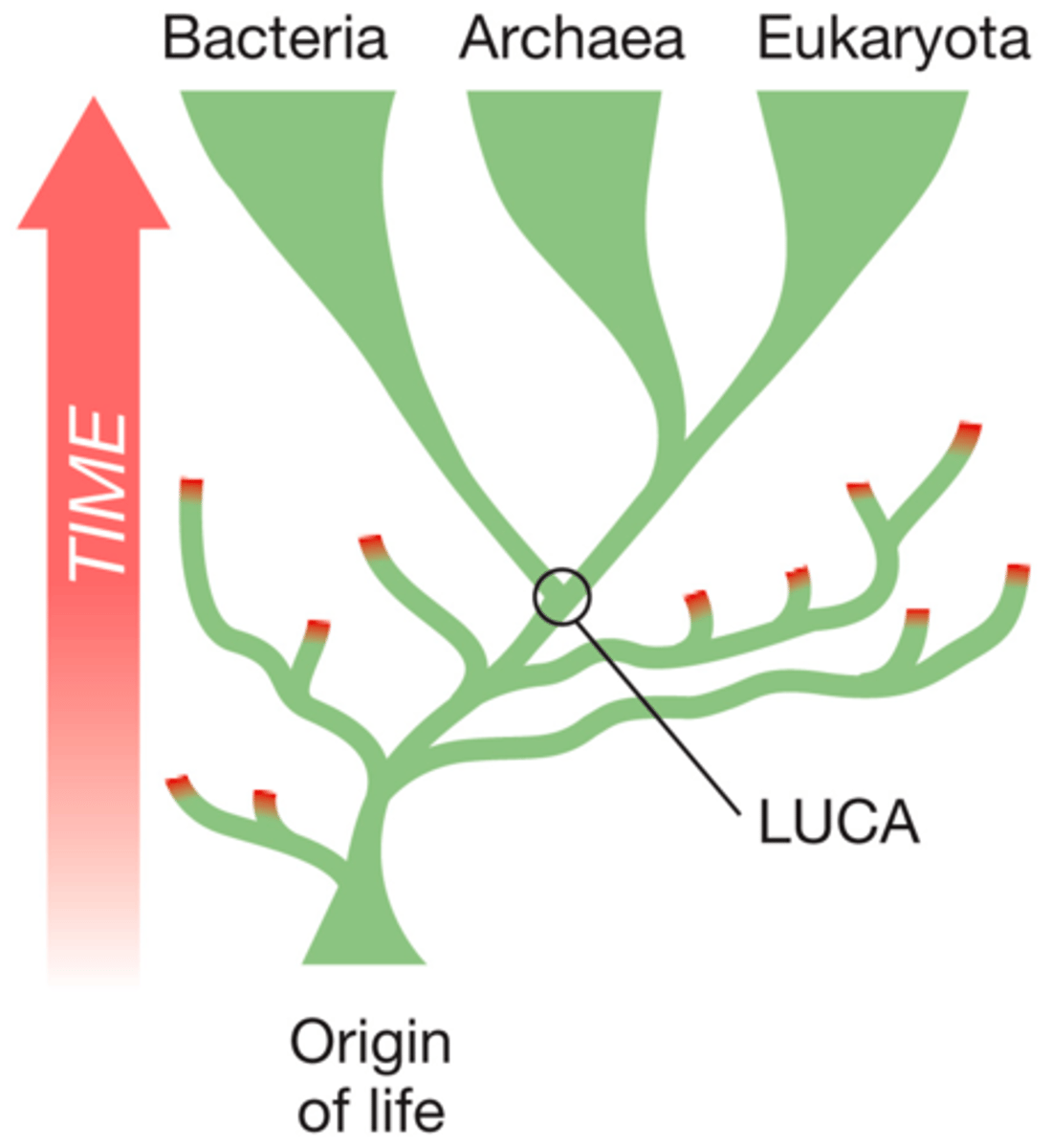
Looking for LUCA, the last universal common ancestor:
In the effort to identify the kinds of genes present in LUCA, researchers identified genes that are shared in both eubacteria and archaea
- Shared genes are perhaps shared with LUCA
But what phenomenon about these cells will "muddy" this picture of shared genes?
· Lateral gene transfer (LGT)
- Genes found in both Archaea & Bacteria could have been shared thru this process
- Such genes would not necessarily have originated in LUCA
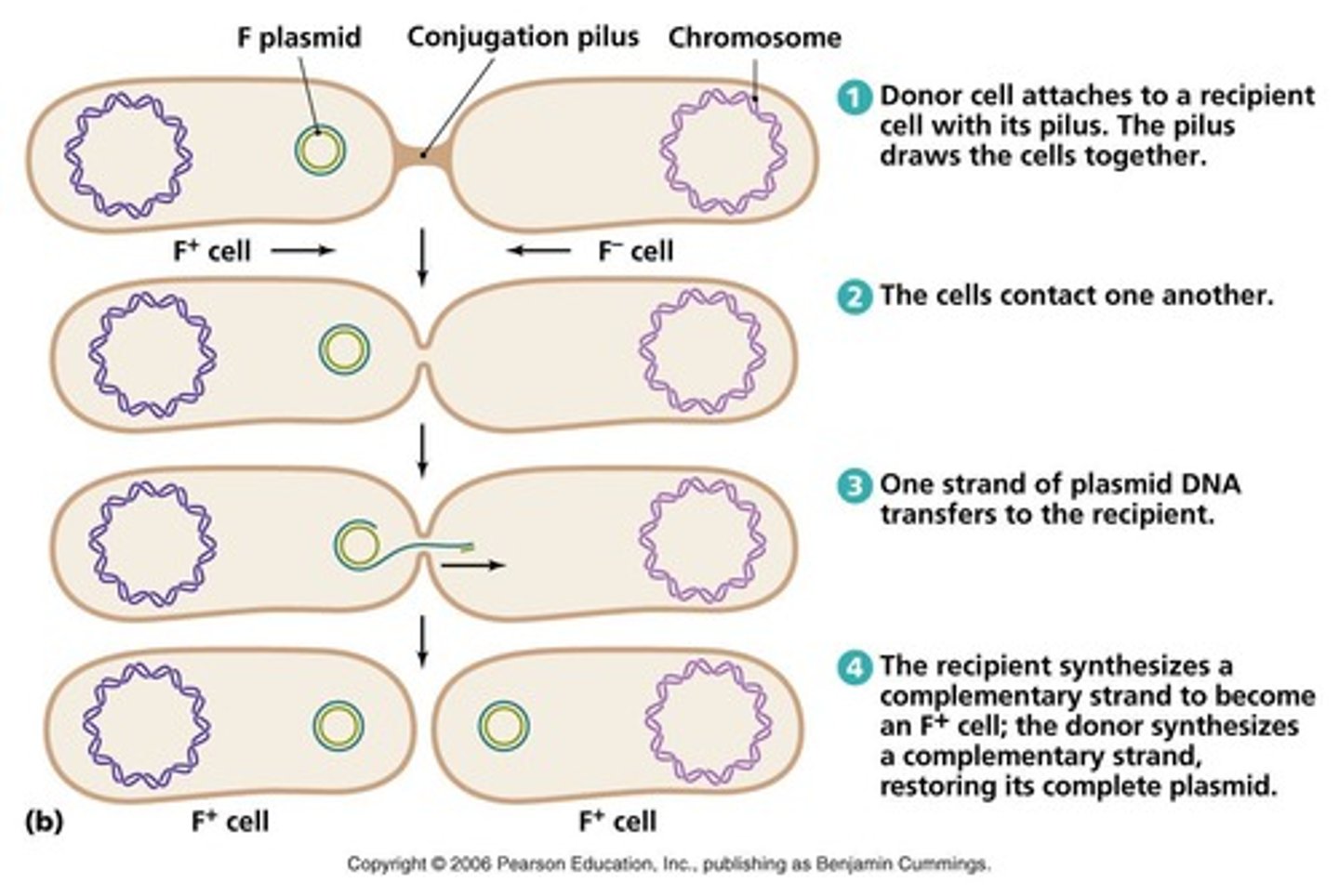
Looking for LUCA, the last universal common ancestor:
The article describes 355 genes that are still arguably descended from LUCA (I won't go into the rationale for this here)
What is especially interesting is that these genes suggest LUCA lived in what sort of environment?
· Hydrothermal vents
- LUCA used molecular hydrogen as energy
o Serpentinization → copious amounts of molecular H in these vents
- LUCA contained a gene encoding the enzyme reverse gyrase
o Found in extremophiles that live in high-temp environments
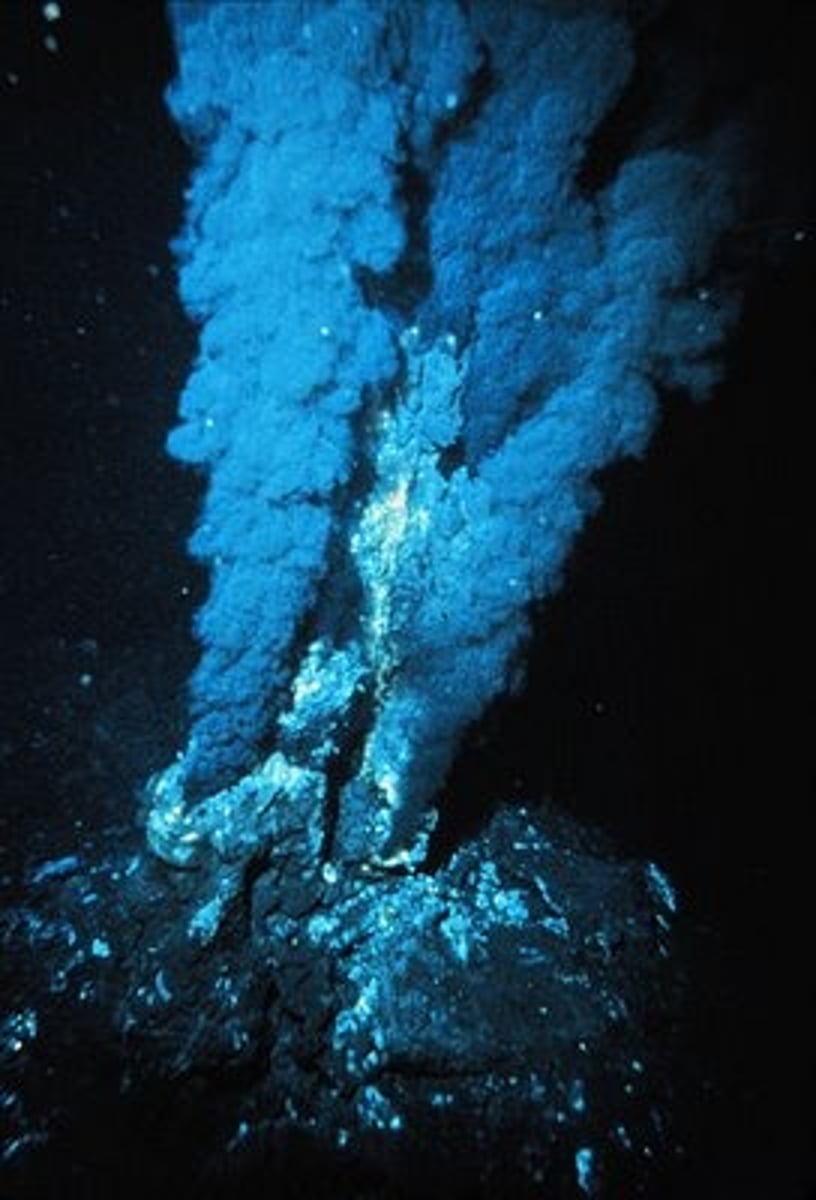
Looking for LUCA, the last universal common ancestor:
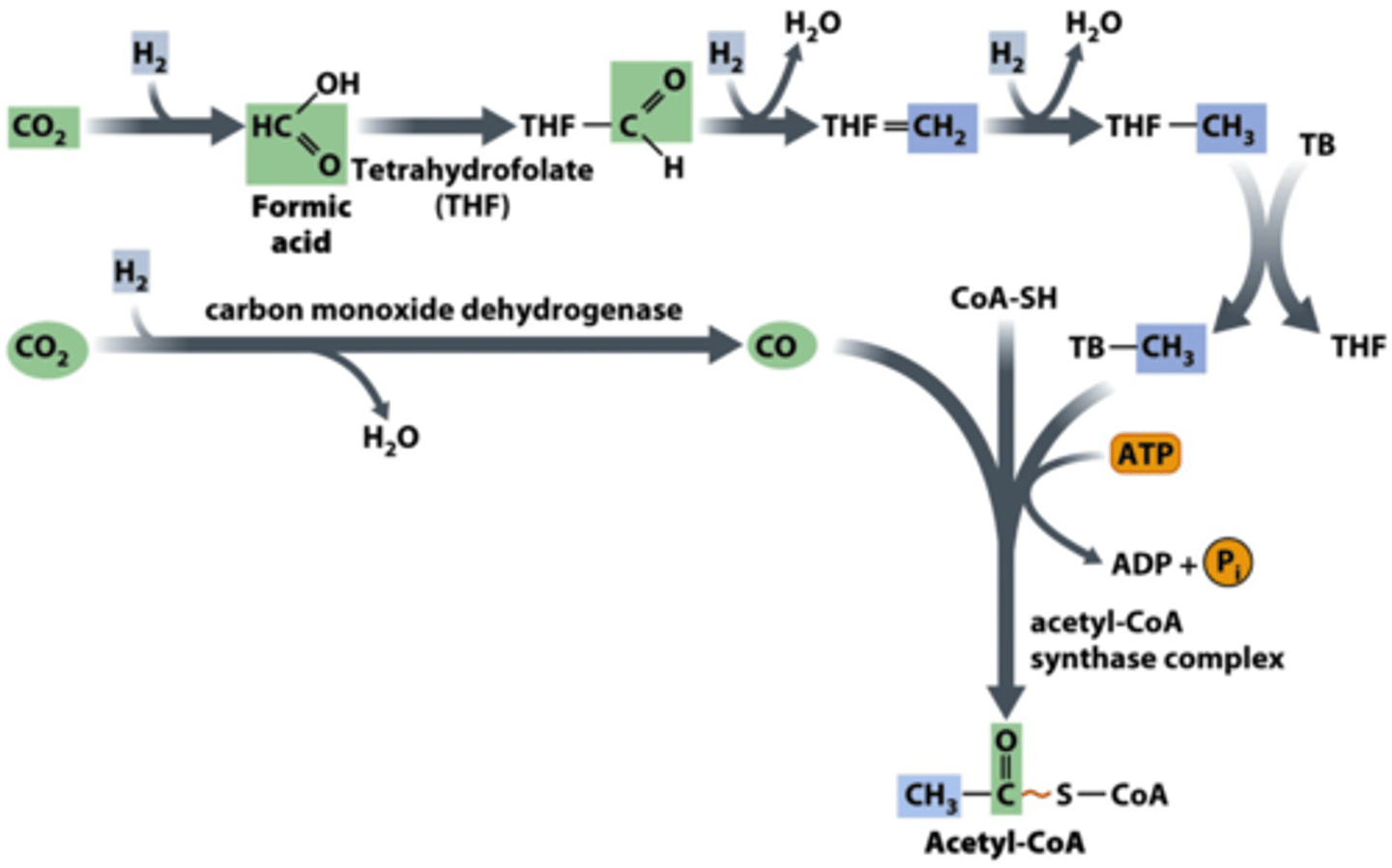
Further down, the article returns to the earliest life and describes a major candidate for the earliest biochemical pathway that is still seen in some cells today that entirely survive on H (from H₂, for example) and CO₂
This pathway is called the W..........-L................ pathway
What environment do cells live in that use this pathway?
· Wood-Ljungdahl carbon-fixing
- Used by Bacteria & Archaea
- Hydrogen & carbon dioxide are reduced to carbon monoxide & formic acid that can be used by life
· Alkaline hydrothermal environment
- Provides structure, natural proton gradients, H, & CO₂
- The pathway requires these things
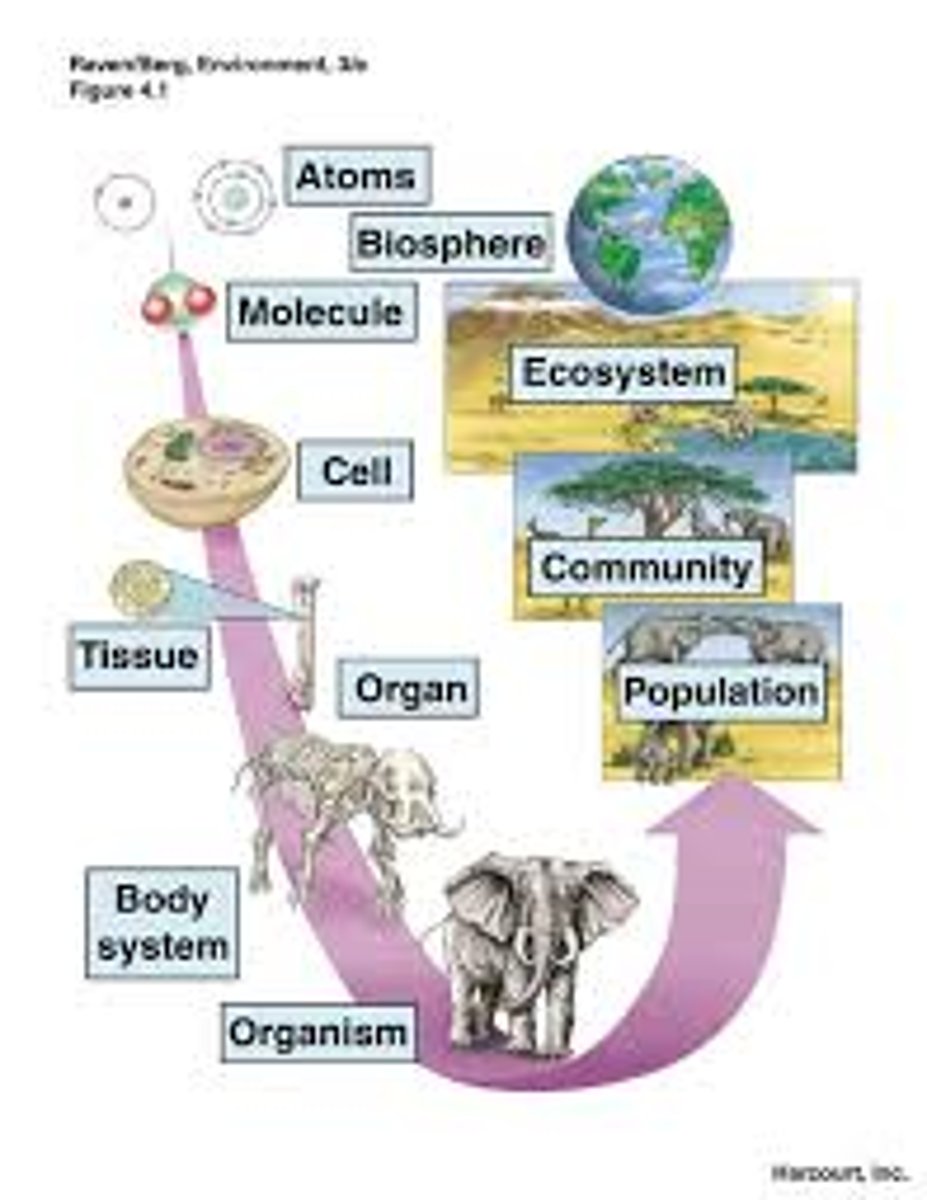
Everything that exists can be described this way:
- They are made of component parts & those parts interact with each other
Properties that emerge from this are called .................................................
· Emergent properties
What is life?
· A body/entity that can:
- Assimilate environmental energy & materials (i.e., has metabolism)
o Metabolism = ability of an organism to take in energy as chem bonds from the environment, then assimilate & convert that energy along pathways inside them
- Resist chemical equilibrium
o Take reactants & convert them into products, which are then used to make other products
o Always taking in raw materials from environment = perpetually off-balance
~ Doesn't really get the chance to go backwards
What are we saying was formed on the early earth?
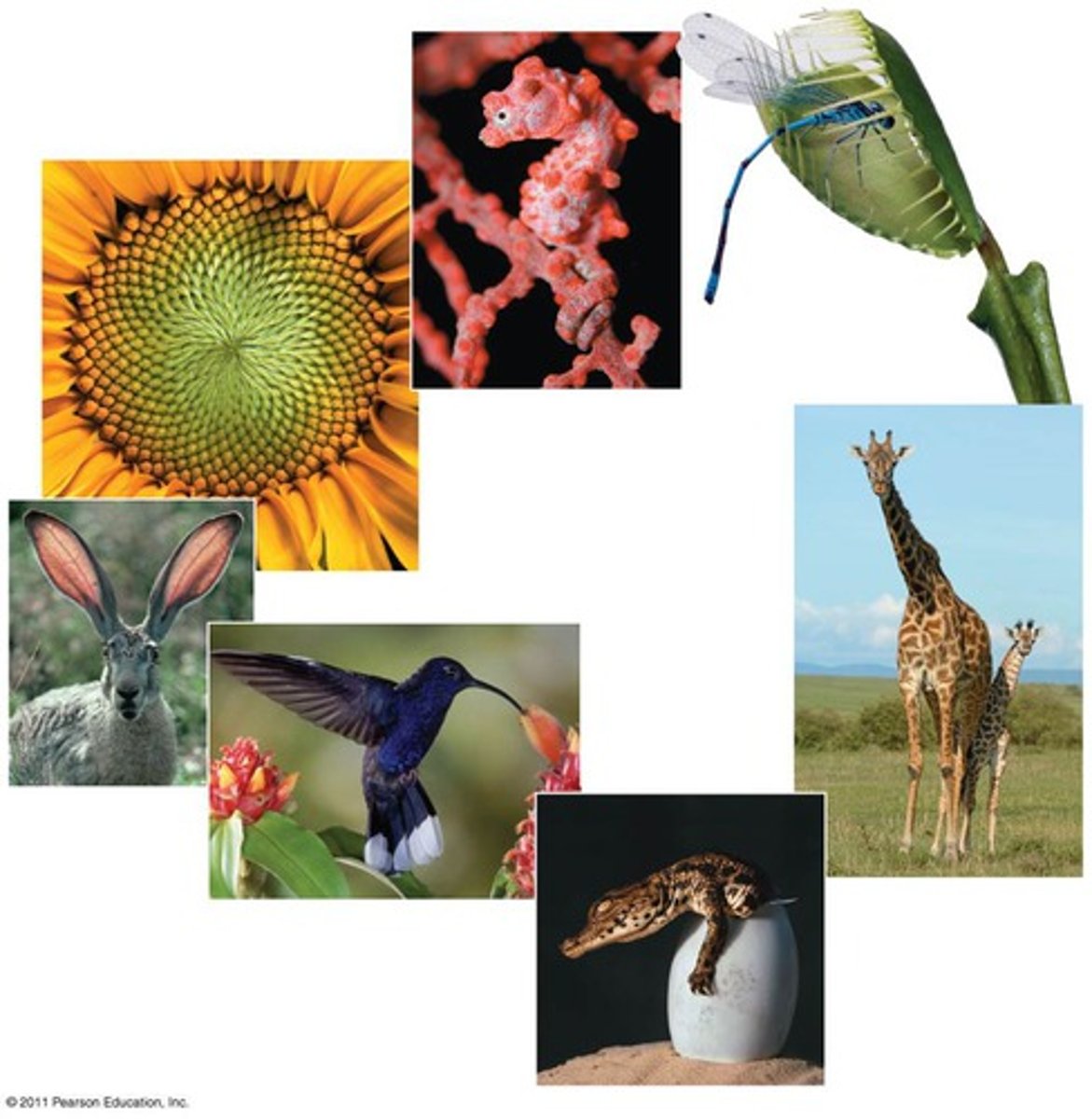
· Life must have begun in an environment that provided a continual input of energy & raw materials
- Conditions of early Earth might have quickly (after Earth cooled) forced the origin of life
Define a few properties of ALL life
- Why are these emergent properties?
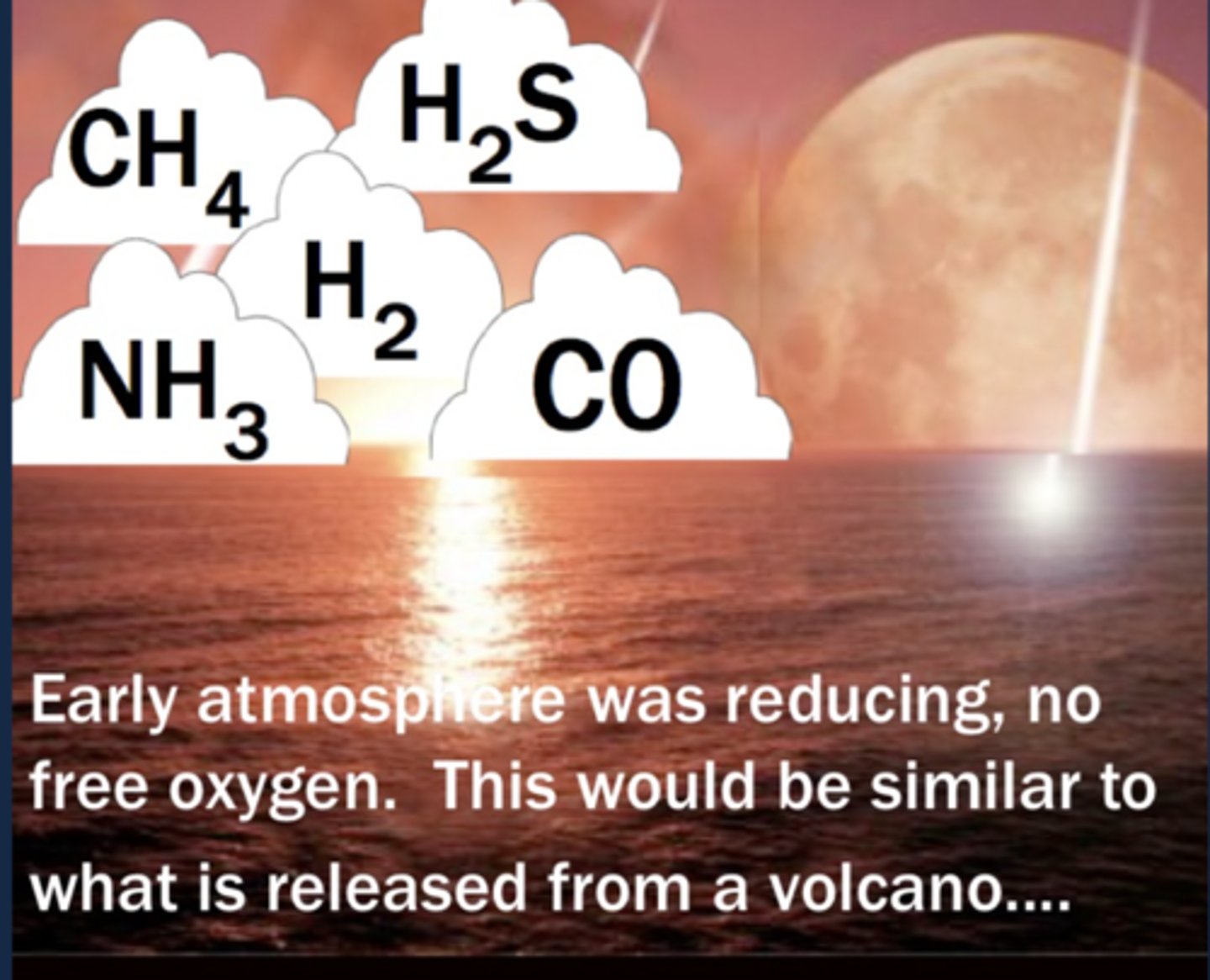
· All life can:
- Become organized
o Being complex means getting better & better at dropping energy during chem equilibrium
- Grow
o More raw materials going towards complexification = individual gets bigger
- Reproduce
o Life has a "replicator" (i.e., heredity)
o DNA = copied & stored genetic info that can propagate itself
o Cells divide to make more cells
- Evolve
o Heredity → variation in replicators
o Who is better at making more copies of themselves?
· Bc their formation/production depends on the interactions betw other factors
- The interactions betw certain conditions force new conditions to form
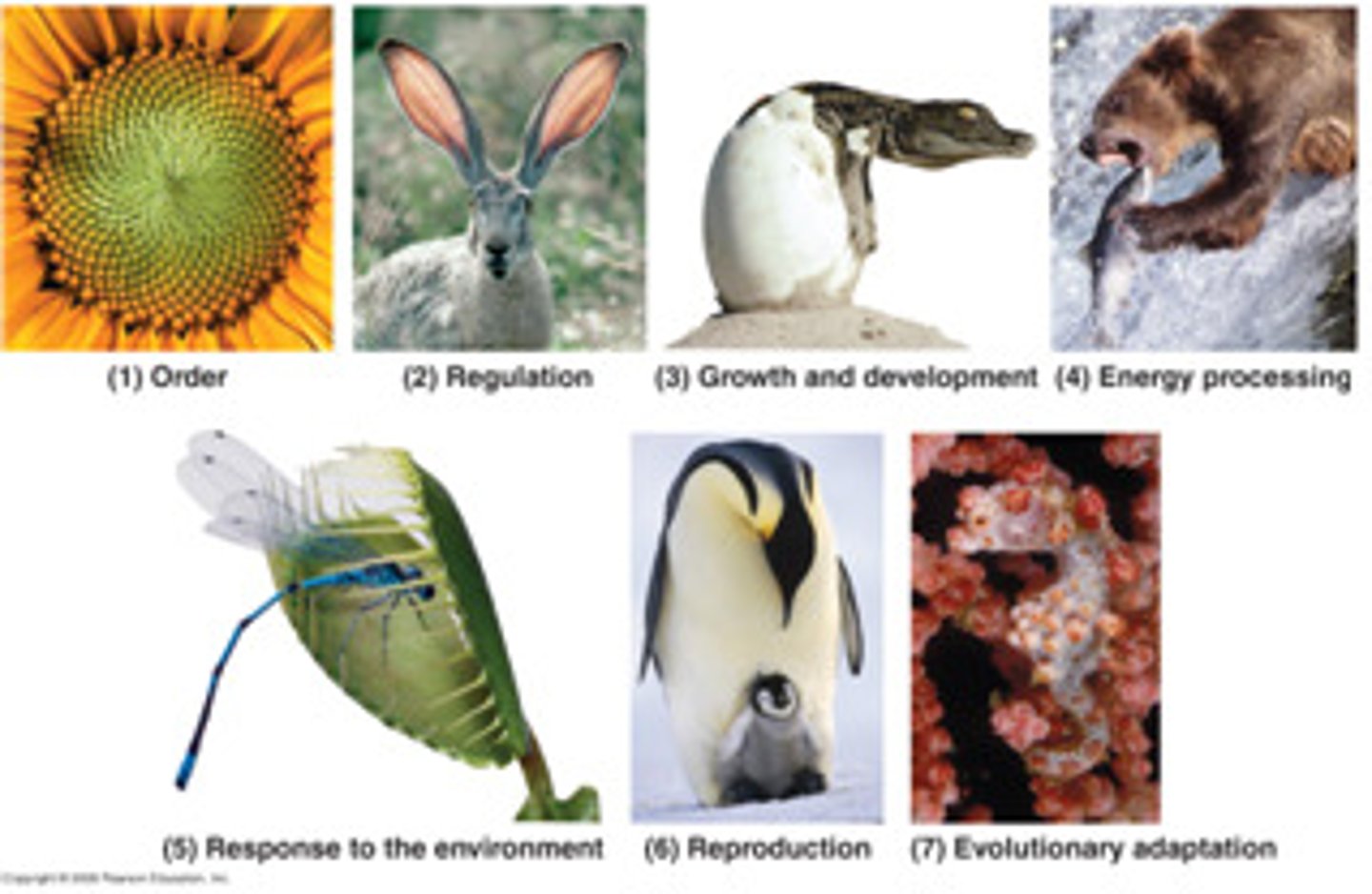
Are these characteristics of life unique to life?
- Or is life just one of many things that is 'life-like'?
· No, there are many things that can be considered "lifelike"
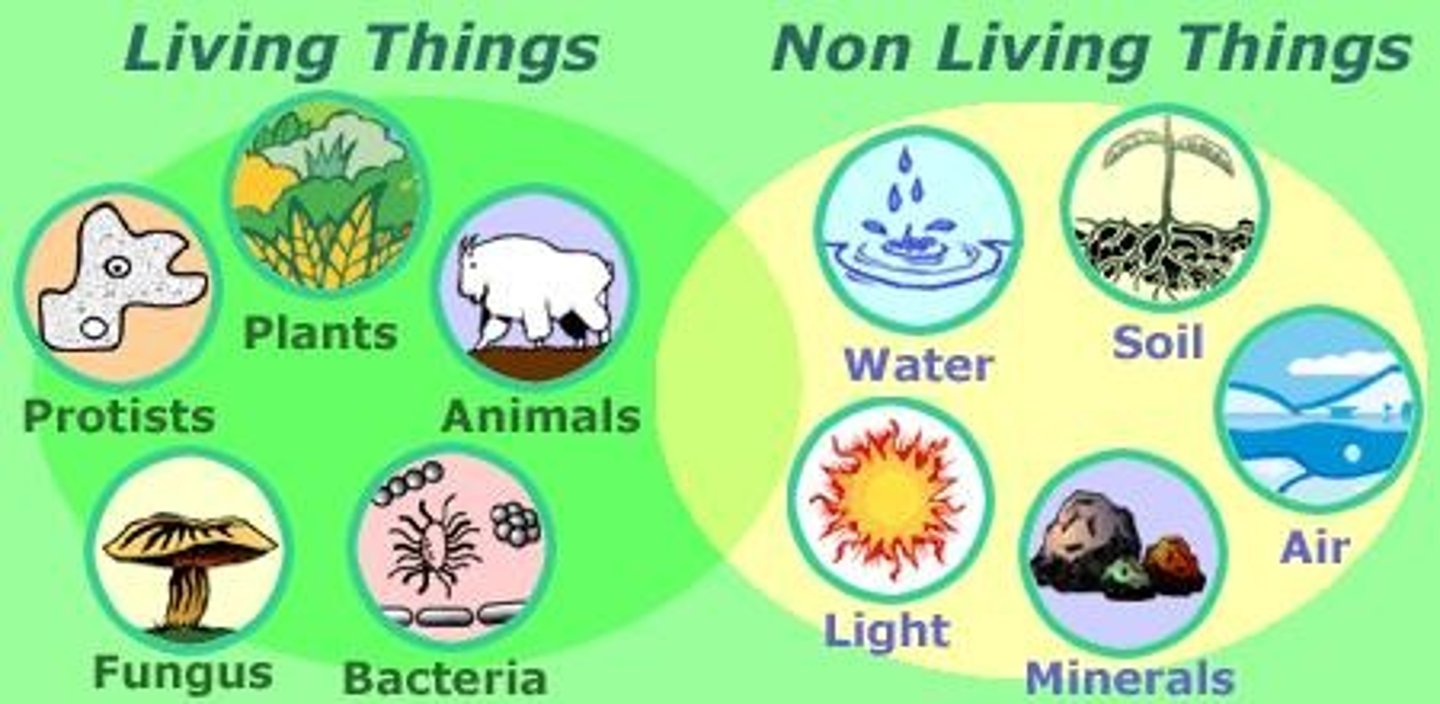
- Fire, crystals, comets, hurricanes, etc.
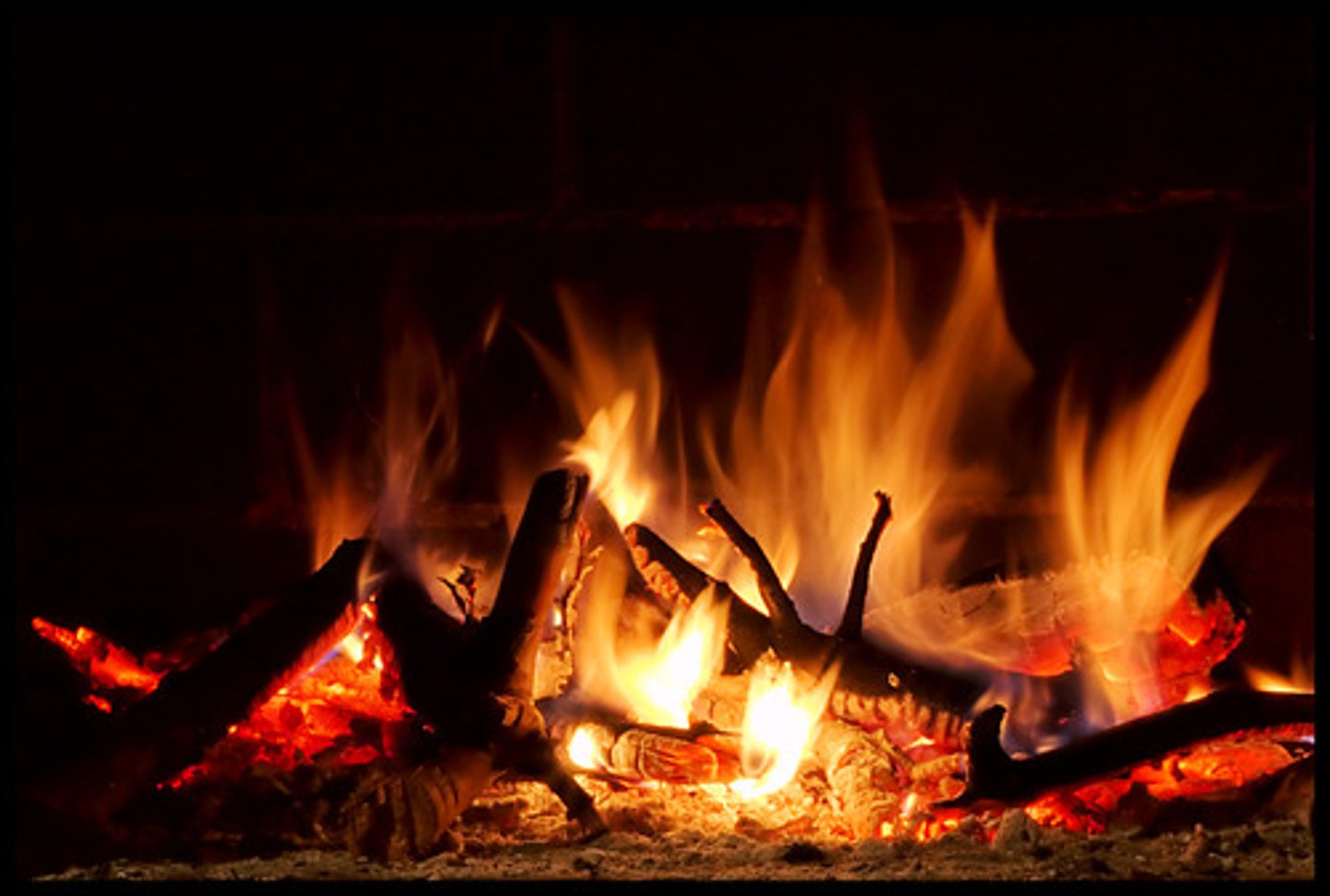
Describe, for example, how fire has some of the properties of life
· Like life, it can become self-organized, grow, reproduce, & evolve to a certain degree
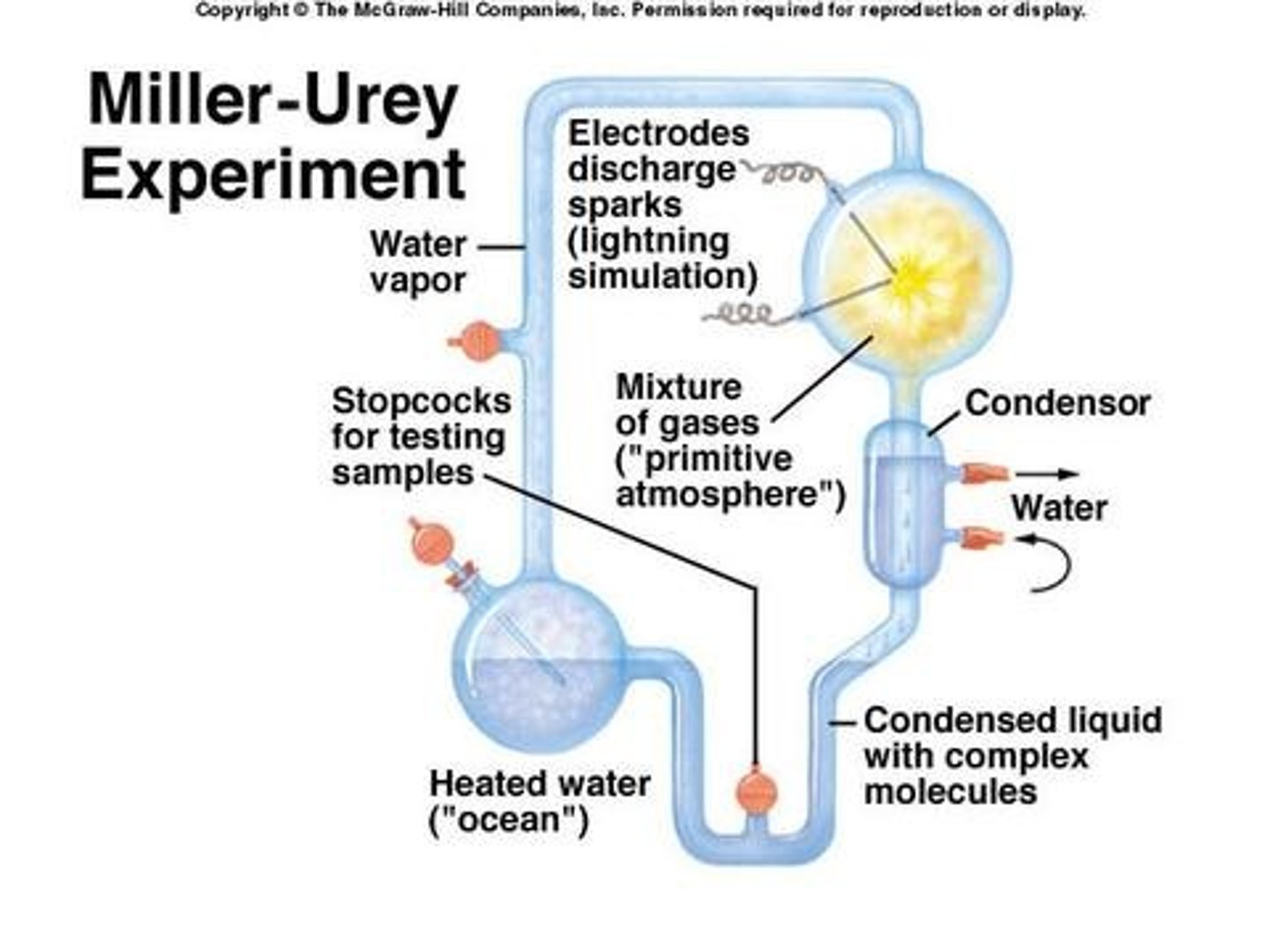
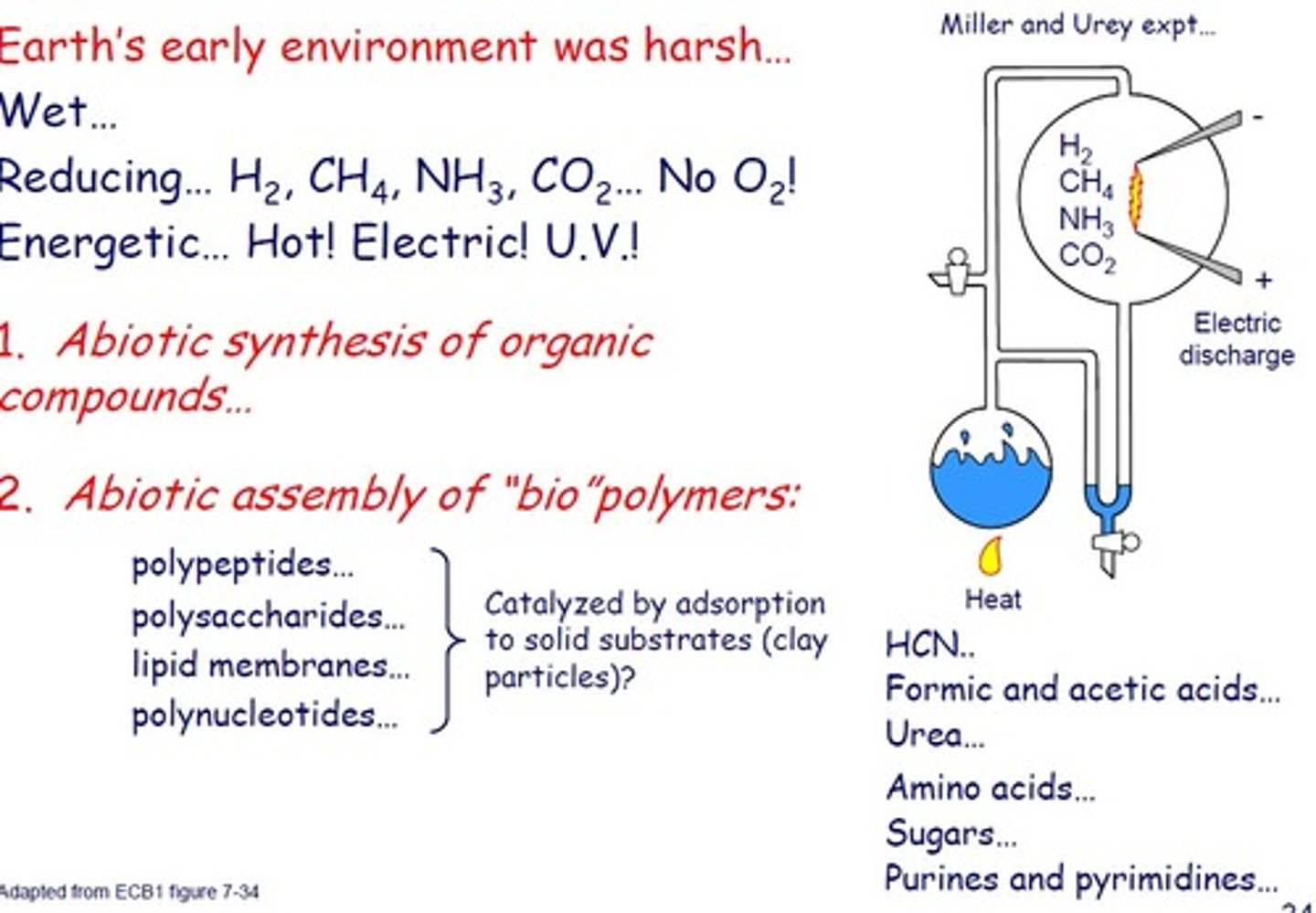
Describe the 1953 Miller-Urey experiment
- Describe the apparatus, what was put into it, and what came out of it
Common mistakes:
- Overstating what they made (no, they did not make DNA or proteins; no, they did not make life)
Other common mistakes: describing the decades-later variations of the M-U experiment as the original M-U experiment
- No, they did not use minerals or UV light
- They did not make acetyl and pyruvate
· Tried to recreate the "primordial soup" of early Earth to test whether/not simple organic compounds can naturally give rise to more complex molecules
- A rich collection of complex molecules produced by natural chem reactions that would eventually produce living cells
· Designed an apparatus that simulated the ancient water cycle
- One chamber had water (i.e., ancient ocean) that was gently boiled (i.e., evaporation)
- Another chamber contained reducible gases like water vapor, methane, hydrogen gas, & ammonia (i.e., ancient atmosphere)
- A condenser cooled the "atmosphere" & allowed water vapor to form drops that fell back into the "ocean" (i.e., rain)
- Added sparks to the "atmosphere" as energy (i.e., lightning)
· After one week, the "ocean" became brownish black/sludgy
- Many complex molecules (i.e., formaldehyde, hydrogen cyanides) were produced from the simple organic compounds that were first added
o H₂O + CH₄ + NH₃ + H₂ → CH₂O + HCN + other compounds
- Those complex molecules then started making amino acids, sugars, & other organic compounds
The key gases used in the M-U experiment have strong reducing properties
Why is this important?
· Bc oxygen wants to break apart organic molecules to take away electrons
- The process of oxidization would have been destructive instead of constructive
o Oxidizing = destructive
- Early Earth would not have had much O₂

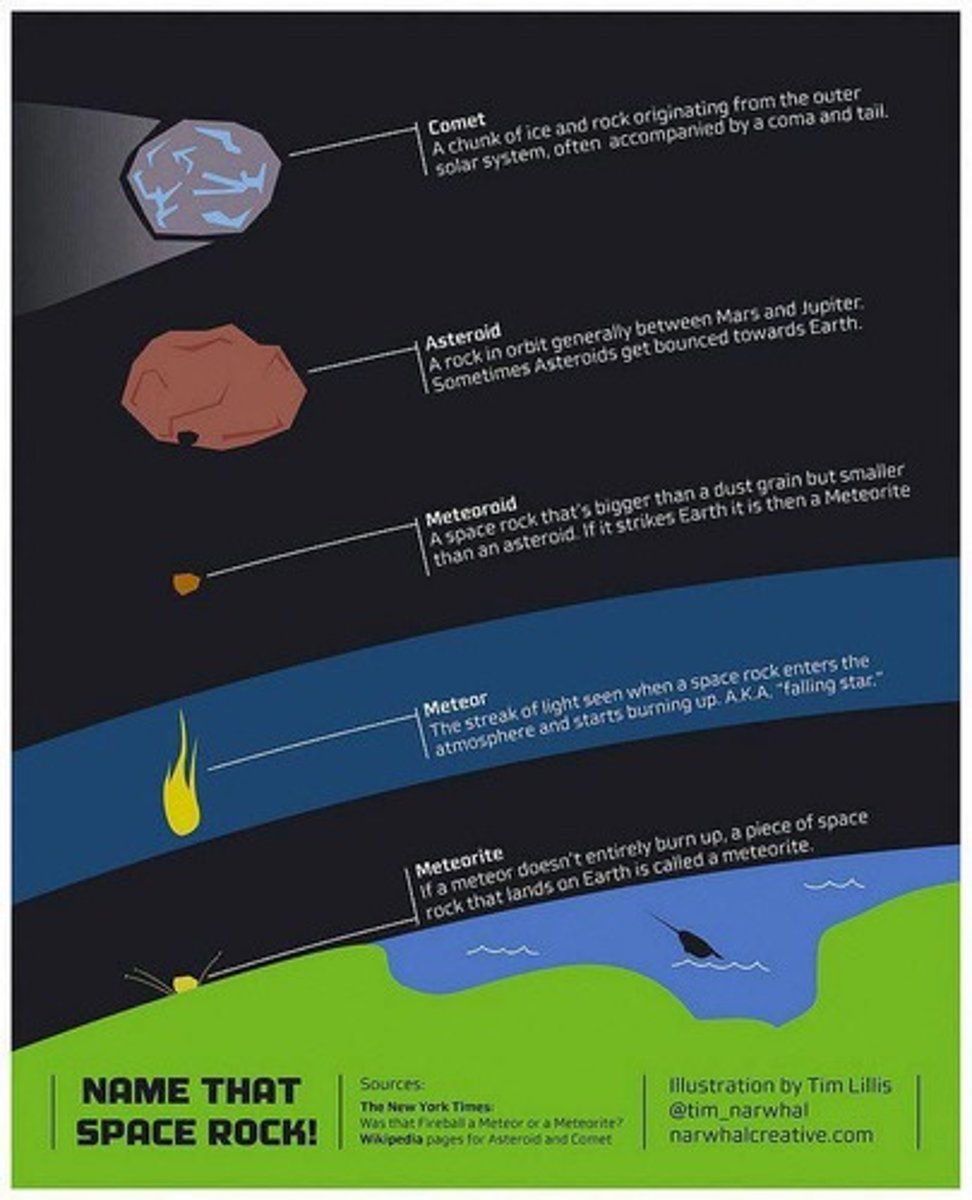
Is it plausible that meteors and comets contributed simple things like amino acids and other building blocks to the early earth?
· Yes, bc there are lots of water & organic compounds out in space
- There are a lot of M-U experiments occurring out there
· When space rocks made out of such compounds fall to Earth, they are absorbed into the environment
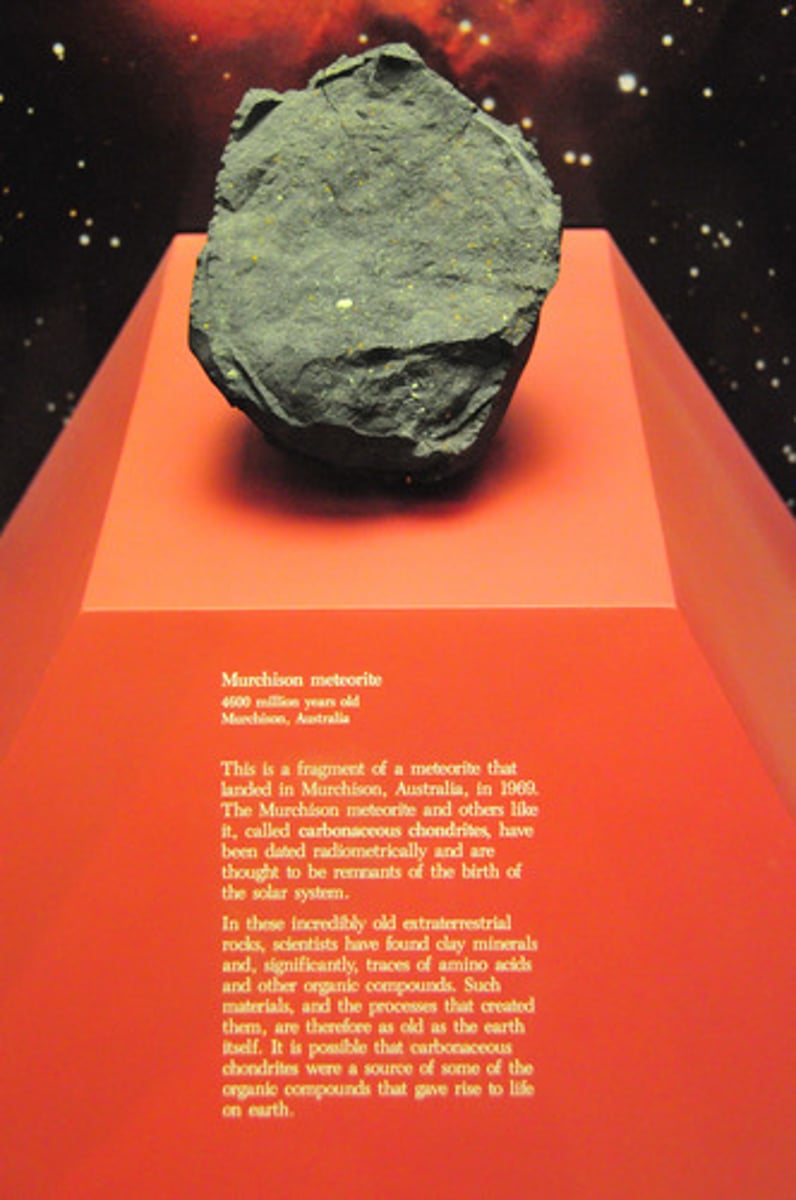
What is the Murchison meteorite?
What was found in this tarry rock from space?
- Once again, do not overstate it
· A "carbonaceous" rock that was formed out in space by an early solar system that was found by ppl who recognized it
· It contains 70 diff amino acids, various nitrogenous bases, hydrocarbon chains, fatty acids, & many other organic compounds
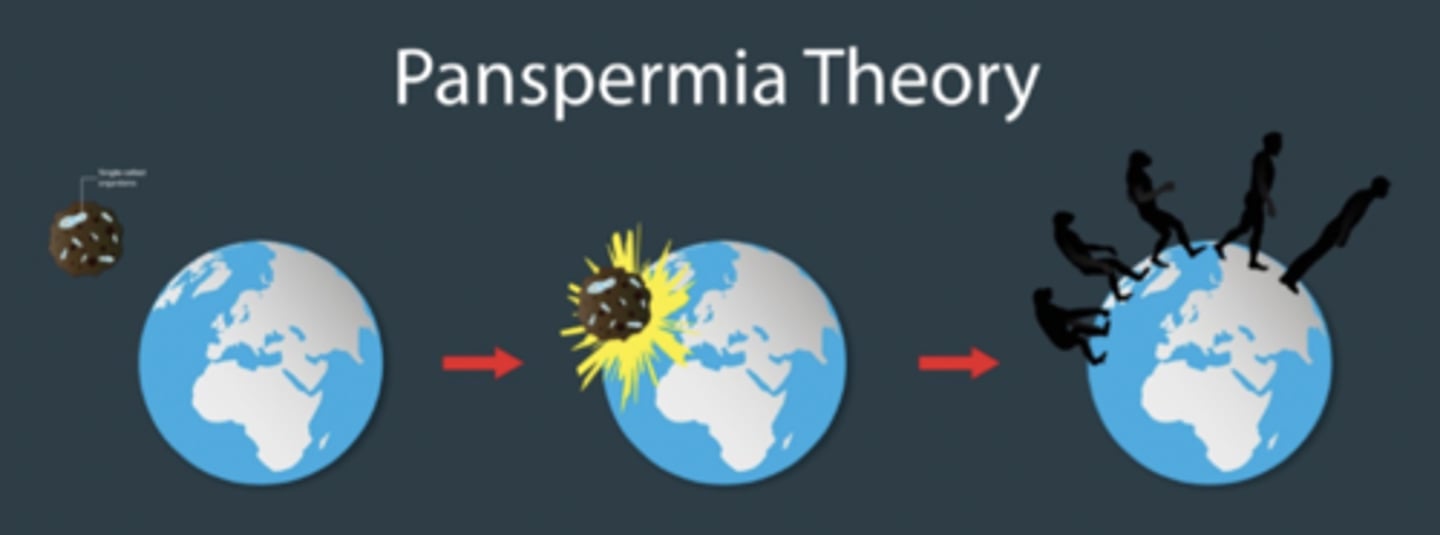
What is panspermia?
· The idea that compounds from space contributed to the origin of life on Earth
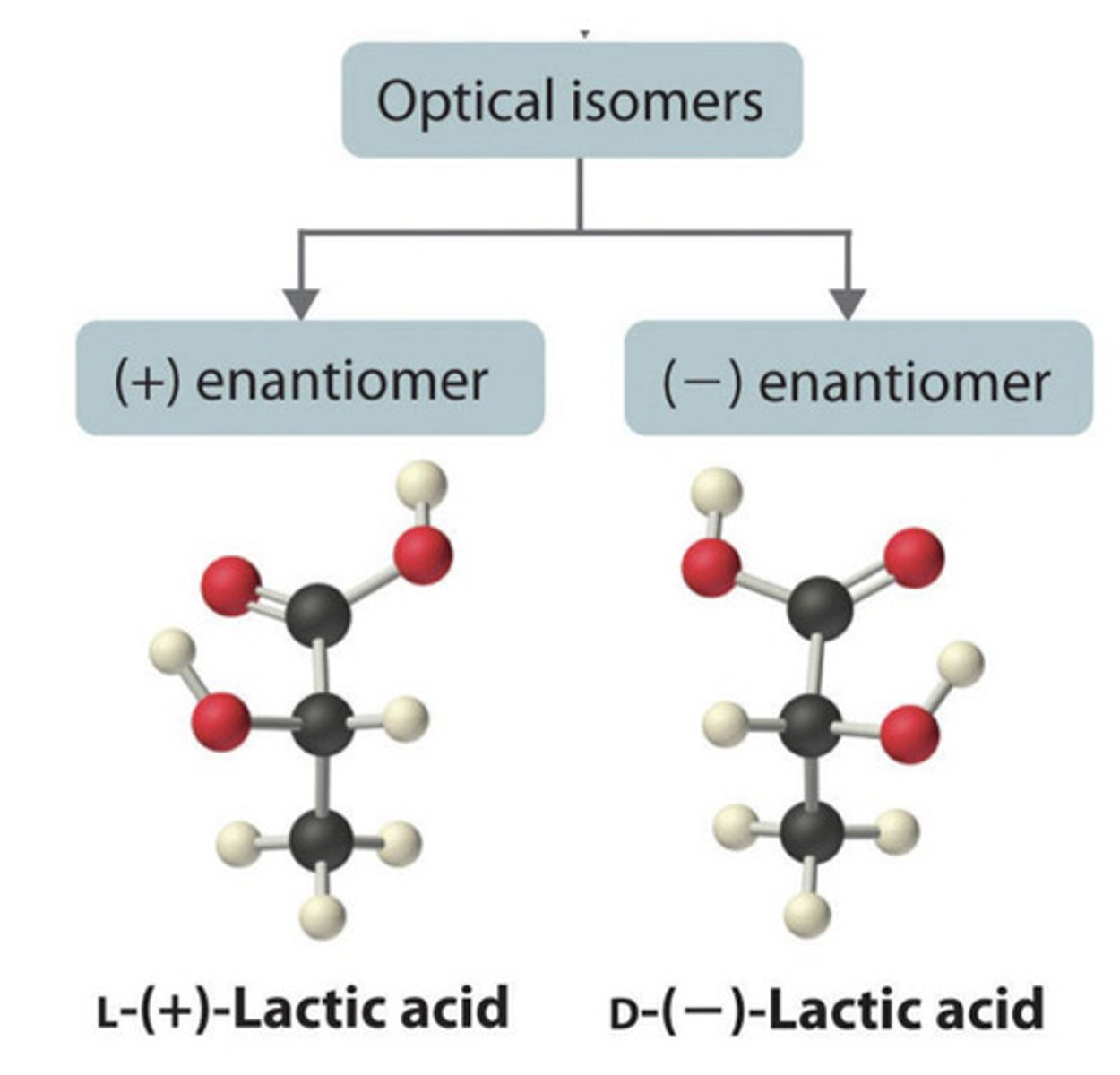
What is different about building blocks (amino acids, sugars, etc.) that are made a-biotically (as in M-U type experiments, or in space) when compared to the same sorts of building blocks made by enzymes (or by simpler catalysts)?
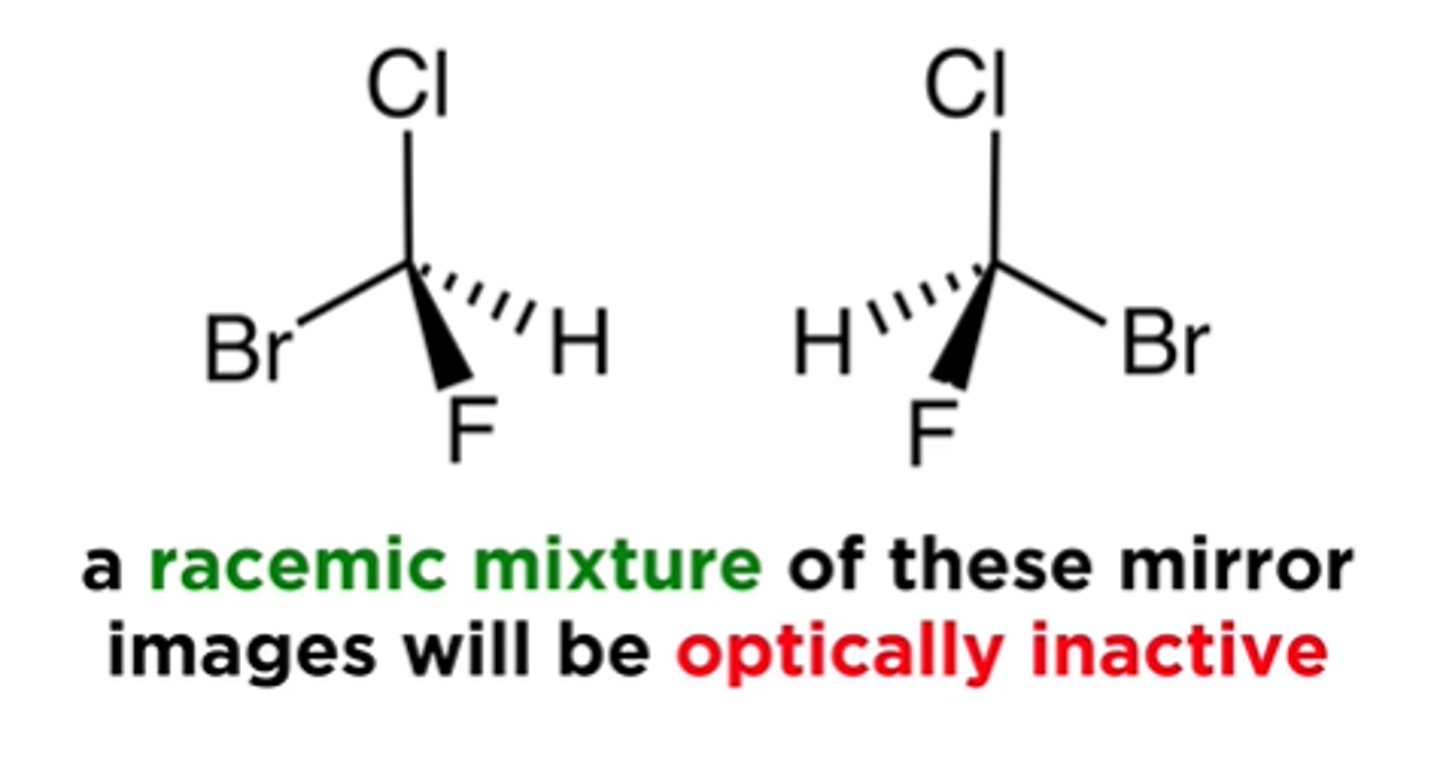
· A-biotic synthesis makes racemic mixtures
- Both left- & right-handed molecules are made
o Asymmetrical organic molecules
- Polymers made of these are unstable & change shape
o No active sites
o Assembly is random
o The same shape is rarely ever made twice
· Enzymes/simple catalysts do not make racemic mixtures
- Same-handed (symmetrical) molecules are made
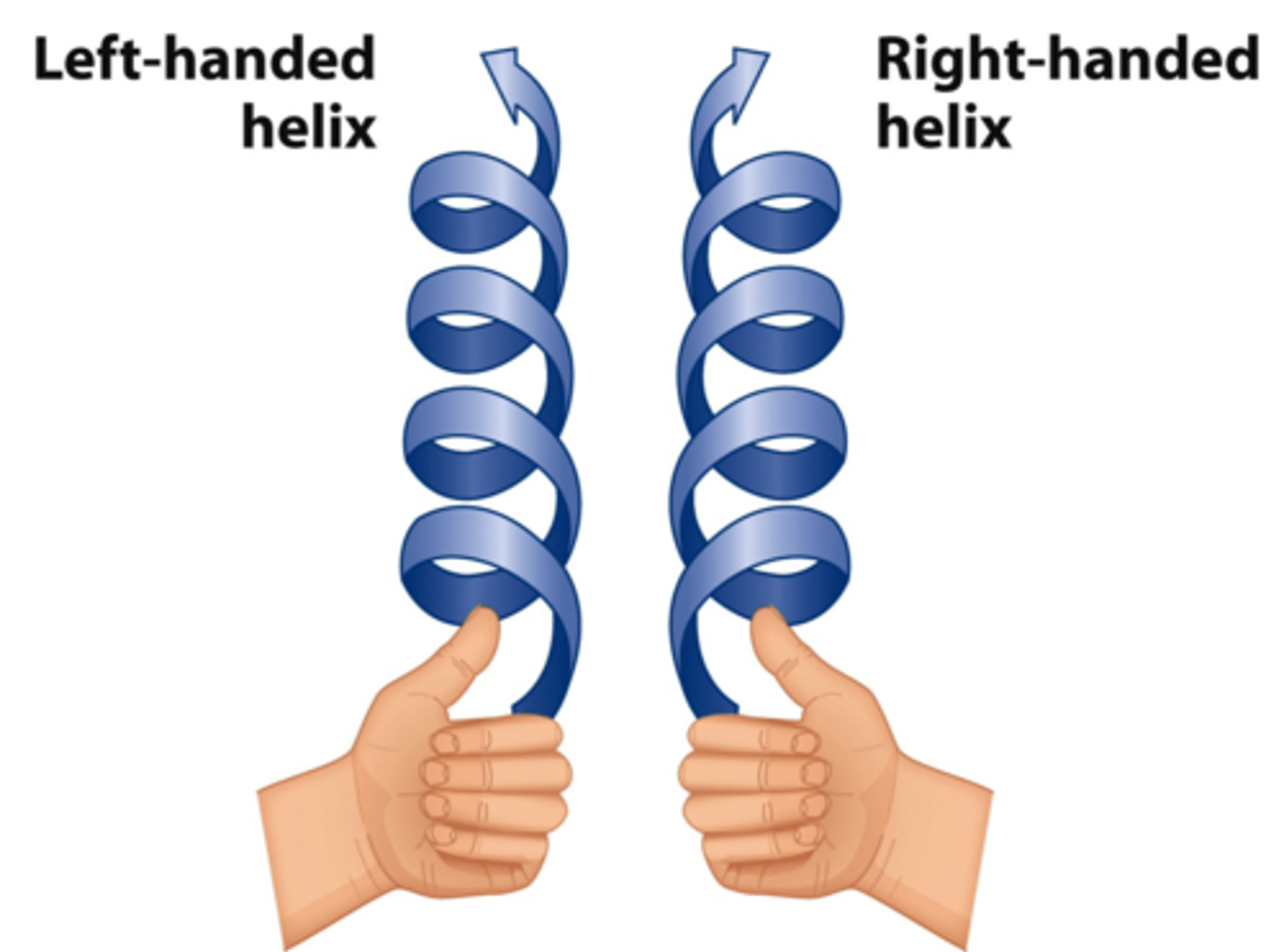
- Polymers fold in on themselves to make a helical shape
o H bonds make them stable
o Shapes can be reproduced
A mixture of left- and right-handed organic molecules are called ............................
· Racemic
Making polymers with racemic mixtures is possible, but it probably poses a problem for the origin of life
What is problematical about the effectiveness of polymers made from racemic mixtures of building blocks?
· They are not biologically effective
- They cannot make consistent enzymes or store info
· Disconnected string
Contrast that with polymers made for molecules of one-handedness
What shapes tend to come out of these sorts of polymers?
· Compacted spirals
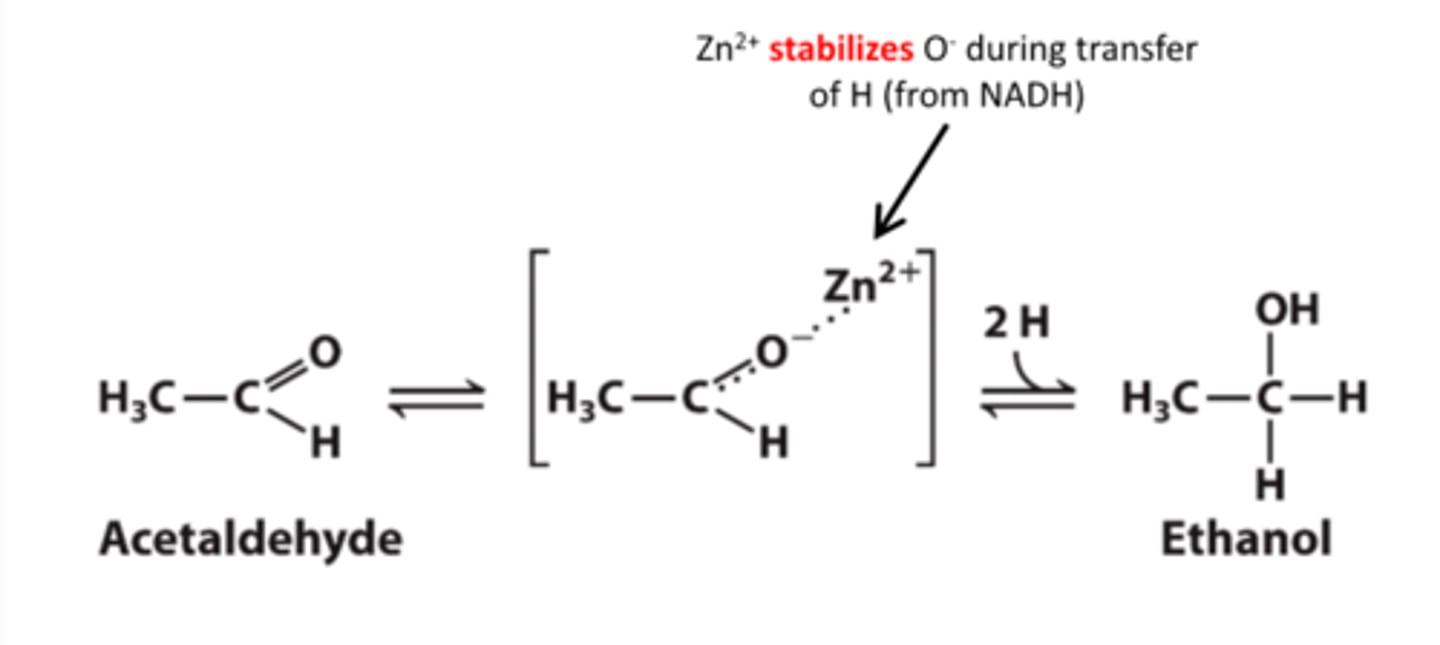
What environmental factors, likely present on early earth, could reduce the racemic mixture problem?
· Simple metal catalysts
Metabolism First and the Origin of Life:
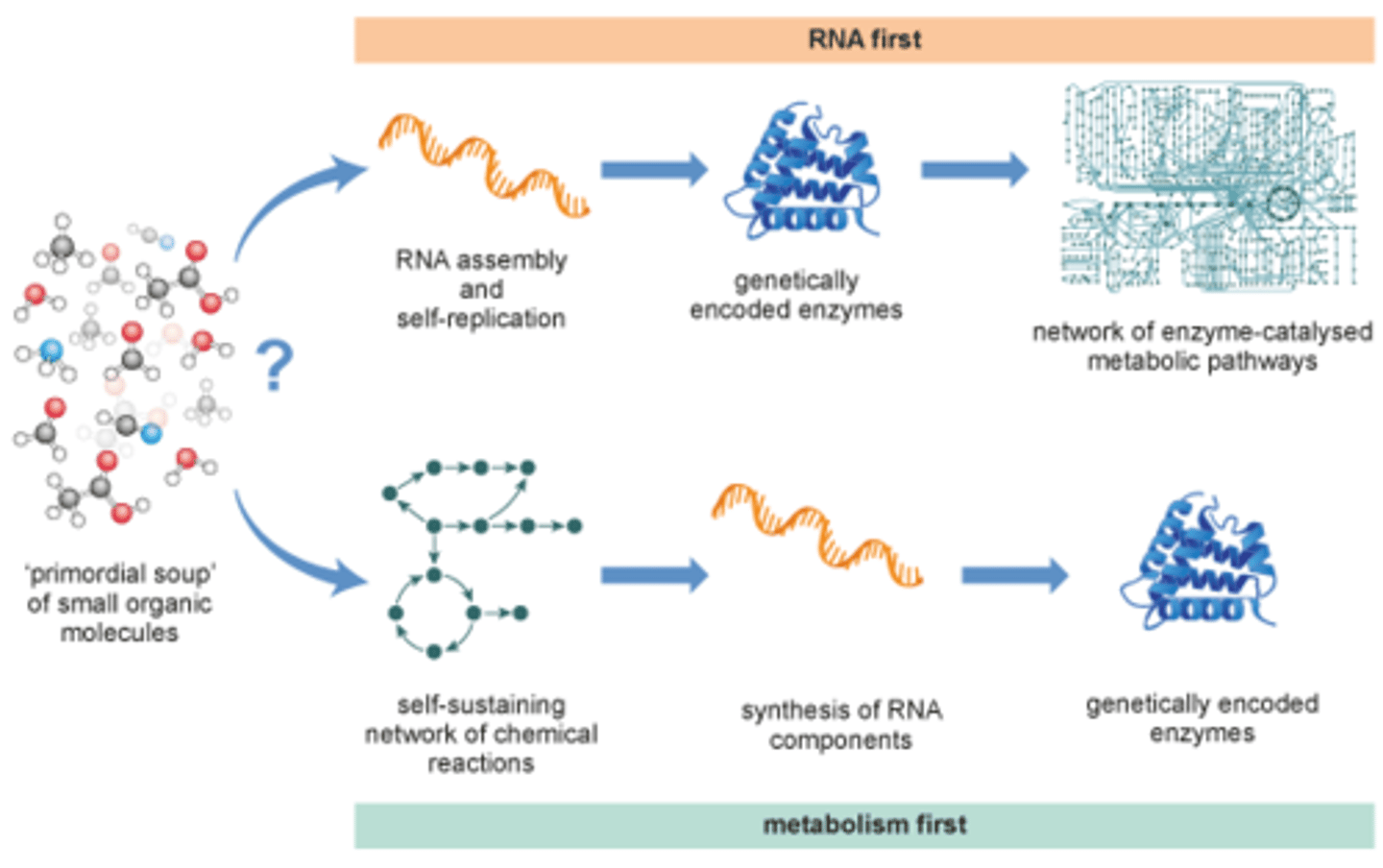
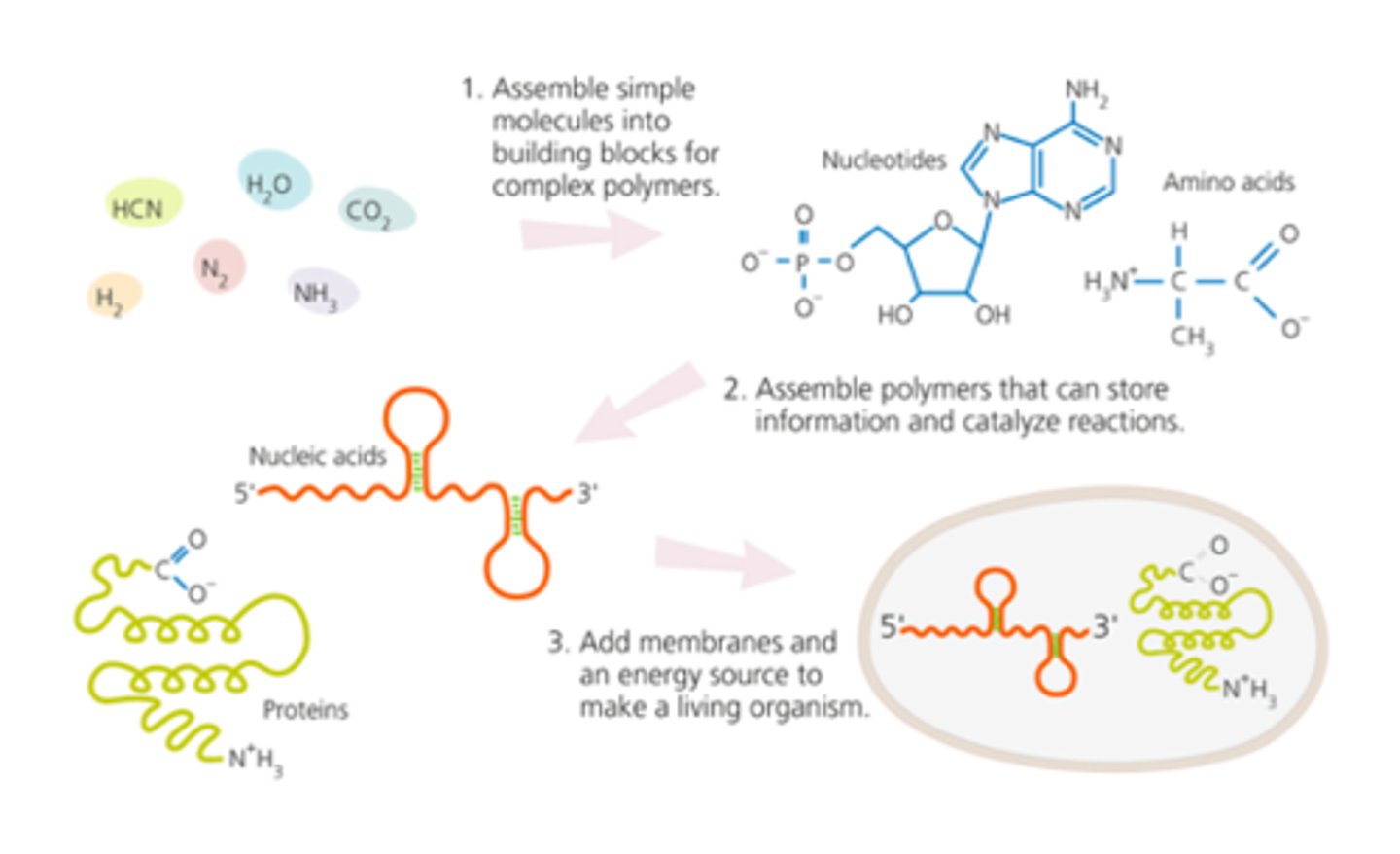
Dr. Moran first describes 3 different models about the origin of life
What are these 3 models?
· Primordial Soup
- Complex organic molecules are created by spontaneous chem rxns
- Over time, organic molecules like amino acids & nucleotides accumulate in a warm little pond
- Eventually, those organic molecules come together to form proteins & nucleic acids
· RNA World
- Nucleic acids (RNA) forms before proteins
- For a time, RNA molecules are the main catalysts in the primordial soup
- Later, proteins take over some catalytic roles
- One problem: a reasonable concentration of nucleotides is needed before the process can begin
· Metabolism First
- The first rxns involve spontaneous formation of simple molecules like acetate (i.e., a 2-carbon compound formed from carbon dioxide & water)
- Pathways leading to the synthesis of simple organic molecules might be promoted by natural catalysts like minerals & porous surfaces in rocks
- The origin of life is triggered by the accumulation of very simple organic molecules in thermodynamically favorable conditions
- Simple organic molecules can combine to form simple amino acids, lipids, etc.,
- Those would then act as catalysts for the formation of more organic molecules, thus begins metabolism
- Simple peptides would eventually form, which could lead to better catalysts
- Near the end, nucleic acids & complex amino acids can form
Metabolism First and the Origin of Life:
Which of these 3 models must have been established first to make much progress in organic evolution?
- Here he cites that it has been very difficult to a-biotically synthesize RNA nucleotides
- He is now wrong about that, btw, but this article came out in 2009
· Primordial Soup
- The various complex molecules of life came after the spontaneous formation of very simple molecules
Metabolism First and the Origin of Life:
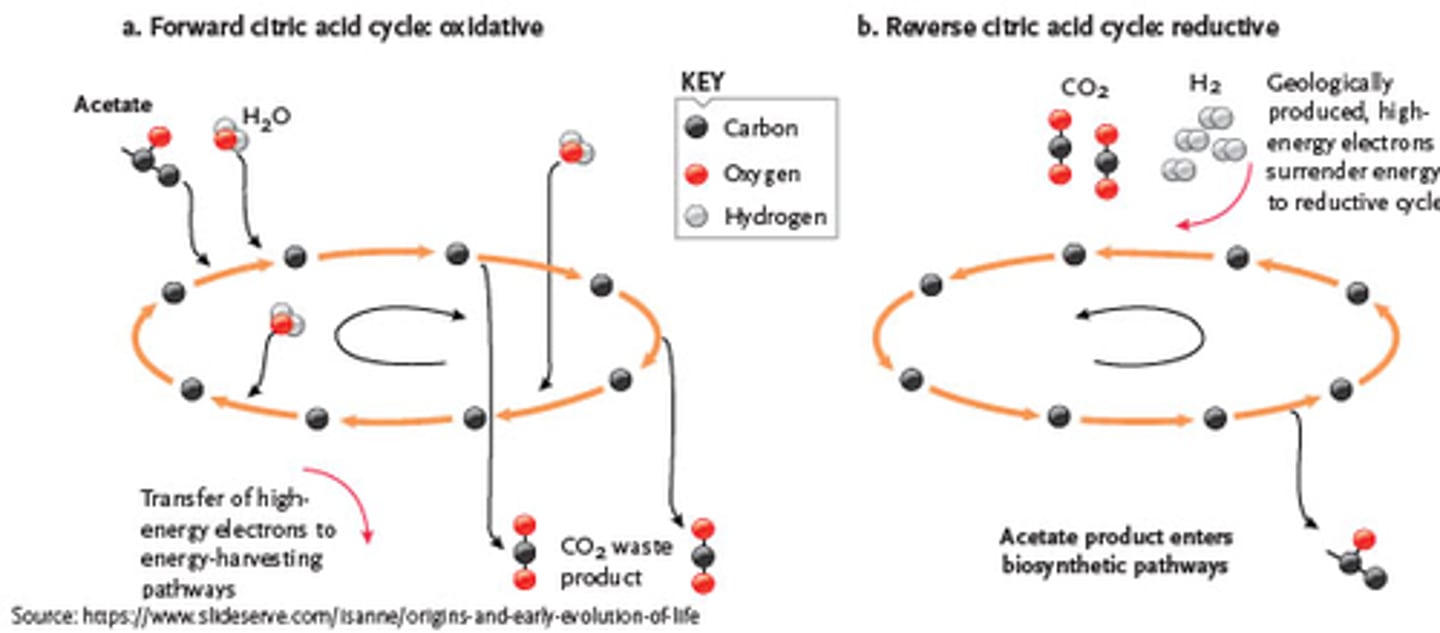
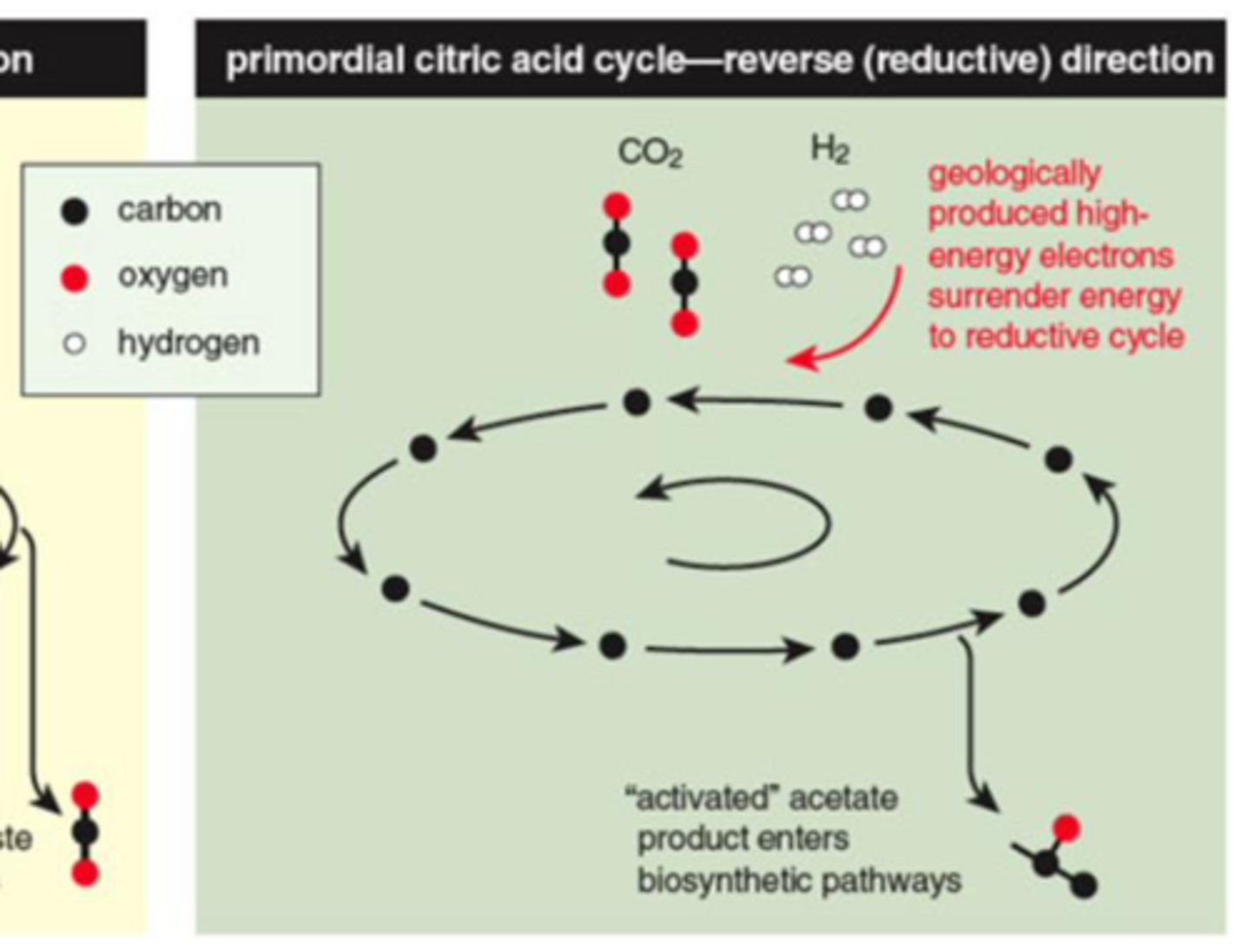
He refers to an important review article (which I have also linked to) which proposes that before the familiar Citric Acid Cycle (aka Krebs cycle) came to be, its precursor was called: ....................................
What is essentially the difference between this and the familiar Citric Acid Cycle?
· Reductive Citric Acid Cycle
· It runs in reverse
- The CAC we know today oxidizes the fuel molecule acetate (activated by the attachment of a carrier molecule) & releases CO₂ as waste
o Input: organic molecule
o Output: chem energy, CO₂, H₂O
- This reductive version of the CAC uses CO₂ to make organic molecules by exploiting the electron-transfer potential (reducing power) of geologically produced molecules like H₂
o Input: chem energy, CO₂, H₂O
o Output: more complex molecule
Metabolism First and the Origin of Life:
What physical environment would be favorable to the assembly of this metabolic pathway?
- Once again, we keep being pointed to the same environment
· Early Earth's atmosphere most likely had very little oxygen but lots of greenhouse gasses like CO₂
· Reductive pathways (e.g., reductive citric acid cycle) that produce simple organic molecules might have been promoted by natural catalysts like minerals & the porous surfaces of rocks, which are typical of ordinary geochemical environments like deep sea vents
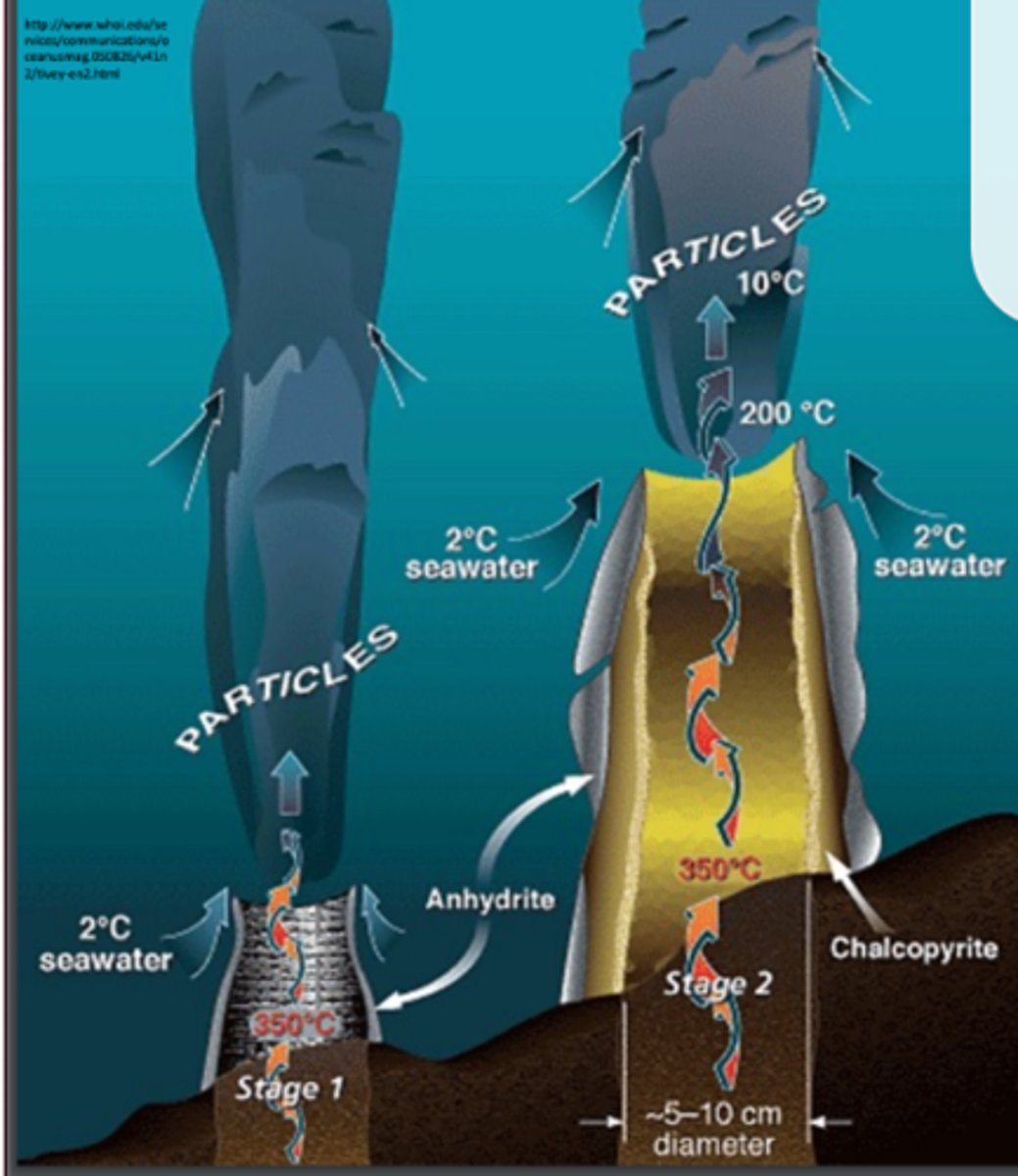
What is the basic dynamic of volcanic activity and sea water at the hotter hydrothermal vents known as 'black smokers'?
· Seawater enters the cracks on the seafloor, gets heated, then is jetted out at high speeds carrying volcanic gases/minerals that solidify when cooled, forming chimney-like structures
Do black smoker hydrothermal vents seem likely to be an ancient feature of the early oceans?
What is the main problem with their chemistry in this regard?
· No
- Altho, they do provide many gases/minerals that bacteria & archaea can use to sustain themselves
· They are very hot & acidic which can hinder the development of simple life
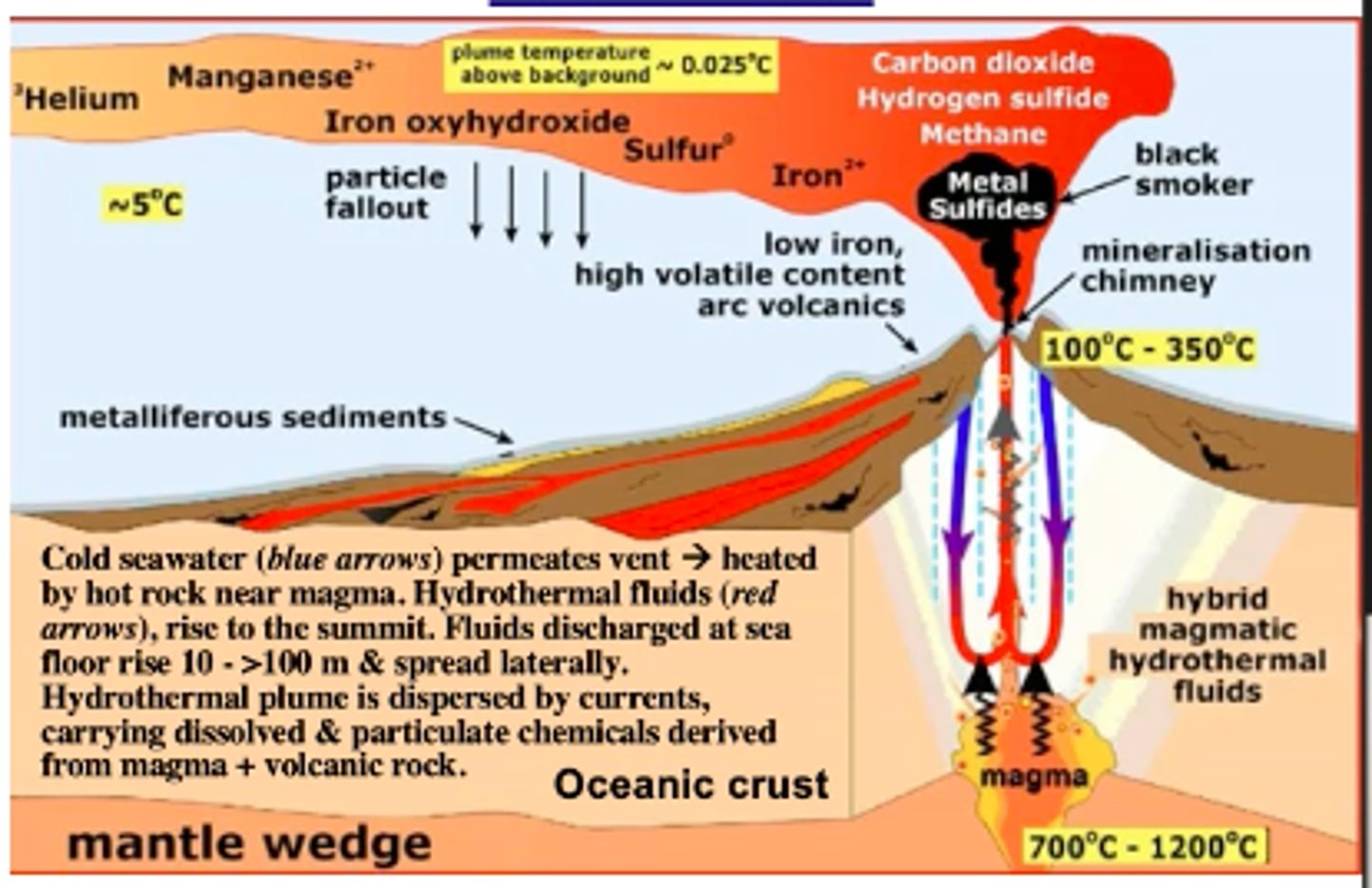
What is it about the chemistry of alkaline hydrothermal vents that make them an especially close match to a standard Miller-Urey environment?
· They are full of mineral cells lined with metal catalysts
- They are also rich in reducible gases
- They are not overly hot, just warm since they are located far away from volcanic activity
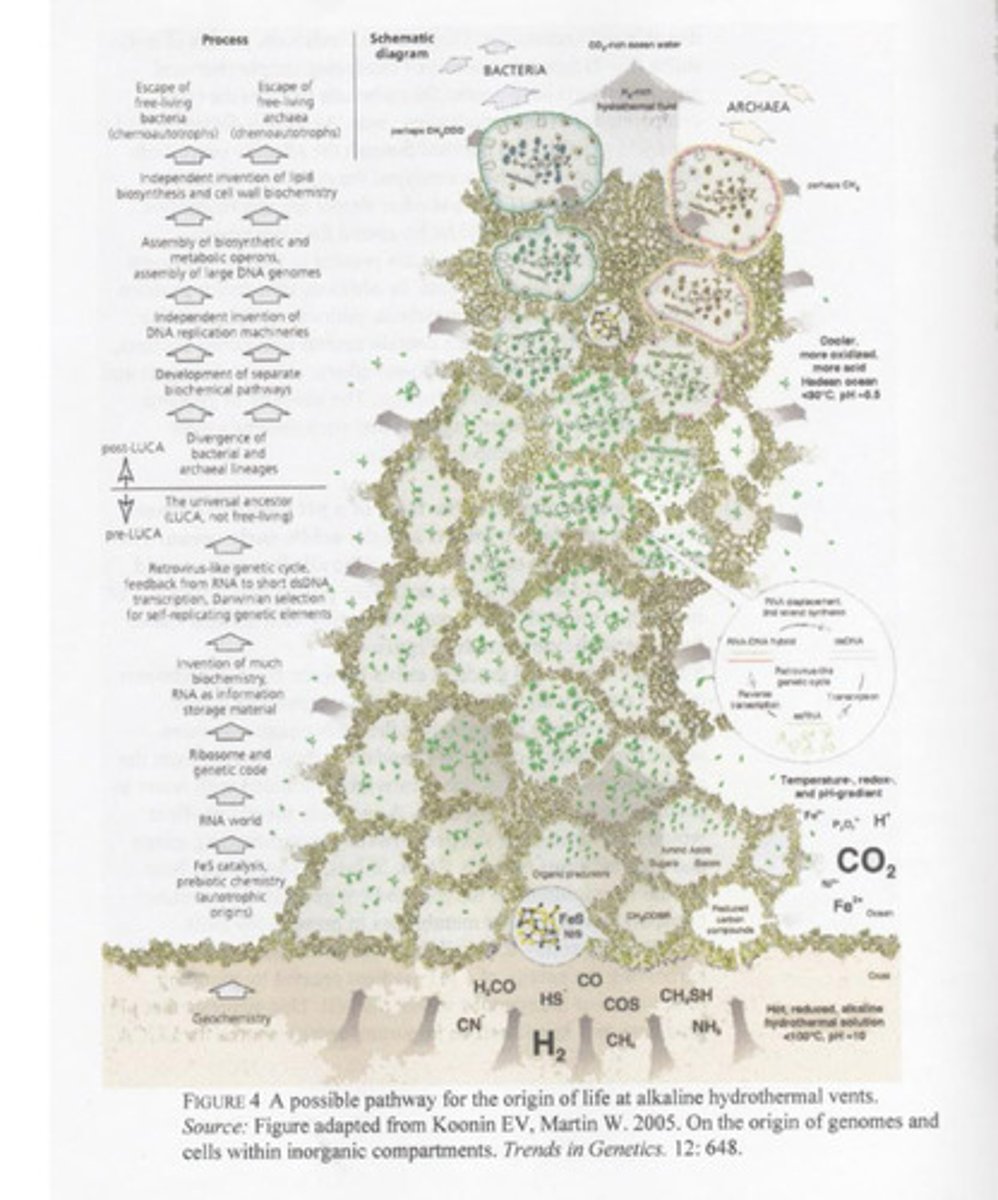
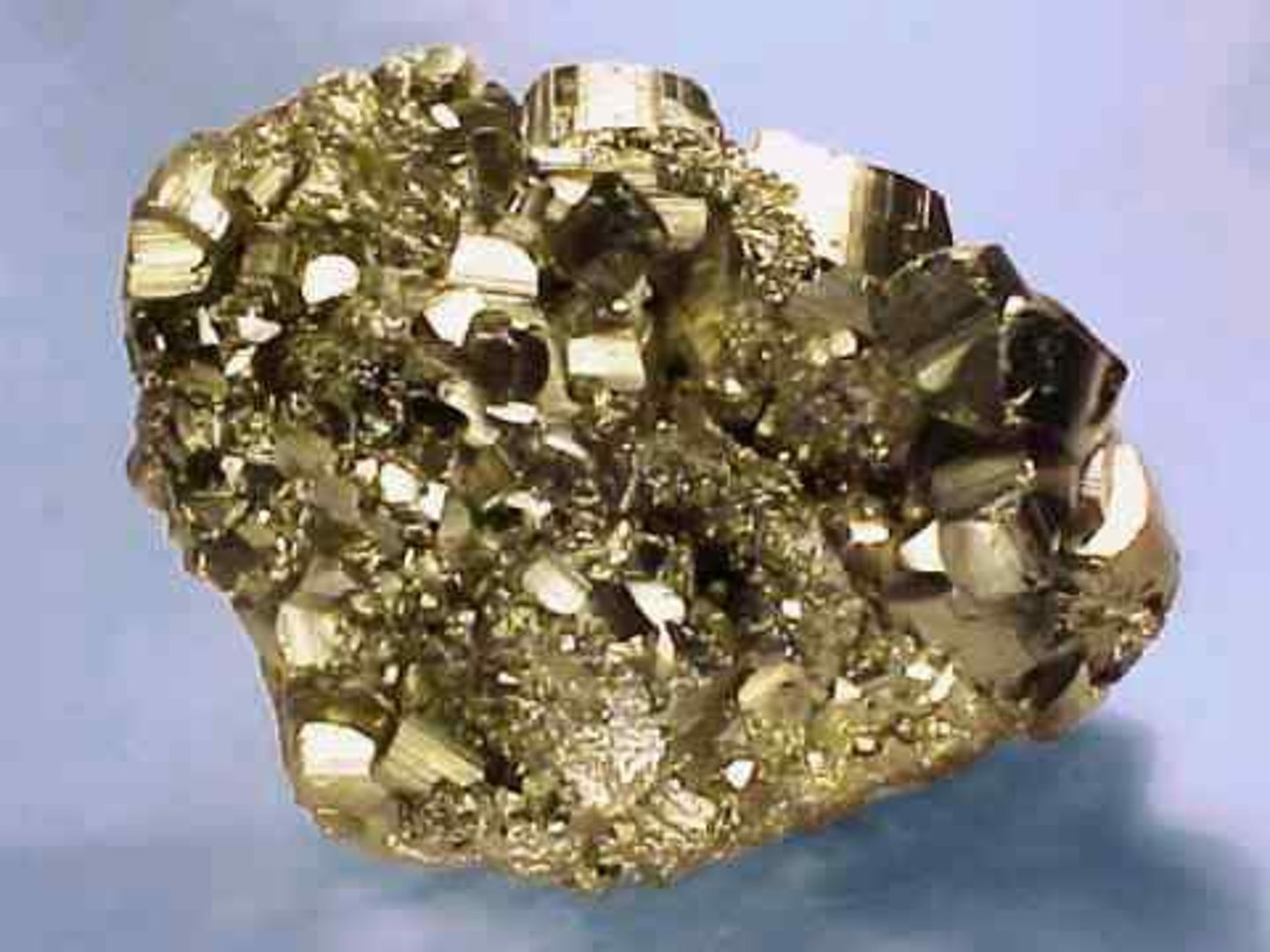
Alkaline vents are permeated with combined FeS and NiS compounds
What common name is given to this kind of mineral?
· Iron pyrites = fool's gold
What sequence of chemical reactions are thought to happen with CO₂ + H₂ in the presence of FeS and NiS compounds?
· CO₂ + H₂ → acetyl
· Some acetyl is spontaneously phosphorylated
- Phosphorylated acetyl is used instead of ATP in many prokaryotes today
o Could provide energy "before ATP"
- Phosphates readily attach in these conditions, making a high energy bond that can support other rxns
o Wants to lose energy/give up electrons
· Metal catalysts + acetyl → pyruvate
- Acetyl & pyruvate form spontaneously in M-U environments
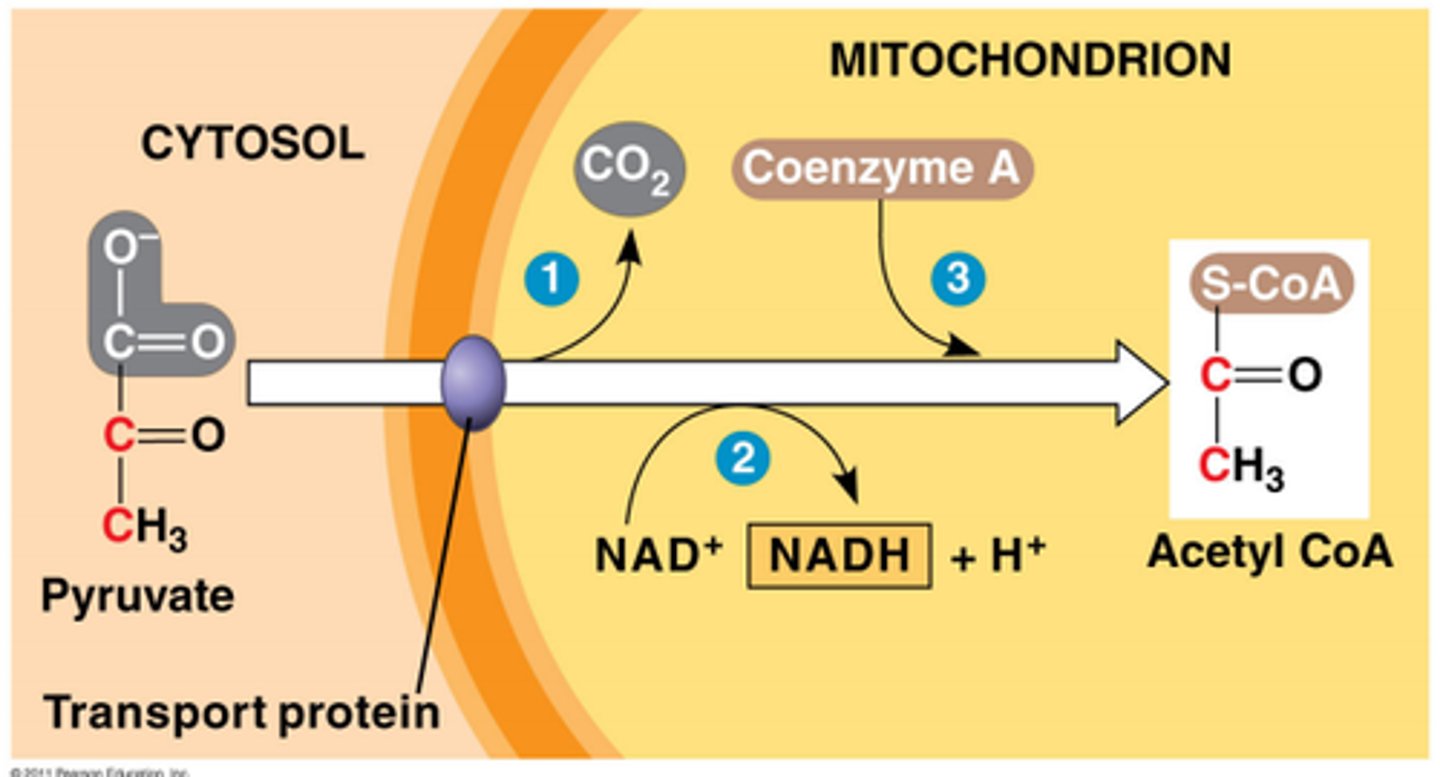
Why does the formation of acetyl, acetyl-P, and pyruvate in alkaline vent environments seem connected to cellular metabolism?
· At the heart of all cell metabolism is acetyl & pyruvate, which work to produce important amino acids & sugars
- Acetyl-P = phosphorylated acetyl
o Phosphates readily attach in M-U environments
o High energy bonds that support other rxns are easily made
~ Wants to lose energy/give up electrons
o Used as energy before ATP
- Pyruvate is made from metal catalysts, acetyl, & CO₂
· Many enzymes contain FeS & NiS prosthetic groups
- The prosthetic grp is the catalyst
- The surrounding protein makes them more specific/specialized
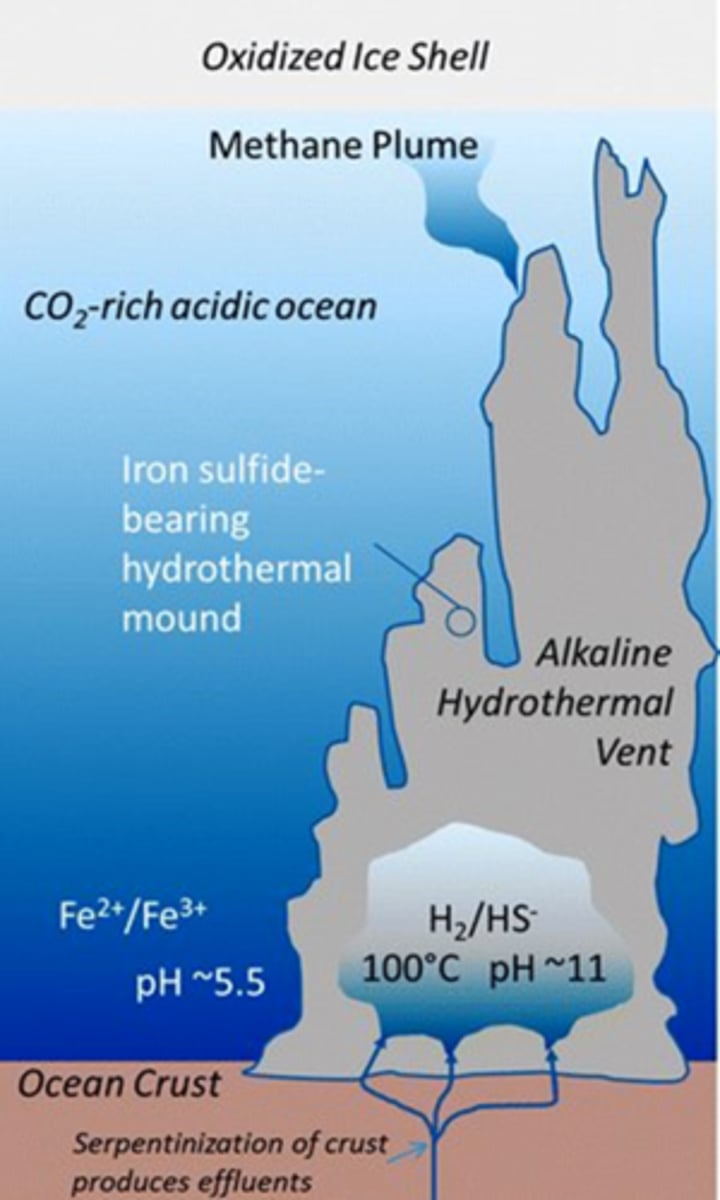
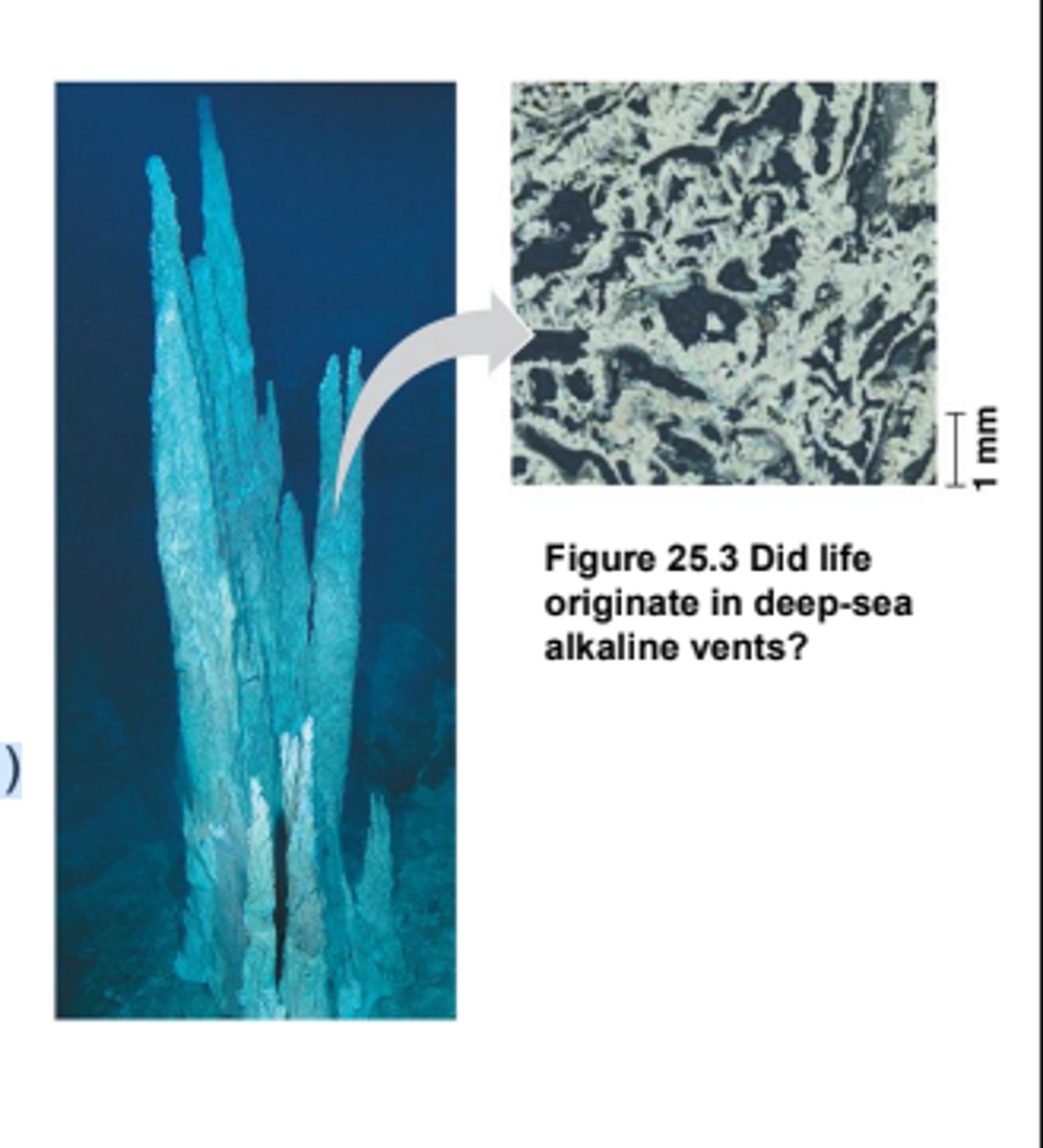
The phrase "Rocky ..................." is often used in discussions about the possible origin of life at alkaline vents
· Roots
- Early life at alkaline vents likely evolved enzymes around the NiS / FeS catalysts
o These metal catalysts + acetyl & pyruvate = deepest homology
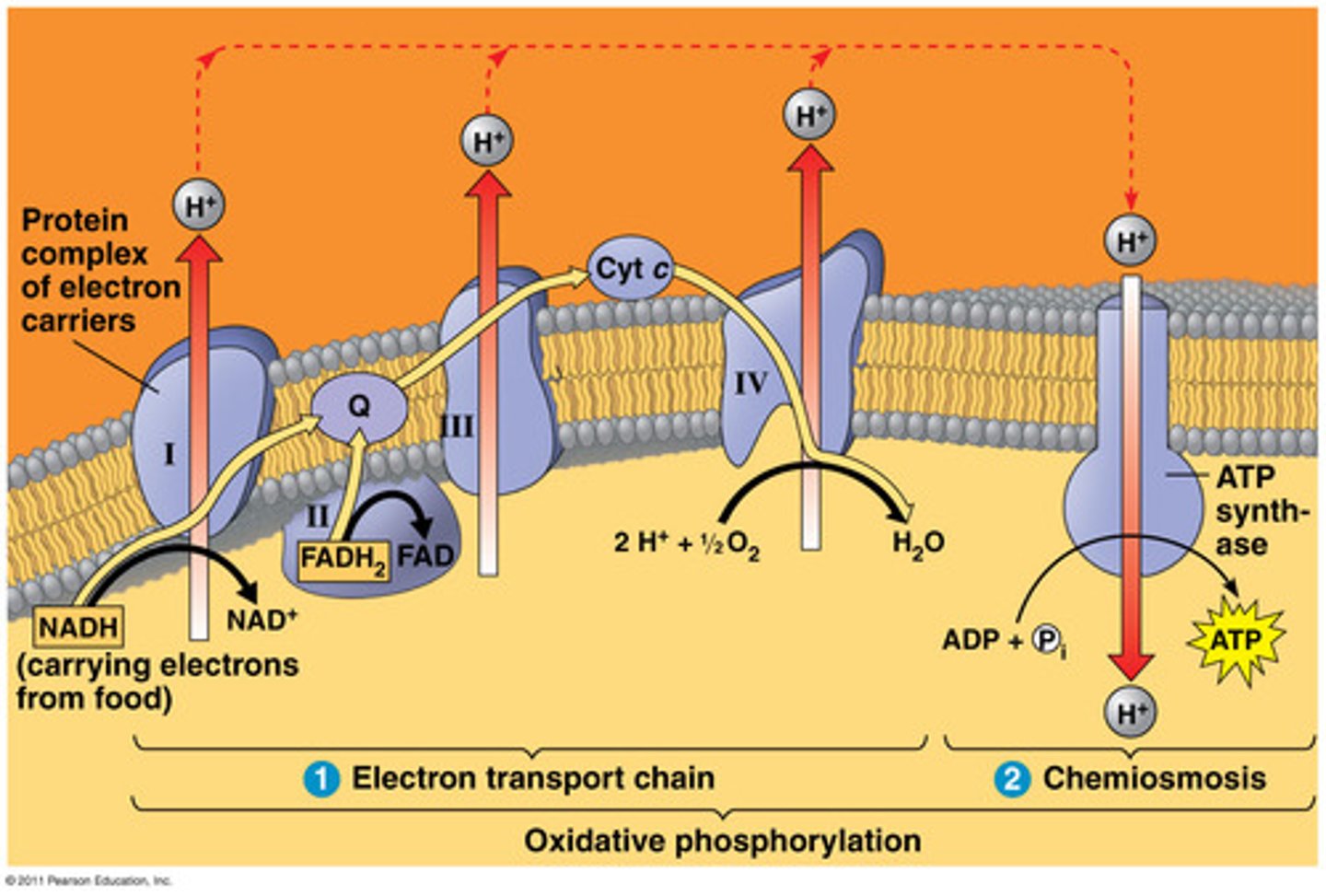
Modern cells today use proton (H+) gradients as a source of energy
How do modern cells continually build these H+ gradients?
· Electron Transport Chains (ETC's)
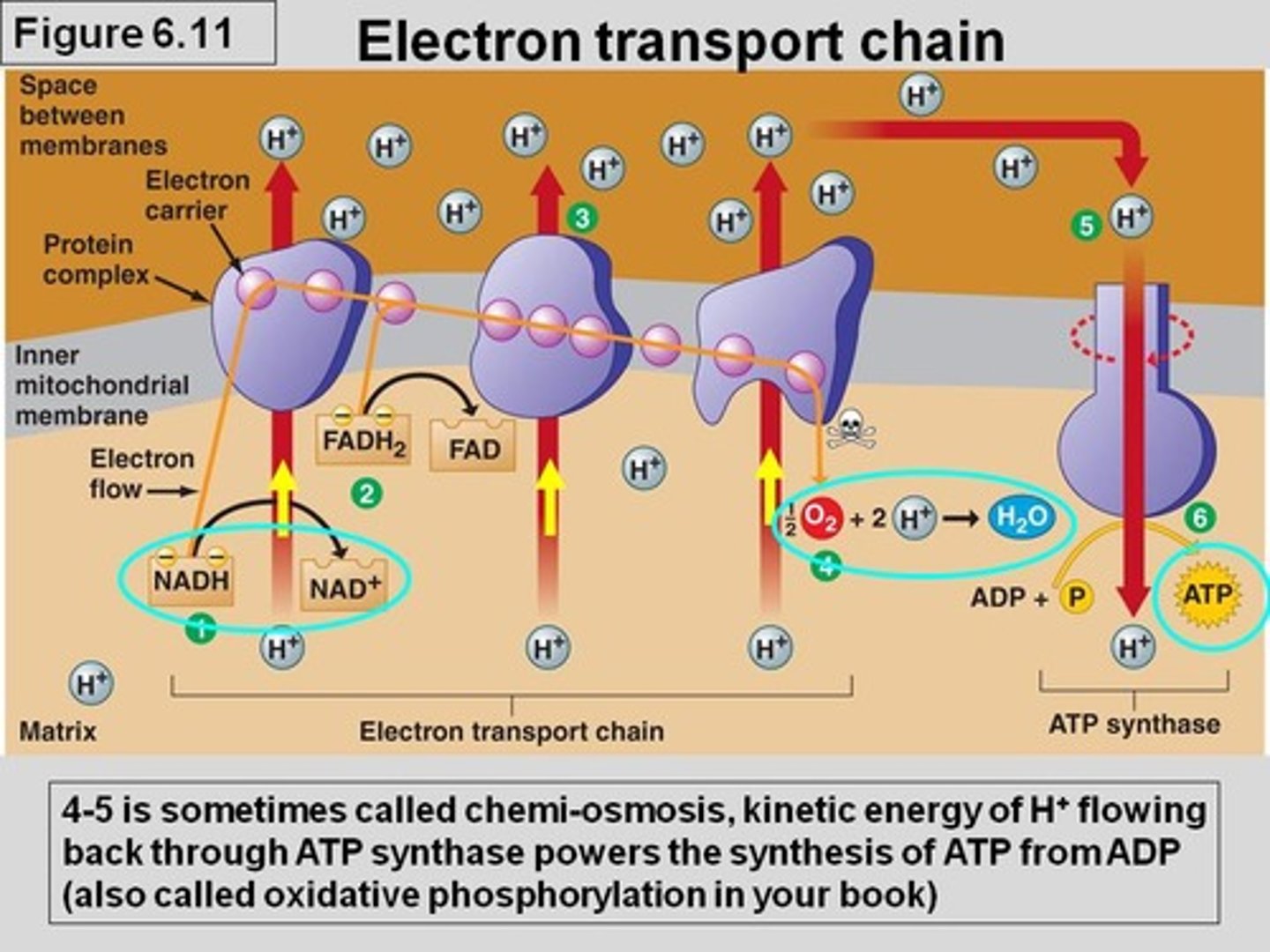
Modern cells today use proton (H+) gradients as a source of energy
What do cells today do with H+ gradients?
- (If you have no idea what this is, look up 'electron transport chains' for respiration)
· ETC's are used during respiration & photosynthesis, where cells break down organic molecules to get electrons
- Protons follow those acquired electrons along the chain
o They are tricked into forming a gradient that is used to run an enzyme that phosphorylates & makes ATP
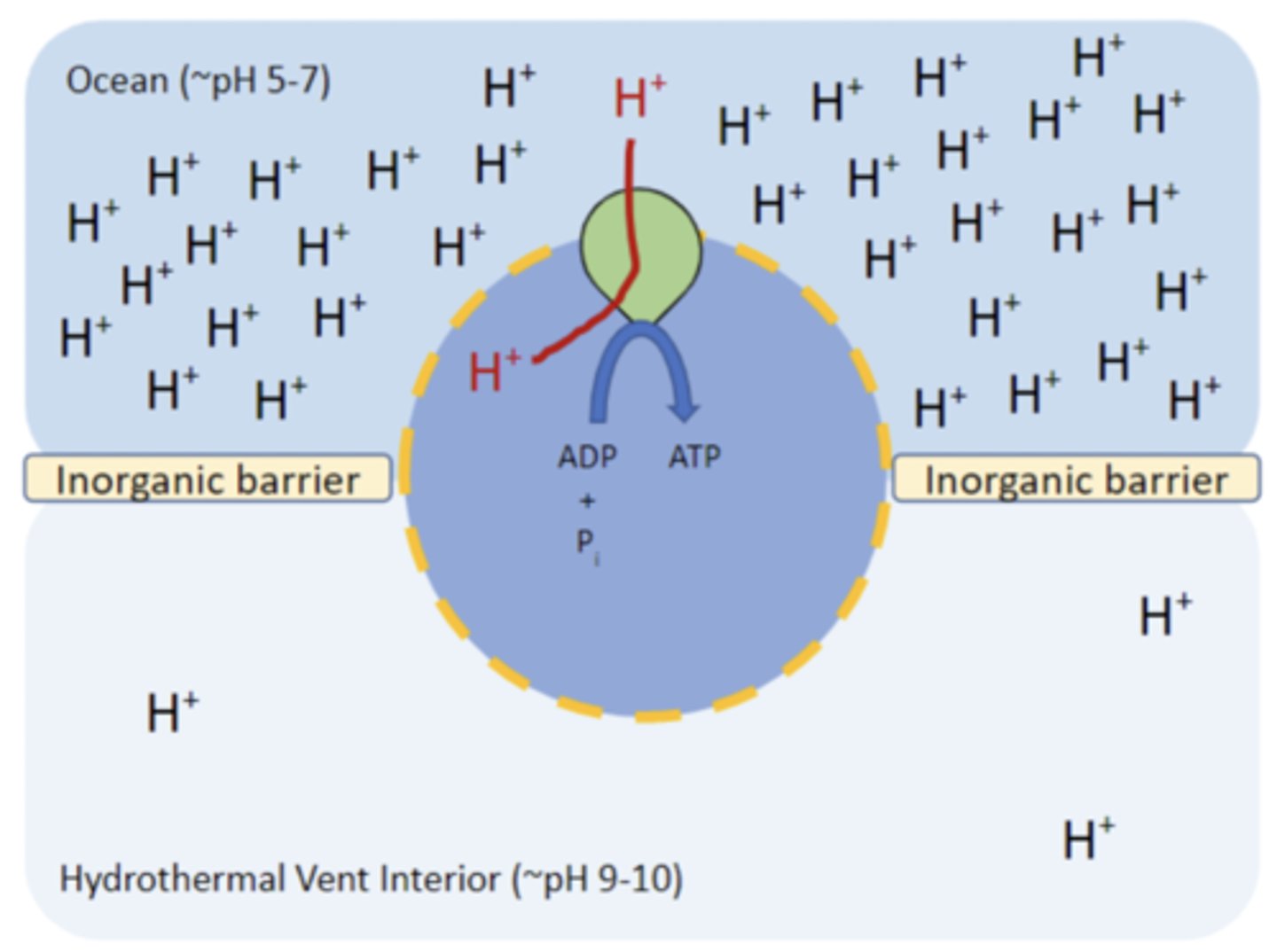
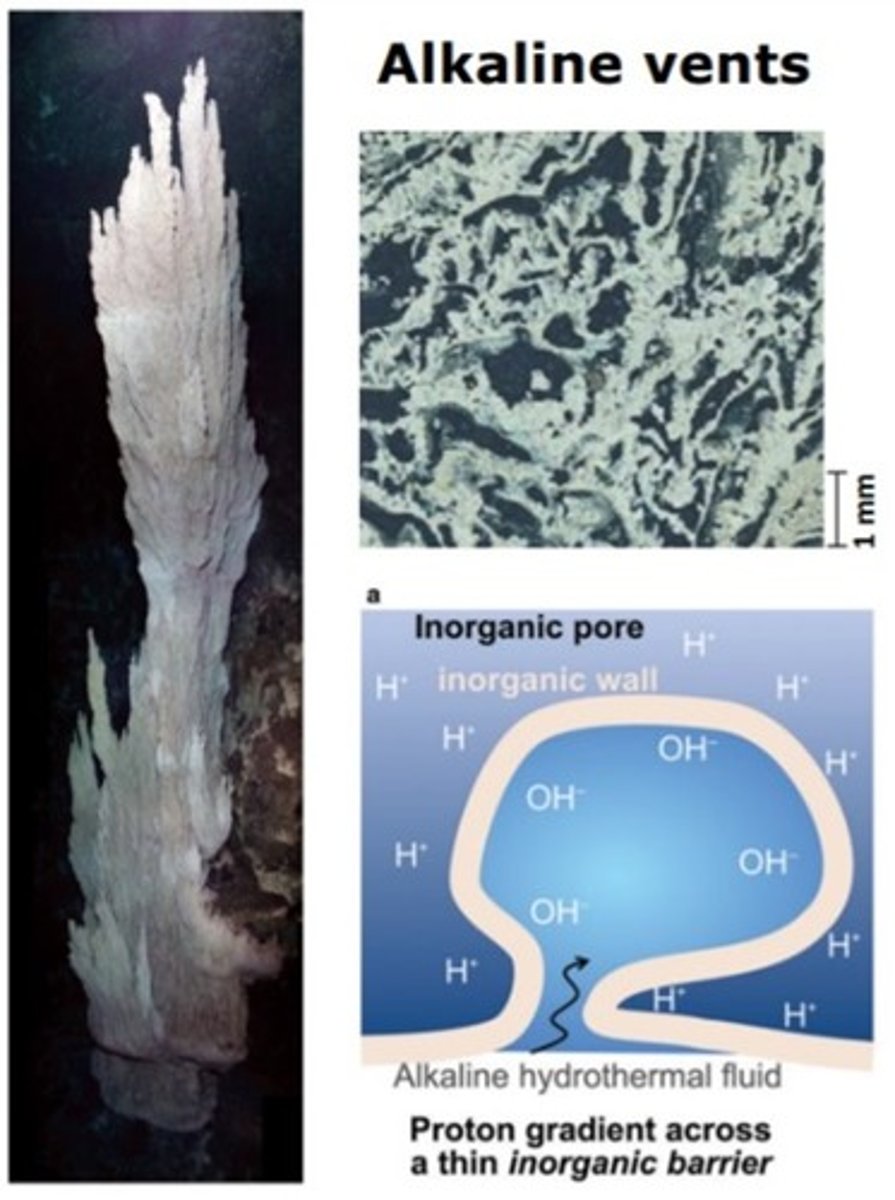
What is it about alkaline vents that naturally result in proton gradients that are supplied 24/7?
· Alkaline vents are low in protons, while seawater has a much higher concentration of protons
- The low-proton concentration of materials being jetted out of alkaline vents meet the high-proton concentration of seawater surrounding them, producing a natural proton gradient that does not require a constant renewal of energy
· H+ provides a proton-motive force
- Acetyl & pyruvate are high in energy, so they want to give up their electrons
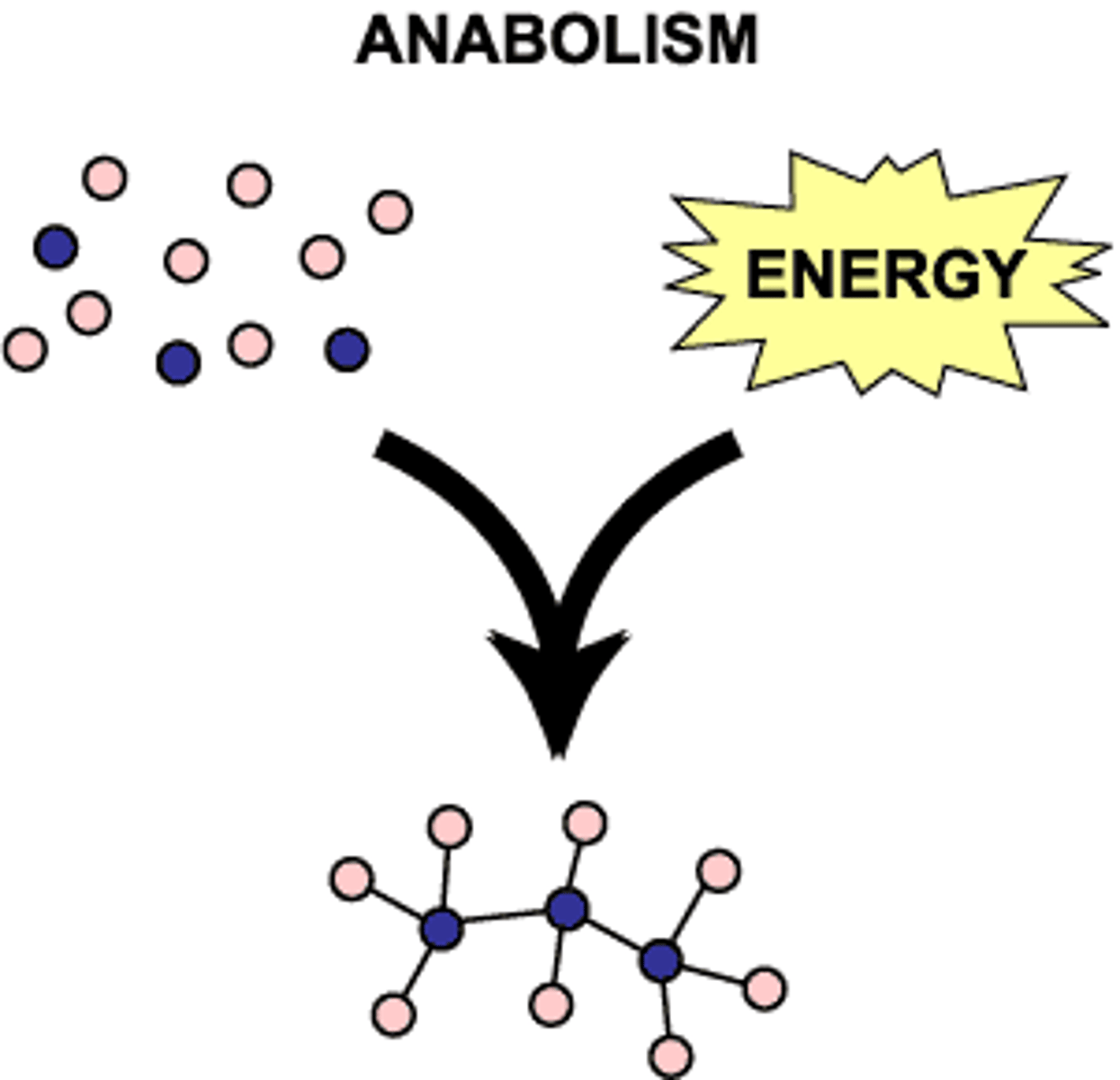
Summarize the general conditions where a system is forced to build order
- Note this requires you to invoke the lack of equilibrium and the constant supply of energy and raw materials
- Here is some structure for this topic:
When a system is supplied with constant ................. & ......................
· Potential/free energy
· Raw materials
Summarize the general conditions where a system is forced to build order
- Note this requires you to invoke the lack of equilibrium and the constant supply of energy and raw materials
- Here is some structure for this topic:
...while never being allowed to reach .............................
- The result is that the system...
· Equilibrium
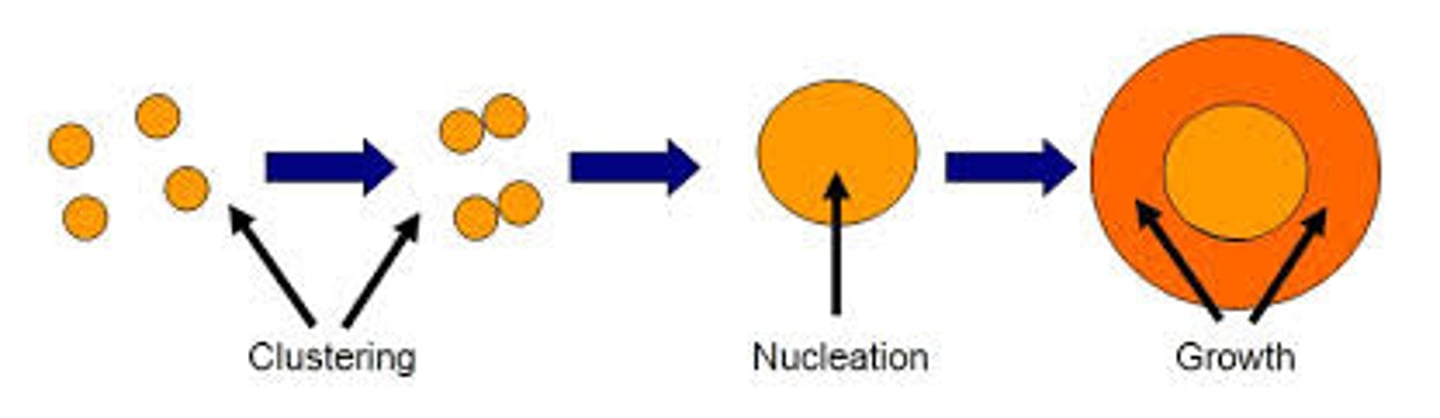
Summarize the general conditions where a system is forced to build order
- Note this requires you to invoke the lack of equilibrium and the constant supply of energy and raw materials
- Here is some structure for this topic:
...changes by becoming ...........................
- This makes the system better at .......................................
· More complex/organized → grows bigger
· Draining energy
What are some familiar non-living examples of the above?
- Interesting how they become "orderly", just like that
· Fire
· Snow/crystals
· Hurricanes
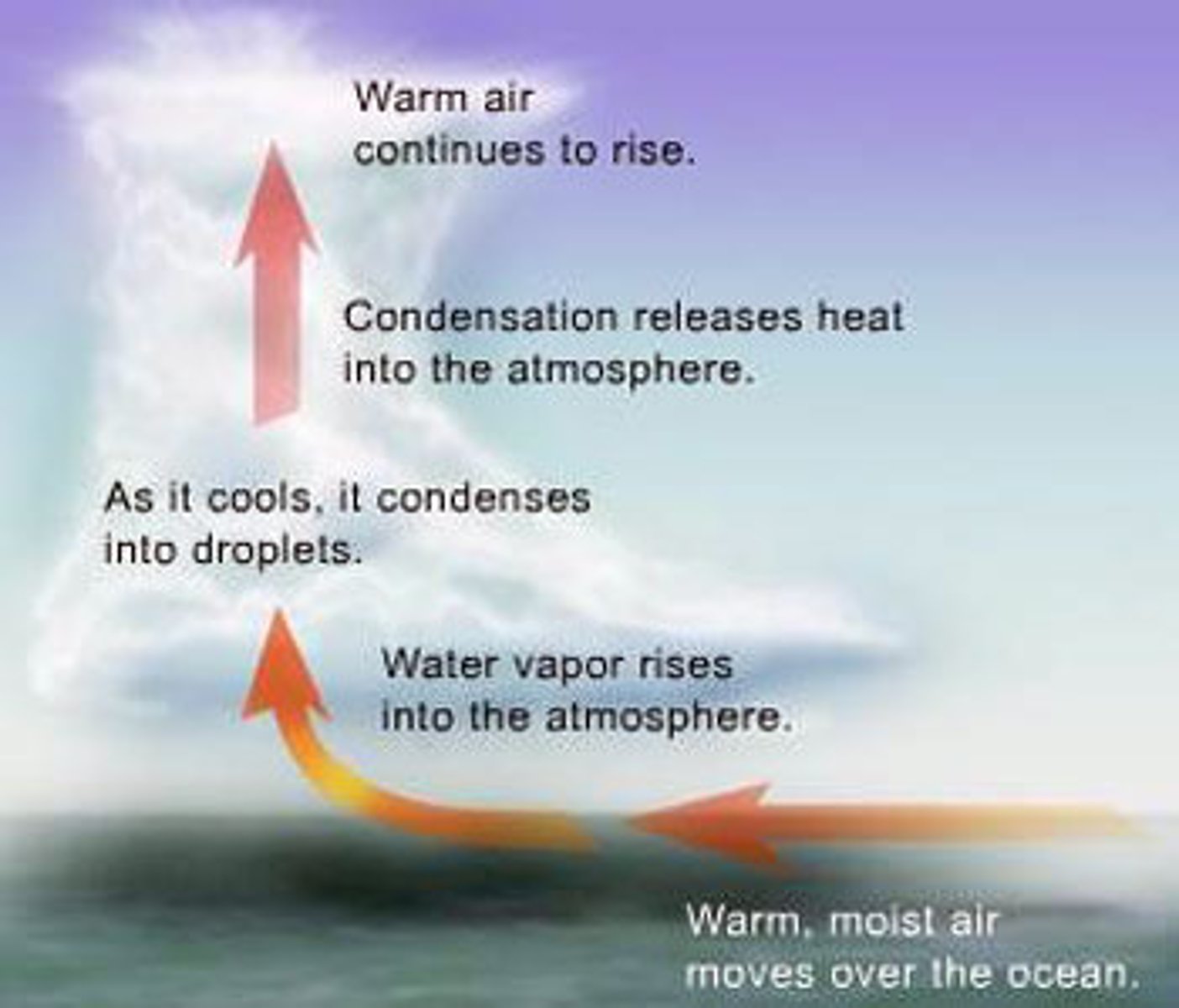
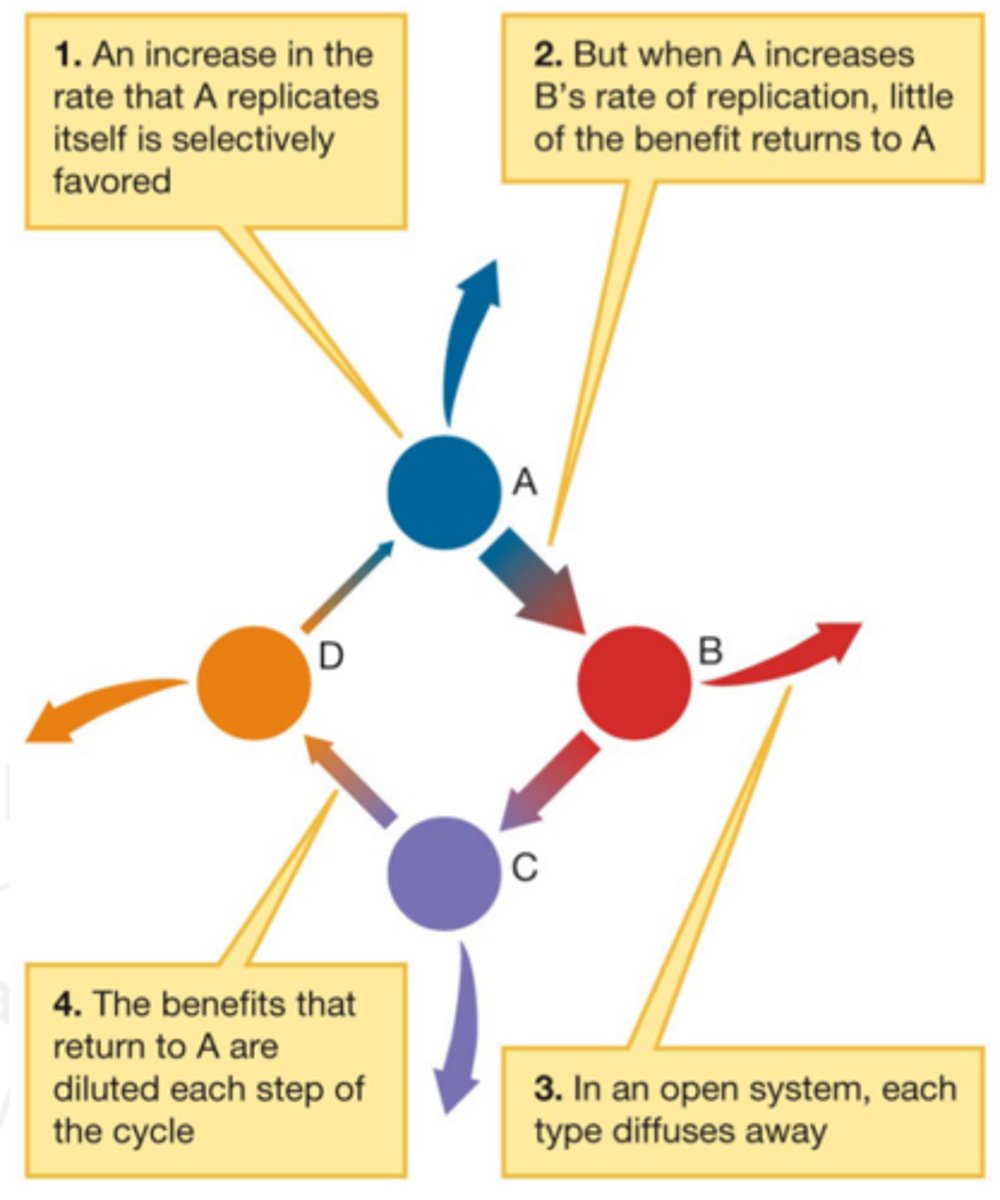
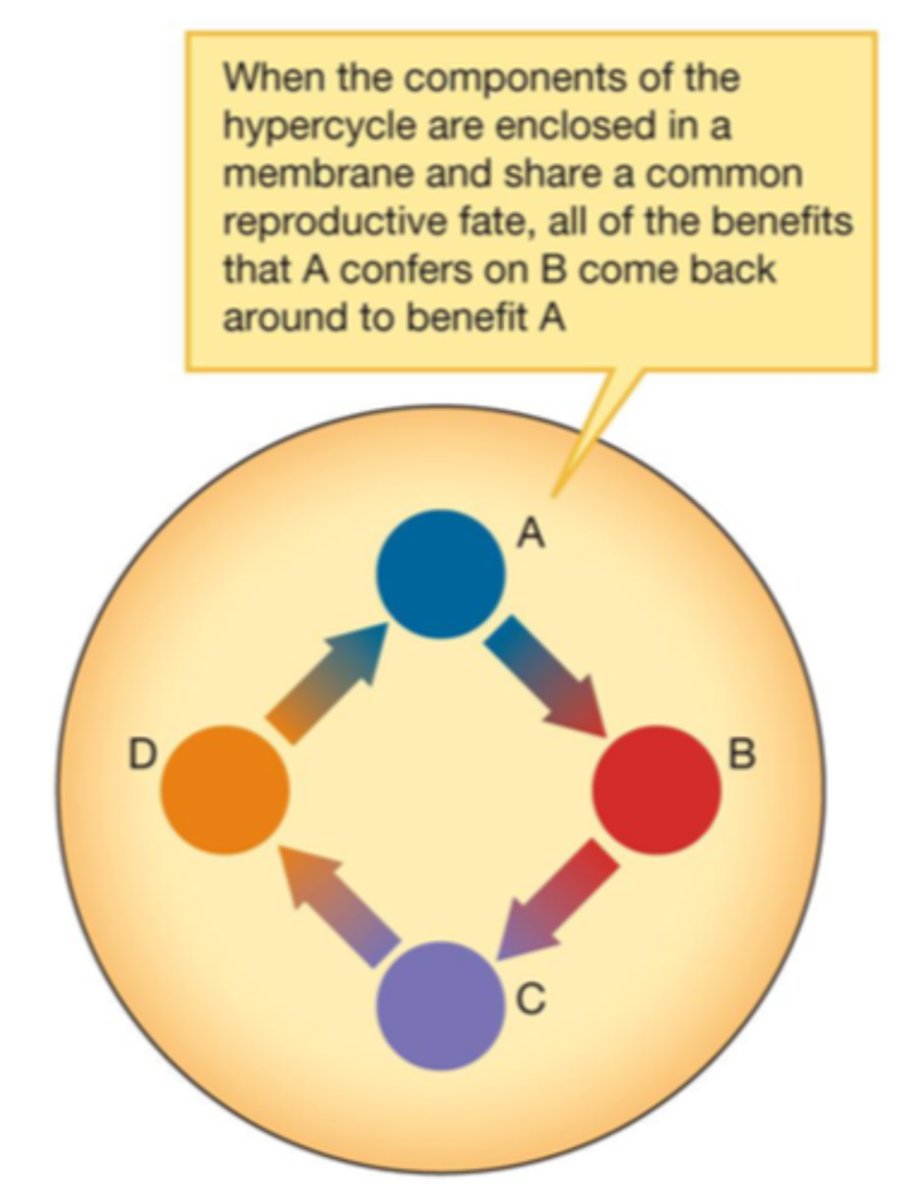
What is a hypercycle?
· The organization of self-replicating, catalytic molecules into a self-propagating cycle
- A cycle of rxns in which the products of one reaction are used as reactants in the next rxn
- A rxn produces A, which is used to make B, which is used to create C, which is used to make D, which is used to create A once again, & the cycle repeats
o A → B → C → D → A
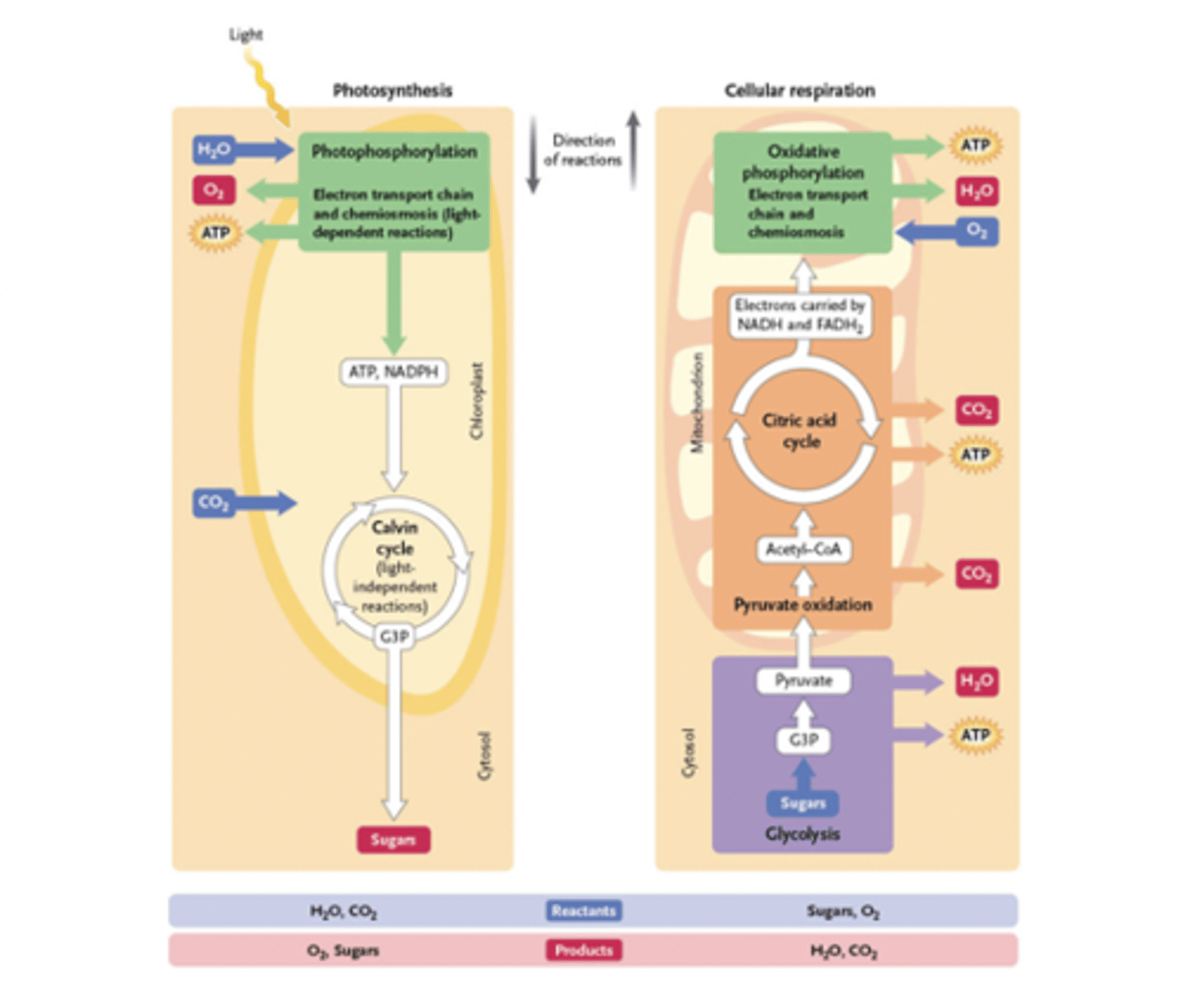
Can you think of metabolic pathways that include hypercycles?
· · The Krebs/citric acid Cycle is involved in cellular respiration
- The Calvin cycle is involved in photosynthesis
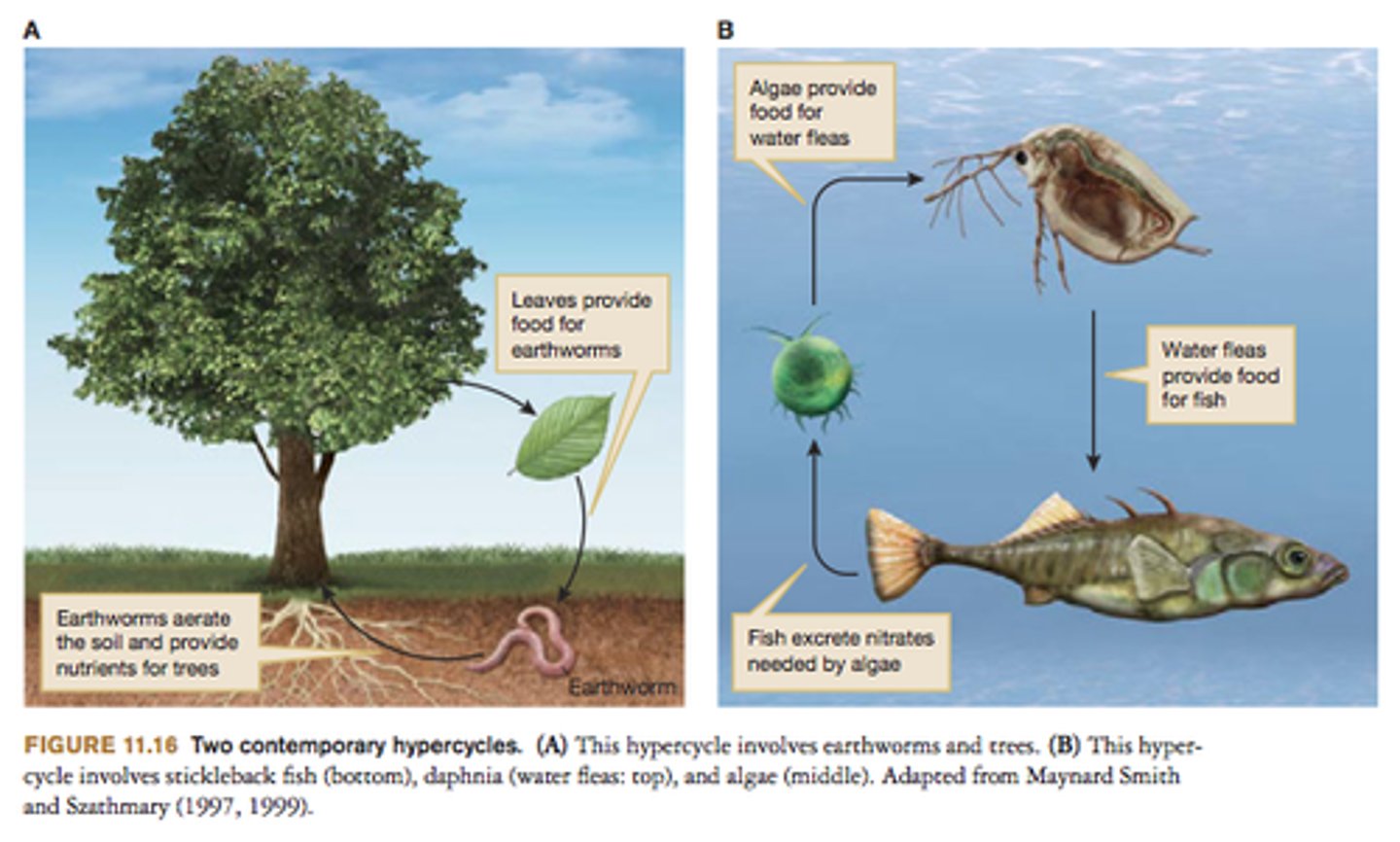
Here is another thought:
- How are food webs in ecosystems constructed as hypercycles?
· Individuals continuously feed/energize each other
- Producers make their own food from sunlight
- Consumers eat producers & other consumers
- Decomposers break down waste/dead matter, providing recycled energy to producers
Why is containment important for building sustained metabolic paths?
· Open systems are inefficient for metabolism bc their reactants can wander off
· Enclosed systems run faster bc their reactants stay in the same place
- More efficient for metabolism = selective advantage
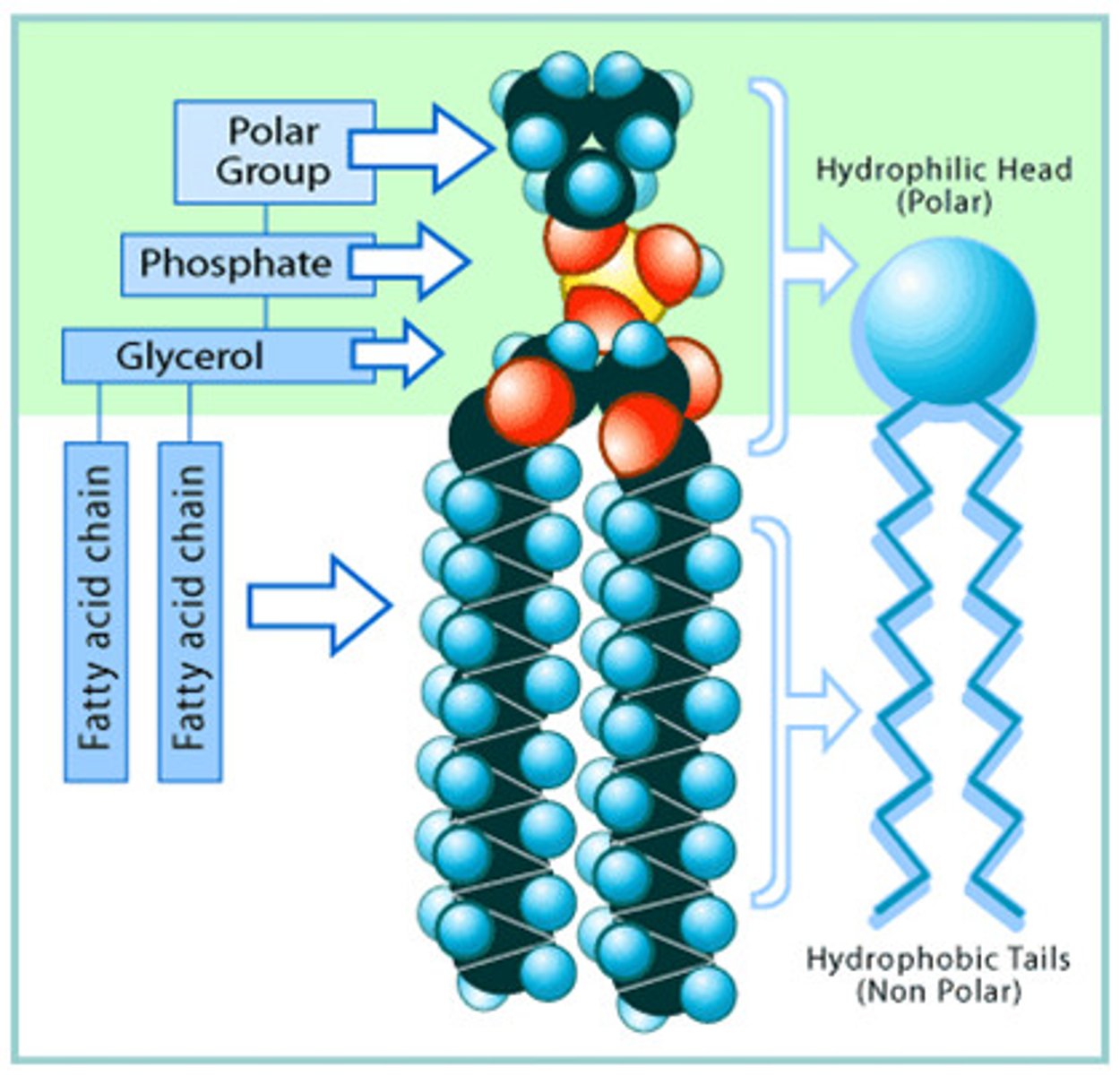
Another possible gift from alkaline vents: 'amphipathic' molecules
What is the basic structure of such molecules?
· Involve chains consisting of one end (i.e., a head) that is polar/charged/water-loving & another end (i.e., a tail) that is nonpolar/water-hating
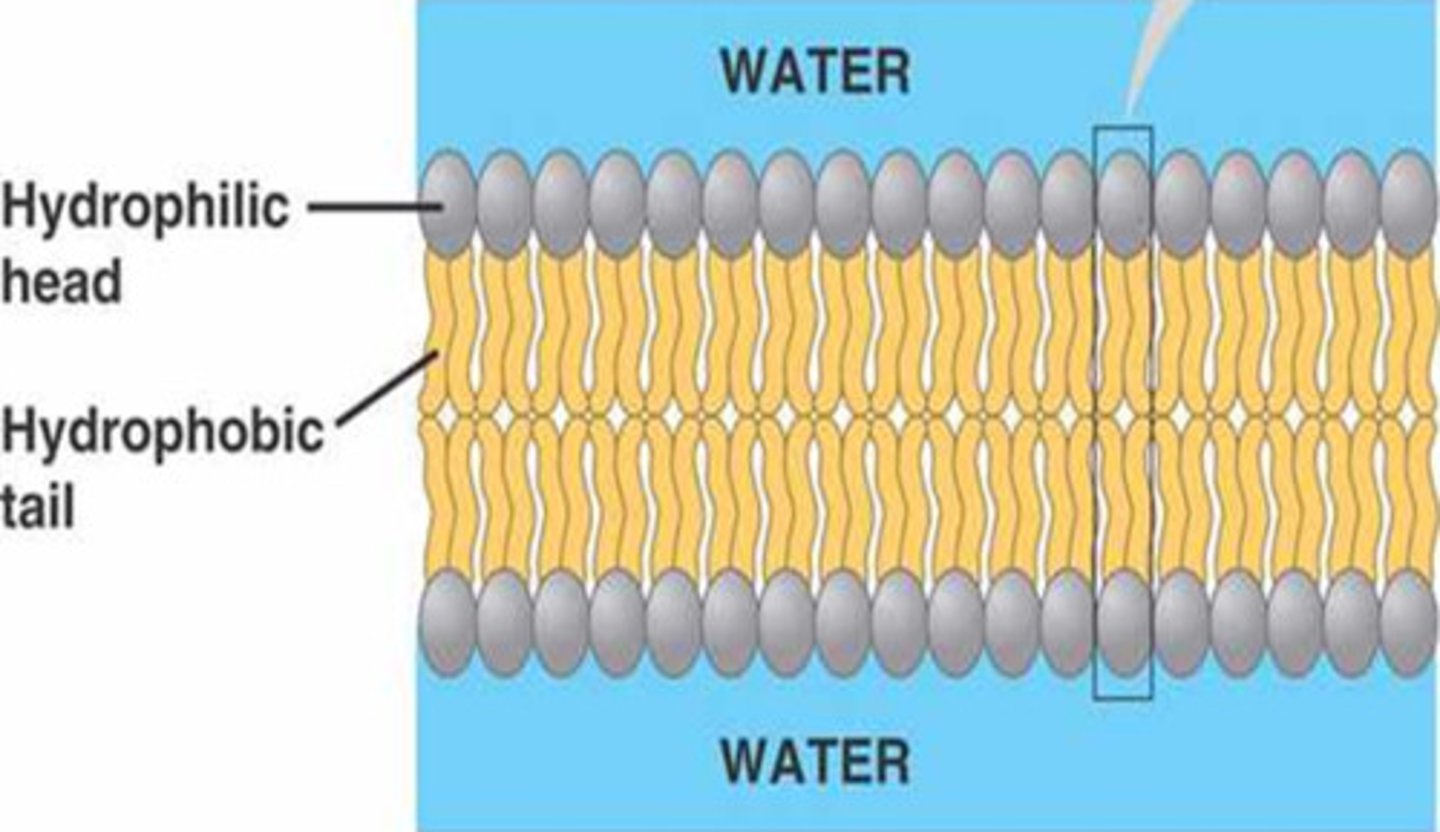
Another possible gift from alkaline vents: 'amphipathic' molecules
What do they do when in water?
· They position themselves with their water-loving/charged heads pointed outward to interact with the water, while their water-hating/nonpolar tails are tucked inward & interacting with themselves
- Fatty acid chain tails face inward
- Polar heads face outward bc they like water
Another possible gift from alkaline vents: 'amphipathic' molecules
Why would these make crude cell membranes?
· Bc such a formation makes it harder for cells to escape while also allowing for a good hypercycle that drops energy more efficiently
Laboratory-made vesicles of a membrane which trap bio-molecules and carry out basic chemical reactions are called .............................
- This term is also used to refer to hypothetical early cells
· Protocells
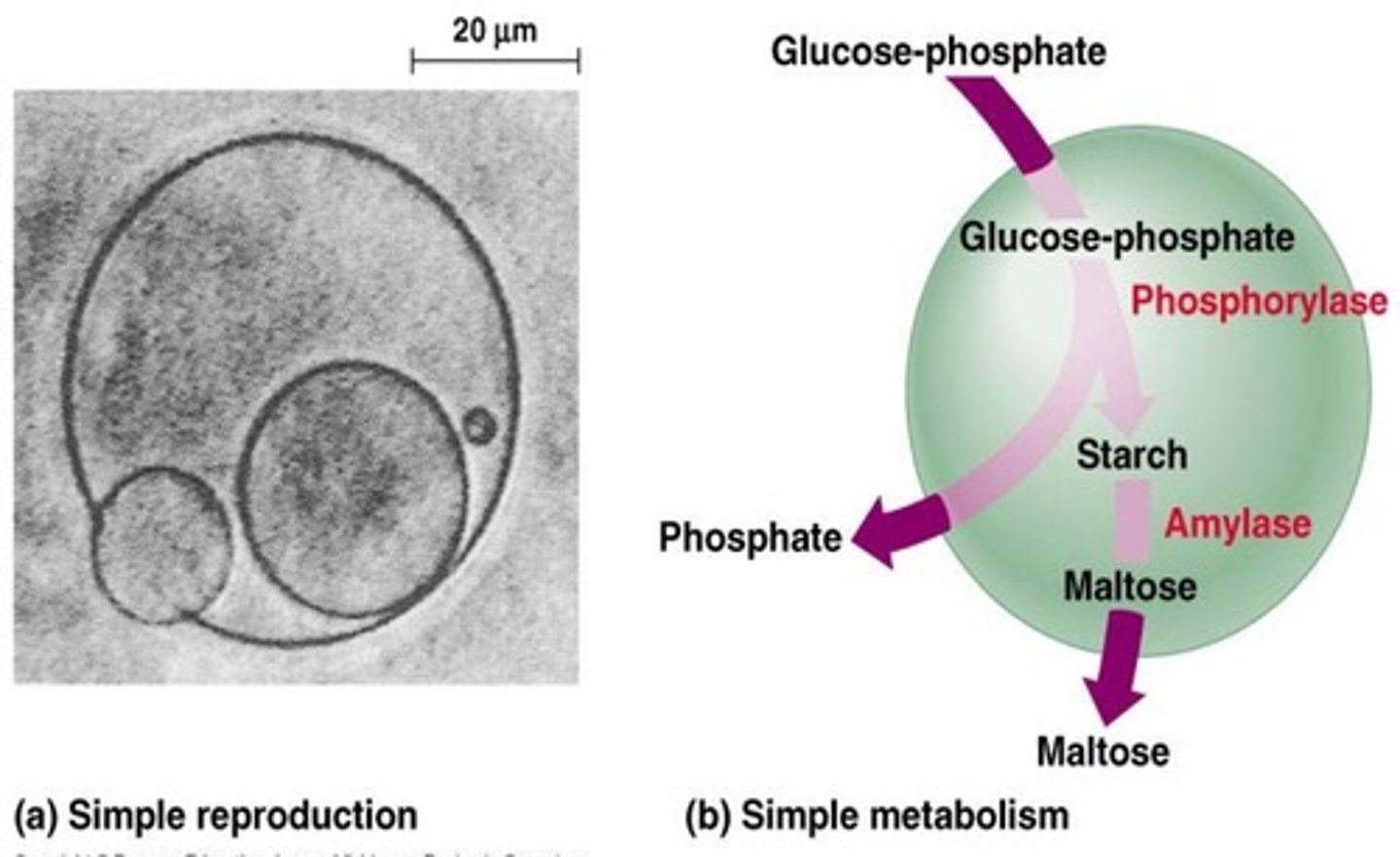
Imagine a scenario where early protocells live in porous alkaline vents
Consider the changes needed in
(a) membranes, (b) supply of H+ gradients & (c) supply of critical molecules like acetyl and pyruvate that would be needed to move out of the increasingly crowded vents
· Those early cells would need to evolve better membranes, electron transport chains, & their own means of making acetyl & pyruvate
- They would need to invent respiration
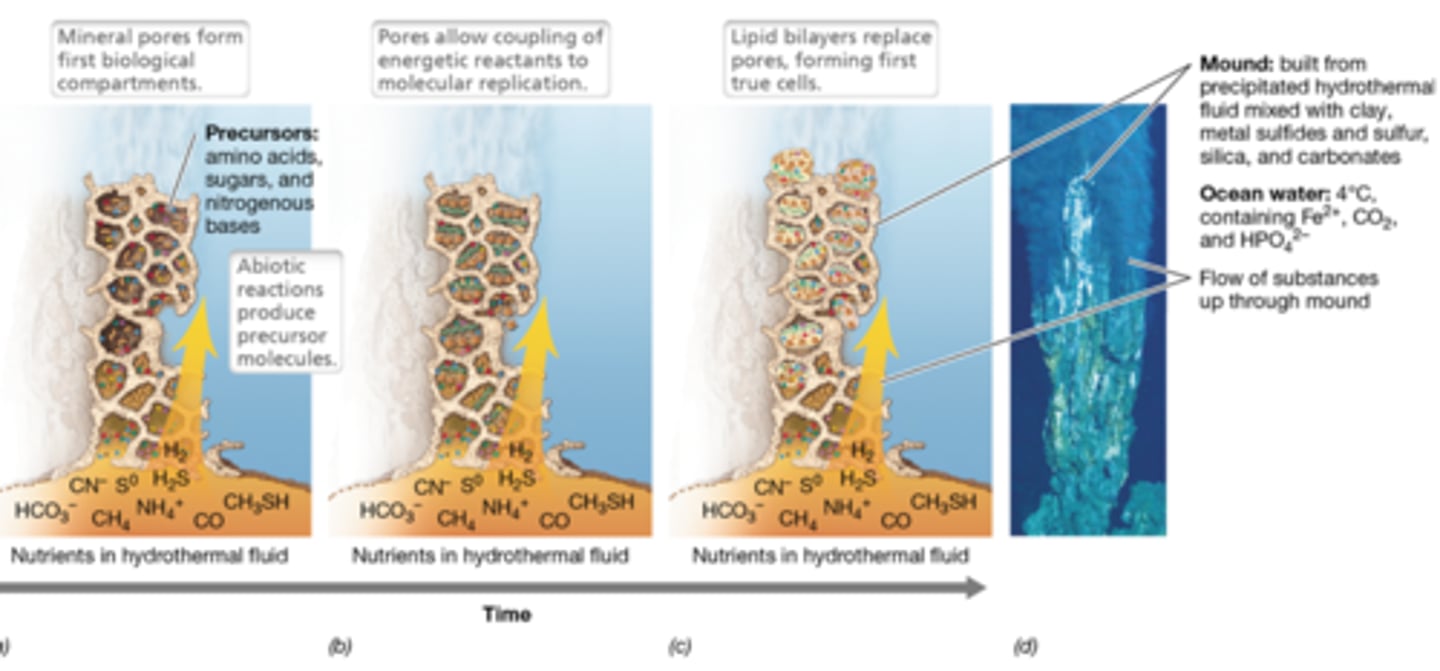
So far, we have seen arguments for how simple metabolic pathways can emerge at alkaline vents (metabolic pathways, containment)
But what else is needed for this transition → life?
· Catalysts
· Building blocks
· Environmental energy
· Polymers
· Heredity (i.e., replicators)
· Natural selection
· Organic precursors
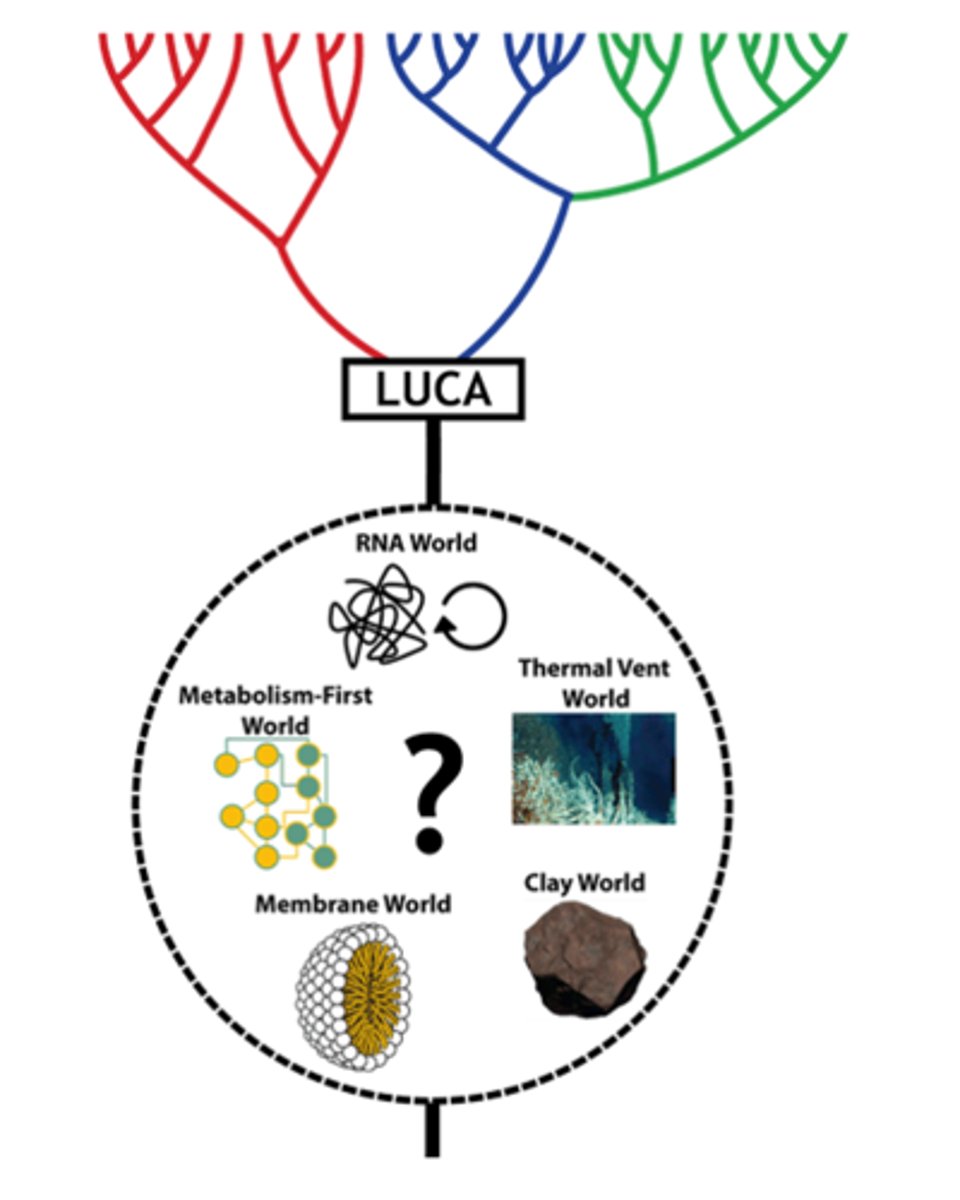
What sorts of environmental factors can cause building blocks to assemble into polymers?
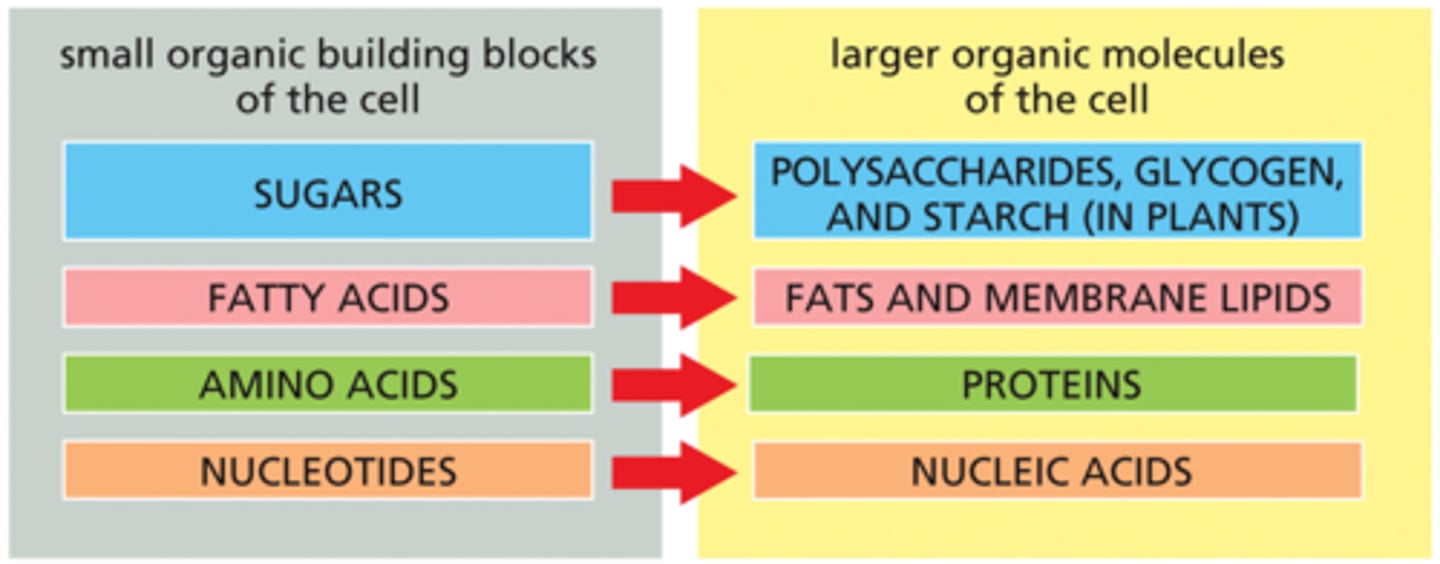
· Mineral/clay surfaces, UV light, & phosphorylated molecules can polymerize organic molecules
What kind of molecule can both store genetic information (meaning, be a 'replicator') and be a catalyst?
- Do cells use these kinds of molecules today?
· RNA molecules can store heredity & act as enzymes = "ribozymes"
· Yes, altho today's cells only use it as a catalyst
· There are many modern RNA ribozymes that could be left over relics of an earlier time when RNA did more than it does today
- Telomere elongation factor ribozyme
- Ribozyme for trimming tRNA
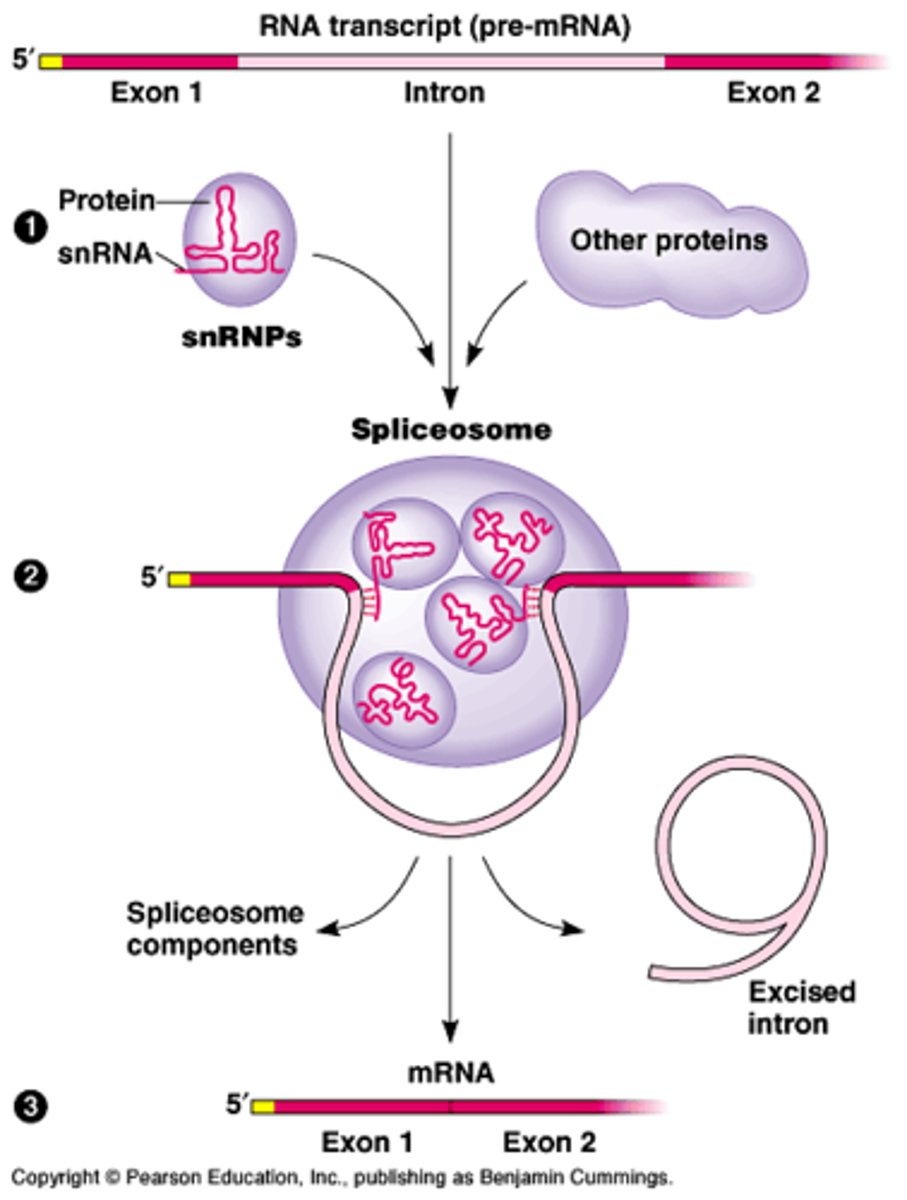
- Ribozyme for splicing mRNA introns & attaching exons together
- Ribozyme in ribosomes that catalyzes peptide bond formation during translation
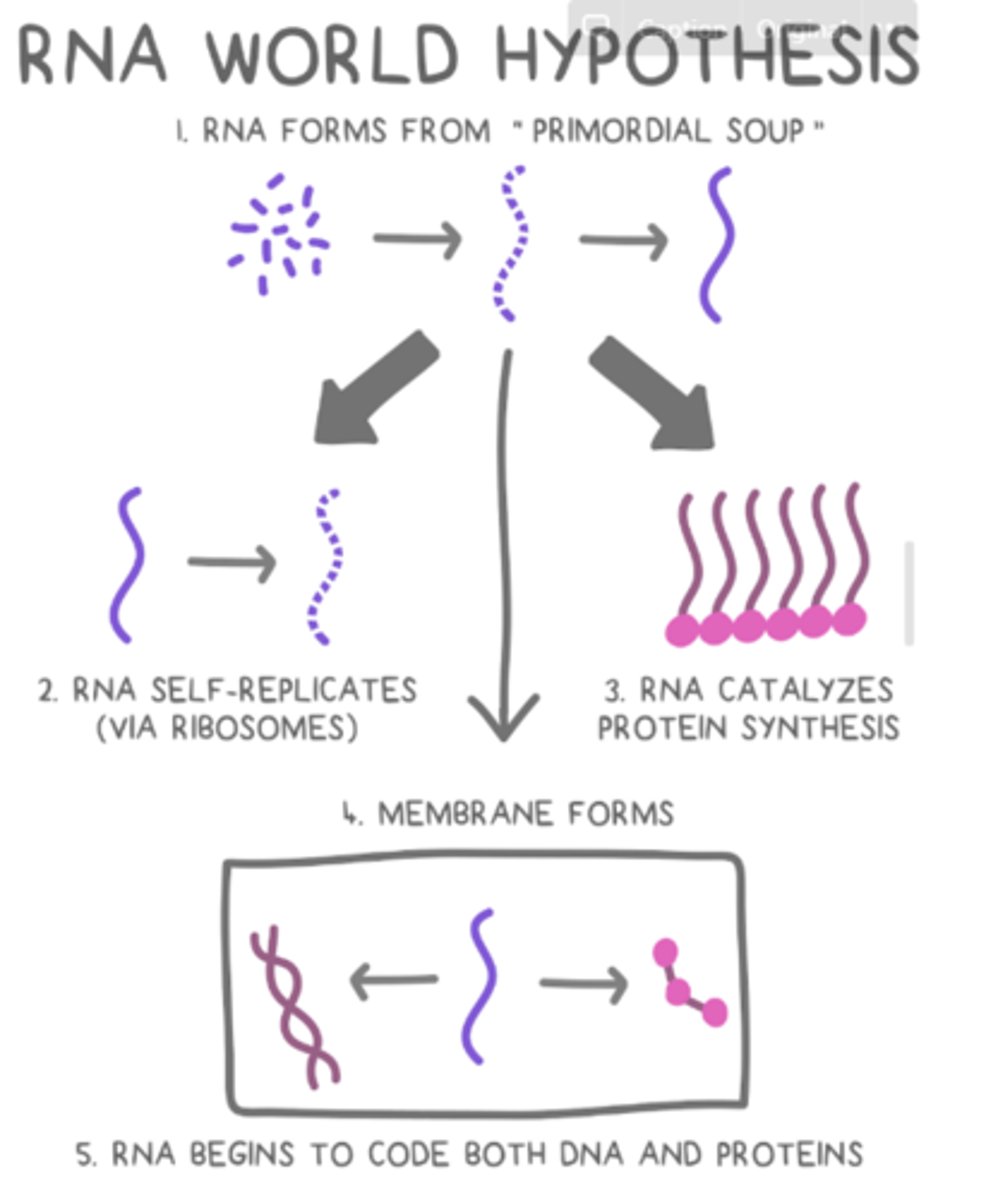
The hypothetical time on an early earth in which the first life forms were based on RNA molecules (& not DNA) is known as ..................................
· RNA World
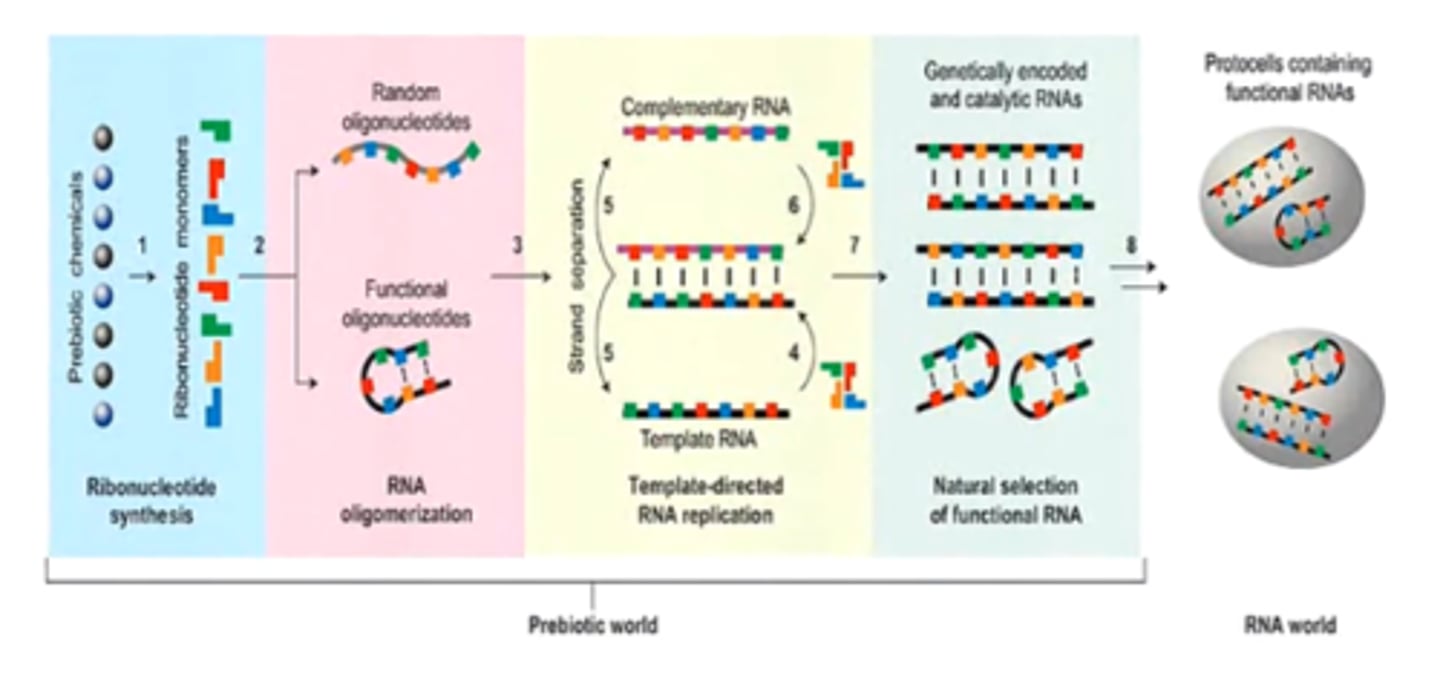
The old-fashioned (overly optimistic) version of the RNA World is where...
· The first life forms were self-replicating RNA molecules
- RNA uses itself as a template to make more RNA
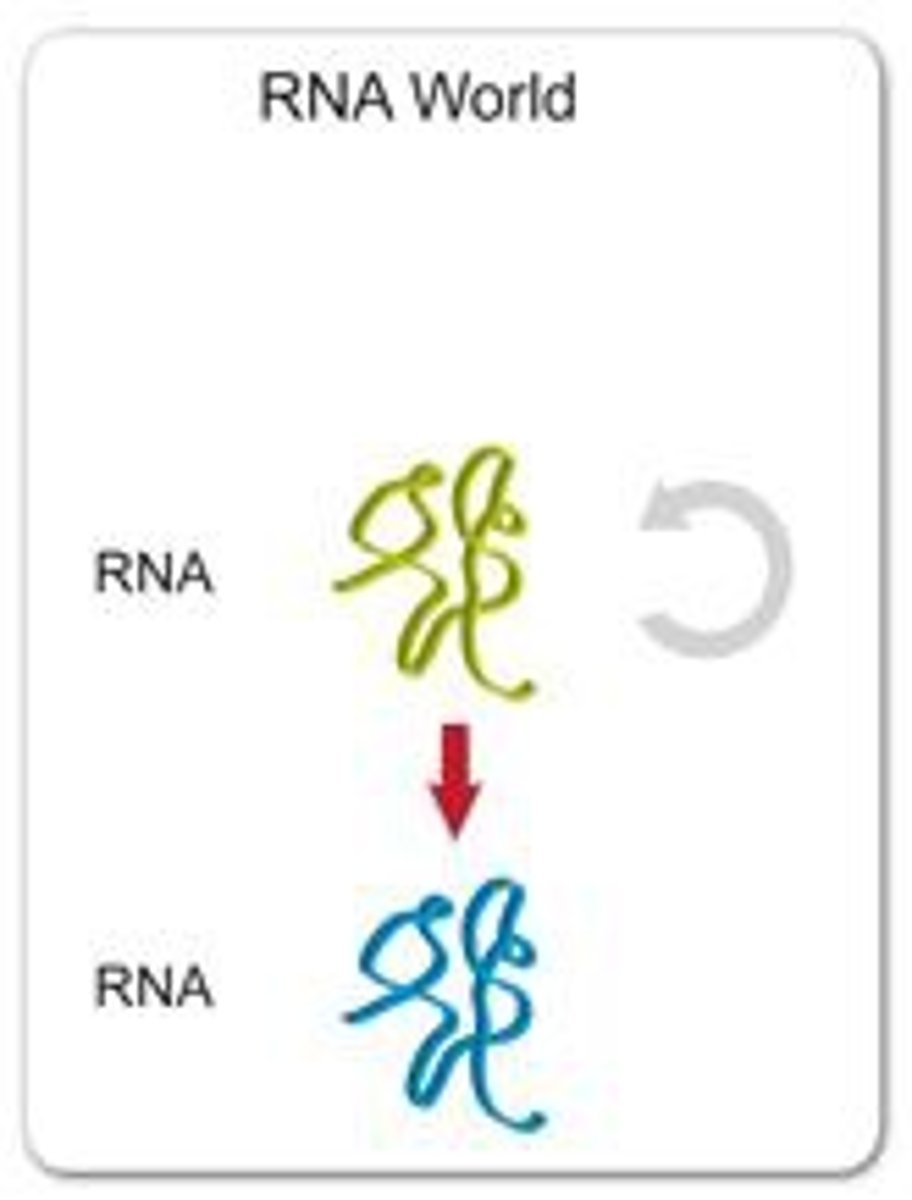
If you see a text illustration that shows RNA molecules fully 'self-replicating', or fully replicating other RNA molecules, are you being shown an image that has ever been demonstrated in laboratory experiments?
· No
- When recreating the RNA World scenario in the lab, researchers found that RNA does not really copy itself
o It either only ligates RNA or extends short stretches of RNA
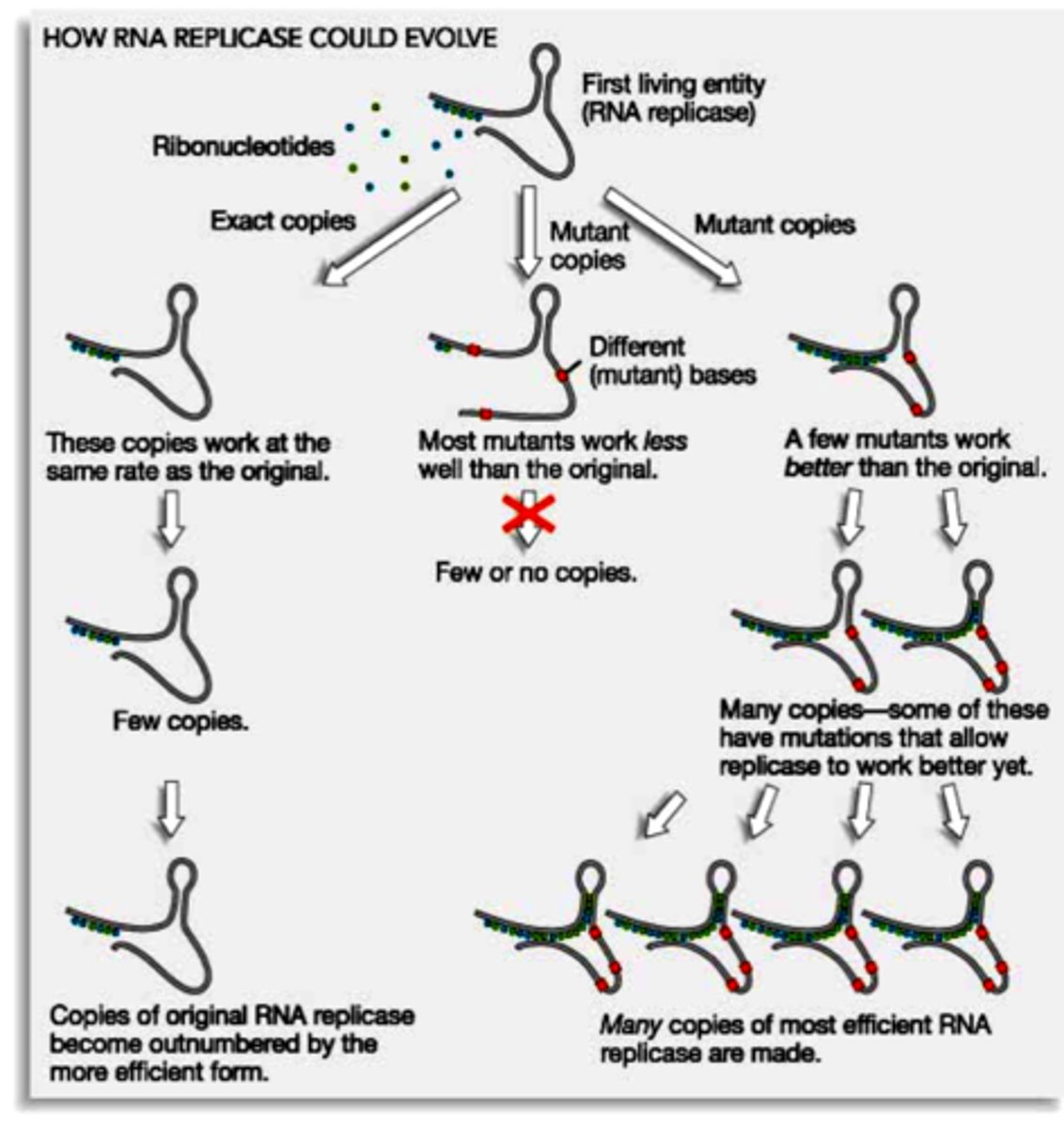
Why can't RNA fully replicate an RNA molecule?
- When RNA is used to make longer RNA, is the mutation rate high or low?
· RNA can't make full-length strands of itself bc it tends to make lots of mistakes during replication
- Mostly deleterious
· Such RNA enzymes have a higher rate of mutation
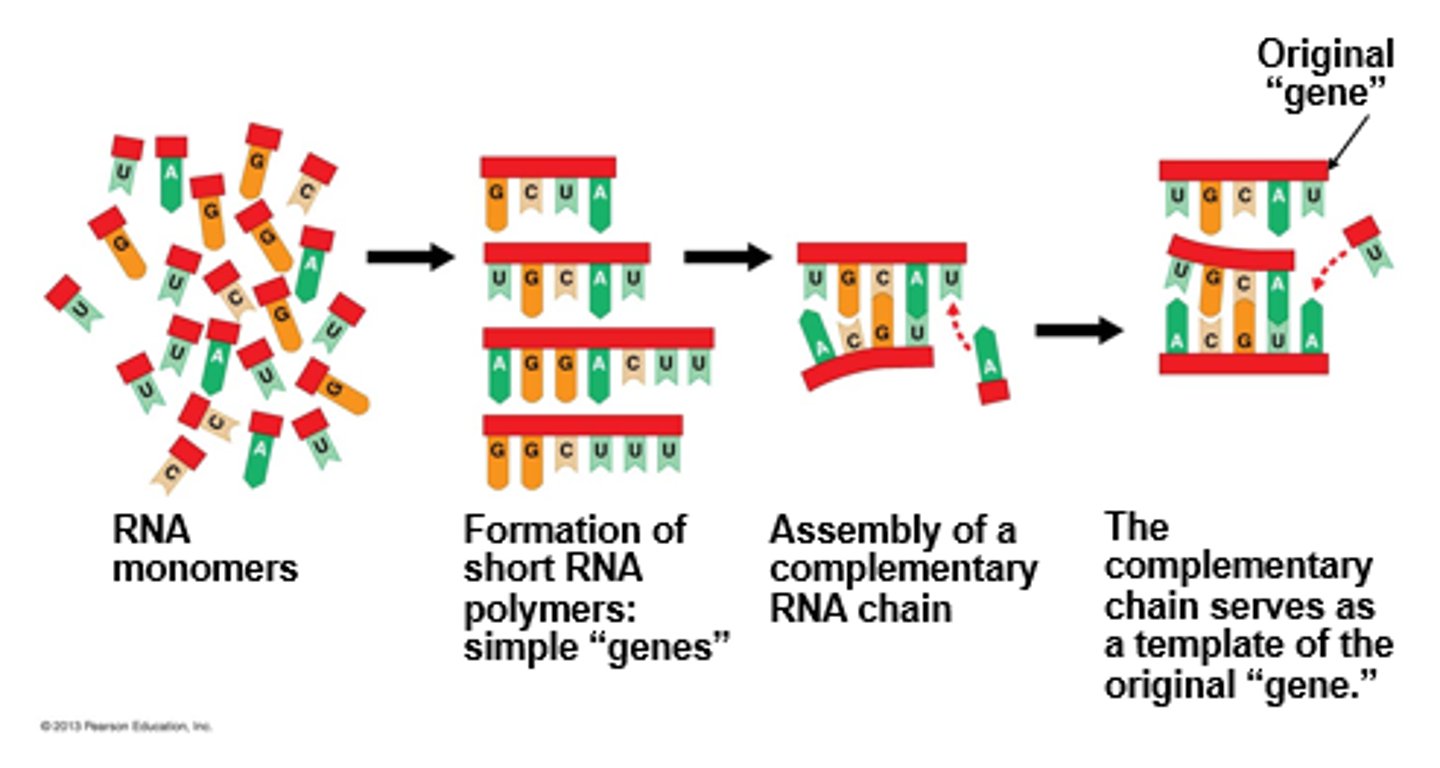
More recent, less 'extreme' versions of the RNA world have RNA being helped by what other big molecule?
· Proteins
- RNA makes proteins that can make better enzymes
- In interdependent partnerships, some proteins even make RNA using an RNA template
o RNA polymerases
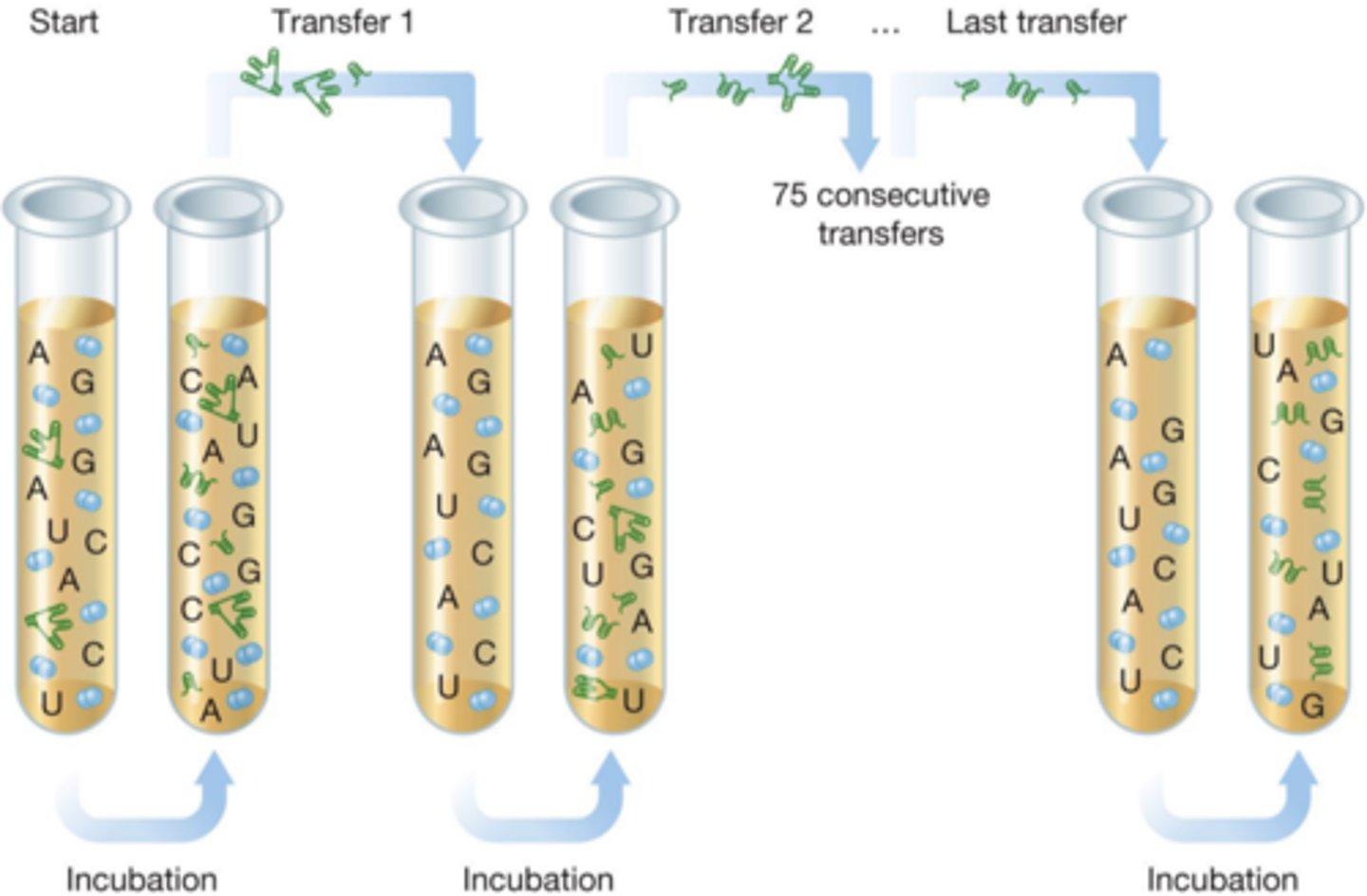
Summarize the 'Spiegelman's' Monster' experiment
In what way does this show plausible 'organic evolution' that parallels natural selection?
- Be sure to understand the outcome of this experiment
- But don't exaggerate
· Shows the evolution of RNA synthesis using proteins
· Random pieces of RNA were placed in a test tube
- Long, short, & medium RNAs were made
- Those synthesized RNAs were transferred to another test tube with nucleotides/enzymes added
- This was done repeatedly
· Medium RNAs were more fit = better at copying themselves
- Long RNAs were not given enough time to get made
- Short RNAs did not fit together bc the enzyme couldn't hang onto them
Much of the above could be processes that emerged together, in parallel
Of the 3 big molecules (Proteins, RNA, and DNA), which of these likely evolved last?
· DNA
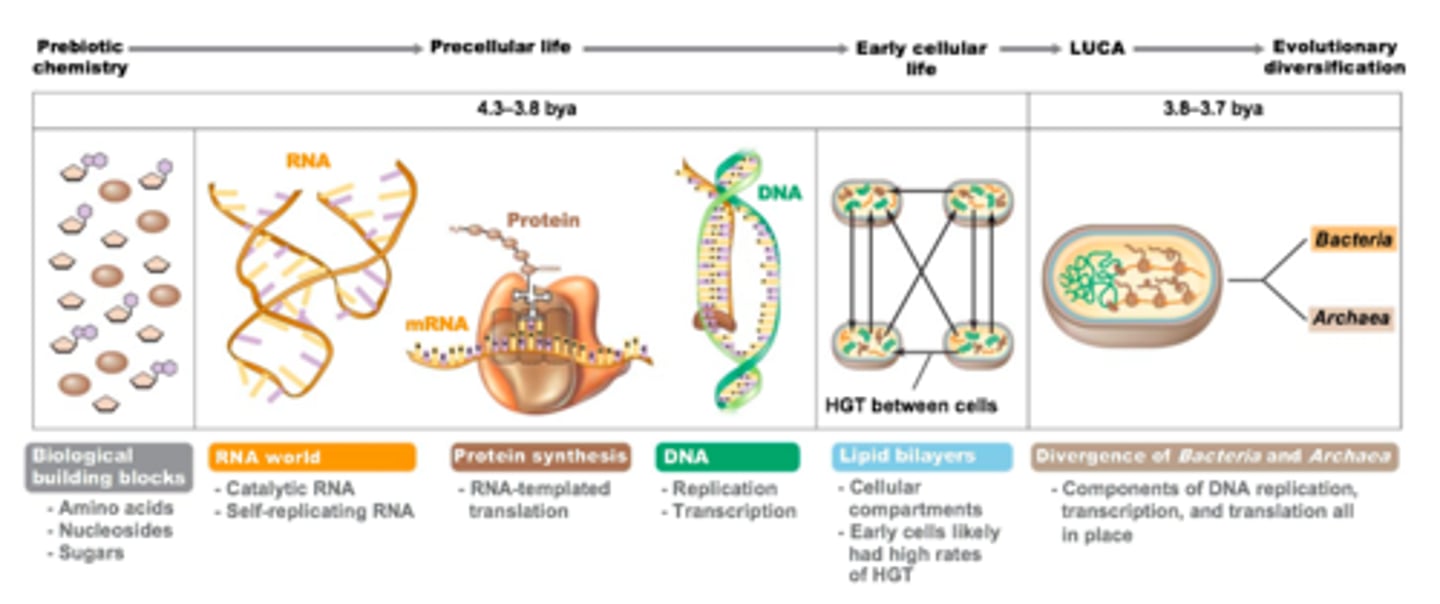
Why do we expect that RNA came before DNA?
· Bc RNA stores info & acts as a catalyst
- Modern RNA ribozymes might be left over relics of an RNA World
- In the past, RNA might have been simpler with fewer components needed for replication
· But RNA makes a lot of mistakes during its replication, whereas proteins make better enzymes
- Some RNAs make proteins
- Some of those proteins like RNA Polymerases are used to make RNA with the help of RNA templates
- Reverse transcriptases are simple proteins that use:
o RNA templates to make DNA
o RNA to make more RNA
o DNA to make more DNA
· DNA is more stable (less reactive) & its replication has a lower mutation rate
- It doesn't get broken down as easily
- Once good info is obtained, a system won't want to lose it
- It doesn't really do anything with all the genetic info it stores
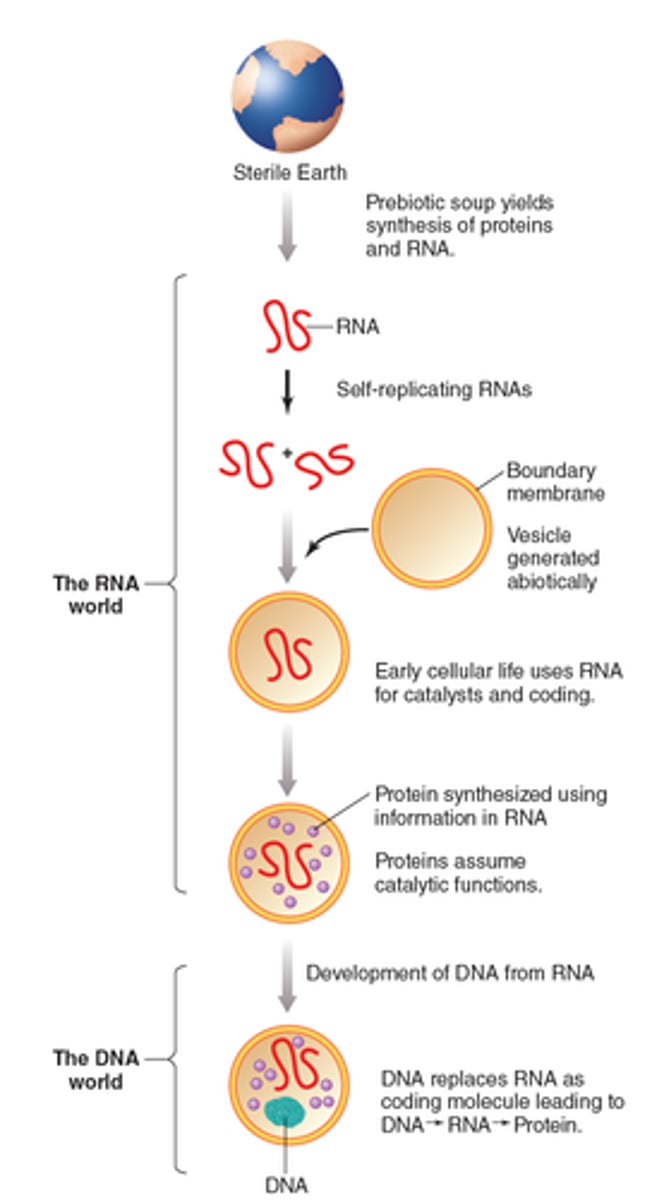
What is 'versatile' about reverse transcriptase proteins?
How could it be a part of the earlier RNA world, and be a harbinger of the 'DNA world'?
- That is the world we are in now
· They are enzymes that can use RNA templates to make DNA & more RNA; they can also use DNA to make more DNA
· Such simple enzymes could have already existed when cells were first starting to form
· They could have been used in the earlier RNA World to create the first segments of DNA
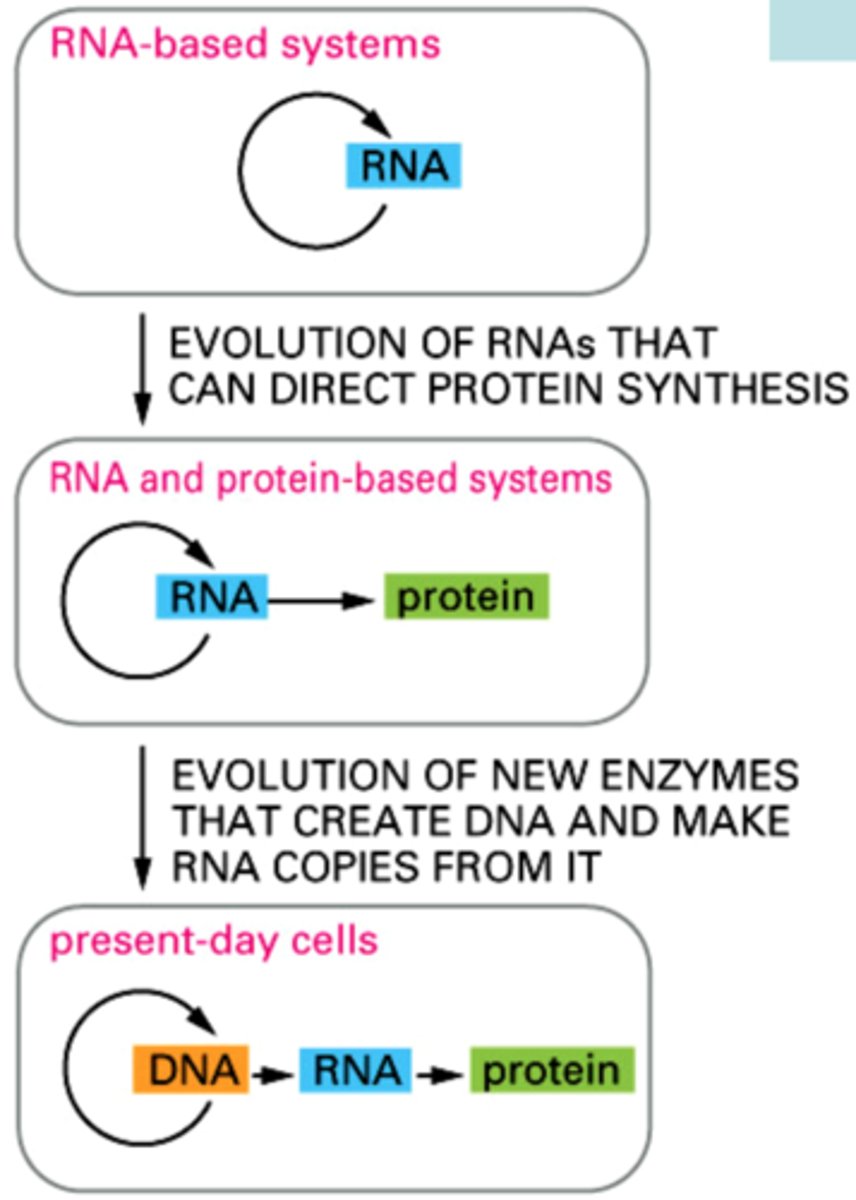
What three sorts of things could communities of the earliest simple life forms do to build the complexity of their metabolic pathways?
- These kinds of things also occur today, btw
· Gene duplications build families of homologous genes
- The duplicated gene becomes redundant & is free to become mutated
- Sometimes mutations change the gene only a little bit
- Diff kinds of genes that are clearly related/similar but have proteins that do slightly diff things are created from such mutations
· Retrograde evolution
- New steps of a metabolic pathway evolve by working the process backwards
- Last step = most primitive = been around the longest
o Pyruvate
- First step = most recently evolved = derived = been around for a smaller amount of time
o Glucose
· Horizontal/Lateral gene transfer allows organisms to pick up genes from other organisms
- Microbes pick up & use DNA from other microbes
- This can happen across species
Building a linear metabolic pathway 'backwards' from later steps → earlier steps is called .....................................
· Retrograde Evolution
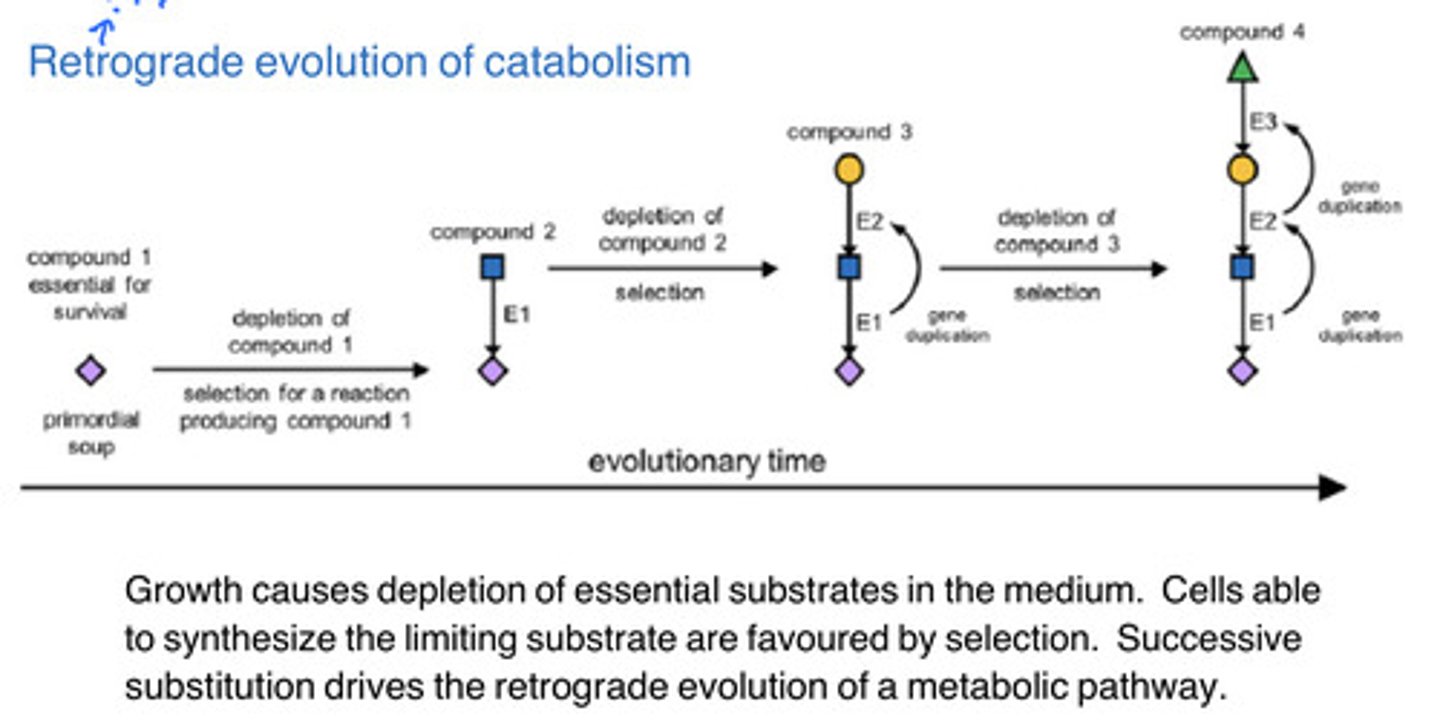
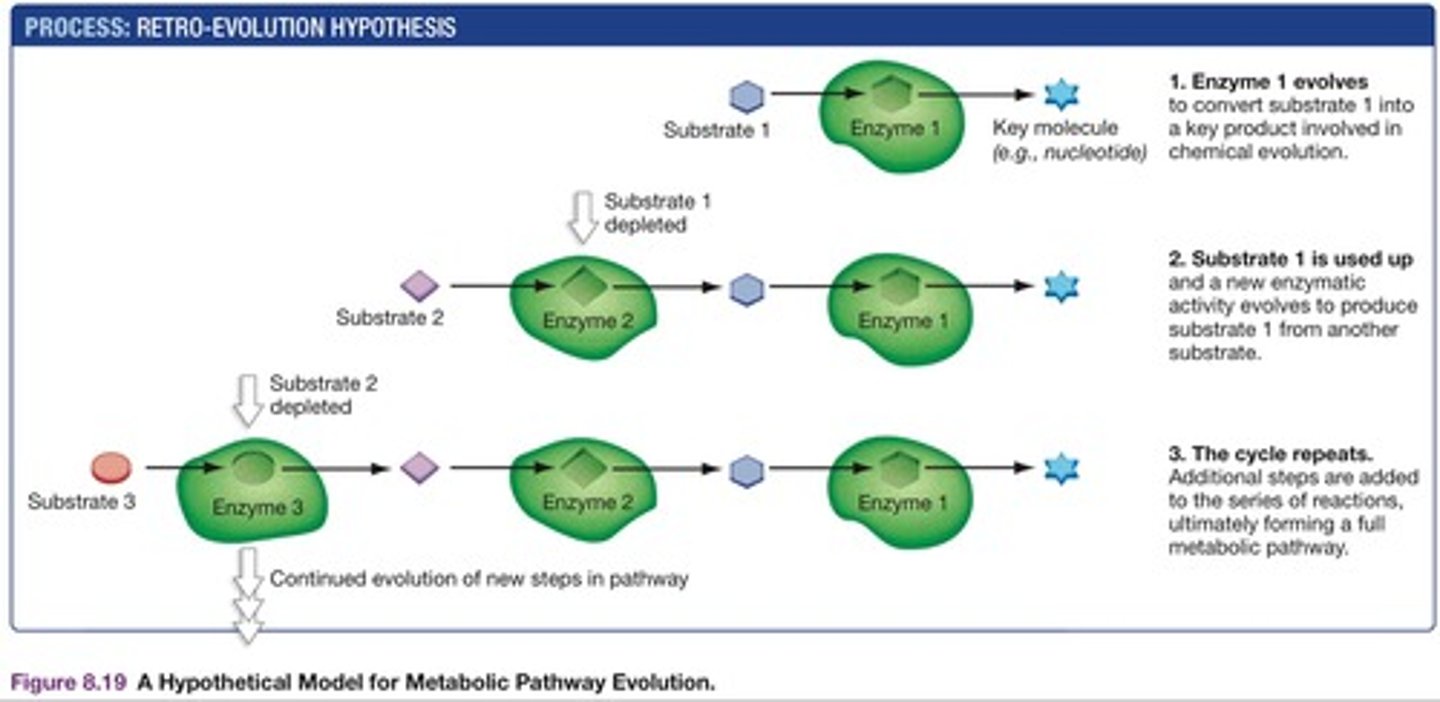
Given a linear metabolic pathway, with beginning and final steps in the pathway, be able to tell me which steps would have evolved 1st, and which would have evolved last (more recently), according to this particular view of how pathways evolve
· Earlier steps evolve last as an adaptation to replenish later steps
· Last = primitive = evolved first = been around the longest
- Pyruvate
· First = recently evolved = derived = evolved last = been around for a smaller amount of time
- Glucose
What is the other way that cells acquire new components to metabolic pathways, or even large portions of pathways all at once?
· Horizontal/Lateral gene transfer can be done across diff species
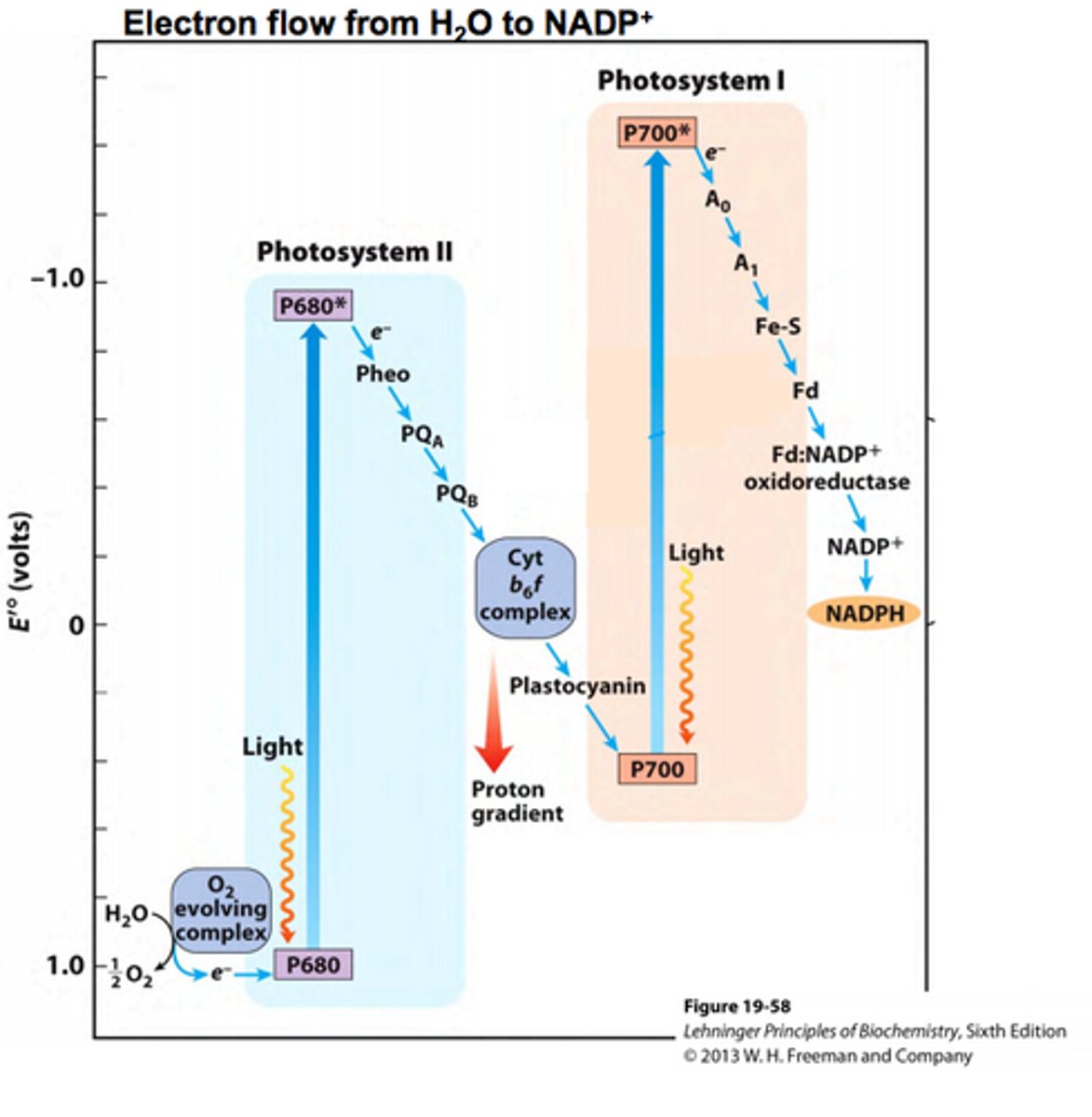
Are metabolic pathways today seen as being 'cobbled together' bits and pieces of other pathways?
· Yes
- Wholesale HGT betw species
o Cyanobacteria have both types of Z-schemes (produces O₂)
~ Could have started out with 1 type, then acquired the other from another species of photosynthetic bacteria
- Retrograde evolution
o There is a large middle part of glycolysis that takes place during respiration
~ The same steps/enzymes can be found in the Calvin cycle, but it's reversed
An early chemical (and not real 'fossil') signs of life in the geological record include an even more skewed ¹²C / ¹³C ratio in carbon particles in ancient sedimentary rocks
- Compare the isotope ratio in concentrated carbon from non-biological sources (like volcanic vents)
How is this ratio different in carbon-rich material made from carbon 'fixed' by life?
· Abiotic sources of carbon like volcanic vents have a ratio of 99 carbon-12: 1 carbon-13
· A signature of life is a much lower concentration of carbon-13
- Living things that absorb carbon like photosynthetic bacteria prefer carbon-12
· Sedimentary rocks contain a lot of graphite (pure carbon)
- Finding a lot of carbon-12 in a patch of soil signifies organic beings like microbes left it behind
- The presence of life changes the balance of carbon
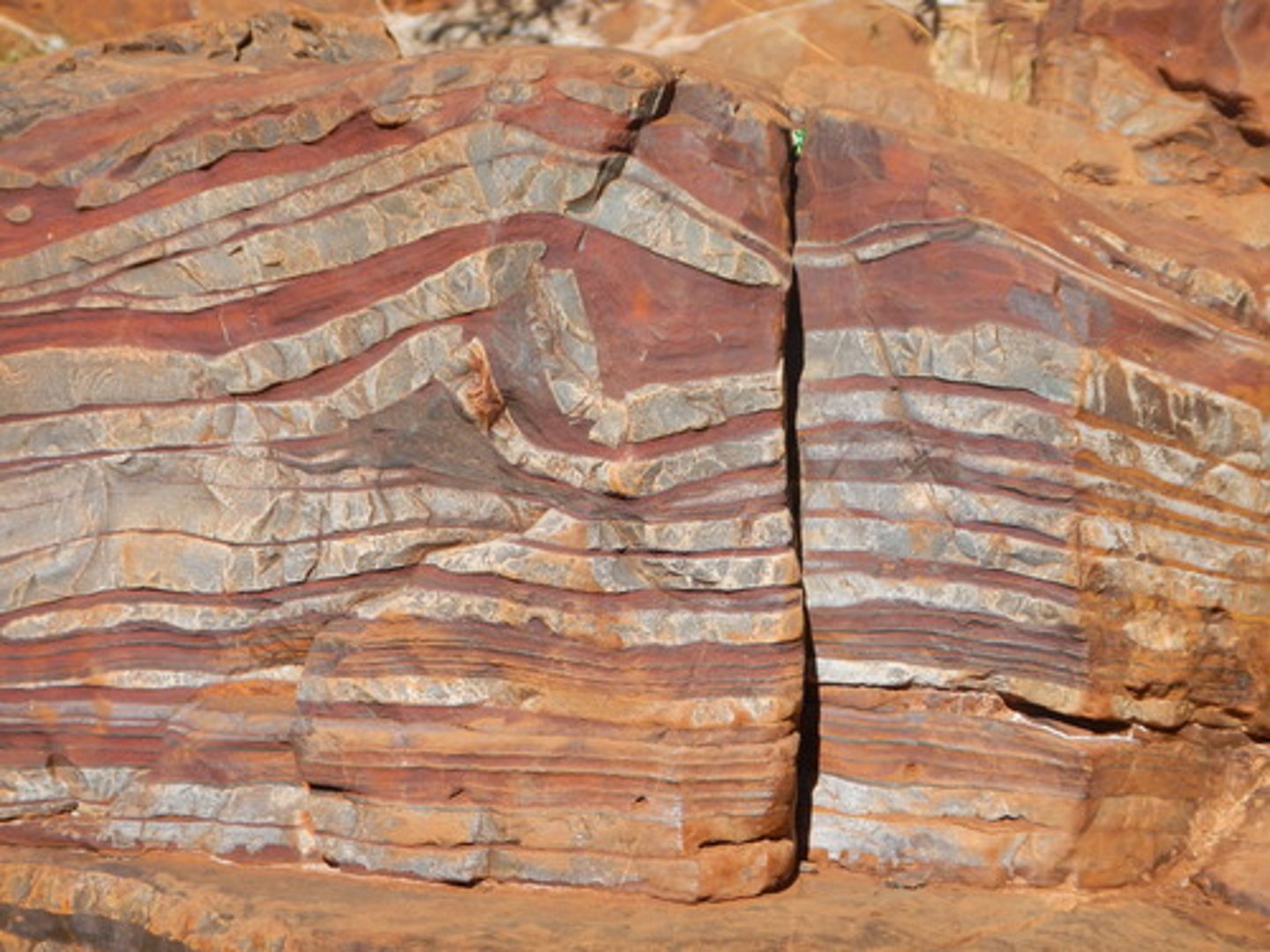
Worldwide deposits of ancient iron ore called banded iron also represent a chemical signature for life
What is banded iron?
- These formations indicated the advent of what specific metabolic pathway?
· Ancient sedimentary rocks with intermittent layers of rust, which holds a lot of oxygen
- O₂ from photosynthesis + dissolved FeO → precipitate as Fe₂O₃ → rust
· Oxygenic photosynthesis / Aerobic respiration
- We mine for that which precipitated out of the oceans via oxygenic photosynthesis
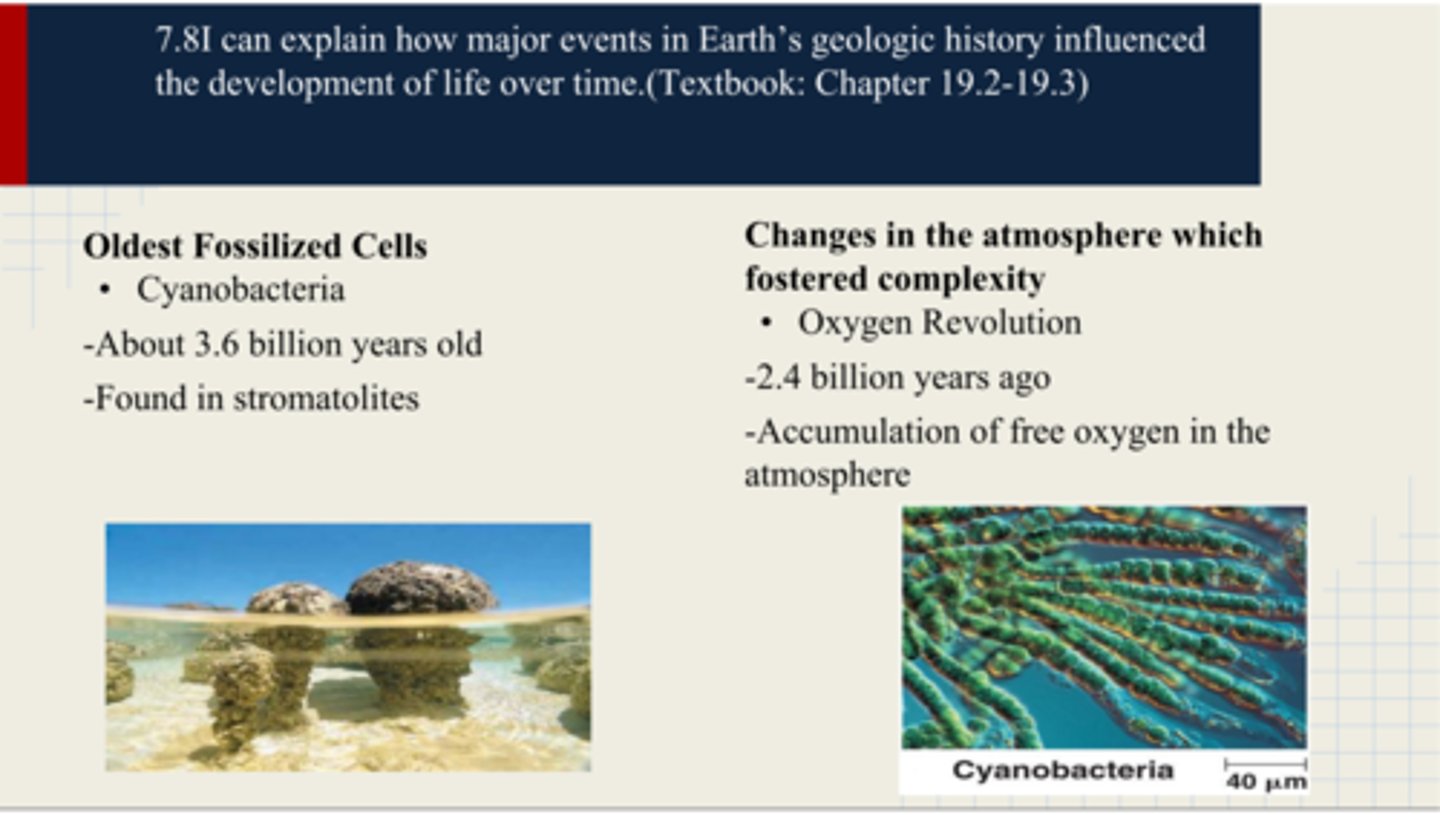
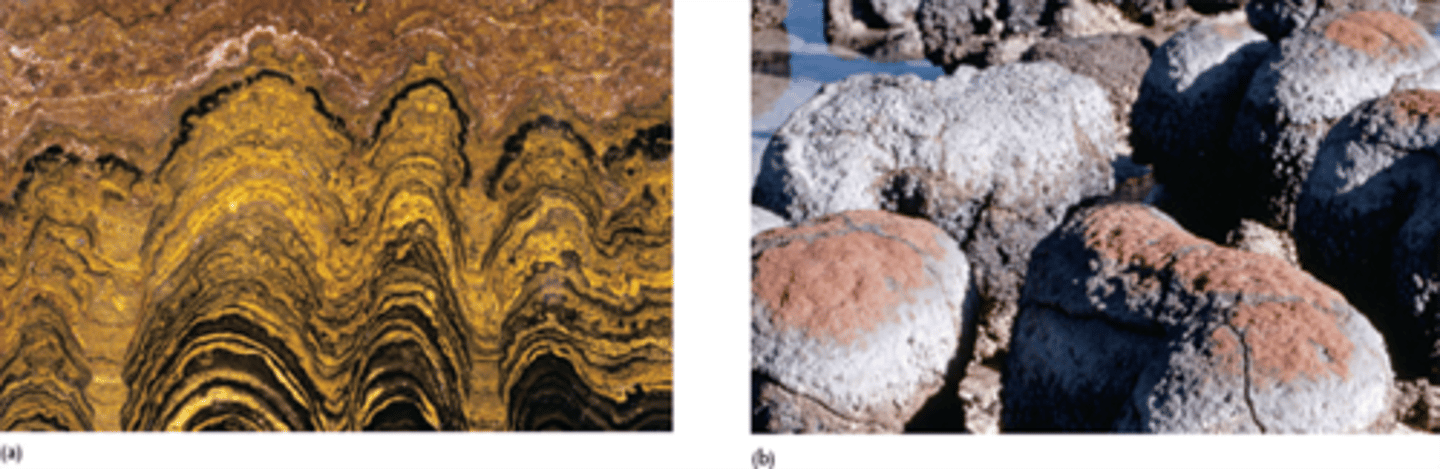
What are stromatolites and how do they figure into the early fossil record of life?
· Mounds of rare bacterial communities that include photosynthetic bacteria
- Ancient bacteria form their own communities that attract sediments, creating slimy mounds of themselves
- They have a distinctive rounded shape
- Cutting them open (illegal) lets u see the diff-colored/aged layers
- Oldest possible fossils = about 3.4 billion yrs old
· Lots of them are found in Australia, especially at Pelican Bay, which is isolated from the open ocean
- Ancient bacteria were able to live there without getting eaten
- They are found on every continent
- These structures stopped forming in open areas that had obvious signs of life
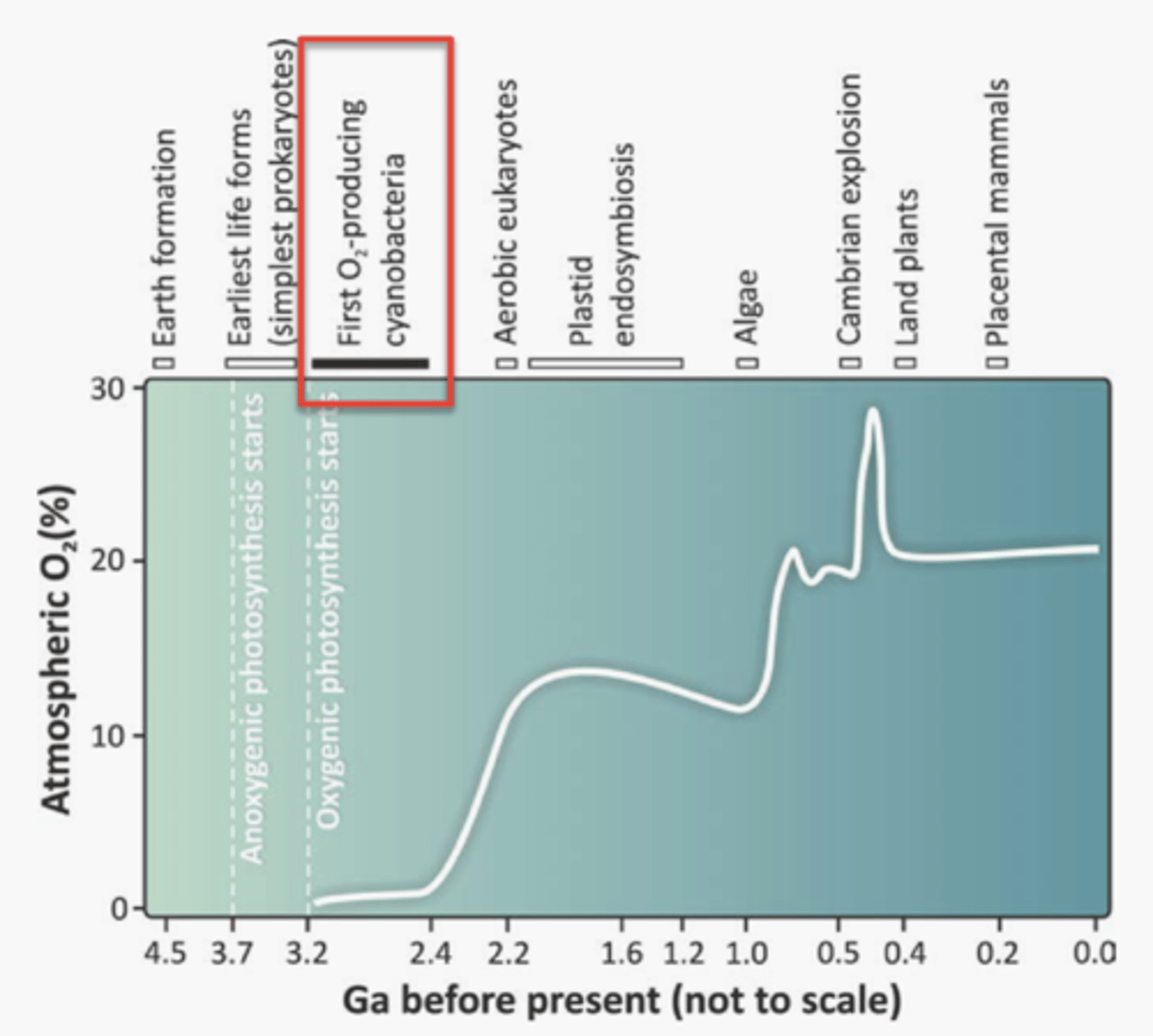
What caused the great oxygenation event?
What delayed this event?
- It would have happened earlier were it not for...(?)
The addition of oxygen to atmospheric and oceanic chemistry caused some crises for a time
- One described here was that ......................................................................
· The early oceans/atmosphere began to oxygenate via oxygenic photosynthesis
· Oxygen being captured/absorbed by iron delayed this crisis
· Microbes that evolved without O₂ were "killed"
- Only the microbes that could tolerate oxygen & its toxicity survived
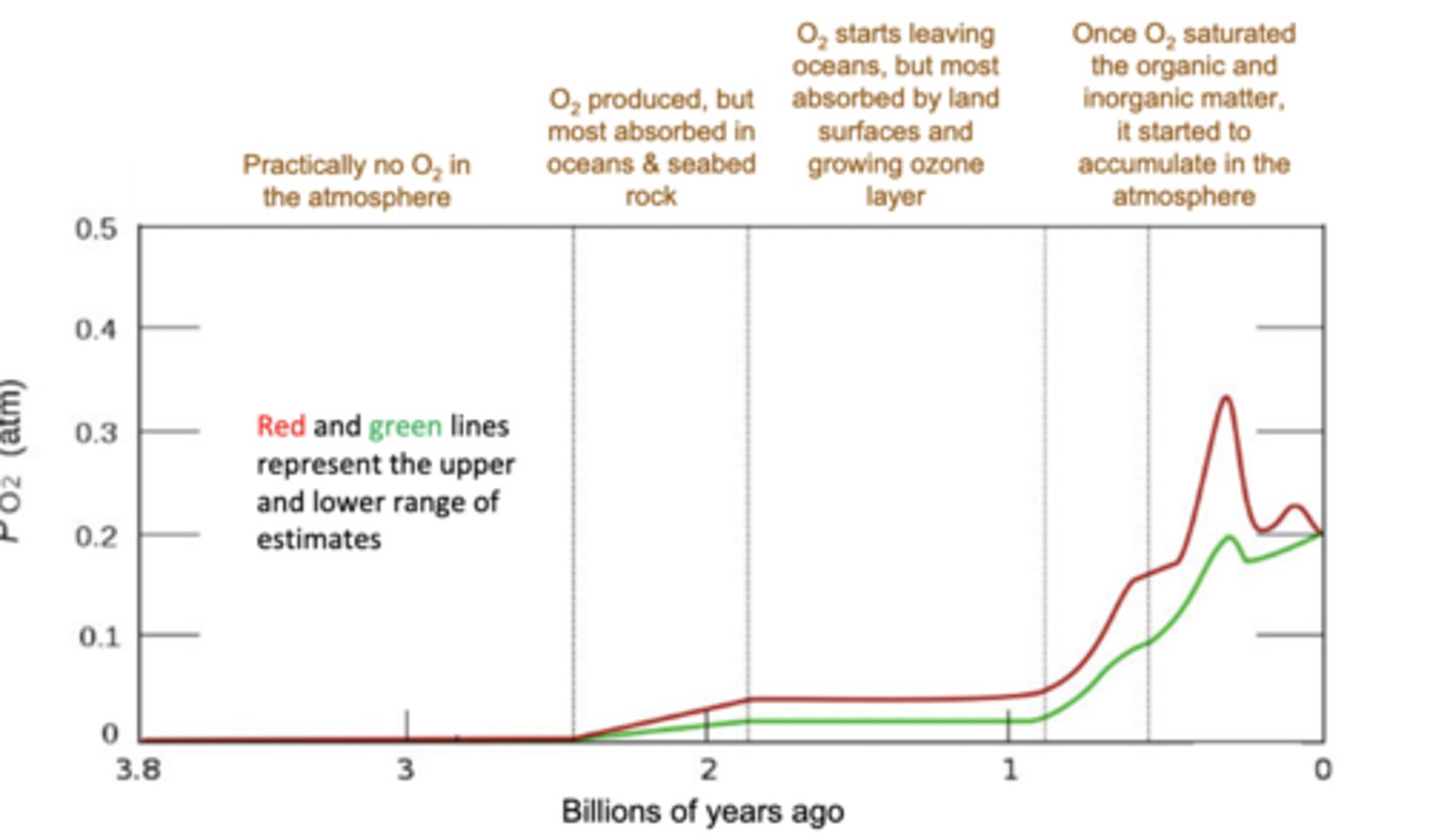
Besides various crises, oxygenation also lead to what extraordinary opportunity?
· Using O₂ in metabolic pathways
- Evolution of aerobic respiration
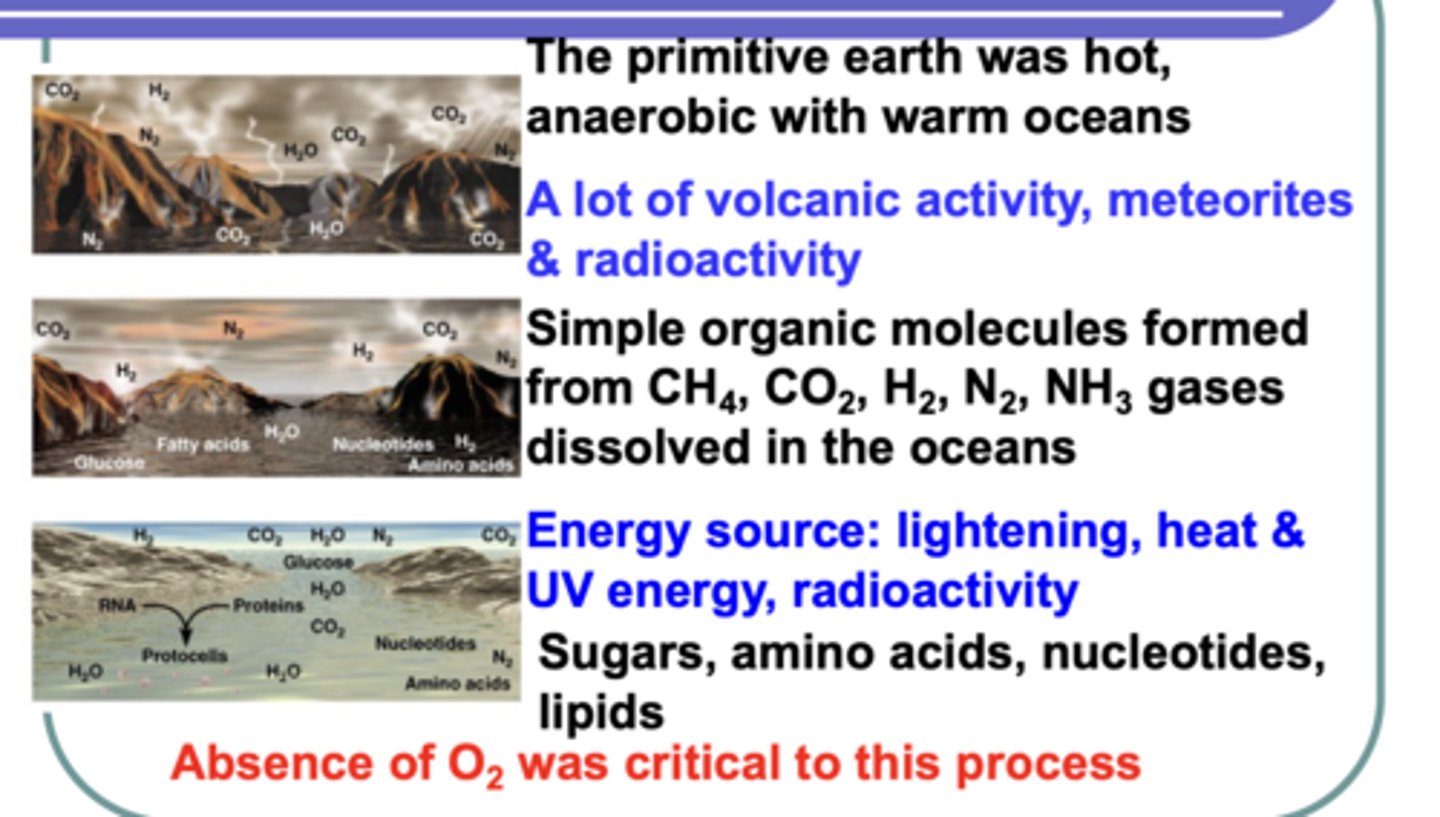
Why would it be hard for life to get started on earth now?
There are 2 major challenges for abiotic → biotic evolution on earth today
- What are the 2 challenges?
· Earth's chemistry is diff
- There's much more oxygen (even deep in the ocean)
o Oxygen is toxic in the early stages of life's development bc it breaks down organic molecules
· Life already exists everywhere
- Seemingly barren environments are chock full of modern bacteria/archaea
o Their ancestors left alkaline vents, then returned millions of yrs later & repopulated inside, kicking out any other microbial residents
- Simpler/newer forms of life will most likely be overpowered/devoured by more evolved/adapted current lifeforms
Explore top notes

