intro to political psychology final
 Studied by 0 people
 Call Kai
 Learn
Learn Practice Test
 Spaced Repetition
 Match
Match Flashcards
 Knowt Play
 Podcast
1/103

There's no tags or description
Looks like no tags are added yet.
Name | Mastery | Learn | Test | Matching | Spaced | Call with Kai |
|---|
No analytics yet
Send a link to your students to track their progress
104 Terms
how common is belief in conspiracy theories in the United States?
public agreement with each of these conspiracy theories is a minority position, but some of the minorities are considerable (up to around 25%).
however, over 55% of respondents agreed with at least one of the conspiracy theory items.
only 12% of respondents endorsed three or more conspiracies.
response patterns suggest that some conspiracy items are highly correlated with ideology (“ideological conspiracies”)
Liberal: Iraq War, Truther
Conservative: Birther, Soros
but others (“general conspiracies”) were not nearly so ideological
financial Crisis, CFLB, ChemTrails
liberals / conservatives are more likely to believe liberal / conservative ideological conspiracies
no strong relationship between ideology and belief in general conspiracies
who believes conspiracy theories?
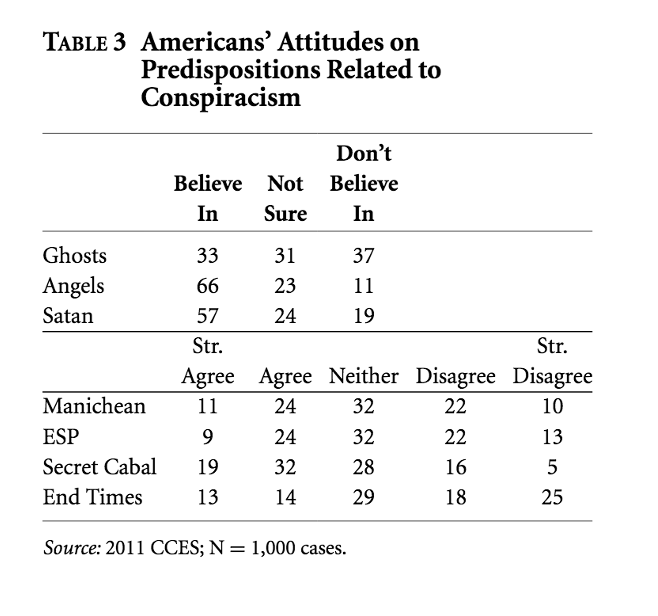
Biggest predictors, by far, are high scores on the Manichean, End Times, Secret Cabal, and Paranormal belief scales.
The End Times variable is the strongest; despite the correlation between conservatism and religiosity, people high on the End Times scale often believe many or all of the conspiracies, even the “liberal” ones.
Members of disempowered groups have somewhat higher propensities toward conspiracy theory beliefs (low education individuals, African Americans)
Some variables are surprisingly unrelated to belief in conspiracy theories (interpersonal trust, political efficacy, authoritarianism)
what happened in the “labeling something a conspiracy theory” experiment?
Does calling something a “conspiracy theory” change belief?
Experiment 1:
150 participants rated speculative/historical conspiracies.
Labeled as “ideas” vs. “conspiracy theories.”
No effect of label.
Experiment 2:
802 participants read a fake Canadian scandal article.
Headline: “corruption allegations” vs. “conspiracy theories.”
No effect of label (even across GCB scores).
Conclusion:
Labeling something a “conspiracy theory” did not change credibility.
Likely because the term isn’t strongly stigmatizing or influential.
have encountered the label before and have become numb to it
People may believe in conspiracy theories because of motivated cognition; the motivation may be stronger than whatever stigma is associated with the label
what happened in the “morality and conspiracy theorizing” experiment?
Do people believe conspiracy theories because they themselves would be willing to take part in conspiracies?
Experiment 1:
189 British undergraduates.
Measured Machiavellianism + willingness to conspire + belief in historical conspiracies.
Results:
Higher Machiavellianism → more willingness to conspire.
More willingness → more belief in conspiracies.
Willingness fully mediates Machiavellianism → belief.
Experiment 2:
60 British undergraduates.
Moral Recall vs. Control.
Results:
Moral Recall ↓ willingness to conspire.
Moral Recall ↓ belief in conspiracies.
Decrease in belief fully mediated by reduced willingness.
Conclusion:
Belief in conspiracies partly reflects projecting one’s own willingness to conspire.
how can we define political polarization?
Policy Polarization – people may cluster toward more “extreme” policies, with fewer people in “the middle”
Affective Polarization – you don’t like / ascribe bad qualities to members of the partisan out-group
Discourse Polarization – degree of incivility / unwillingness to consider side’s point of view
There can be a mismatch between “true” levels of polarization and the “actual” ones
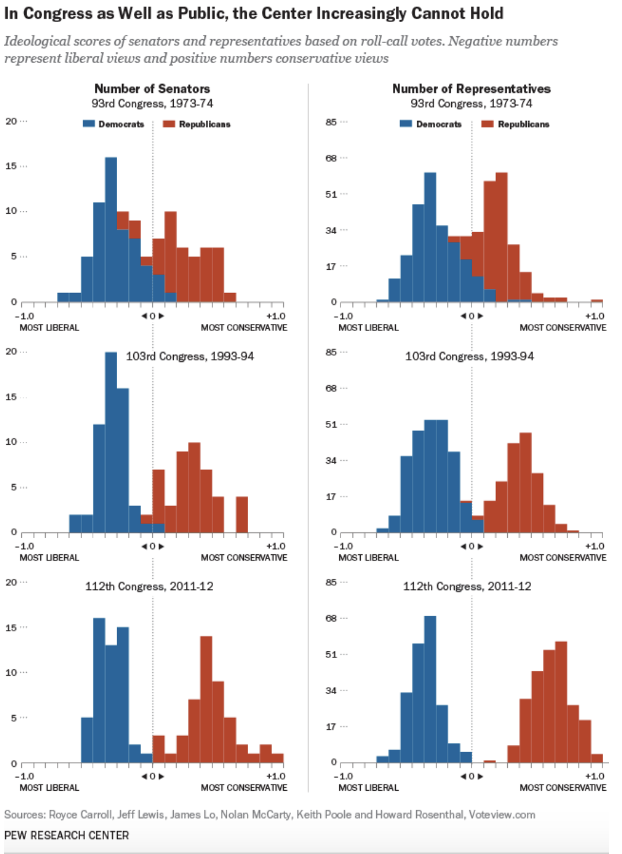
is there more policy polarization now than in the past among elites?
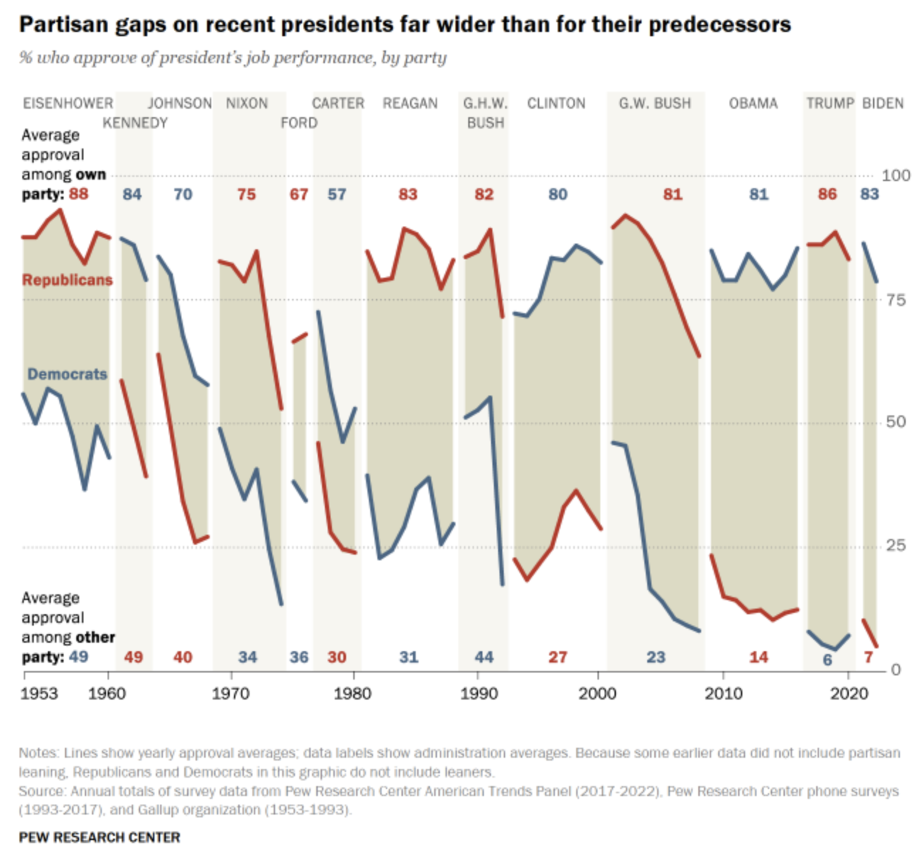
Pew Research Center analysis finds that, on average, Democrats and Republicans are farther apart ideologically today than at any time in the past 50 years.
Democrats and Republicans are ideologically farther apart than in the past 50 years.
Both parties are more cohesive; only ~24 moderates remain in Congress (vs. 160+ in 1971‑72).
Democrats have become somewhat more liberal; Republicans much more conservative.
Nearly half of House Republicans are from the South; nearly half of House Democrats are Black, Hispanic, or Asian/Pacific Islander.
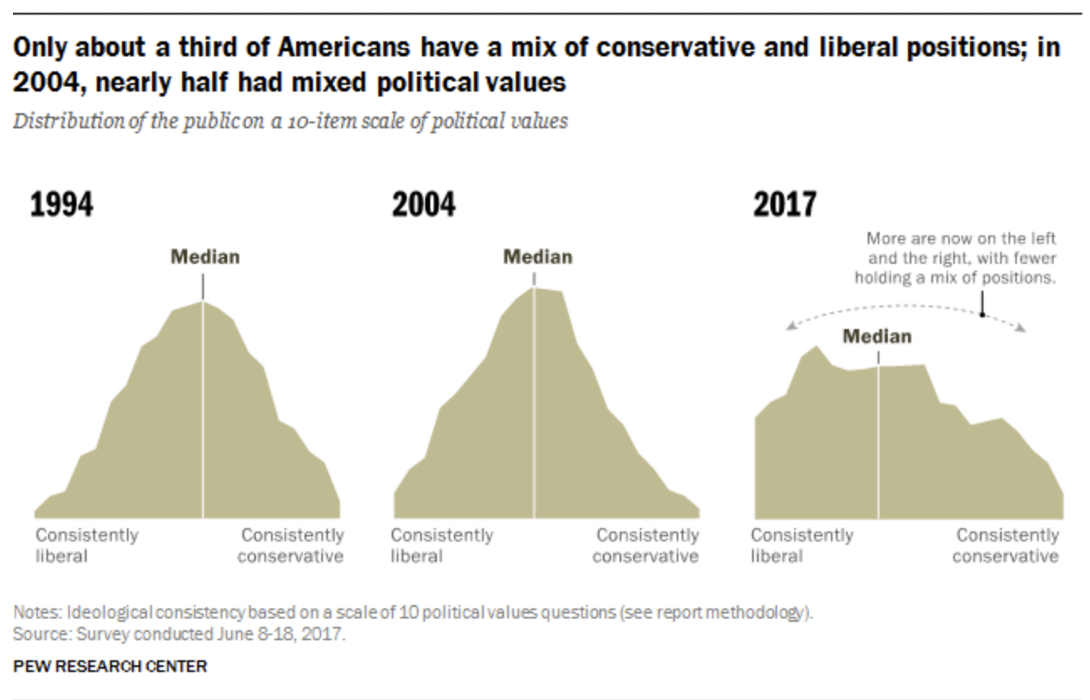
is there more policy polarization now than in the past among the general public?
only about a third of Americans have a mix of conservative and liberal positions — while in 2004, nearly have the public had mixed political views.
there is also less of an overlap in the political values of Republicans and Democrats in the past
is policy polarization greater among citizens who are more, or less, politically engaged?
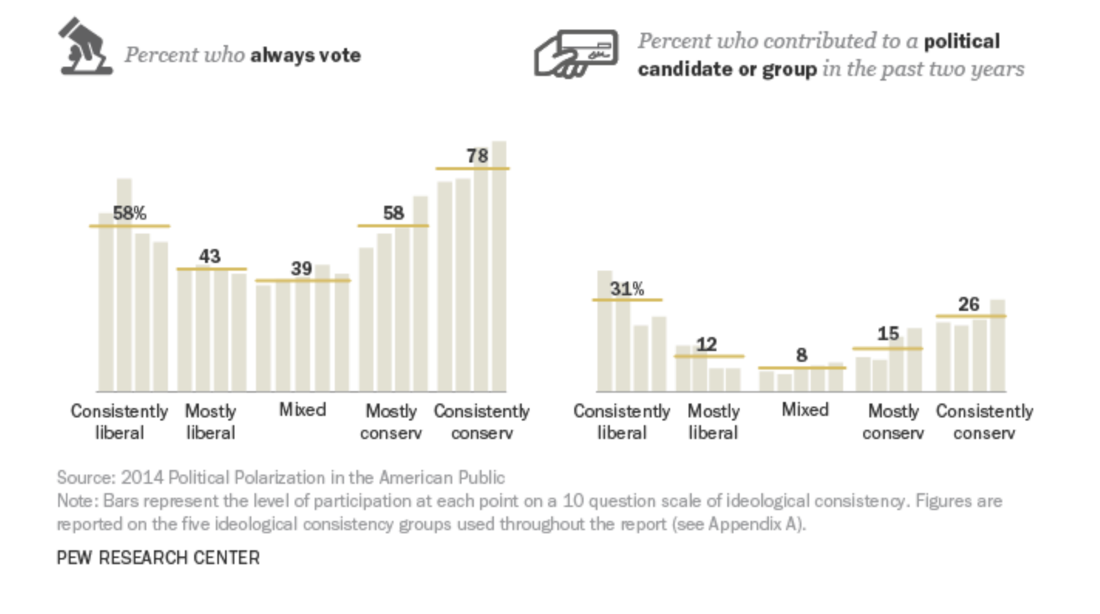
policy polarization is greater among those who are more politically engaged. polarization is the strongest among highly engaged and the share of consistently liberal or conservative Americans doubled (10% → 21%).
animosity has more than doubled since 1994.
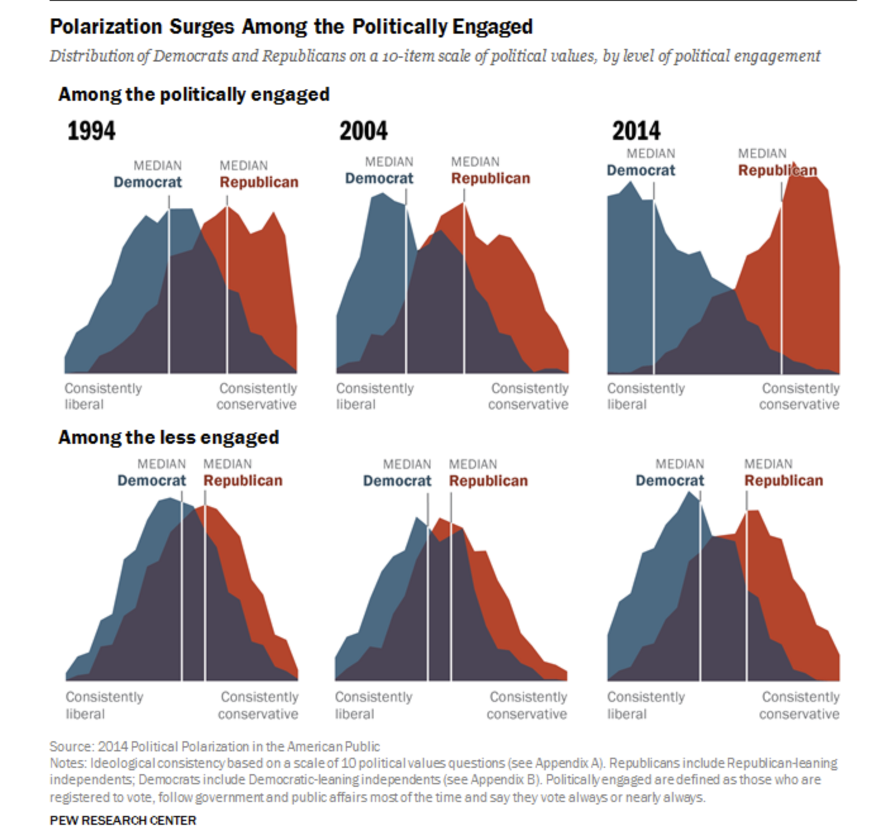
how is polarization among the politically engaged likely to have disproportionate effects on politics?
these highly polarized individuals are a part of the majority who always vote. meaning, moderates / mixed opinionated people do not influence politics because they do not make up the majority of this share. they are disproportionately shaping political outcomes.
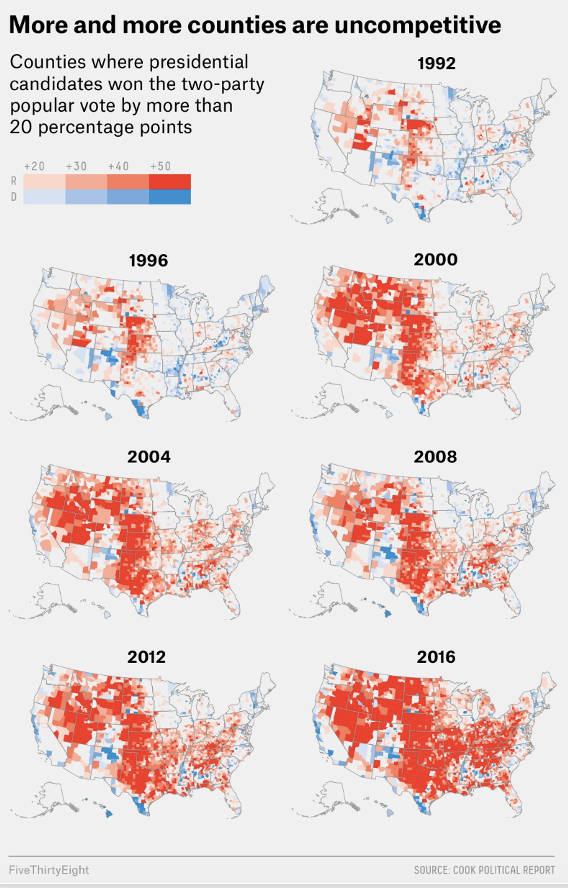
how has geographic polarization in the US changed within the last few decades?
Fraction of U.S. counties with presidential candidates within 10% of each other
1992: 35.2%
2016: 9.7%
(even though 2016 was a closer contest overall)
Fraction of U.S. counties with presidential candidates not within 50% of each other
1992: 3.0%
2016: 38.4%
“landslides everywhere”
what this means:
Voters are increasingly sorted geographically into politically like-minded areas.
Elections are decided by fewer swing areas, while most counties are safely red or blue.
National closeness can mask local extremity, and is sharply divied
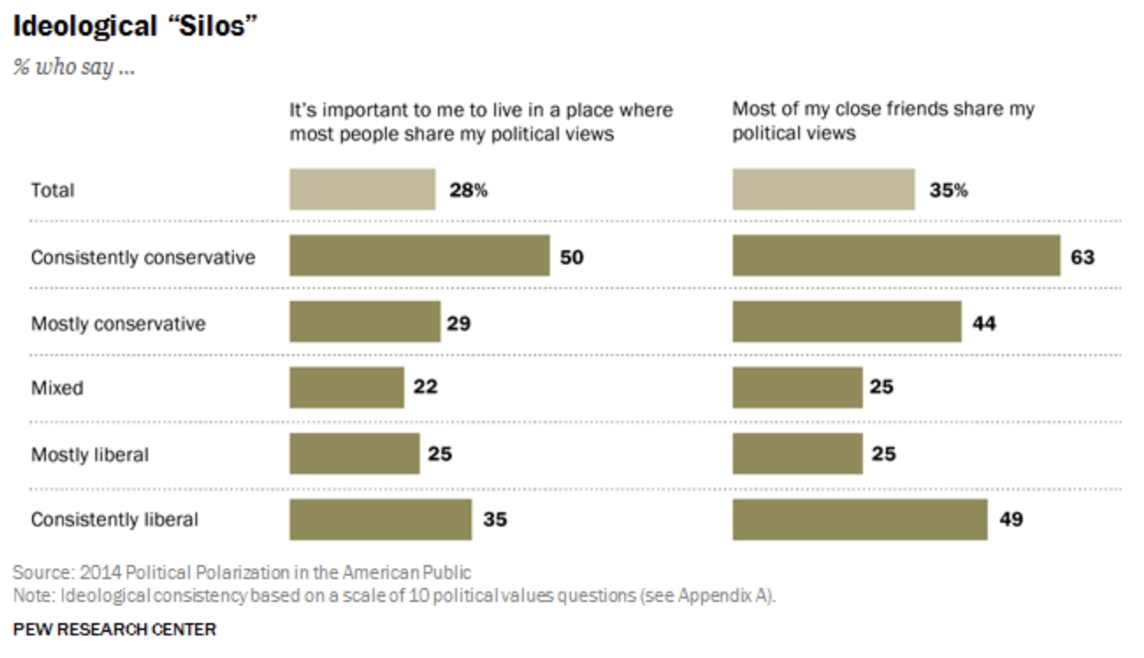
what is the definition of homophily?
Tendency for people to form social or other ties with others who are similar to themselves.
Homophily in social networks: people tending to have friends/contacts who agree with them politically
Residential homophily: people tending to live near others who agree with them politically
what is affective polarization?
the tendency of people identifying as Republicans or Democrats to view opposing partisans negatively and co partisans positively
the growing dislike, distrust, and hostility between opposing political groups, where people feel strong positive emotions for their own "in-group" (like their party) and negative feelings (animus) toward the "out-group" (opposing partisans), often overshadowing policy disagreements.
how does affective polarization look currently in the US?
there is a viewpoint of “beyond dislike,” with in-groups viewing our-groups as a “threat to the nation’s well-being.”
27% of Democrats see the Republican party as a threat to the nation’s well-being
36% of Conservatives see liberals this way
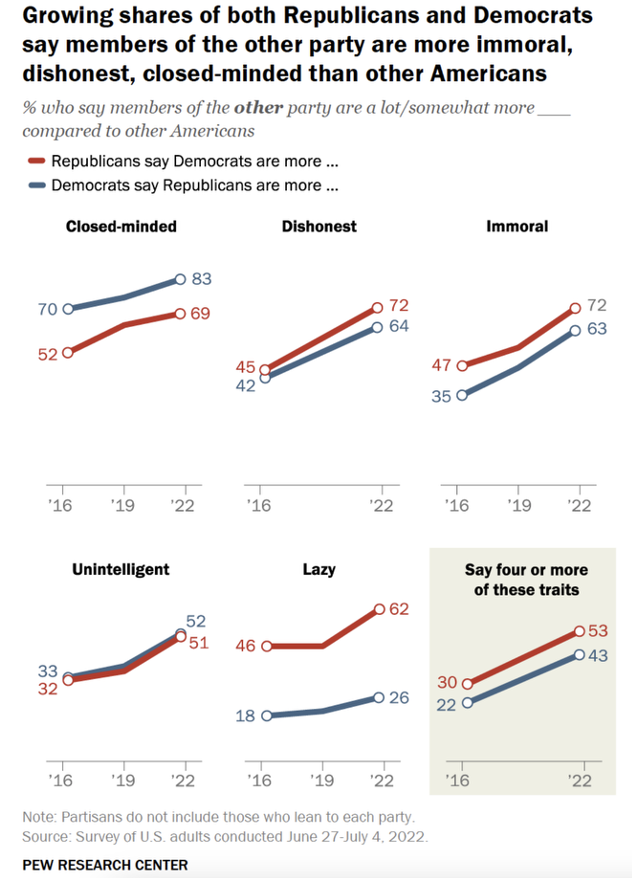
growing shares of both Republicans and Democrats say members of the other party are:
immoral
close-minded:
dishonest
unintelligent
lazy
overall, these types of viewpoints have been increasing for the last two decades
what happened during the BIAT (brief implicit association test) when labeling partisans figures?
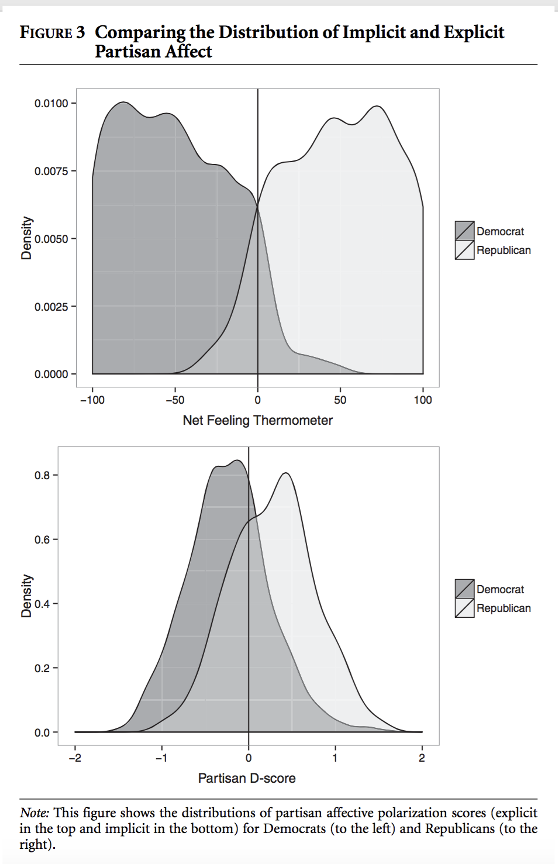
Both Republicans and Democrats show in-group preference in the BIAT.
During the BIAT:
Both R’s and D’s react faster when pairing own party + good.
D-score measures this difference in reaction times.
Explicit bias (feeling thermometer):
People report warmer feelings for their own party than the other.
Stronger among strong partisans, but present even in leaners.
To compare:
Partisan implicit bias is about as strong, or even slightly stronger than common measures of racial implicit bias.
Partisanship acts like a strong social identity; people favor their own group both consciously and unconsciously.
what happened during the partisan hiring bias study?
Setup:
Respondents saw two resumes for the same job.
Candidates’ partisanship randomly signaled via campus activities.
Candidates’ race randomly signaled via stereotypical names.
Findings:
Both Democrats and Republicans preferred hiring co-partisans.
In-group preference persisted even when the out-group candidate was more qualified.
Effect is comparable to race-based hiring bias seen in real-world audit studies (White candidates often favored over Black candidates).
Note: Hypothetical scenario; most respondents likely lacked real hiring experience.
Broader context: Similar in-group bias appears in politics, e.g., representatives’ responsiveness to constituents.
what happened during the dictator / trust game studies?
Dictator Game:
Participant splits $10 with another person.
$0 = selfish, $5 = fair.
Finding: People give more to co-partisans than to out-partisans → in-group favoritism affects altruism.
Trust Game:
Sender splits $10; amount is tripled for recipient, who can return some money.
Measures social trust.
Finding: Senders trust co-partisans more, sending larger amounts → in-group favoritism affects trust.
Overall Insight: Partisanship influences both altruism and trust, not just opinions or evaluations.
what happened in the social media and political polarization study?
Study: Republicans and Democrats on Twitter; followed bots retweeting the opposite party.
Treatment: 24 retweets/day for 1 month; engagement checked via quizzes.
Findings:
Republicans exposed to liberal bot → became more conservative.
Democrats exposed to conservative bot → no significant change.
Implications:
Exposure to opposing views can increase polarization.
why might a partisan become more partisans when exposed to communications from the other side?
People might be negatively surprised by the extremism/quality of communications on the other side
Could spark (selective) interpretation of differences between your party and the other party (seeing the other side’s arguments recontextualizes how you think about your own side’s)
Could expose people to things they disagree with that they then counter argue based on their preexisting views
May provoke people to remember their own’s sides arguments and reasons for political commitments
Maybe people get angry / placed in emotional state by encountering arguments they disagree with, might facilitate enhanced in-group identification
what are some other social contacts in regards to political polarization?
Literature on social contact and political polarization has mixed results
Uses different kind of social contact and communication, different kinds of issues, different kinds of measures (policy views, partisanship, etc.)
Some persuasive work suggests face-to-face discussion of policy issues in a mixed partisan discussion group can moderate participants’ views…
…while discussion in a homogeneous partisan group can tend to intensify them (e.g. Klar 2014, American Journal of Political Science)
Our discussion of homophily suggested that political discussion groups may be becoming increasingly homogeneous, potentially reinforcing polarization
In experiments involving face-to-face political discussion, people are often pleasantly surprised by the nature of the interaction and it might lower affective polarization a bit temporarily.
what is moral contagion?
When political elites use moral-emotional language, message diffusion is enhanced (as measured by re-tweets on social media)
Especially true for messages involving “moral outrage” (e.g., moral anger and disgust)
All of this is true both for conservative and for liberal elites, though the effect is stronger among conservatives
Moral-emotional language is likely to be more politically polarizing than some other kinds of messaging (e.g., unemotional discussions of policy)
This is one way in which social media can contribute to the amplification of political polarization
What do you think some of the implications of political polarization might be?
Possible increase in political violence (Jan 6, Charlie Kirk and other assassinations)
Campaigning may be rooted in negative interpersonal accusations/insults rather than on policy
Can lead to greater acceptance of lower standards of debate, conduct, etc because of affective polarization / because people just support their own party
Policy may become unpredictable, gyrating back and forth as administrations change
Policy may become more extreme / more extreme ideas may be seen as more normal than they were
Both parties may become unappealing to a growing number of people / cynicism, or maybe an opening for new parties
Congress may simply do less because compromise becomes less possible
People may disengage from politics because it has become ineffective or unpleasant
Echo chambers may mean that citizens learn less and have more biased ideas about the world than they would
Elected politicians may become less representative of the public / lower quality
Many people who would be qualified for office may choose not to run
Easier for politicians who want to divide people to find favor
Limits number of quality of enjoyable interpersonal connections citizens see themselves as being able to have
How are automatic partisan reflexes affecting accountability in political elites?
if judgments about elected officials’ performance are merely automatic partisan reflexes, it is no longer possible to reward politicians for doing well or punish them for doing badly.
If government gets little done (because of gridlock, or because politicians don’t try), citizens may decide they may as well vote based on partisan identity.
what are some potential causes of our current political polarization? why is it happening now?
Internet/social media – information sources may be more biased/opinionated/extreme than older media forms (e.g. newspapers, network news) – fragmentation over the last decades (legacy media → cable → internet)
Decreased norms of social civility / tendency to elect politicians who don’t prioritize decorum or harmony
Fears of evolving demographic change / changing immigration patterns
Deindustrialization / globalization have had strong negative consequences in some industries / regions of the country – neither party has been perceived as solving these problems
More sophisticated / emotionally manipulative marketing techniques as well as microtargeting
Compared to the Cold War or World War II, less of a common enemy that helps keep the country unified
Evolving norms of news presentations / presentation about facts
We are overwhelmed with sources of information – paradoxically might make us more shallow, also means that it’s harder to know what sources to trust
Stronger rural/urban divide
Increased role of money in politics
Echo chambers / technology facilitates homophily and only talking to people you agree with
The decline of local newspapers and their replacement with national news sources
Growing inequality
how may our current political political polarization be a “positive feedback loop” (the further it goes, the further it is likely to go) or a “negative feedback loop” (a self-correcting process, where some force causes political polarization to start declining again after reaching some maximum level)?
Positive feedback loop
AI may further destabilize trust in facts/authorities/one another, people may rely more on in-group loyalties
polarization may cause more sorting of people into geographically homogeneous areas
increased social loneliness, fewer social connections IRL, facilitates these polarization processes
Negative feedback loop
eventually public concern/disgust with polarization could bring about prioritization of de-escalation/unity
the prospect of looming disaster, if it becomes salient and widely shared might motivate de-escalation
what (if anything) could be done to reduce polarization in the US today?
Some people argue regulation of social media / misinformation is one way – but who regulates, and what do they choose to regulate; 1st Amendment rights, etc
Cultivating habits/norms of civil discourse across divides, either in media or in daily life
Cultivating norms of ensuring highest quality of candidates/behavior/policy on your own side
Emphasis of superordinate identities (overarching; e.g. national identity is superordinate to party identities), and tailoring of the meaning of them to embrace tolerance of political differences
Institutional reforms (redistricting, campaign finance, open primaries, ranked choice voting)
Bolstering civic education in schools, city halls
Take measures to reduce inequality / alleviate economic pain in areas disrupted by deindustrialization etc
what happened during the milgram obedience experiment?
To what extent do people obey authority, even when it conflicts with their conscience?
Setup:
Participants = “teachers”; a confederate = “learner.”
Teachers instructed to deliver electric shocks for mistakes, escalating from 15V → 450V.
Learner (actor) gave pre-recorded screams and begged for shocks to stop.
Experimenter (authority figure, lab coat) prodded participants to continue:
“Please continue.” → “You have no other choice, you must go on.”
Participants could stop at any time; experiment ended if they refused 4 times or reached max voltage.
Results:
63% delivered the maximum shocks.
Most questioned the procedure but obeyed when prompted.
Those who refused did not check on the learner or demand the experiment stop.
Obedience was robust across settings, though small variations existed.
Lessons / Concepts:
Blind obedience to authority
Mindlessly taking the first small step → slippery slope
Connected to the theory of conformism (Asch line experiments)
what is the “agentic state theory”?
holds that when a person comes to view himself as the instrument for carrying out another person’s wishes, he no longer sees himself as responsible for his actions
what are the two kinds of “diffusion of responsibility”?
In hierarchical organizations, underlings claim that they were following orders, superiors claim they were just issuing directives and not doing anything per se
In a group of peers, individuals engage in activity they otherwise would never engage in alone (“groupthink”), or fail to act when they would never fail to act alone (“bystander effect”)
what happened in the bystander effect experiment?
Setup:
Subjects believed they were in a discussion about personal problems.
Groups of 2–5 strangers, communicating via intercom only.
A confederate faked an epileptic seizure over the intercom.
Experimenters measured time until someone helped.
Results:
The more people present, the longer it took for anyone to help.
Shows diffusion of responsibility: people assume someone else will act.
Broader Evidence:
Bystander effect appears in many settings.
Diffusion of responsibility also reduces effort in shared tasks (e.g., tug-of-war studies).
what are some political implications of the bystander effect / diffusion of responsibility?
People may not vote / participate because they think others will do enough
May be undermotivated to deal with social problems experienced by other people
Responsible actors will try to diffuse blame for failures of policy / conduct of war
People may be less motivated to take action on well-known policies or when politics is at a larger scale
Failure to act on climate change or other large-scale issues that involve general responsibility
The number of people in a political role (executive vs small legislative chamber vs large legislative chamber) may affect extent of diffusion
People who oppose a policy may be less likely to protest or act in other ways if they others doing so
what is the definition of an extremist?
An extremist is a person who is excessive and inappropriately enthusiastic and/or inappropriately concerned with significant life purposes, implying a focused and highly personalized interpretation of the world. Politically, it is behavior that is strongly controlled by ideology, where the influence of ideology is such that it excludes or attenuates other social, political, or personal forces that might be expected to control and influence behavior.
That is, extremists are concerned only with the logic of their own behavior and their ideological construction of the world – tending to disregard the lives of others or alternative ways of looking at things.
Extremists “believe what they prefer to be true”, making their worldviews very resistant to change (to a greater-than-usual extent)
why are extremists, extremists?
Most scholars: extremism is not some kind of mental illness
Case studies indicate that individuals committing “extremist” acts are generally not “insane”
Is there an “extremist personality”?
Basically, not really
Studies of torturers, bombers, terrorists, and other extremists suggest there is no clear “personality profile” for extremism
Of course, there are some features typical in extremists
People who commit extremist actions are typically lacking in empathy for others and tend to “dehumanize” their victims
Tend to have more of an “external locus of control” (believe the external environment determines what happens to them) than an “internal locus of control” (believe they have considerable control over their own fate)
how does the milgram experiment (voltage shocks) apply to extremist acts?
most subjects were willing to defer to authority by turning the dial all the way up
Milgram argues: these are not sadistic individuals; what drives their behavior is a “person-situation interaction effect”
This relates to the finding that extremist acts of violence are “nearly always fostered by groups, as opposed to individuals. When someone kills for the sake of promoting a higher good, he may find support and encouragement if he is acting as part of a group of people who share that belief.”
how does extremism function with social identitiy theory?
In Social Identity Theory, there is importance to belonging to groups & seeing those groups positively in comparison to others
One theory about much extremist violence is that when this is not possible, people look for some out-group to blame
Intergroup conflict over resources is always a fact of life, but under conditions of severe socioeconomic/political depression, the environment is often conducive to the identification of one group as a scapegoat that is blamed for all of society’s ills
Negative stereotypes of the scapegoat are propagated, and the poor treatment of the scapegoat group undergoes social justification (is rationalized as proper)
This process may proceed all the way to dehumanization of the scapegoat, wherein members of that group are described as less-than-human
Under certain circumstances, social identity pressures can lead “ordinary” people towards “extremist” behavior
Individuals have social identity needs that can be served by scapegoating/dehumanizing out-group members
Group membership typically involves conformity pressures that can help intensify and consolidate negative feelings about out-group members
As individuals form more extreme attitudes or participate in extreme behaviors, “escalation of commitment” problems make it harder to withdraw from group membership
For example, committing acts of violence can intensify one’s commitment to a group, because it would be impossible to justify those acts of violence outside the context of the group’s ideology
Why do people conform to group norms and obey authority, and what factors increase obedience?
People conform to group norms for a variety of reasons
Desire to be a “good group member” for social identity reasons; discomfort in violating behavioral prescriptions
Violating group norms may lead to being disliked by other members of the group
At times, violating group norms can also lead to banishment or to punishment or violence from other group members
People also, as we have seen, often defer to authority figures, even to the point of committing acts they would never ordinarily commit alone
Obedience is enhanced:
When actions are authorized by authority
When actions are routinized, making it possible to do mechanically and with little thought
When any victims of the actions are dehumanized in advance
When individuals feel compliance pressures from other group members
Sometimes, and especially in periods of trouble, the most fanatical members become group leaders, issuing harsher behavioral prescriptions, and acting strongly to prevent dissension within the group
what are some contexts / examples for extremism?
Terror*st Organizations
Ideological splinter groups
Race-based splinter groups
Paramilitary organizations
Organizations of state terror (e.g. torture & “disappearances” in Latin America)
Acts of g*nocide
what is the definition of genocide?
UN definition:
Acts committed with the intent to destroy in part or in whole a national, ethnic, racial, or religious group as such.
Historically, tends to result from an intense feeling of frustration and threat, usually operating in the context of difficult social economic and political circumstances
what were the effects of the Rwandan Genocide?
Between 800,000 and 1,000,000 people killed in the space of about 3 months (from a population of less than 10 million)
Rwanda has two major ethnic groups
Hutu (85% pre-genocide)
Tutsi (14% pre-genocide)
Small Twa (“pygmy”) population (1%)
what did Rwanda look like during the pre-colonial period?
In pre-colonial times, Hutus and Tutsis lived in relative harmony: same language, same religion, economic interdependence
Non-rigid caste system, by which Tutsis were usually herders and Hutus were usually farmers
Tutsi came to mean “rich” (someone with many cows); Hutu came to mean “servant” (someone with fewer than 10 cows)
Under certain circumstances, a Hutu could become a Tutsi
Tutsi (mixed with a few Hutus) became the economic & political elite
how was Rwanda structured during the colonial era?
German colony, then Belgian after WWI
Belgians chose to administer power through the Tutsi (partly because of who the pre-existing elite was, partly because Tutsis are stereotyped as having closer-to-“European” appearance: lighter skin, more aquiline features, taller)
Belgians strongly favored Tutsis in jobs and education, issued identity cards with individual ethnicities immutably recorded
Hutus came to view Tutsis as an elitist class and an arm of the colonial state
Ethnicity became politicized in a way it had not been before
Rwanda won independence in 1959; Hutus overthrew the colonizers and many Tutsis went into exile in neighboring countries (esp. Uganda)
what did Rwanda look like under Hutu rule?
Many Tutsis lived in refugee camps for decades
Relations between Hutus and the Tutsis in Rwanda were generally bad-tempered, with intermittent violence, but not catastrophic
By the late 1980s, exiled Tutsis pressed for return to Rwanda & permanent resettlement
The Hutu government under long-time Pres. Juvenal Habyarimana said that Rwanda was already overpopulated & couldn’t take the refugees back
Amid stalled negotiations, Tutsis in Uganda formed the RPF (Rwandan Patriotic Front) under Paul Kagame and began incursions into Rwanda in 1990 with an eye towards overthrowing the regime (or forcing concessions)
what was causing major issues with the Rwandan government in the 1990s?
Habyarimana (who came to power in 1973) had been losing popularity anyway
Rwanda was desperately poor; 95% of land under cultivation, genuinely overpopulated; hunger was rampant; average woman had 9 children; one of the poorest countries in the world
Habyarimana developed a strategy of playing on ethnic loyalties, emphasizing the Tutsi threat, and dividing Hutus who supported him from Tutsis and “collaborationist” Hutus (“moderate Hutus”)
As part of this, anti-Tutsi sentiment and anti-Tutsi behavior was encouraged (actively or tacitly) in a variety of different ways
Media (Kangura, RTLM)
Formation of militias (Interahamwe)
what was the Kangura newspaper? what were some of its implications?
Kangura was a state-owned newspaper that launched an anti-RPF and anti-Tutsi campaign in October 1990
Became infamous for anti-Tutsi propaganda and propagating “Hutu Power” ideology
Perhaps most famous for the “Hutu Ten Commandments”
Constant tales of Tutsi plotting to “re-enslave” the Hutu upon their return
“which weapons are we going to use to beat the cockroaches for good?”
what did the Hutu Ten Commandments and related propaganda consist of?
Hutu Ten Commandments:
Promote Hutu supremacy and Tutsi exclusion in all aspects of life.
No social, marital, or economic ties with Tutsi; considered betrayal.
Reserve political, military, and economic power for Hutu.
Encourage Hutu unity, vigilance, and propagation of Hutu ideology.
Establish ethnic loyalty and in-group enforcement; foster hostility toward Tutsi.
these “commandments” and the related propaganda can be thought of as:
Defining behavioral prescriptions for (Hutu) group membership
Systematically dehumanizing the Tutsi (calling them inyenzi, or cockroaches)
what was the Radio Télévision Libre des Mille Collines (RTLM) and what were its impacts?
free radio/television of the thousand hills; Rwanda known as the “Land of a Thousand Hills”
Much of the population illiterate, so radio propaganda was a crucial part of the regime’s plans
Constant sensationalized stories about the threat posed by the Tutsi
RTLM repeatedly stressed the need to be alert to Tutsi plots and possible attacks and called upon Hutu to prepare to 'defend' themselves against the Tutsi
Constant warnings about how RPF combatants dressed in civilian clothes were mingling among displaced people fleeing combat zones. These broadcasts gave the impression that all Tutsi were necessarily supporters of the RPF force fighting against the government.
what was the Interahamwe?
A Hutu paramilitary organization set up & tacitly encouraged by the government; allowed to attack Tutsis in the population without repercussions
Literally, “those who work together” or “those who fight together”
Began openly “rehearsing” for genocide, carrying out drills and such
Mostly poorly armed – machetes were the most common weapon held by militia members
how did the Rwandan genocide play out on April 6th, 1994?
President Habyarimana’s helicopter was shot down; unclear who was responsible.
Power-sharing negotiations with the RPF were underway.
Violence erupted almost instantly.
RTLM radio broadcast calls to “cut down the tall trees.”
Roadblocks set up; Tutsi, moderate Hutus, and Hutus opposing anti-Tutsi propaganda were killed.
Ordinary citizens, local officials, clergy, and militias participated.
Many felt forced to kill or feared for their own lives.
Propaganda and ideology were crucial in mobilizing ordinary people to commit violence.
what are some key takeaways that happened during the Rwandan Genocide?
The rallying cry to the killers during the genocide was: “Do your work.”
Hundreds of thousands of Hutus worked as killers in regular shifts over a period of weeks.
In the massacre at Nyarubuye Church, Tutsis asked the mayor how they might be spared. He suggested they sanctuary at the church. They did, and a few days later, the mayor came at the head of a pack of policemen and villagers. All were killed, often purposely slowly.
what was the ultimate conclusion of the Rwandan Genocide?
About 75% of the Tutsis in Rwanda were killed within a month; killing continued for three months.
The genocide ended partly because there were so few Tutsis left; partly because the RPF took the country in July.
The RPF leader Paul Kagame is president today.
With the return of Tutsi refugees from Uganda, and some Hutus remaining in exile in eastern Congo, the Hutu/Tutsi mix in the current population is ironically close to what it was pre-genocide
It is now a serious crime in Rwanda (“divisionism”) to draw any ethnic distinctions whatsoever in speech
how does the media play into mass political violence?
mass media can play a role in facilitating mass political violence by stirring up resentment, issuing false propaganda, and dehumanizing members of a minority group
what happened in the “reducing intergroup prejudice and conflict using the media” study?
Field experiment in Rwanda; communities randomly assigned to “New Dawn” (intergroup tensions) or control soap opera (reproductive health/AIDS).
Intervention: Soap opera addressed mistrust, trauma, and intergroup communication; episodes played in group settings over a year, ensuring exposure.
Findings:
Reduced prejudice: Participants more likely to trust across groups, reject in-group-only norms, and express empathy for others (prisoners, survivors, poor people).
Promoted active social behavior: More open discussion, expression of dissent, and collaborative decision-making within communities.
Well-designed media interventions can lessen intergroup conflict, foster empathy, and encourage constructive social norms, even if core beliefs about past violence remain unchanged.
what is the definition of nationalism
an ideology and movement centered on loyalty and devotion to a nation, emphasizing its interests, culture, and unity above others, often driving the desire for self-governance (self-determination) and a strong national identity, though it can manifest as mere patriotism or extreme, aggressive devotion
A nation is a potentially powerful in-group
“Nationalists” are individuals who give their primary loyalty to their perceived nation
A nation-state exists when, on the whole, citizens of a country are nationalists (for the same perceived nation)
“Nations” are not necessarily coterminous with “countries”
Some countries function as nation-states, while in others, citizens’ primary political loyalties may be directed elsewhere (such as towards ethnic groups, rather than the community of the nation-state as a whole)
what are the three typologies for non-nation states?
Multinational state
Several groups of people, who think of themselves as separate nations and who actually have the capacity to establish viable independent states, live together in a single country
Primary identity group is the nationality they belong to rather than the population of the country as a whole
Core Community non-nation-state
Countries with a dominant ethnic or sectarian community who believe that they are the primary nation embodied in the country, identify with that nation in the strongest terms, and generally control the government
Other communities, which give primary loyalty to their own ethnic groups, are also present within the territorial state. Such groups may desire independence, but would not have the capacity to establish a viable state
In many cases, the “core community” advocates the integration and assimilation of the other groups, encouraging the minorities to speak the dominant group’s language, abandon their customs, etc.
“Nation without a state”
A group of people who are physically dispersed across multiple states, in none of which they are the dominant group
how do nationalists form social identities around the membership in the nation?
Motivated to have a strong, positive attachment to their nation
Committed to the unity, independence, dignity, and well-being of the national community
Love the nation itself even when they dislike their government
what does variation in nationalism look like?
there is substantial variation across countries in the strength of nationalistic identification
example: 80-91% — Bangladesh, Colombia, Ecuador, Ethiopia ; 10-19% — South Korea
USA: 79% (1999), 62% (2006), 56% (2011), 46% (2017)
has changed within the last decades
There is also substantial variation within countries in the strength of nationalistic identification.
The poor tend to be more nationalistic than the rich
Minority groups tend to be less nationalistic than majority groups.
what are some effects of nationalism?
Nationalists tend to be more sensitive to (perceived) threats to the nation-state, and to view the source of the threat through a more extreme image
Nationalists are also more sensitive to opportunities to advance their country’s influence & are more likely to support expanding state influence at the expense of others
Nationalists are more concerned with their country’s prestige and dignity than are non-nationalists, and are more willing to take action to rectify perceived affronts
Leaders of nation-states, compared to non-nation states, are better able to make effective appeals to the citizens to make sacrifices to enhance state power
The public is more willing to serve in the military and to have a more intense commitment to the defense of the state
These effects can be understood in social identity terms
how can leaders use nationalistic symbols?
Leaders of nation-states can use nationalistic symbols to arouse passionate feelings of devotion to the nation
Flags
Reference to historic events such as success in great battles
The idea of the “motherland” or “fatherland”
Nationalists respond readily to the use of such symbols, and are mobilized to achieve national goals
what were the results of the subliminal exposure to national flags study?
Israeli citizens; treatment group exposed to subliminal images of the Israeli flag before a questionnaire; control group not exposed.
Measure: Participants’ Identification With Israeli Nationalism (IWIN) assessed beforehand.
Findings:
Reduced polarization: Exposure to the flag made both high-IWIN and low-IWIN participants express more moderate, centrist preferences.
Voting intentions: Treatment group favored centrist parties more than control group.
Issue positions: Moderating effects observed on attitudes toward the 2005 Gaza pullout.
Insight: Subliminal national symbols can temper political polarization and encourage moderation, even among strongly identified partisans.
other studies on exposure to flags suggest that exposure to them evokes in group social norms as well as emphasizing in group versus out group identities
what is irridentism?
the desire to join together all parts of a national community within a single territorial state
Nationalists are often deeply concerned with the objective of gathering together communities existing outside the borders of the state whom they regard as a part of their national community
Members of the community who live outside the territory of a nation-state are called the diaspora
how is social identity theory a potential cause for nationalism?
People emphasize positive traits of their national group and compare themselves to out-groups.
Strong nationalists are more likely to engage in social competition rather than switching groups.
not always a bad thing, but can go wrong: when things go wrong, there is a propensity to assume that someone else is responsible (sonce own failures are not recognized) → scapegoating
National pride can motivate achievements and innovation, but can also lead to scapegoating and blame of others.
Strong nationalists are sensitive to insults or frustrations toward their group and seek positive comparisons.
Group dynamics such as loyalty, obedience, and conformity influence how nationalists behave.
Responses to other countries or nationalities depend on the perceived image of the out-group.
what is the security dilemma?
Defensive measures by a state (arms buildup, increased spending) can be misperceived as offensive, triggering fear, arms races, or war.
Cognitive biases (fundamental attribution error, actor-observer distinction) make misperceptions more likely.
helps entrench “the enemy image” → “inherent bad faith” perspective
Nationalism amplifies the dilemma:
Strong national pride can intensify enemy images and suspicion of other states.
Nationalist populations may support aggressive or hard-line policies in response to perceived threats.
Cognitive rigidity is reinforced by loyalty, in-group favoritism, and conformity, making compromise harder.
Outcome: Nationalist sentiment can escalate defensive measures into conflict, even when original intentions are peaceful.
Policymakers often fail to understand how their actions are likely to be perceived (or misperceived) by neighboring states
Cognitive rigidity: when an actor becomes unwilling/unable to update their beliefs about a counterparty, regardless of the events that take place
what happened during the rise and the ultimate breakup of Yugoslavia?
Multi-national state (1918–2003) made up of distinct ethnic nations (Serbs, Croats, Bosniaks, Slovenes, etc.)
most had their own independent state at one point
Created after WWI partly for security; borders did not match ethnic settlement patterns / geographic distribution of different ethnicities
Deep ethnic & religious divisions (Catholic, Orthodox, Muslim populations mixed across republics)
WWII intensified nationalism
Yugoslavia fell apart during the war - nationalities ended up on different sides of the conflict
Croat Ustashe (fascist) committed mass violence against Serbs
Serbian Chetniks, Nazi forces, and Communist Partisans fought each other
Tito’s Communist Partisans ultimately won and became head of state w/ communist dictatorship
Tito era (post-WWII–1980): stability through suppression of nationalism
Promoted “brotherhood and unity” and Yugoslav identity to minimize tensions
stressing common Yugoslav national identity but recognizing Serbian/Croatian/etc. ethnic identities
Decentralized system of six republics
Nationalism criminalized; no group allowed to dominate
Tito served as key unifying figure
After Tito’s death (1980): institutional weakness
Rotating presidency replaced strong leadership
Leaders appealed only to their own republics
Nationalism resurged, weakening Yugoslav identity
Outcome: Yugoslavia fragmented into separate nation-states along ethnic lines
what did Serbian nationalism look like in Yugoslavia?
Structural position: Serbs were the largest nationality and influential in the military, yet felt politically and economically deprived within Yugoslavia
Geographic dispersion: Serbs lived across multiple republics, fueling fears of vulnerability and fragmentation
Core symbols & myths:
“Only unity saves the Serbs” (CCCC)
Serbian Orthodox identity advocating for independence against Rome
Battle of Kosovo Polje (1389) as a foundational narrative of heroic sacrifice and victimhood
Ideology of “Greater Serbia”:
Nationalist intellectuals promoted an expanded, ethnically homogeneous Serbian state
Maps and historical claims used to justify territorial expansion
Elite nationalism (1980s):
1986 SANU Memorandum claimed Serbs were oppressed, economically exploited, and disadvantaged by arbitrary borders
Framed Yugoslavia as dominated by Croats and Slovenes
Milosević’s role:
Rose to power by mobilizing nationalist grievances
Tight media control and propaganda: repetition of national myths, demonization of out-groups, denial or distortion of Serb violence
Blamed out-groups for Serb actions (“projecting faults onto others”)
Result:
Nationalism radicalized public opinion, justified violence, and helped drive Yugoslavia’s collapse and ethnic conflict
what is an example of nationalism in other republics within yugoslavia?
Nationalist passions were on the rise in the other republics as well, aided by fear of what was happening in Serbia
Croatians and others shared a “barbarian image” of Serbia (superior in capability, inferior in culture, aggressive in intentions)
Milosevic: “If we have to, we’ll fight. I hope they won’t be so crazy as to fight against us. Because if we don’t know how to work and do business, at least we know how to fight.”
what took place during the war in yugoslavia that ultimately caused the breakup?
Breakup begins (1990–1991):
Slovenia & Croatia vote overwhelmingly for independence
Croatian Serb minority rejects Croatian independence and revolts
Yugoslav Army (Serb-dominated) intervenes
Serbian position:
Milosević accepts secession only if borders are redrawn to include Serbs outside Serbia
Appeals to irredentist Serbian nationalism
Early conflicts:
Slovenia: brief Ten-Day War; Serbia disengages
Croatia: prolonged fighting over Serb-populated regions
Bosnian War (1992–1995):
Multi-ethnic Bosnia becomes main battlefield
Serb forces conduct sieges (Sarajevo) and ethnic cleansing (e.g., Srebrenica)
At times, three-sided war among Serbs, Croats, and Bosniaks
International intervention:
NATO air strikes lead to Dayton Accords (1995)
Aftermath:
Bosnia split into Bosniak-Croat Federation & Republika Srpska
Montenegro independence (2006) peaceful
Kosovo independence (2008) disputed by Serbia
Nationalist propaganda, when paired with ethnic intermixing and political collapse, can rapidly escalate state breakup into mass violence
When national identity overrides civic identity, democracy, coexistence, and accountability collapse
Political elites (especially Milošević) used nationalism strategically to gain and maintain power
what is legitimacy and how does it apply to political systems?
Legitimacy is a psychological property of an authority, institution, or social arrangement that leads those connected to it to believe that it is appropriate, proper, and just.
Because of legitimacy, people feel that they ought to defer to decisions and rules, following them voluntarily out of obligation rather than out of fear of punishment or anticipation of reward.
Being legitimate is important to the success of authorities, institutions, and institutional arrangements since it is difficult to exert influence over others based solely upon the possession and use of power.
When governing power is effective, citizens “relate to the powerful as moral agents as well as self-interested actors; they are cooperative and obedient on grounds of legitimacy as well as reasons of prudence and advantage.”
Central to the idea of legitimacy is the belief that some decision made or rule created by these authorities is valid in the sense that it is entitled to be obeyed by virtue of who made the decision or how it was made.
what are some potential sources of legitimacy?
A legitimating ideology is a set of justifications or “legitimizing myths”
several distinct sources of legitimacy according to social theorist Weber:
Legitimacy based upon deference to customs and values (traditional authority)
Legitimacy based upon devotion to the actions or character of an authority (charismatic authority)
Legitimacy linked to the process of rule creation and interpretation (rational bureaucratic authority)
Weber’s work makes clear that the legitimation of authority and institutions through “the rule of law,” while widespread in modern societies, is only one of many ways in which social arrangements might potentially be justified.
The legitimacy of institutions can be immensely valuable for society – think about the difference between a society where election results are accepted without a second thought, versus one where any election result might potentially be contested with violence
what are the two different kinds of fairness?
“Procedural fairness”
Focuses on the fairness and the transparency of the processes by which decisions are made
An institution exhibits procedural fairness when everyone with a “like case” is treated in the same way by the institution
Related concepts: “due process”, “procedural justice”, “equality of opportunity”
“Outcome Fairness”
Focuses on the fairness of the ultimate outcomes of a decision making process
Related concepts: “distributive justice”, “equality of outcomes”
what happened during the ultimatum and dictator game when regarding fairness?
ultimatum:
Two players randomly paired: Proposer decides how to split a sum of money; Responder accepts or rejects
If accepted → split occurs; if rejected → both get $0
Typical findings (U.S. students):
Proposers usually offer $4–$5 out of $10
Responders often reject low/unfair offers (≈ $3 or less)
Key insight:
People care about fairness, not just maximizing money
Proposers anticipate rejection and/or value fairness themselves
dictator:
Proposer divides a fixed sum (e.g., $10); responder has no choice
Responder must accept whatever is offered
Purpose: distinguish altruism from strategic fear of rejection
Findings:
Average offer ≈ $2 (much lower than in ultimatum game)
Key insight:
Ultimatum game fairness reflects both altruism and strategic concern, not pure generosity
what were the results of the “fairness judgements” — real-life fairness study?
Setup: Subjects randomly assigned as plaintiff or defendant in a simulated court case; read identical case materials
Asked to judge:
What the real judge awarded
What they thought was “fair”
Then negotiated a settlement with time/cost incentives
Findings:
Plaintiffs judged higher awards fair than defendants
Greater divergence in fairness judgments → more negotiation failures and higher costs
Closer fairness judgments → quicker, mutually beneficial agreements
Key insight:
People’s sense of fairness is influenced by their role, and differences in fairness perception can block negotiations.
People may be internalizing the roles to which they’re randomly assigned, and responding as they imagine those roles would respond, emotionally and otherwise — in group vs out group dynamics
what happened in second version of the fairness judgements study?
Original Study:
Subjects learned their role (plaintiff/defendant) before reading case materials
Plaintiffs judged larger awards as fair than defendants → strong self-serving bias
28% of pairs failed to reach agreement
Second Version:
Subjects learned their role after reading case materials
Discrepancies in fairness judgments reduced to ~1/3
Only 6% of pairs failed to reach agreement
Key Insight:
Knowing your role early increases self-serving bias, making negotiation harder
Delaying role assignment reduces bias and improves cooperative outcomes
Explains why conflicts can be intractable when parties focus on self-interest
what are some context effects of the ultimatum game (trivia game)?
Setup:
Subjects paired and take a trivia quiz
Higher scorer becomes proposer, lower scorer becomes responder
Results:
Proposers offered less than in the standard ultimatum game
Responders accepted lower offers than usual
Interpretation:
Fairness judgments are context-dependent
People adjust what they consider “fair” based on perceived merit or earned advantage
what were the results of the “science denial across the political divide” experiment?
Goal: Test whether political biases affect interpretation of scientific data across issues.
Issue Manipulation: Participants randomly assigned to seven issue areas – six politically polarized (immigration, gun control, climate change, healthcare reform, nuclear power, same-sex marriage) and one unpolarized control (skin rash treatment).
Results Manipulation: Column labels (“increase” vs. “decrease”) randomly assigned so the logically correct answer could point in either direction.
Political Orientation & Attitude: Measured on a conservative-to-liberal scale, including stance and strength on each issue (e.g., support/oppose immigration reform).
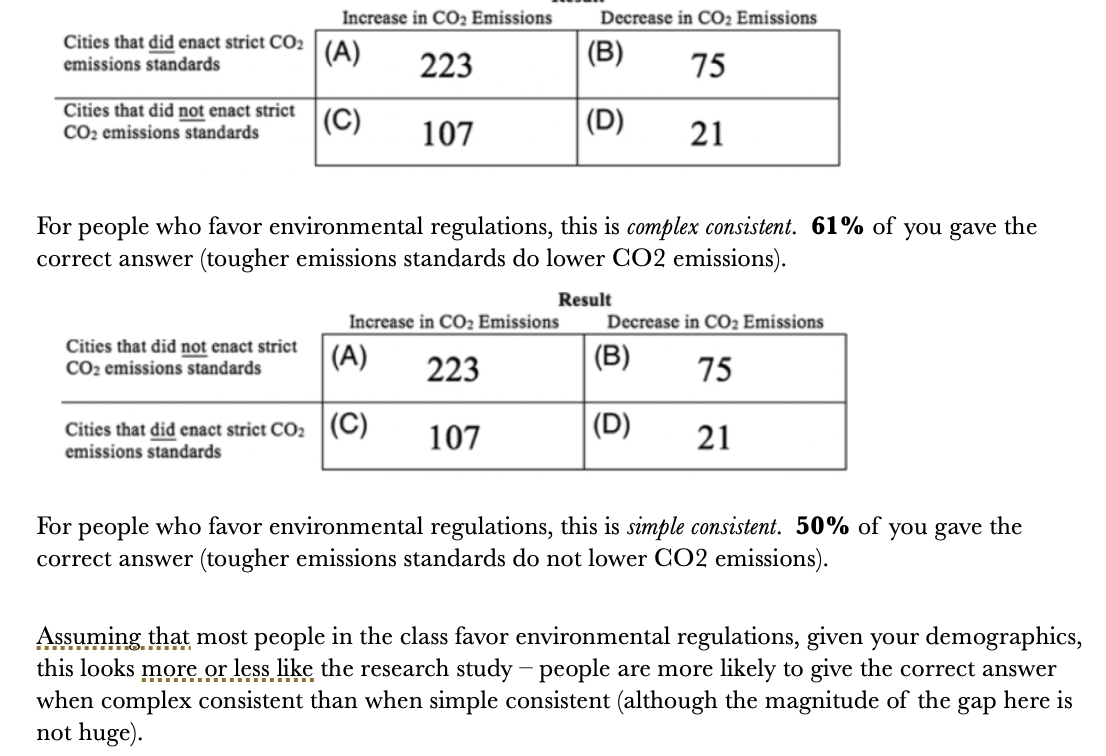
Simple vs. Complex Strategy Consistent:
Simple heuristic consistent: Simple cues point to an answer aligned with participants’ attitudes (but may be incorrect).
Complex strategy consistent: Simple cues point opposite to attitudes; solving correctly requires reasoning beyond heuristics.
Findings:
Participants were more likely to answer correctly under complex consistent conditions than simple consistent conditions.
Patterns were similar for liberals and conservatives.
Implications:
People initially rely on heuristics, but motivated reasoning can lead them to correct answers when they engage in deeper analysis.
Political ideology does not systematically bias logical reasoning across issues.
What are some political psychology factors that may affect belief in the seriousness of Covid-19 / willingness to follow public health recommendations?
Base rate fallacy (ignoring statistics, and instead focusing on anecdotal evidence from specific cases)
Biased attribution of political leaders
People accept attitude-congruent information (and, as we know, selectively seek information from attitude-congruent sources)
Conformity to in-group policy positions/norms/attitudes
People’s views may have been determined by preexisting dispositions (e.g., toward power of the state) rather than case-specific evidence
Age cohort differences / Overconfidence that “I am healthy” and won’t get Covid
Availability heuristic – difference perceptions in risk based on what’s happening in your area / your media ecosystem
Social dominance / hierarchies
Different regional values/attitudes
how does partisanship / taking cues from those who are similar relate to Covid?
Some citizens may simply take at face value cues from in-party elites about the true level of threat from Covid (e.g., conservative/liberal differences on perceptions of Covid may simply be down to different messaging from conservative/liberal elites)
For social identity reasons, Republicans/Trump supporters may experience a motivation to more positively evaluate the administration’s performance on the pandemic; selective interpretation that it all isn’t so bad may result. Similarly, Democrats/Trump opponents may experience a motivation to more negatively evaluate the administration’s performance and also engage in selective interpretation
how can a huge disruption (like covid) inspire motivated cognition & scapegoating / conspiracy theorizing ?
Need for closure / uncertainty avoidance
Pandemic induces deeply unpleasant uncertainty over an extended period of time
Minimizing or wishing it away may reduce perceived uncertainty
Dissonance reduction
Arrival of pandemic may induce dissonance between goals and the present reality (e.g., prospects for success of a valued business)
Minimizing or wishing it away may reduce dissonance among goals, self-image of success, and current circumstances
The pandemic may provide an opportunity to derogate outgroup members by holding them responsible in some way or another
E.g., conspiracy theories saying the virus was intentionally created and intentionally released by China or by global elites for nefarious purposes
Such conspiracy theorizing can help reestablish a sense of control, in a situation where all of us self-evidently lack control
what is psychological reactance?
When something threatens or eliminates people’s freedom of behavior, they experience psychological reactance, a motivational state that drives freedom restoration.
“I become frustrated when I am unable to make free and independent decisions”
Advice and recommendations usually induce me to do just the opposite”
Some people are high in reactance; others are low.
how did validation play into Covid?
Some communication about mask use, etc., may be interpreted as “virtue signaling” by out-group members; pushback prevents loss of perceived in-group status
Validation can “level the moral playing field” by focusing on commonalities of experience or understanding, and reduce salience of (partisan) in-/out-group divides
Public health messaging that is seen as morally superior or smug may generate more pushback than messaging that attempts validation (and may play into negative societal stereotypes about condescending liberals)
What are some factors (situational or dispositional) that might affect degrees of attraction to conspiracy theories?
Personality traits (Machiavellianism, belief in End Times, etc)
Loneliness / lack of social connection
People’s upbringing (household, local politics, growing up in unfavorable circumstances)
Social influence / conformity from those around you
In a hyperpartisan environment, trust is lower and people are more drawn to negative accounts of outgroup members
The degree of novelty of the thing that is to be explained
Reactance
Transparency of government / past conduct of national government in history
Degree to which conspiracy thinking is already prevalent in the political/social environment
what happened during the “cognitive roots of extreme suspicion” study?
Hypotheses:
Anxiety increases likelihood of perceiving a conspiracy.
Partisanship effects:
Govt conspirator: more conservatives perceive conspiracy.
Corporate conspirator: more liberals perceive conspiracy.
Multiple/anonymous victims heighten conspiracy beliefs compared to a single, identifiable victim.
Experimental Scenario:
Fictional news article about mysterious illness in a small town.
Biochemical plant implicated; cover-up suggested.
Key elements: secretive actors, personal gain, harm to common good, vague details to allow filling in motives.
Treatments:
Anxiety: primed by US financial crisis prompt.
Conspirator Type: government vs. corporation.
Victim Identifiability/Number: single named vs. multiple anonymous victims.
Measures:
Did company act wrongly?
Evidence of cover-up?
Connection between perpetrators and victims?
Results:
Anxiety increased conspiracy belief.
Corporate conspiracies: liberals more likely to believe; government conspiracies: no partisan difference.
Multiple & unidentified victims → higher conspiracy beliefs than single identifiable victims.
Key Insight: Perceived lack of control and event magnitude amplify conspiratorial thinking, moderated by partisan worldview and victim characteristics.
what were the results of the “effect of narrative news format on empathy for stigmatized groups” study?
narrative vs. non narrative news attitudes
Research Question:
Does narrative storytelling in news increase reader engagement, compassion, and pro-social attitudes compared to non-narrative reporting?
Design:
Subjects read one health-care news article about a stigmatized group (immigrants, prisoners, or the elderly).
Random assignment to narrative (personal story) or non-narrative (fact-based, report-style) version.
Key Manipulation:
Narrative format: focuses on an individual’s lived experience and emotions.
Non-narrative format: focuses on statistics, experts, and policy context.
Key Concept – Transportation:
Being mentally and emotionally “swept into” a story.
Measured using a narrative transportation survey scale.
Main Results:
Narrative stories produced greater transportation than non-narrative stories.
Narrative stories induced more compassion toward stigmatized groups.
Greater compassion → more positive attitudes toward the group.
More positive attitudes → stronger behavioral intentions (donate, sign petitions, discuss issue).
More positive attitudes → greater interest in learning more (e.g., clicking links).
Bottom Line:
Narrative news increases emotional engagement, which improves attitudes toward stigmatized groups and motivates supportive behaviors.
what did the “empathy and political polarization” study find out about the relationship between the two in American society?
Study 1 (Survey):
Measured dispositional empathy (Interpersonal Reactivity Index).
Measured polarization (in-party vs out-party favorability) and social distance (discomfort with close ties to out-party members).
likely to rate out-party as “very unfavorable”
Findings: Higher empathy → stronger in-party favoritism and empathy increases emotional intensity toward politics, which can heighten negative feelings toward political opponents, but it also has an approach-oriented side that makes people more willing to tolerate contact with out-group members.
Study 2 (Experiment):
Subjects read a campus-protest vignette where party of protestors/speaker was randomized.
Measured support for censorship, punishment, sympathy, and schadenfreude (pleasure from another’s misfortune).
Findings: Higher empathy → more support for censoring opposing-party speech and more schadenfreude toward harmed out-party members; no effect on punishment or basic sympathy. empathy heighten motivated reactions depending on which party was perceived as the victim or threat.
Overall Conclusion:
Empathy often functions as parochial empathy (concern for ingroup), intensifying affective polarization rather than reducing it.
what is validation?
Validation is the recognition and acceptance of another person's thoughts, feelings, sensations, and behaviors as understandable.
Validation of an opinion does not imply agreement.
Validation is thought to reduce defensiveness and perceived threat, increase attentiveness to and openness to counterarguments.
In general, validation of a respondent’s concerns may improve evaluation of the person providing pushback, encourage open-mindedness, and make opinion change more likely.
what did studies show about culture in political psychology?
“Culture of Honor”
Lab experiment:
Southern vs non-Southern U.S. subjects were either insulted (bumped into + called “asshole”) or not.
After insult, Southerners were more likely to interpret ambiguous words as violent (e.g., GUN vs FUN) and showed higher cortisol and testosterone.
No regional differences appeared in the control condition.
Field experiment:
Employers received letters from applicants who had killed someone in an honor-related conflict.
Southern and Western employers responded more sympathetically and cooperatively than Northern employers.
Broader takeaway:
Cultural norms (e.g., honor) shape perception, emotional response, and moral judgment, even in subtle cognitive tasks — not just explicit attitudes
In honor cultures, insults are perceived as serious threats to status and identity, triggering physiological stress responses (↑ cortisol, ↑ testosterone)
culture can prime automatic reactions, outside of a conscious awareness
what was the pizzagate conspiracy?
A predecessor conspiracy theory that has become incorporated into the QAnon conspiracy
Shortly before the 2016 election, Wikileaks released hacked emails from the account of John Podesta (an advisor to Hillary Clinton)
Most of these emails were extremely boring. Some referred to a desire to order cheese pizza
“Cheese pizza” was interpreted by conspiracy theorists as a reference to child pornography
Quickly led to a theory that a Satanic child trafficking ring was being run out of the basement of a pizzeria (Comet Ping Pong) in Washington DC
Child Pornography = Cheese Pizza = Comet Ping Pong
Death threats against pizzeria owners (especially at Comet Ping Pong, but elsewhere, including Roberta’s in Bushwick); a 28 year-old North Carolina man showed up at Comet Ping Pong with an AR-15 to “self-investigate”, surrendered to police when he satisfied himself that there were no children in danger
how did the QAnon conspiracy theory start?
Pizzagate per se faded after 2016/early 2017 (though it resurged again in 2020)
But: On October 28, 2017, an anonymous individual now referred to as “Q” posted for the first time on the message board 4chan.
This individual has claimed to have “Q” level security clearance and to be a patriot embedded within the deep state, spilling its secrets.
Q has provided “details” of “deep state” complicity in a global child trafficking ring that also involves members of the global elite in finance, entertainment, etc. Children were said to be kept in underground prisons to extract life-extending compounds from their blood.
Q has made numerous predictions that have proven false – for instance, providing a specific date on which Hillary Clinton would be arrested – but this has not detracted from Q’s appeal.
In the evolving Q mythology, President Trump came to be seen as a hero who would destroy the deep state and save the world’s children from the international conspiracy.
what are some key beliefs of the QAnon conspiracy theory (from the book ”An Invitation to The Great Awakening”)?
“A battle of epic proportions”; “the result of this battle will determine the fate of your children”
Remember that belief in coming “End Times” was highest political psychology correlate of belief in conspiracy theories
“The war between Good and Evil is no longer merely symbolic”
Also remember “Manichean” thinking (the world/politics is ultimately a struggle between good and evil) was among the other strong political psychology correlates
“Criminally corrupt government leaders, celebrities, religious leaders, media figures, and corporate heads will be tried and punished for crimes involving treason, human trafficking, ritual sacrifice and unspeakable perversions.”
Promise of long-deferred justice against out-group members
“A following of millions of viewers worldwide”; WWG1WGA (Where We Go One We Go All)
Powerful new in-group, especially valuable for those whose sense of social identity is threatened
“QAnon is a master of the Socratic method, asking questions and imploring followers to do their own research, to be logical and to think for themselves”
Bestows respect on people who feel looked-down on, perfect appeal to individuals inclined toward high reactance
“Consider why the media would insist that you – a thinking and capable adult – should avoid Q at all cost”
Using tendencies toward reactance to pull people away from mainstream media and toward Q belief
what is an example of how the QAnon conspiracy adapted to other environments?
The QAnon conspiracy is adaptable to different environments; in Germany, for instance, it has merged to varying degrees with protests against coronavirus safety measures, general anti-government sentiment, anti-Semitic tropes (e.g., “globalist” child trafficking → recycled medieval propaganda about Jews drinking the blood of Christian babies), etc.
It is estimated that QAnon has around 200,000 followers in Germany.
what is the relationship between QAnon believers and Trump?
President Trump entered into politics promoting the “Birther” conspiracy (the false idea that President Obama was born in Kenya)
Trump promoted QAnon-linked Twitter accounts more than 250 times
Oct 15 “Town Hall” event on NBC:
Moderator: “Can you just once and for all state that that is completely not true and disavow QAnon in its entirety?”
Trump: “I know nothing about QAnon, I know very little….Let me just tell you what I do hear about it is they are very strongly against pedophilia and I agree with that.”
Trump’s retweets have frequently communicated memes associated with QAnon, such as “nothing can stop what’s coming” and “where we go one we go all [#WWG1WGA]”. He has also pointedly used the phrase “the calm before the storm,” another Q signifier, in public appearances.
how has QAnon spread dehumanizing rhetoric?
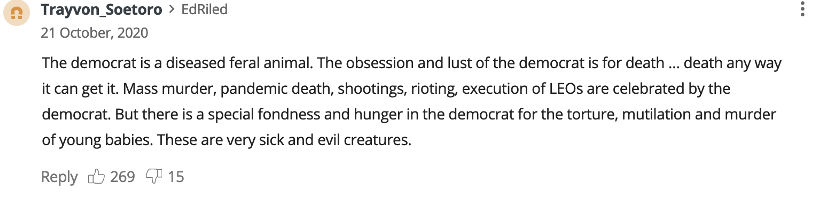
QAnon has facilitated the spread of dehumanizing rhetoric about out-group members (Democrats or liberals) in the United States; a significant portion of the population has internalized this rhetoric.
what is metadehumanization, and how does it differ from dehumanization?
We have already seen the idea of dehumanization and its sometimes tragic results
Metadehumanization is the perception that another group dehumanizes your own group
An in-group’s perception of metadehumanization may or may not accurately reflect the degree to which an out-group actually dehumanizes the in-group
what were the results from the “metadehumanization erodes democratic norms” study?
Goal: Examine how dehumanization and perceived dehumanization (“metadehumanization”) affect political attitudes and democratic norms.
Measure: Ascent of Man scale used to capture subtle dehumanization by rating how “fully human” groups are seen as being.
Key Concepts:
Dehumanization: Rating the out-group as less human than the in-group.
Metadehumanization: Belief that the out-group dehumanizes your group.
Findings:
Both Democrats and Republicans overestimate how much the other side dehumanizes them.
Higher metadehumanization → greater perceived threat, leading to more dehumanization and prejudice toward the out-group.
predicated (weakly) by higher levels of political interest, political knowledge, and use of online media
Dehumanization and metadehumanization are both linked to higher anti-democratic spite (willingness to hurt the out-group even at a cost to democracy).
Broader Implication:
Metadehumanization can create a self-reinforcing spiral (similar to a security dilemma), undermining democratic norms by framing politics as existential conflict rather than competition among equals.
how does the metadehumanization study suggest a pathway for reducing political polarization / increasing support for democracy?
Reducing negative out-group rhetoric may over time reduce the degree of metadehumanization
Education about politics (including teaching people about studies like this)
Labeling the point of origin of polarizing online content (e.g., showing a lot of it isn’t from the US at all)
Contact hypothesis – spend more time talking with out-group members and seeing that they’re mostly nice and reasonable
what is "pluralistic ignorance”?
There is often a mismatch between public opinion and perceptions of public opinion
Incorrect societal beliefs about the views held by society are referred to as pluralistic ignorance
Important forms of pluralistic ignorance exist across social identity group boundaries
e.g., Democrats (Republicans) may have incorrect views about what Republicans (Democrats) actually believe or prefer
Pluralistic ignorance can contribute to political polarization (unwarranted belief in the extremity of out-group members’ views)
Othering: treating out-group members as fundamentally different from in-group members (in ways that are exaggerated)
Out-Group Homogeneity Bias: unwarranted or excessive belief that members of an out-group think/behave the same as each other, neglecting actual differences in opinion/behavior
Pluralistic ignorance can sometimes inhibit policy change
what are some policy areas / values where perception of public opinion are likely incorrect (for members of one or both parties)?
Abortion
Covid response / politics of vaccines
Immigration
Attitudes about taxes/spending
Cultural issues
Gun control
Comfort with more extreme behaviors of in-group politicians
Climate change
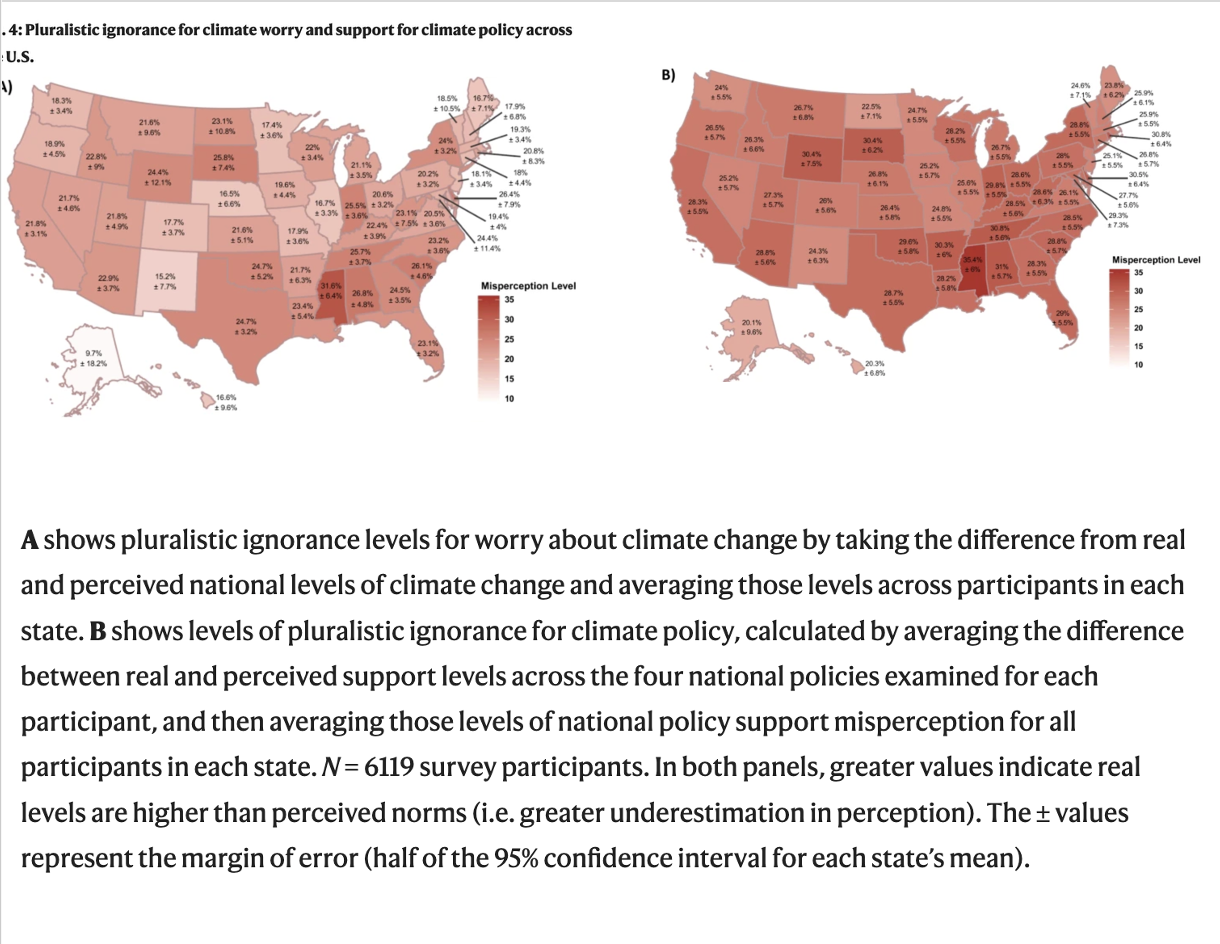
what did the “Americans experience a false social reality
by underestimating popular climate policy support by nearly half” study find?
Public belief in climate change, and support for various policies to address it, are higher than most people believe (especially among Republicans)
80-90% of Americans underestimate these quantities when asked to estimate them, indicating high degrees of pluralistic ignorance
what happened in the “Breaking the Rules to Rise to Power: How Norm Violators Gain Power in the Eyes of Others” experiment?
Research question: Do people who violate social norms get perceived as more powerful rather than less?
Core idea: Successfully breaking norms can signal freedom from social constraints, which people may interpret as power.
Design:
Participants watched one of two videos of a man ordering food in an open-air cafeteria.
Norm-violation condition: rude, inconsiderate behavior (feet on chair, ashes on floor, no “please/thank you,” doesn’t clean up).
Control condition: polite, norm-abiding behavior.
Measures:
Perceived power (Generalized Sense of Power Scale).
Expected emotional response when his order is wrong (anger vs sadness).
Approach tendencies (assertive, confrontational, action-oriented).
Inhibition tendencies (helplessness, passivity, acceptance).
Key findings:
The norm violator was judged as more powerful than the polite patron.
He was seen as angrier, less sad, more approach-oriented, and less inhibited.
Norm-breaking behavior conveyed an image of someone who takes charge and faces conflict.
Interpretation:
Violating norms—when done without punishment—signals dominance and autonomy.
These traits align with stereotypes of decisive, forceful leadership.
Broader implication:
In times of crisis, threat, or polarization, norm-violating leaders may appear especially attractive, as existing norms are seen as ineffective or outdated.
what are some real-world examples of norm-breaking that is seen today?
Personal attacks can be seen as a sign of strength or willingness to fight the other side (against old norms of politeness, civility)
Less professional / coarser behavior may be seen as a sign of strength of authenticity
Current mid-cycle redistricting frenzy
Exclusion of out-party media/figures from events/discourse (against old norms of universalism); now, re-including those figures is pushback against hyperpartisan group norms
Not conceding election defeats / questioning electoral outcomes
When are Transgression Credit and Innovation Credit granted to the greatest degree?
Transgression Credit: a social psychology concept where people show leniency or apply a double standard, forgiving rule-breaking (transgressions) by leaders from their own group (ingroup) more readily than they would for regular members or leaders from other groups
“Accrual Hypothesis” – Leaders accrue “prototypicality” (e.g., are seen as highly typical members of the in-group), and are then given the freedom to redefine group norms.
“Nixon goes to China”
“Conferral Hypothesis” – Group members’ willingness to concede that the right to be supported as leader is invested in the leadership role itself.
Legitimacy, belief in leader’s qualifications, knowledge, strength, etc.
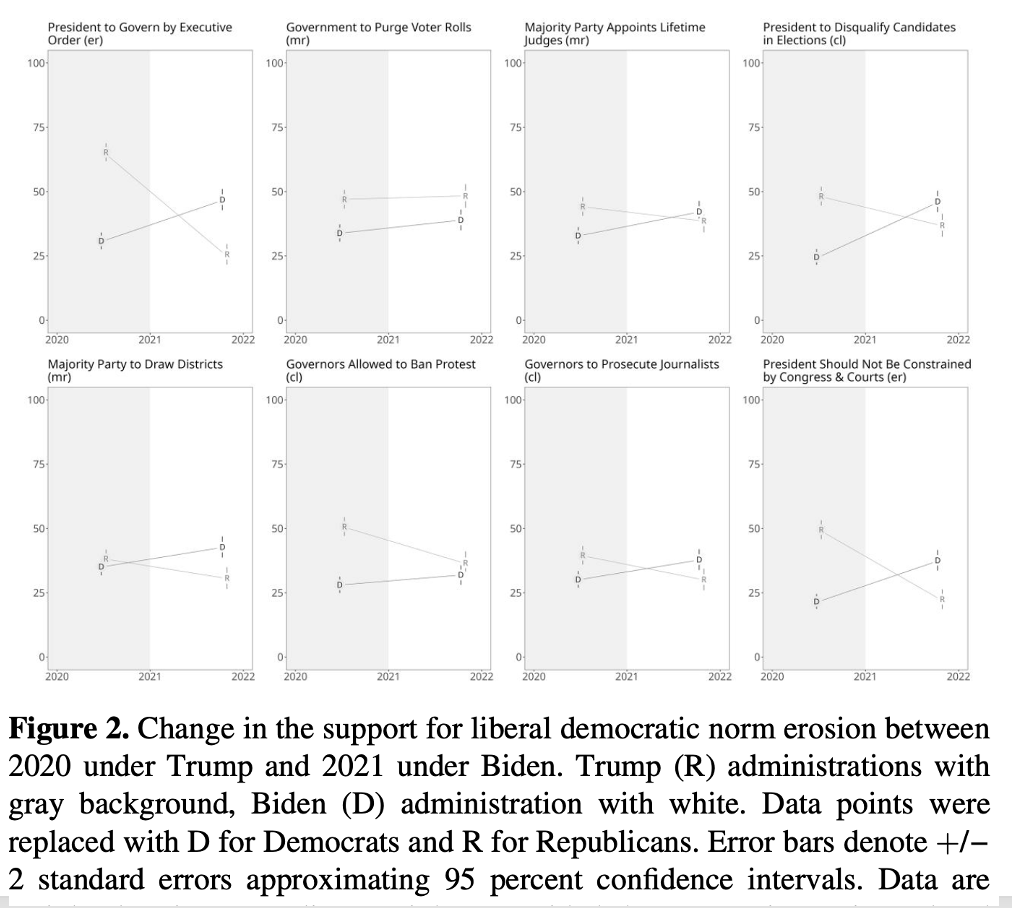
what did the “Americans of Both Parties Support Liberal Democratic Norm Violations More Under Their Own President” find?
Americans think it’s “sometimes justifiable for the president to close the Congress” more often when their own party holds the presidency.
Commitment to democratic norms is often conditional, not absolute.
Partisan identity can weaken democratic accountability by making people tolerate norm violations when they serve in-group goals.
 Note
Note  Flashcards (248)