Unit 3 Psych: Developmental Psychology
 Studied by 0 people
 Call Kai
 Learn
Learn Practice Test
 Spaced Repetition
 Match
Match Flashcards
 Knowt Play
1/28

There's no tags or description
Looks like no tags are added yet.
Name | Mastery | Learn | Test | Matching | Spaced | Call with Kai |
|---|
No analytics yet
Send a link to your students to track their progress
29 Terms
Developmental Psychology
Examines our physical, cognitive, and social change throughout the life span
Nature vs. Nurture
How does genetic inheritance and experience influence our development? Genetic physical traits, environmental personality, trauma, behavior
Continuity vs. Discontinuity
Is development a gradual process or does it proceed through the sequence of separate stages like climbing a ladder? stags like butterfly life cycle(caterpillar, chrysalis, butterfly)
Stability Vs. Change
Which of our traits persist through life? How do we change as we age?
How do Psychologists Study Development?
Cross sectional
Uses people of different ages to compare how certain characteristics may change over the course of life
Can be hard when groups have grown up in different times
Longitudinal
Examines one group of participants over a long period of time
Costly, takes a long time, and typically lose participants over time
Teratogens
Harmful agents that reach the embryo or fetus during prenatal development and can cause harm
Types of Teratogens
Viruses: Flu or rubella
Nicotine
Drugs: legal and illegal
Ex: Thalidomide
Fetal Alcohol Syndrome
Rooting, sucking, and grasping reflexes
Rooting Reflex - A baby’s tendency, when touched on the cheek, to open mouth and search for a stimulus such as a bottle
Sucking Reflex - The baby will suck on anything put in their mouth
Grasping Reflex - When something is placed in the palm of the hand or foot, the baby will try to grab hold of it.
Moro and Babinski Reflexes
Moro reflex - When startled the baby will flail out its arms and legs, then pulls them back in
Babinski reflex - When a baby’s foot is stroked, he or she will spread their toes
Maturation
biological growth process that enable orderly changes in behavior
Motor Development in Infants
Sequence is the same for motor development (roll over, sit up, stand, crawl, walk, etc) but timing varies
In U.S.- 25% learn by 11 months, 50% within a week of 1st birthday and 90% are walking by 15 months.
Identical twins tend to learn to walk on the same day.
Critical and Sensative periods
Critical period - The optimal period early in life when certain exposure to certain stimuli or experiences will produce normal development
Sensitive Period - Period that humans have to form attachments
Imprinting
Instinctive bonding to the first moving object seen right after birth
Some Animals will imprint- humans do not!
Puberty, Primary sex characteristics, Secondary sex characteristics, Spermarche, and Menarche
Puberty (notes: a horrible thing with many negative effects[not excuse harassing others, bullying, being an an a$$hole or not controlling oneself], at least part of the reason middle school sucks)
The period of sexual maturation, during which a person becomes capable of reproducing
Primary sex characteristics (notes: necessary for reproduction)
Ovaries, testes and external genitalia that make reproduction possible
Secondary sex characteristics (notes: not necessary for reproduction, non-reproductive traits)
Nonreproductive sexual traits- female breasts, voice changes, body hair
Spermarche (notes: it has become increasingly clear the FLE is useless [cont in menarche notes])
First ejactulation
Menarche (notes: we didn’t learn about any of this [also they have blatantly lied about things])
First menstrual period
Physical Changes in Middle Adulthood
As you age, your body experiences decline
physically - more aches and pains. :)
Decline in fertility in both men and women
Women experience menopause- menstrual cycles ends.
Also refers to the biological changes a woman experiences as her ability to reproduce declines
Physical Changes in Late Adulthood
Life expectancy is rising
Globally, life expectancy has increased from 66.8 years in 2000 to 73.4 in 2019 (WHO, 2024)
Life expectancy in United States is 78.5
Women typically outlive men by about 4.7 years
Aging Body
As we get older, our cells stop reproducing and become more vulnerable- ex- cold weather, a fall, mild sickness bother us as we age
Muscle strength weakness, eyesight gets worse , reaction time decreases.
Language
Our spoken, written or signed words and the way we combine them to communicate meaning
Phonemes, Morphemes, and Grammar
Phonemes - The basic unit of sound in a spoken language (not letters!)
English language has 44 (makes up the 500,000 or so words we have)
Some units have more than one phonemes
ex-vowels -based on long or short sound
Dog has how many?
Three phonemes- d, au, g
Morphemes - The smallest units of meaning
Can be a word or part of a word - prefix or suffix
Unbreakable
3 un-break-able
Pretested
3 pre-test-ed
Grammar - A Language’s set of rules that allow people to communicate
Semantics- language’s set of rules for deriving meaning from sound
Syntax- set of rules for combining words into grammatically sensible sentence
Language consists of phonemes put together to become morphemes, which make up words
Language Development
Babbling Stage
Starting around 3-4 months, the infant makes spontaneous sounds
Ex- da-da-da, na-na
One-Word Stage
1-2 years old. Uses one word to communicate big meanings
Ex- “da”- “look over there”
Telegraphic Stage
Around 2 , uses two or more words to communicate meaning
Ex- Want milk, play cars
Language Acquisition
The ability to learn language is universal BUT…
Children acquire language much easier than adults
Adults tend to make grammatical errors when speaking if learning the language as an adult (overgeneralization of language rules)
Jean Piaget(1896-1980) and his 4 Stages
According to Jean Piaget, Children develop schemas through continuous and discontinuous processes such as assimilation and accommodation
Stage 1: Sensorimotor Stage
0-2 Years
Experiences the world through senses
Babies engage in motor activities that bring a desirable result
Ex- touching a musical toy will make a satisfying noise
Do not have object permanence
The understanding that an object exists even if you can not see it
Stage 2 Preoperational Stage
2-7 years old
Have object permanence
Begin pretend play
Begin to use language to represent objects and ideas
Egocentric
Can’t look at the world through anyone’s eyes but their own
Animism
Children believe inanimate objects have lifelike qualities, and feelings
They do NOT understand the concepts of conservation
The idea that a quantity remains the same despite changes in appearance and part of logical thinking
Theory of the mind
Preschoolers form Theory of the Mind when they can begin to infer the mental states (beliefs, intents, desires, emotions and knowledge of others.
Still egocentric tho
Having ToM is important bc it provided the ability to predict and interpret the behavior of others
Stage 3 Concrete Operational
Ages 7-11
Children can demonstrate concept of conservation
Learning to think logically
Stage 4 Formal Operational
Late Childhood through adulthood
Can think abstractly
Hypothesize
Have higher order thinking skills
Not all adults reach achieve formal operational thinking
Schema, Assimilation, and Accommodation
Schema - A mental outlook or framework developed as a child and used to organize knowledge
Assimilation - Interpreting new experiences into one’s existing schema
Accommodation - Adapting to one’s current understandings to incorporate new information
Vygotsky’s Theory of social interaction and the mind
Lev Vygotsky
emphasized how a mind grows through interaction with the social environment
Differed from Piaget
Parents and teachers scaffold (giving children temporary support while developing higher levels of learning)by mentoring them and giving new concepts to dev higher level thinking.
Zone of Proximal Development
The zone between what a child can and can’t do- It’s what they can do with help
“Proximal” refers to the skills that the learner is close to mastering
Ecological Systems Model
Emphasizes the influence of various environmental systems on a person's development
Human development is shaped by interactions with different levels of social environments
Chronosystem: historical events (ex-COVID), political changes, life experiences
Macrosystem: cultural influences (geography, culture, values, socioeconomic status, religion)
Exosystem: environments that indirectly affect a person (parent’s jobs, mass media, community, neighbors)
Mesosystem: How different people in your microsystem interact with each other? (coaches and teachers? Teachers and Parents?)
Microsystem: Who were/are your major influences close to you?
Attachment Theories - Stranger Anxiety, Attachment, Harry Harlow and Margaret Harlow, Contact comfort, and Mary Ainsworth: Attachment Theory
Stranger Anxiety
After 8 months children develop stranger Anxiety
The fear of strangers that infants display
They have schemas for familiar faces; when they can’t assimilate new faces into their remembered schemas they stress
Attachment
Refers to a bond between a caregiver and a child. It has a significant impact on a child’s development on both a social and emotional connection
Harry Harlow and Margaret Harlow
Harlow and Harlow investigated attachment, maternal separation and dependency
Theorized that infants attach to those who provided comfort not nourishment
Experimented on Rhesus monkeys
Cloth mother w/ no milk vs. wire mother with milk
Contact Comfort
The study showed that the monkeys overwhelmingly preferred contact comfort- comfort via touch, snuggles etc
Mary Ainsworth: Attachment Theory
Developed the Stranger Situation.
Experiment was to see how a child reacts when a mother leaves a room with a stranger
Goal was to investigate various forms of attachment and bonding between children and their mothers
Developed the following:
Secure Attachment
When mother leaves: Child is upset
Return of mother: Child makes an effort to touch mother and seek comfort
Avoidant Attachment
When mother leaves: Child is indifferent
Return of Mother: May seek contact but then pull away
Ambivalent Attachment
When mother leaves: VERY distressed
Return of mother: They are not comforted by the parents return. Could show Resent towards them
Disorganized Attachment *Added in 1990 by Mary Main
When mother leaves: no clear attachment behavior
Return of Mother: confused or apprehensive around presence of mother
Are Attachment Styles the Result of Parenting?
Question: Is attachment styles a result of parenting or genetic influence (temperament )?
Temperament defined: a person's characteristic emotional reactivity and intensity
Developmental studies conclude that heredity affects temperament and temperament affects attachment styles
Easy Temperaments in children
Typically generally happy and adaptable
Difficult Temperaments in children
Tend to be more irritable and harder to soothe; slow to warm up to people
Authoritarian
Parents who impose rules and expect obedience.
“My way or the Highway”
Children with authoritarian parents often can’t make decisions for themselves.
Permissive
Parents who seek friendship with their children and set few boundaries.
Children of permissive parents may be more impulsive and demanding because they are use to getting their way
Authoritative
Responsive to the input and needs of their children
Set rules, but not demanding
Children are usually well balanced and have good decision making abilities and high self esteem
How does childhood neglect and abuse affect children’s attachment?
Adverse Childhood Experiences (ACE)
Children without an attachment to anyone ( raised in institutions, or raised in homes with extreme abuse and neglect) are often withdrawn, frightened
Some never recover and the trauma stays with them and they may become abusers themselves (30% of people who have been abused later abuse their children) (Dumont, 2007)
Most are resilient- they withstand the trauma and become well adjusted adults
How do Peer Relationships Develop over Time?
Young Children
Engage with each other through play
Parallel Play
Playing side by side but not playing together
Pretend Play
Adolescents
Rely on peer relationships as they age
Egocentric in terms of:
Personal fable
they believe they are unique and invulnerable to harm)
Imaginary audience
They believe that everyone is paying attention to them and looking at everything they do.
Adults Social Developments
Culture plays a role in determining when adulthood begins and when major life events occur
Social Clock- cultural expectations for when certain life events should occur
Relationships with other adults result in forming families or family like relationships
They provide mutual support and care
James Marcia’s Identity Theory
People go through 4 identity statuses as they develop their identity
Diffusion stage
People who have not decided on who they are or what they want
Foreclosure
A premature commitment to an identity but without giving much thought to their decision
Moratorium
Trying to seek a more meaningful identity
Achievement
A committed sense of self…you know who you want to be…
The stages are based on the level of exploration and commitment a person has made regarding their identity
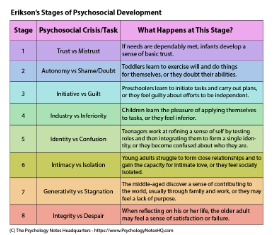
Social Development: Erikson’s 8 Stages
Erik Erikson
Maintained that personality develops in a predetermined order
8 stage of psychosocial development
infancy to adulthood
During each stage, the person experiences a psychosocial crisis which could have a positive or negative outcome for personality development
 Note
Note  Flashcards (100)