BS1030 Topic 7 - Metabolism 1
 Call Kai
 Learn
Learn Practice Test
 Spaced Repetition
 Match
Match Flashcards
 Knowt Play
1/35

There's no tags or description
Looks like no tags are added yet.
Name | Mastery | Learn | Test | Matching | Spaced | Call with Kai |
|---|
No analytics yet
Send a link to your students to track their progress
36 Terms
What is metabolism?
sum of all chemical reactions in the body
What is catabolism?
breaking down molecules to release of energy (usually oxidative)
names end in lysis (e.g glycolysis) and generates ATP & NADH
What is anabolism?
the formation of complex molecules from simple ones : uses energy usually reductive
Names end in genesis (e.g lipogenesis) and uses ATP, GTP, UTP
What are the three stages in catabolism?
1) Digestion of macromolecules - Large molecules broken down into smaller ones and absorbed• no energy gained
2) production of Acetyl coA - Small molecules broken into simpler units that play key role in metabolism• some energy gained
3) Oxidation of Acetyl to produce ATP - ATP produced form complete oxidation of acetyl units • Lots of energy gained
What joins phosphate groups in ATP together
phosphoanhydride bond
How are carbohydrates digested?
Carbohydrates digested first in mouth by amylase
breakage of glycosidic bonds to produce monosaccharides (galactose and fructose)
can be transported from gut/through Basel membrane via transporters (GLUT5 for fructose and GLUT2 for galactose)
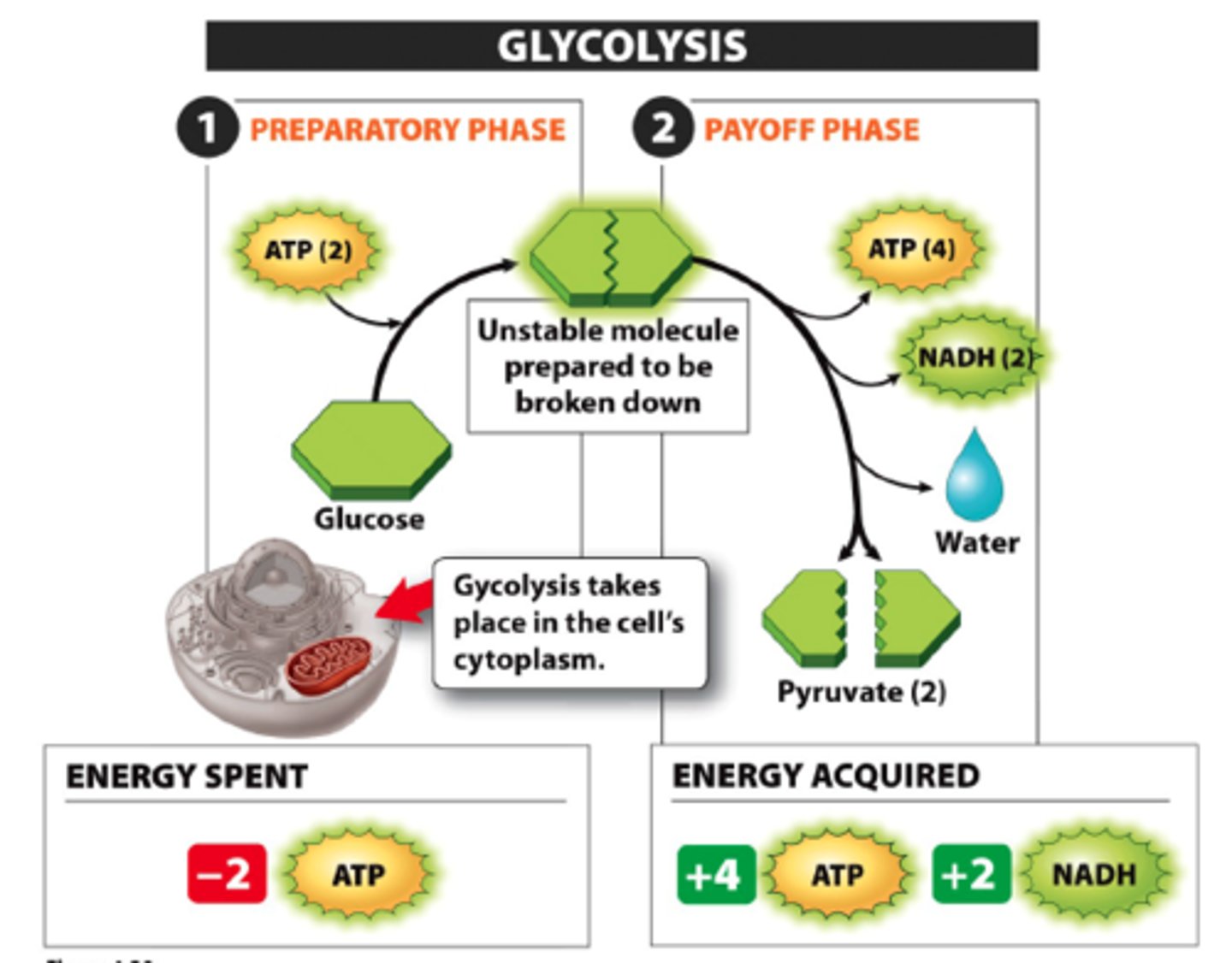
What are the 2 stages of glycolysis?
preparation phase and payoff phase
What is the role of hexokinase?
Phosphorylates glucose to make glucose 6 phosphate
ATP consumed and traps glucose inside cell (makes it hydrophilic)
What is the role of PFK-1 (phosphofructokinase -1) in glycolysis?
phosphorylates fructose 6-phosphate • ATP consumed • essentially irreversible
What is the payoff phase of glycolysis?
Oxidative conversion of glyceraldehyde 3-phosphate to pyruvate and the coupled formation of ATP and NADH
What is the preparation phase of glycolysis?
glucose is phosphorylated (adding phosphate group to a molecule derived of ATP)
What are the main dietary sources of metabolic energy?
Carbohydrates, fats, and proteins
How is ATP regenerated in cells?
By substrate-level phosphorylation and oxidative phosphorylation.
What are common electron carriers?
NADH, NADPH, FADH2
what is NADH?
The reduced form of NAD⁺ that carries high-energy electrons (electron and H+ ion carrier)
What is NADPH used for?
Reductive biosynthesis in anabolic pathways.
What is FAD and FADH₂?
Flavin adenine dinucleotide and its reduced form; electron carriers derived from riboflavin.
What is coenzyme A (CoA)?
A carrier of activated two-carbon (acetyl) groups derived from pantothenate.
Why do metabolic pathways involve many steps rather than one reaction?
To release energy in small, usable amounts
What are the main ways metabolic pathways are regulated?
Regulation of enzyme activity
Regulation of enzyme amount
Regulation of substrate availability
What is allosteric regulation?
Regulation by binding of small molecules at a site other than the active site, causing conformational change.
What is reversible covalent modification?
Regulation of enzyme activity by phosphorylation or dephosphorylation.
Give an example of reversible covalent modification.
Glycogen phosphorylase is active when phosphorylated and less active when dephosphorylated.
How can cells regulate the amount of enzyme present?
By controlling gene expression
How does substrate availability regulate metabolism?
By controlling entry of substrates such as glucose into cells or availability of NAD⁺/NADH.
What is glycolysis?
A central metabolic pathway that converts glucose into pyruvate, producing ATP and NADH in the cytoplasm
What are the main stages of glycolysis?
Preparation phase - glucose is trapped and split; ATP is consumed
Payoff phase - ATP and NADH are produced
What is the net yield of glycolysis per glucose molecule?
2 ATP, 2 NADH, and 2 pyruvate.
What are the key sugar intermediates you should recognise?
Glucose
Glucose-6-phosphate
Fructose-6-phosphate
Fructose-1,6-bisphosphate
Which enzyme traps glucose inside the cell?
Hexokinase (uses ATP)
Which enzyme catalyses the committed step of glycolysis?
Phosphofructokinase-1 (PFK-1)
Which enzyme produces NADH in glycolysis?
glyceraldehyde-3-phosphate dehydrogenase
Which enzymes produce ATP in glycolysis?
phosphoglycerate kinase and pyruvate kinase
What are the three irreversible reactions in glycolysis?
Hexokinase
Phosphofructokinase-1
Pyruvate kinase
What is substrate-level phosphorylation?
Direct transfer of a phosphate group from a high-energy intermediate to ADP to form ATP.
Why must NAD⁺ be regenerated in glycolysis and how ?
To allow glycolysis to continue by accepting electrons.
Pyruvate is reduced to lactate by lactate dehydrogenase, oxidising NADH back to NAD⁺.

