Lecture 12: Reasoning – Introduction and Deductive Reasoning
 Studied by 3 people
 Call Kai
 Learn
Learn Practice Test
 Spaced Repetition
 Match
Match Flashcards
 Knowt Play
1/20

There's no tags or description
Looks like no tags are added yet.
Name | Mastery | Learn | Test | Matching | Spaced | Call with Kai |
|---|
No analytics yet
Send a link to your students to track their progress
21 Terms
What is deductive reasoning?
Using facts to reach a logically certain conclusion.Think given A and B is true then statement C must be true.
What is inductive reasoning
Using facts to reach a ‘plausible’ conclusion, this allows for room for doubt.
What is a syllogism?
E.G all men are mortal. Socrates is a man. Therefore, Socrates is mortal.
Syllogisms are tools for formalising arguments.
What is the difference between a major vs. a minor premise vs. a conclusion?
‘All men are mortals’ – the major states a general rule
‘ Socrates is a man’ - the minor premise states a specific state.
‘ Therefore, Socrates is mortal’ – the conclusions is the statement we asked to accept
What is an antecedent vs. a consequent?
‘ If Socrate is a man, (Antecedent) then he is mortal ‘ (Consequent)
What is affirming evidence?
Affirming " evidence" refers to a fact (in the minor premise) that agrees with the major premise in some sense.
What is denying evidence?
“Denying” evidence refers to a fact (in the minor premise) that disagrees with the major premise in some sense.
What are valid arguments?
Conclusion is necessarily true if the premises are true • i.e., it is impossible for the premises to be true and the conclusion to be false (at the same time)
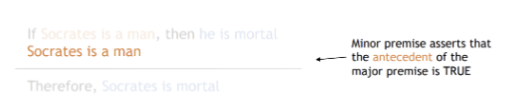
What is a valid argument by affirmation?
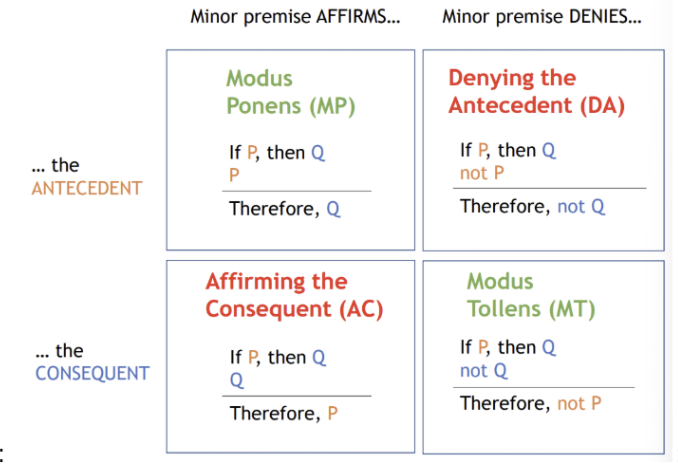
Uses antecedent and affirms → modus ponen, in which a minor premise asserts that the antecedent of the major premise is TRUE
What is the valid argument by denial?
Uses consequents and denies → modus tollens, in which a minor premises asserts the consequences of the major premises is FALSE

What are invalid arguments?
Conclusion might be true, but it is not guaranteed by the premises • i.e., it is possible for the premises to be true but the conclusion can still be false
What is the invalid argument by affirmation?
affirming the consequent, minor premises asserts the consequent of the major premises is true.

What is the invalid argument by denial?
denying the antecedent, minor premise asserts the antecedent of the major premises is false.

Draw the table?
Do people follow the deductive rules?
Adults are good with arguments with the antecedent
Adults are not good at the consequent .
Kids assume that affirmatory arguments are correct.
There seems to be a developmental pipeline between how kids develop their reasoning into adults.
Describes Watson’s Selection Task
Participants are told that if there is an R on one side there are 2 on the back. Participants are asked to flip the card depending on whether there is a 2, R or OTHER. This is analogous to the different arguments under deductive reasoning.
The experiment finds that most people use the positive test strategy selection for the two cards that affirms the rule, technically this isn’t necessarily true for both types of reasoning.
Note that both adults and kids follow this positive evidence system
What is the difference between an indicative rule vs. a deontic rule?
An indicative rules states that ‘if this then that’
A deontic rule states that ‘if this then we should do that’.
What is inductive reasoning?
Inductive arguments rely on limited evidence to make a (general or specific) conclusion seem more plausible.
More usable in everyday life as people generally have access to less perfect information.
What to note about inductive reasoning?
People are more willing to endorse an inductive argument when the premise and conclusion items are similar.
People are more willing to endorse an inductive argument when the premises are dissimilar.
People are more willing to make inductive generalisations when they have more examples!
What is an argument from ignorance?
Claiming that X must be true just because you can’t prove that X is false
Technically these are both deductively valid.
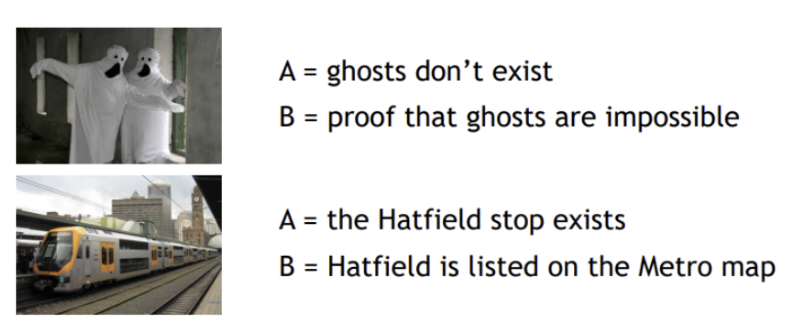
However, the hatfield stop example with the metro, exists in an epistemically closed world, that is, the train network is presumed to be a closed system
In the case of ghosts, this is not the case. We don’t know everything about the world therefore, we don’t know if ghosts exist or not.
Generally, arguments from ignorance have greater belief if it exists in an epistemically closed world
What is a circular argument?
Assuming that X is true in order to prove that X is true – God exists because the Bible says so, and the Bible is the word of God.
Circular arguments are often an implicit appeal to an explanatory system.
People find circular arguments are more convincing when the alternative explanation is less plausible
 Note
Note  Flashcards (491)