BI 222 Topic 2
 Call Kai
 Learn
Learn Practice Test
 Spaced Repetition
 Match
Match Flashcards
 Knowt Play
1/65

Earn XP
Description and Tags
1-59 are from lecture, 60-66 are added from the weekly videos because he didn't get to endo and exocytosis in class. :)
Name | Mastery | Learn | Test | Matching | Spaced | Call with Kai | Chat |
|---|
No analytics yet
Send a link to your students to track their progress
66 Terms
Membrane fluidity is based off of
phospholipid movement
How often do phospholipids move laterally?
~ 107 times per second
How often do phospholipids flip flop?
~1 time a month
Viscous materials have phospholipids with _____ tails.
saturated - straight tails.
Fluid materials have phospholipids with _____ tails.
Unsaturated - bent tails.
The tail of a phospholipid is ______.
Hydrophobic. (Hating)
The head of a phospholipid is _______.
Hydrophilic (loving).
Transmembrane proteins - aka…
Integral Proteins
Transmembrane proteins are called so because they?
Go all the way through the plasma membrane (PM).
The hydrophilic parts of a transmembrane protein is found…
Outside the PM, the part you would see from outside the cell.
The hydrophobic part of the transmembrane protein is found…
inside the membrane, along with the tails of the phospholipids.
Peripheral proteins are found….
Only on the surface of a PM, not all the way through it. They are usually temporary.
The purpose of cholesterol in the PM is?
To be a fluidity buffer to large changes within a membrane.
What types of fluidity control does cholesterol offer?
Both hot/cold, and viscous/fluid.
The purpose of carbohydrates on the plasma membrane is?
cellular identification/recognition.
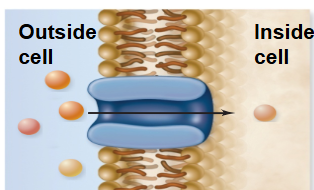
This is a what doing what?
Transporter protein conducting facilitated diffusion.
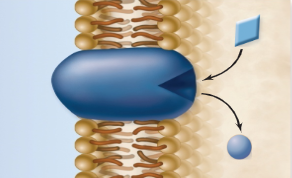
This is a what doing what?
Enzyme breaking down a protein.
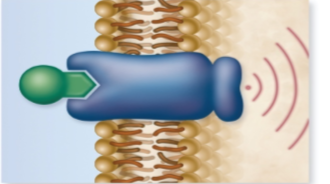
This is a what doing what?
Surface receptor reading a protein.
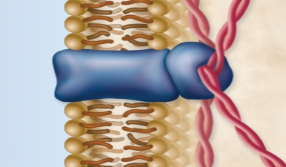
This is a what doing what?
A transmembrane protein attached to the cytoskeleton.
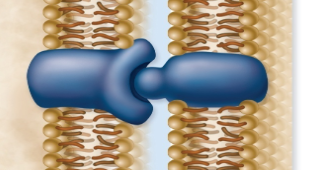
This is a what doing what?
Cell to cell adhesion membrane adhering.
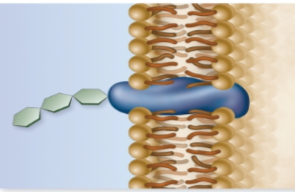
This is a what doing what?
A cell surface ID transmembrane protein waiting to be read.
Diffusion
the movement of an item from high to low concentration
Items always naturally move ____ a concentration gradient without a found of energy to do differently.
down
Passive transport means?
No energy required to diffuse across a membrane.
What are the two types of passive transport?
Simple and facilitated diffusion
Simple diffusion
item can move directly through the membrane.
Particles for simple diffusion must be what?
small and nonpolar.
What is the consequence of simple diffusion?
It is harder to establish a concentration gradient.
Examples of things that undergo simple diffusion
O, CO2, H2O (slightly slowed)
Facilitated diffusion means?
Membrane protein is required for diffusion, but no energy is used.
This is done through channel and carrier proteins
Channel proteins are for what molecules?
Smaller, charged molcules.
ions, Na+, K+, Cl-
Facilitated diffusion channel proteins specifically for cells that need to move large amounts of water
Aquaporins!
Carrier proteins are for what?
Larger items like monosaccharides and amino acids
Osmosis
diffusion of water across a membrane.
high [H2O] → low [H2O]
What happens when something dissolves into H2O?
H2O binds to it.
Hypertonic
High solute, outside the cell.
Low H2O outside - so the water inside the cell will move out.
Hypotonic
Low solute outside the cell.
Higher H2O outside - so the water will move into the cell
Isotonic
equilibrium between inside and outside of a cell.
Active transport!
Requires energy and a membrane protein.
Moves things UP a concentration gradient
[low] → [high]
Uniporter
moves one molecule one way across the PM
Symporter
moves two molecules the same direction across a membrane.
Antiporter
moves two molecules, opposite directions across the membrane, effectively switching which side they are on.
Primary Active transport
requires ATP directly
all items move UP their concentration gradient.
What established electrochemical gradients?
Primary Active Transport
Proton pump does what?
pumps proton (H+) ions
[in] → [out]
The proton pump is used by who?
Mostly plants, fungi, and bacteria.
Moves h= outside, and adds more of a positive charge outside.
What is the main pump used by animals?
Sodium potassium pump.
Na + / K +
What happens in the sodium potassium pump?
3 NA + out
2 K+ in
This increases the outside positive charge.
Secondary Active Transport
uses energy stored in the gradient (H+ or Na+)'
items moving down release E that is used by the cell to do work, usually transporting things up the concentration gradient
What type of transport do plants use for moving sucrose?
Secondary Active Transport
Plants use 2nd active transport to do what?
Use ATP to pump 1 H+ outside cell, and then a symport pulls the H+ and a sucrose molecule back inside the cell.
What type of transport do humans use for moving glucose?
Secondary active transport
Humans use 2nd active transport to do what?
pump Na + outside the cell with the sodium potassium pump, and then the NA+ glucose import takes a Na+ and a glucose and brings them inside the cell.
Parietal Cells
1/3 main types of stomach lining cells that excretes chemicals.
What is the first step of the Parietal Cell process?
CO2 comes into the cell from the blood, and combines with OH from the dissociating water to make HCO3
What is the second step of the Parietal Cell process?
Protein 1 - an antiport, pumps out 1 H+ (from the dissociated water) from the lumen and draws in one K+ ion using 1 molecule of ATP.
(Both are going up their gradient.)
What is the third step of the Parietal Cell process?
Protein 2 - a channel protein, releases the K+ ion down it’s concentration gradient into the lumen
What is the fouth step of the Parietal Cell process?
Protein 4 - a secondary antiport draws out the HCO3 into the bloodstream and brings in a Cl - ion.
What is the fifth step of the Parietal Cell process?
Protein 3 - a channel protein, diffuses a Cl - ion outside into the lumen.
Vesicle
small pocket of cell membrane that surrounds something
Endocytosis
“In”
fuses to cell and opens to allow vesicle contents to go inside the cell.
Exocytosis
“Out”
fuses to the cell to allow vesicle contents to move out of the cell.
usually expels waste, or other important molecules like cellulose for cell walls.
What do endo and exocytosis require?
Large amount of energy
Phagocytosis
Large food or bacteria is surrounded by cell like it “eats” it.
Receptor mediated
Molecules bind to receptors in an encoded pit on the PM.
When enough molecules are there, it deepens and seals into a vesicle.
Pinocytosis
takes in fluids and tiny particles.