Paleo 419 Final
 Call Kai
 Learn
Learn Practice Test
 Spaced Repetition
 Match
Match Flashcards
 Knowt Play
1/145

There's no tags or description
Looks like no tags are added yet.
Name | Mastery | Learn | Test | Matching | Spaced | Call with Kai |
|---|
No analytics yet
Send a link to your students to track their progress
146 Terms
Who discovered Chasmosaurus (Ceratopsidae)
Russel
Ceratopsidae Stance
Slightly sprawling based on footprints but not as much as the proposed “Russell Sprawl”
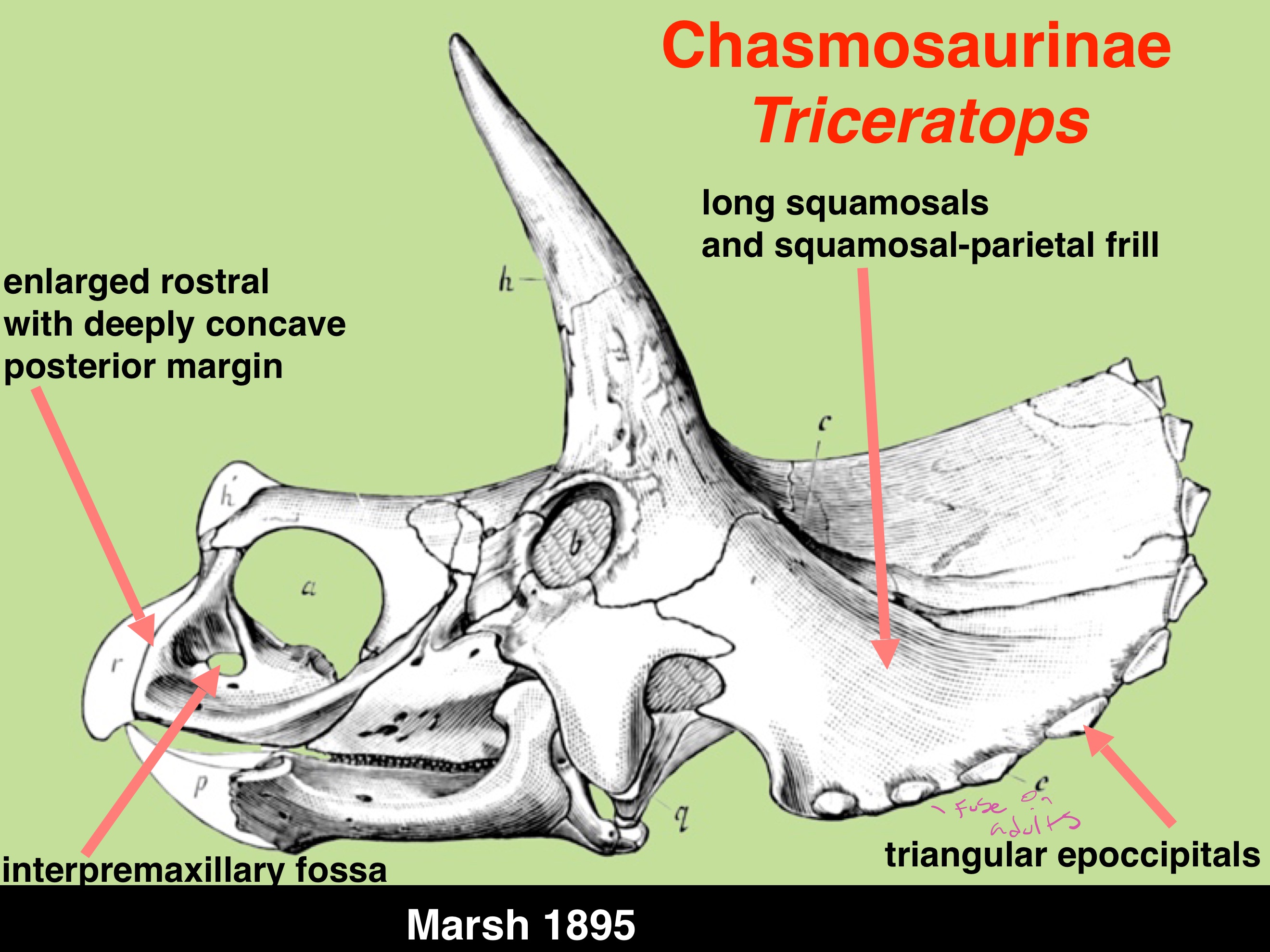
Chasmosaurinae Synapomorphies
long squamosals and squamosal-parietal frill
enlarged rostral with deeply concave posterior margin
interpremaxillary fossa
keyhole shaped frontal fontanelle
triangular SQ epoccipitals
Purpose of the keyhole shaped frontal fontanelle in Chasmosaurinae
Adds strength because supraorbital horns are long and heavy
What group is Regaliceratops peterhewsi in?
Chasmosaurinae
Chasmosaurus belli (Chasmosaurinae)
found at edge of hill with its arms lost in a sinkhole
Dinosaur Park Formation
Upper Cretaceous
Eotriceratops xerinsularis (Chasmosaurinae)
Dry Island Park, Alberta
Horseshoe Canyon Formation
Triceratops ancestor
Destroyed by acidic water
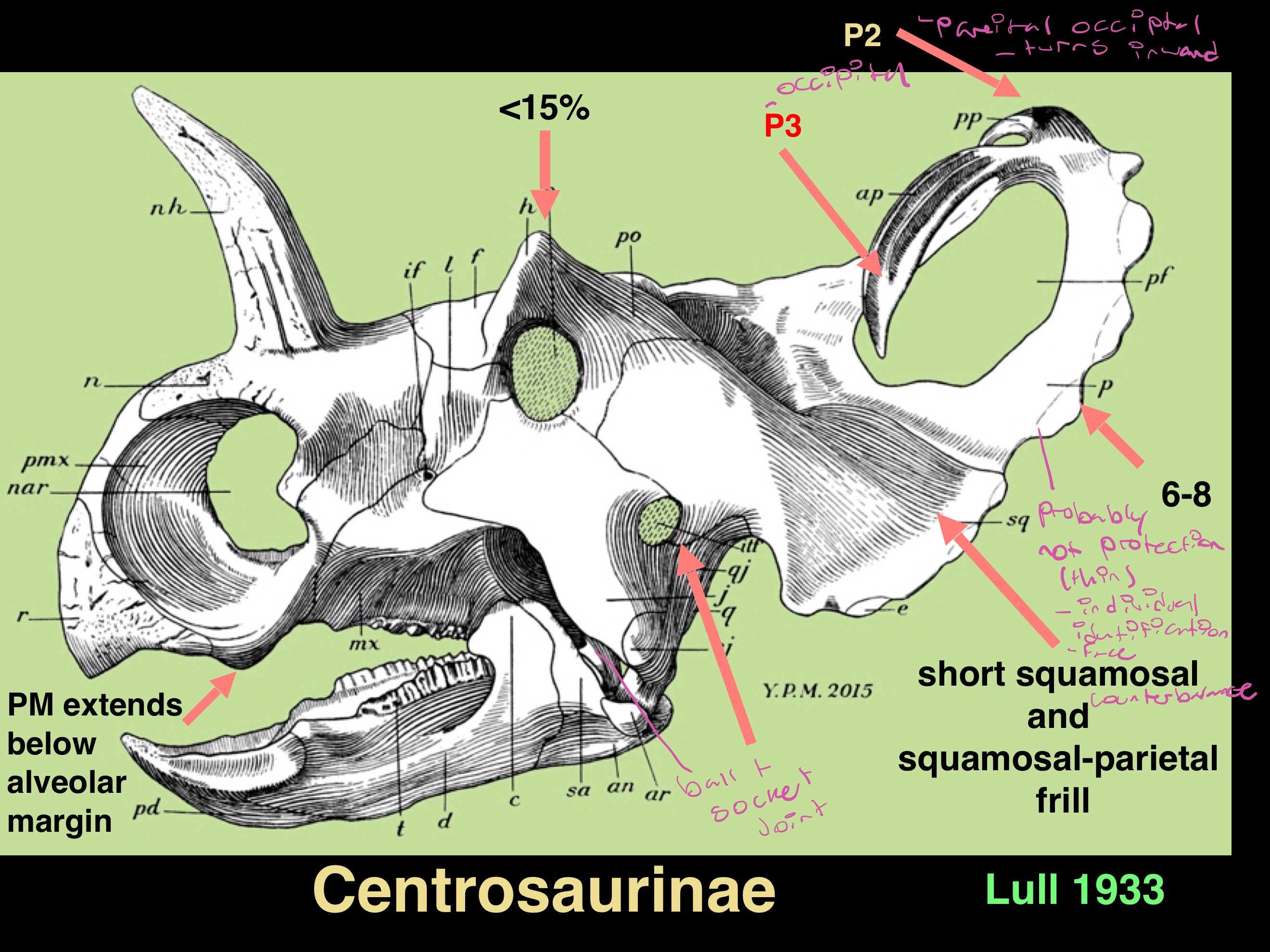
Centrosaurinae Synapomorphies
PM extends below alveolar margin
postorbital horns less than 15% length of skull
jugal intratemporal flange
short squamosal and squamosal-parietal frill
6-8 parietal epoccipitals on each side
parietal epoccipital 2 medially directed
parietal epoccipital 3 can become a large horn
Frills too thin for self defence
Monoclonius (Centrosaurinae)
first described by E.D. Cope
Montana
What group is Centrosaurus apertus, Centrosaurus nasicornis, Xenoceratops foremostensis, Albertaceratops nesmoi, Coronosaurus brinkmani in?
Centrosaurinae
Centrosaurus nasicornis - DPP
Xenoceratops foremostensis - distinctive frills
Albertaceratops nesmoi - type from AB
Styracosaurus albertensis (Centrosaurinae)
Tyrell museum
Scott Pearsons found weathered horn with a skull underneath
Had bosses as well
Pachyrhinosaurus (Centrosaurinae)
Wann Langston collected at Scabby Butte
Bonebed from Pipestone Creek with 300 bones per cubic meter
Abbasid’s look like Triceratops
Boss instead of horns
Wapiti river
Achelosaurus (Centrosaurinae)
New Pachyrhinosaurus species
Campanian - Upper Cretaceous
DPP
Pachyrhinosaurus from Alaska (Centrosaurinae)
Pachyrhinosaurus peretorum
Maastrichtian
Hovasaurus + Centrosauru death assemblages
Hovasaurus young and old specimens found suggesting natural deaths. Centrosaurus deaths mostly found in one age suggesting catastrophic death
Scelidosaurus (Thyreophora)
Lower Jurassi
England
named in 1860 by Owen
Marine deposits
Predentary lost
Cingulum
Teeth with cylindrical, tall roots
Stegosaurs (Thyreophora)
low tubular skulls
flattened dorsal surface of p
Originally thought to have 2 brains
Huyangasaurus taibaii (Thyreophora)
late Jurassic
China
sister group to Stegosauridae
retains, premaxillary teeth, and ossified tendons in tail
Double series of plates on back
preacetabular process 35 degrees outward
Ilia diverged at the front
Broad abdomen
Only 1st digit is a hoof
Plates with blood vessel canals to help cool down
Tuojiangosaurus multispinus (Thyreophora)
late Jurassic
China
Different plates to Stegoceras
Stegoceras (Thyreophora) similarities to Sauropods
pedal digit I lost III and IV with 3 phalanges verts with small neural canal & tall neural arch
Liaoningosaurus paradoxus (Thyreophora)
Primitive Ankylosaur
Size of a fist
Aquatic deposits
Fish gut contents
Nodosauridae (Thyreophora)
supraorbital boss rounded
only bocc in occipital condyle
ornamentation on pm
Heavily ornamented premaxillary
Sauropelta edwardsi (Nodosauridae)
Complete set of scutes found
Early Cretaceous, Montana
Edmontonia and Panoplosaurus (Nodosauridae)
Same species
No tail club
Shoulder spikes
Footprints found
Teeth way smaller than ankylosaur
Cingulum
Borealopelta markmitchelli (Nodosauridae)
Brown, Henderson, Vinther, Sistiaga, Herrera, Summons
Soft tissue found
Stomach contents
Had countershading
Antarctica
Vertebrae with fused tendons
Ankylosauridae (Nodosauridae)
Late Cretaceous, North America
pyramidal sq boss
tail club
Tail club bigger than skull
Advanced lineage
Osteoderms fused to dermal bones
Scutes cover external mandibular fenestrae
Antorbital fenestrae closed
Skate covers eye like a eyelid
Ilia spread to make room for plant fermentation vat
What group is Struthiosaurus and Euocephalus in?
Ankylosauridae (Nodosauridae)
Pinacosaurus quarry
Bayan Mandahu
China
Suggest gregarious ankylosaurs
Babies found
Alag Teg formation
Mongolia
Baby anklosaurs found but no adults
Lots of limbs
What group is Pinacosaurus, Tsagantegia, Saichania, Tarchia and Zaraapelta nomadis in?
Advanced Ankylosauridae (Nodosauridae)
Sauropodomorpha synapomorphies
transversely compressed internarial bar
diameter of external naris at least 60% orbit diameter
infratemporal fenestra extends forward to point below orbit
tooth crowns overlap in lateral view
ventral deflection of anterior end of dentary
Prosauropoda (Sauropodomorpha)
late Triassic
Europe, Greenland, Sauriermuseum Frick
Posteriorly inset first dentary tooth
Large pubic obturator foramen
Anchisaurus (Sauropodomorpha)
McCoy Brook Fm.
Lower Jurassic of Nova Scotia
Lufengosaurus (Sauropodomorpha)
Lower Jurassic of Lufeng Basin
Yunnan, China
30+ skeletons found
Massospondylus (Sauropodomorpha)
early Jurassic
South Africa
Argentina, Arizona
Embryos found
Mussaurus (Sauropodomorpha)
tiny
Late Triassic
Argentina
Sauropoda (Sauropodomorpha) synapomorphies
pneumatic vertebrae in neck and trunk
External sculpturing by pneumatic tissue
Massive columnar limbs
Short lower legs, hands, feet
Pneumatic entrance in the centrum
I-beam shaped bones - strength, least weight
Shunosaurus (Sauropoda)
Late Jurassic, China
snout broadly rounded in dorsal view
posterior margin of external naris is posterior to posterior margin of antorbital fenestra
What group is Mamenchisaurus and Omeisaurus in
Sauropoda (Sauropodomorpha)
Nigersaurus (Sauropoda)
Early Cretaceous, Niger
part of Rebacchisauridae
Primitive skulls
Dicraeosaurus (Diplodocoidea, Sauropoda)
Late Jurassic, Tanzania
Tall neural spines, bifurcated
Posterodorsally placed external nares
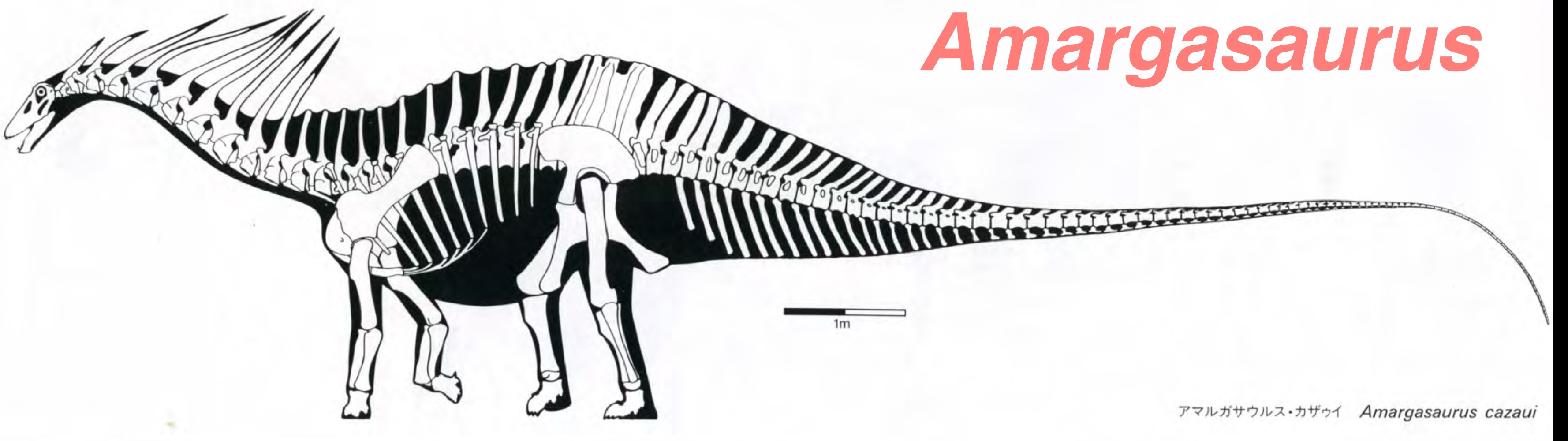
Amargasaurus and Pilmatueia faundezi (Sauropoda)
tall spines on neck
Argentina
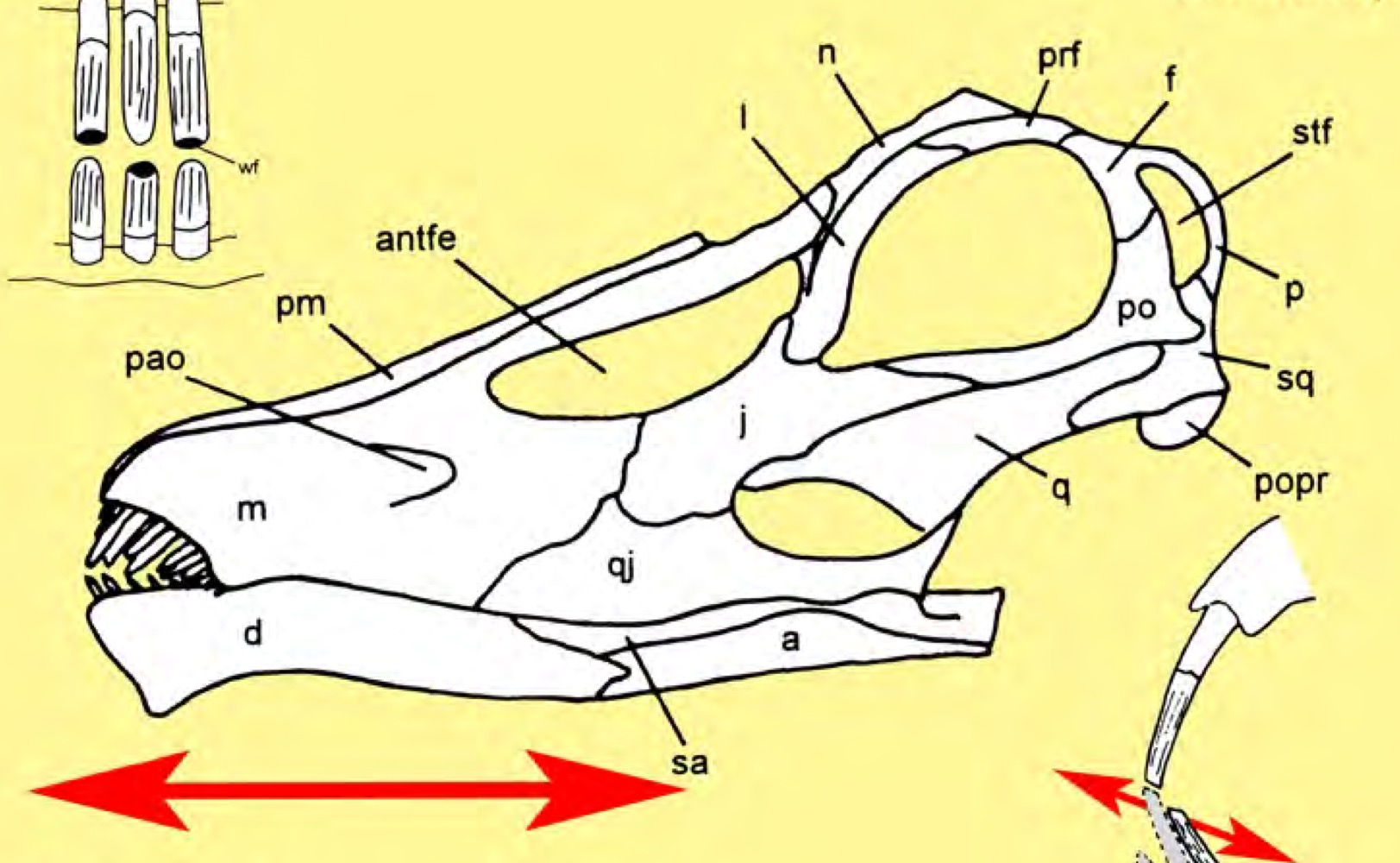
Diplodocus longus (Sauropoda)
Elongated dentary, tiny mouth
Late Jurassic
Tall neural spines
Long neck and tail
Barosaurus lentus (Sauropoda)
Thought to have stood on hind legs to get leaves like elephants
Supersaurus (Sauropoda)
very long neck
Late Jurassic
Dry Mesa, Colorado
Macronaria groups (Sauropoda)
Includes camarasaurids, brachiosaurids, titanosaurids
Brachiosauridae (Macronaria, Sauropoda) synapomorphy
enlarged deltopectoral crest
H/F length ratio of almost 1.0
Brachiosauridae (Macronaria, Sauropoda) species
Brachiosaurus - Late Jurassic USA
Giraffatitan - Tanzania
Europasaurus - Late Jurassic Germany
Kent Stevens
showed that the osteological neutral pose in Berlin Brachiosaurus specimens put the head just over 6 m above the ground
Titanosauria (Macronaria, Sauropoda) synapomorphy and species
robust radius and ulna (proximal width of radius at least a third of its length)
Alamosaurus, Argentinosaurus, Saltasaurus
Argentinosaurus (Titanosauria, Macronaria, Sauropoda)
largest dinosaur ever found
Plaza Huincul, Argentina
Los Barrealis
Neuquen, Argentina, bone bed at the end of a lake
Fuglognkosaurus (Titanosauria, Macronaria, Sauropoda)
Portezuelo Formation
Cretaceous, Argentina
Auca Mahuida
bone bed
Has lots of sauropod eggshells
Skin impressions on eggshells
Embryo skull found
Opisthocoelicaudia and Nemegtosaurus (Titanosauria, Macronaria, Sauropoda)
Mongolia
Large femur found
Footprints found
Theropoda synapomorphies
reduced number of fingers
Pneumatic skull
most diverse (successful) clade of dinosaurs
Late Triassic (Carnian) to Recent, and on all continents
What group is Eoraptor and Herrerasauridae in
basal saurischians outside of Theropoda
Tawa
Part of Neotheropoda
Ghost ranch
Very basal
Ceratosauria (Neotheropoda) synapomorphies
Shares characteristics as Coelophsis
axial neural spine extends anteriorly beyond prezygapophysis
dorsoventrally low postaxial neural spines
transverse processes on dorsals triangular and backswept
supracetabular crest overhangs most of front of acetabulum
pubis bows anteriorly
astragalocalcaneum
4th finger remanent
Coelophysoidea (Neotheropoda)
PM-Max articulation
subnarial diastema
premax teeth do not extend beneath external naris
maxillary alveolar margin curves sharply anteriorly
Chinle Formation
Ghost Ranch, New Mexico
Upper Triassic
Bone assemblage found shows pack behaviour and drought death
What bone forms the crest in Dilophosaurus? (Ceratosauria, Neotheropoda)
Formed by nasal + lacrimal
Dilophosaurus and Sinosaurus (Ceratosauria, Neotheropoda)
early Jurassic
Premaxilla/maxilla separation
Sinosaurus had pits on the side of its face - poison gland?
Neoceratosauria (Neotheropoda) synapomorphies
derived Ceratosauria
6 sacral vertebrae
narrow, reduced mid-sacral centra
cnemial crest anteroposteriorly long
Brevis canal wider than theropoda
Quilmesaurus curriei (Neoceratosauria, Neotherpoda)
Late Cretaceous
Argentina
Large cnemial crest
Named after prof
Carnotaurus (Neoceratosauria, Neotheropoda)
Argentina
Skin impressions
Medium sized
Small teeth
Broad nasal
Short skull
How long did Neoceratosauria (Neotheropoda) survive?
survive until end of Cretaceous in southern hemisphere
before Cretaceous was the dominant carnivores
Aucasaurus (Neoceratosauria, Neotheropoda)
late Cretaceous
Argentina
Very tiny arms - has tibiotarsus
Big ball joint links to scapula coracoid
4 fingers
Majungatholus, Masiakasaurus and Noasaurus (Neoceratosauria, Neotheropoda)
late Cretaceous
Argentina
Tiny phalanx preserved
Cryolophosaurus synapomorphies (Neoceratosauria, Neotheropoda)
Antarctica
Big lacrimal crest
Squamosal contacts jugal to derived temporal fenestra (like advanced allosaurs)
Primitive ankle
Tetanurans traits
sharp rim defining antorbital fossa
prominent scapular acromian
fibular condyle of proximal head of Tibia distinctly inset from cnemial crest
Allosaurus (Tetanurans) traits
MC II 180% > MC I
shaft width of MC III < 50% shaft width of MC II
triangular proximal end of MC III on palmar surface of base of MC II
Knob on the femur
Groups in Carnosauria (Tetanurans)
Allosaurids, Carcharodontosaurids, Megaraptorids, Monolophosaurus, Neovenatorids, Sinraptorids
Carnosauria traits (Tetanurans)
long axis of naris more than half length of long axis of orbit
lateral surface of nasal participates in edge of antorbital fossa + pneumatic nasal recesses
paroccipital processes directed posterolaterally from occiput so distal ends below level of foramen magnum
Important localities to Carnosauria (Tetanurans)
Jiangjunmiao and Wucaiwan ‘color rock’ formations in China
Monolophosaurus jiangi (Carnosauria, Tetanurans)
Xinjiang
China Middle Jurassic
Skull like Creatosaurus
Post cranial like allosaurides
Crest
Spinosauroidea (Tetanurans)
includes first dinosaur found - megalosaur
Late Cretaceous
Skull like crocs
Non serrate teeth
Northern Africa
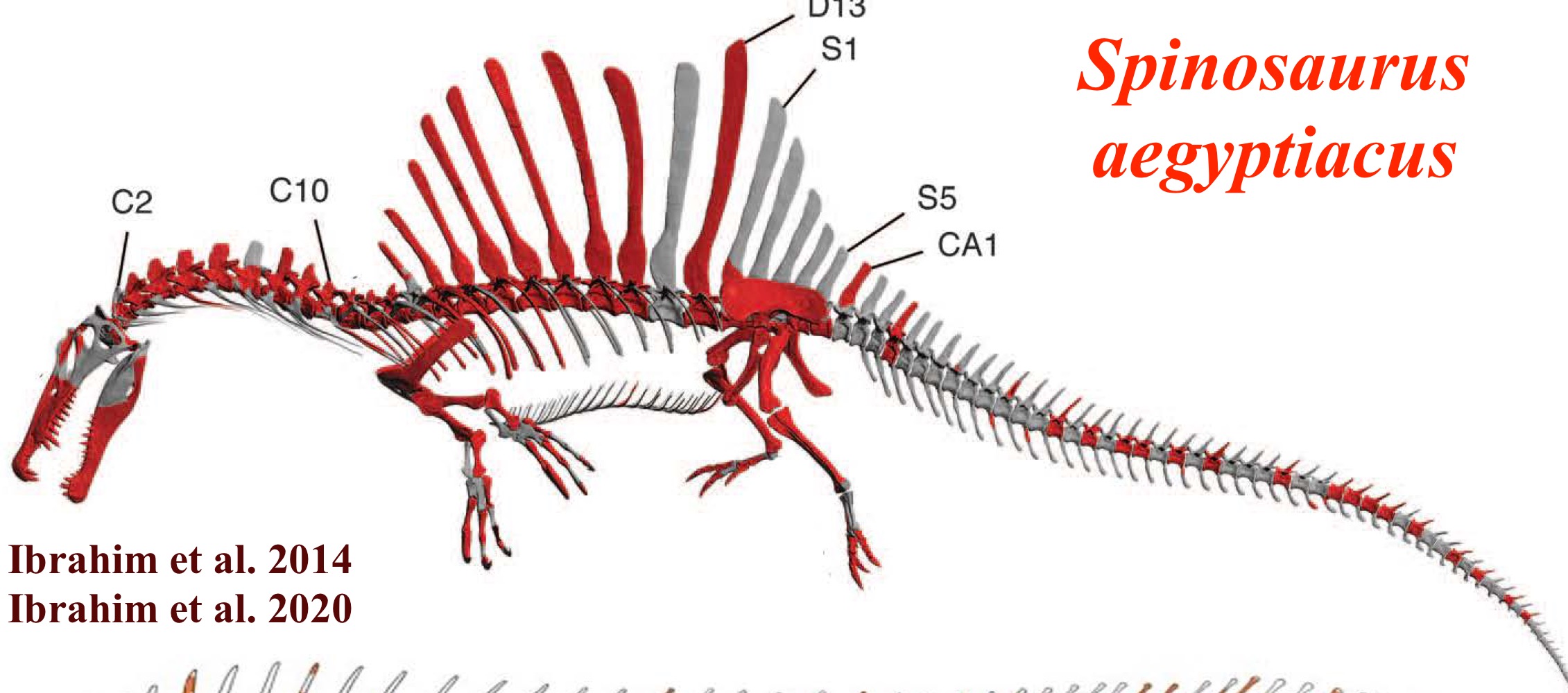
Spinosaurus (Spinosauroidea, Tetanurans) traits
Late Cretaceous
Northern Africa
PM ant to external naris longer
anterior ramus maxilla longer than high
Elongate premaxilla with diastema
Thin swimming tail
Long neural spines
Legs like allosaurs
Baryonyx walkeri and Irritator challengeri (Spinosauroidea subfamily, Tetanurans)
distinctive braincase
Serrated theropod teeth
Long legs
Africa
Asfaltovenator vialidadi
Chubut
Argentina Lower Jurassic
Spinosauroidea, Tetanurans
Sinraptor dongi (Spinosauroidea, Tetanurans)
Late Jurassic
Northwestern China
Very open skull
extra openings in antorbital fossa
4 premaxillary teeth instead of 5
Fukuiraptor kitadani (Spinosauroidea, Tetanurans)
Fukui Prefectural Museum, Japan
Currie
Early Cretaceous
astragalus found in Japan and Australia
Katsuyama Quarry - Fukui Prefecture with many individuals found with altricial death
Megaraptor namunhuiquii (Spinosauroidea, Tetanurans)
huge claws
Originally thought to be a dromeosaur
Skull found in a wall of a canyon
ilium like tyrannosaur with penumatosars or pneumatic vertebrae through sacral ribs
First dinosaur ever found by Owen
Neovenator salerii (Megaraptoridae, Tetanurans)
Early Cretaceous
Isle of Wight
Cleveland-Lloyd Quarry
Utah Late Jurassic
Has huge bonebed
Quicksand killed lots of prey which attracts predators to die
Allosaurus (Megaraptoridae, Tetanurans)
Acrocanthosaurus (Megaraptoridae, Tetanurans)
found during WWI
North Carolina
Very big, similar to tyrannosaurus
5 premaxillary teeth like allosaurs
Lower Cretaceous
Carcharodontosaurus vs Tyrannosaurus teeth (Megaraptoridae, Tetanurans)
Tyrannosaurus teeth were better for breaking bones
Carcharodontosaurus teeth were better for shearing with serrations and flatter
Giganotosaurus (Megaraptoridae, Tetanurans)
longer skull than Tyrannosaurus
Slicing teeth
Northern Patagonia
Argentina
Huge
Mapusaurus roseae (Megaraptoridae, Tetanurans)
10 individuals found together
Bigger than gigantosaurus
Where was a holotype of Tyrannosaurus rex found (Coelurosaurs)
Quarry of in Dawson County, Montana
Barnum Brown
Tyrannosauroidea (Coelurosaurs)
U. Jurassic (Asia) to U. Cretaceous, N. Hemisphere
D-shaped PM teeth
fused nasals
large posterior surangular foramen
median vertical ridge on lateral surface of ilium
elongate metatarsals (arctometatarsalian)
Dilong paradoxis (Tyrannosauroidea, Coelurosaurs)
feathered tyrannosaur - insulation
Gorgosaurus libratus (Tyrannosauroidea, Coelurosaurs)
2/3rds grown
No feathers
Skin impression
Lawrence Lambe
What group is Daspletosaurus, Gorgosaurus, Albertosaurus sarcophagus in?
Tyrannosauroidea, Coelurosaurs
in the same paper as T-Rex
Important Tyrannosauroidea (Coelurosaurs) limb bone bed
Dry Island Buffalo Jump Provincial Park
found by Barnum Brown
Can see age differences, Tyrannosaurs have a huge growth spurt in their teens
Alioramus remotus (Tyrannosauroidea, Coelurosaurs)
Natural History Museum of Mongolia
Smaller
Lower skull
Less bite force
Tyrannosaurus Rex (Tyrannosauroidea, Coelurosaurs)
huge bite force
Ears face forward 50% bigger brain
Good smell and hearing
Teens hunt because they are more agile
Live in packs
Medullary bone
Seen in Tyrannosauroidea (Coelurosaurs) and modern birds
Builds eggshells
Only in females that are ready to lay eggs
Spongy bone inside femur
Helps to not lose calcium from bones
Compsognathidae (Coelurosaurs)
Scipionyx, Compsognathus, Sinosauropteryx
fan-shaped dorsal spines
more than 60 caudal vertebrae
digit I longest in hand
manual ungual of digit I more than 2/3 length of radius
Sinosauropteryx (Compsognathidae, Coelurosaurs)
found in bone bed with Compsognathus
China split fossil in half to make more money
First feathered theropod
Arms short, long claws
Ornithomimus (Compsognathidae, Coelurosaurs)
late Cretaceous
Alberta
“Bird mimic”
Phalanges missing due to a river
Keratinous beak
Feather tracks on arm
melanosomes found
Explore top notes

Explore top flashcards
