L2: Similarity
 Studied by 0 people
 Call Kai
 Learn
Learn Practice Test
 Spaced Repetition
 Match
Match Flashcards
 Knowt Play
1/23

There's no tags or description
Looks like no tags are added yet.
Name | Mastery | Learn | Test | Matching | Spaced | Call with Kai |
|---|
No analytics yet
Send a link to your students to track their progress
24 Terms
Euclidian metric
used when the dimensions of the stimuli are perceptually integral dimensions; comparisons between stimuli are made using several dimensions that are combined prior to the comparison process (simultaneously)
city block metric
used when the dimensions of stimuli being compared are perceptually separable, known as separable dimensions; all dimensions are included simultaneously in the distance calculation
domain general
a psychological construct that operates the same way in different domains; computation carried out in the same way regardless of context
lexical decision task
a task in which letter strings that are either words or non-words are presented visually to a subject and the subjects must decide as quickly as possible if the string is a word or a nonword; reaction time to respond is usually measured
minimality assumption (Geometric)
an assumption that nothing can be more similar to an object that it is to itself; self-similarity = maximum similarity = minimum distance
however, the probability of judging two stimuli as identical is not constant for all stimuli
multidimensional scaling (MDS)
a computational technique that takes pairwise ratings of similarity and calculates the resulting psychological space of the entire set of objects:
objects that are similar will appear to be “near” each other in the plotted psychological space
objects that are dissimilar will appear to be “far” from each other in plotted psychological space
Nosofsky Rocks: had people rate different types of rocks based on similarity, with Group 1 focused on high-level training and Group 2 learning classifications at the subtype level
novices cannot distinguish the 3 types and rely on surface features
experts use causal features and can distinguish
plotted on MDS
pairwise similarity
a similarity rating between two pairs of objects
problem space
Newell and Simon (1972), the arrangement of the current state, goal, obstacles to reaching that goal, and operators that allow one to reach the goal; problem solving is a process of moving through the problem space from the initial state to the goal state
separable dimensions
perceptual dimensions or features that can be perceived separately, like height and width
spreading activation
a theory about how facts and concepts are connected in long-term memory; activation spreads from one active node in the network to other similar concepts and nodes, which then become active as well
surface similarity
similarity between two objects or things caused by the two objects sharing features at a surface level
symmetry assumption (Geometric)
an assumption that the similarity of two objects should not change as a condition of comparison order; the distance between A and B = the distance between B and A
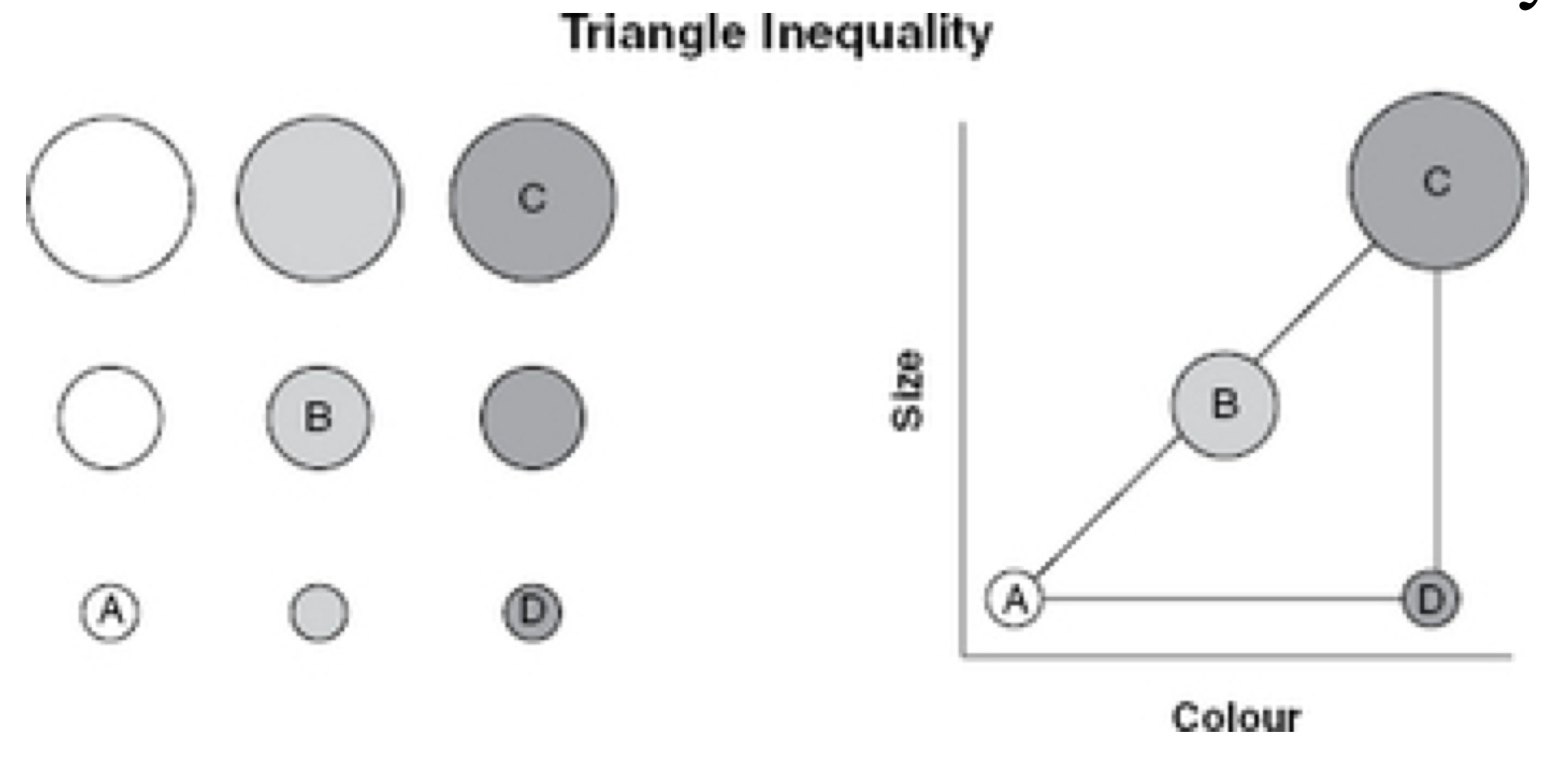
triangle inequality assumption (Geometric)
the assumption that, for a set of three objects in psychological space, the additive psychological distance between two objects must be greater than or equal to the distance between any one pair
Why study similarity?
underlies many important cognitive processes (object recognition, memory retrieval, problem solving, inductive reasoning)
a “domain general” construct
diagnostic tool (expert vs. novice)
grounded in perception, relating to the physical reality of objects
Similarity and Thinking
Object recognition: objects are recognized at least in part by a function of their similarity to stored patterns of known and previously seen objects
Memory retrieval: related to semantic memory, where retrieving memories involves a retrieval cue to contact the most similar representations in memory
Problem solving: experts can group problems based on the similarity of their process, to assist in solving the problem
Inductive reasoning: we make predictions about future outcomes based on the assumption that the future will be similar to the past
Similarity-Coverage Model
Osherson et al., 1990, assumes that inductions and inferences are based on an understanding of the similarity among the items or concepts being considered in a given argument
How do you measure similarity?
rating tasks
forced choice tasks
sorting tasks
rating task
subjects are presented with a series of pairs and are asked to indicate on a scale of how similar they are to each other; subjective and variable
over time, there should be some agreement about the relative similarity among objects
does not tell you how the judgement was made, the underlying conceptual structure, or contextual factors
difficult to assign a single number to a similarity
forced choice task
subject is presented with a single target stimulus and two+ alternatives, required to choose which one of the alternatives is the best match for the target stimulus; subjective and standard
sensitive to context
researcher can gain some insight into subjective sense of similarity
sorting task
subjects are asked to sort objects or pictures of objects into groups based on similarity; no rating assigned to similarity
takes advantage of contextual effects on similarity judgements
gives insight into how objects are grouped together
participants are usually not given strict instructions, meaning the researcher must infer what similarity metric was used
Contrast Model
(Tversky) the similarity between two objects is expressed as a linear combination of the common and distinctive features between the two objects; deals with the interaction between features
able to predict asymmetries because the two objects are not constrained to be equal
most useful when dealing with the similarity among items when some items are more familiar, more important, or are at different levels of hierarchy
North Korea is more similar to Red China than the other way around, since Red China has more salient, distinctive features than North Korea
Transformational Model
based on the notion that there is something similar about two things if one can be transformed into the other
accounts for the kind of similarity from non-featural aspects
Imai (1977) — provided participants with simple patterns of symbols and asked them to rate the similarity between different patterns; the only way to reliably make judgements was to base them on different kinds of transformation
found that single transformation pairs were rated as more similar than multiple transformation pairs when surface features were held constant
Alignment Models
feature comparisons are important, and similarity is based on overall configurations in comparison to other objects (context-dependent)
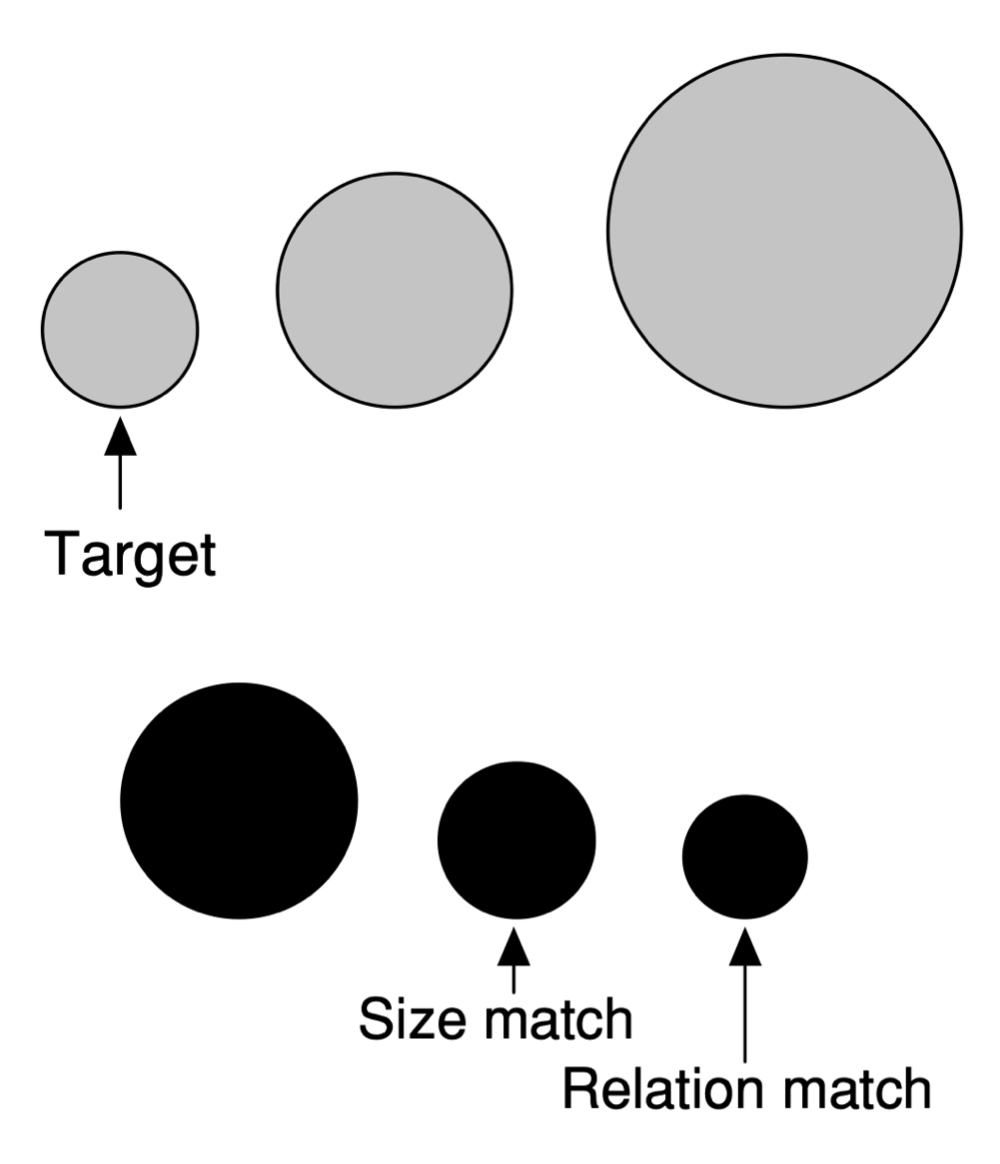
Why is similarity flexible?
when looking for similarity, subjects tend to choose fixed categories
when looking for categorization, subjects tend to choose variable categories
quarter vs. pizza for a 3-inch round object
 Note
Note  Flashcards (500)