Lesson 4.1 Uniform circular motion

0.0(0)
studied byStudied by 1 person
0.0(0)
call kaiCall Kai
learnLearn
examPractice Test
spaced repetitionSpaced Repetition
heart puzzleMatch
flashcardsFlashcards
GameKnowt Play
Card Sorting

1/9

encourage image

There's no tags or description

Looks like no tags are added yet.

Last updated 11:35 PM on 1/26/26
Name
Mastery
Learn
Test
Matching
Spaced
Call with Kai

No analytics yet

Send a link to your students to track their progress

10 Terms

1
New cards
What is uniform circular motion?

The motion of an object travelling at a constant speed in a circle. Examples include: toy plane on a string, carousel in a microwave, spin dryer, ceiling fan, and clock hands.
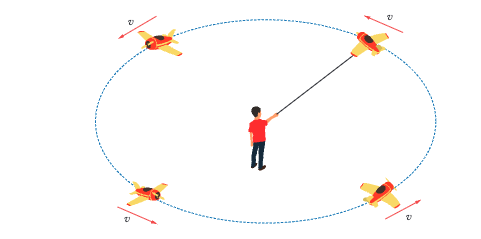
<p>The motion of an object travelling at a constant speed in a circle. Examples include: toy plane on a string, carousel in a microwave, spin dryer, ceiling fan, and clock hands. </p>
2
New cards
What is the difference between revolving and rotating?

Revolving: moving in a circle around an external centre point (e.g. ball on string revolves around your hand or Earth revolves around Sun). Rotating: spinning around an internal axis (e.g. Earth rotates on its own axis once per day).
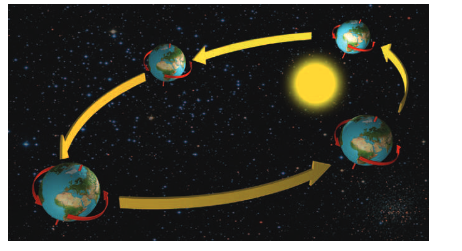
<p>Revolving: moving in a circle around an external centre point (e.g. ball on string revolves around your hand or Earth revolves around Sun). Rotating: spinning around an internal axis (e.g. Earth rotates on its own axis once per day). </p>
3
New cards
What is inertia and how does it relate to circular motion?
Inertia is the tendency of an object to resist change in its motion. According to Newton's first law an object would continue in a straight line unless acted on by an unbalanced force. In circular motion a force must constantly act to change direction.
4
New cards
What is centripetal force? Include symbol and units.
The force acting on an object in circular motion that constantly pulls or pushes it towards the centre of the circle. Symbol: Fᶜ. Unit: newton (N). From Latin "centrum" (centre) and "petere" (to seek) meaning "centre-seeking force".
5
New cards
What is centripetal acceleration? Include symbol and units.
The acceleration experienced by an object moving in a circular path directed towards the centre of the circle. Symbol: aᶜ. Unit: m s⁻². It exists because velocity direction is constantly changing even though speed is constant.
6
New cards
Why does an object in uniform circular motion have acceleration even though speed is constant?

Velocity is a vector with both magnitude (speed) and direction. In circular motion the direction continuously changes so velocity changes. Since acceleration is the rate of change of velocity there must be acceleration even at constant speed.
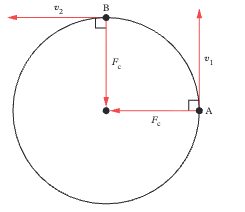
<p>Velocity is a vector with both magnitude (speed) and direction. In circular motion the direction continuously changes so velocity changes. Since acceleration is the rate of change of velocity there must be acceleration even at constant speed. </p>
7
New cards
What is the relationship between centripetal force and velocity direction?
The centripetal force vector (Fᶜ) is always perpendicular to the velocity vector (v). Force points toward centre while velocity is tangent to the circle at every point.
8
New cards
What provides the centripetal force in these examples: (a) ball on string (b) car on road (c) Moon orbiting Earth?
(a) Tension in the string. (b) Friction between tyres and road. (c) Gravitational attraction between Moon and Earth.
9
New cards
Why does a front-seat passenger feel pressed against the car door when going around a roundabout?
The car door provides centripetal force pushing the passenger toward the centre of the turn. The passenger's inertia means their body wants to continue straight. They feel "pushed out" but actually the door is pushing them inward to follow the circular path.
10
New cards
A ball on a string undergoes uniform circular motion. After 100 revolutions what are the displacement and average velocity?
Both are zero. Displacement is the straight-line distance from start to finish. After complete revolutions the ball returns to its starting position so displacement = 0. Average velocity = displacement/time = 0. (Note: average speed is NOT zero as distance travelled is not zero.

Explore top flashcards