ED.19- ALLOMETRY AND SCALING LAWS
 Call Kai
 Learn
Learn Practice Test
 Spaced Repetition
 Match
Match Flashcards
 Knowt Play
1/11

There's no tags or description
Looks like no tags are added yet.
12 Terms
allometry
The study of the relationship between size and shape, how biological processes scale with body size and with each other and the impact of this relationship on ecology and evolution.
result of differential growth
static, evolutionary and ontogenetic
allometric equation
Y = aX^b (a power function)
Y = body part being measured in relationship to the size of the organism
X = measure of size used for basis of comparison (usually a measure of body size, e.g. mass or length)
a = initial growth index (size of Y when X = 1)
b = allometric or scaling exponent (proportional change in Y per unit X)
scaling exponent
defines the type of scaling relationship. positive allometry is when b is greater than 1 when comparing like dimensions.
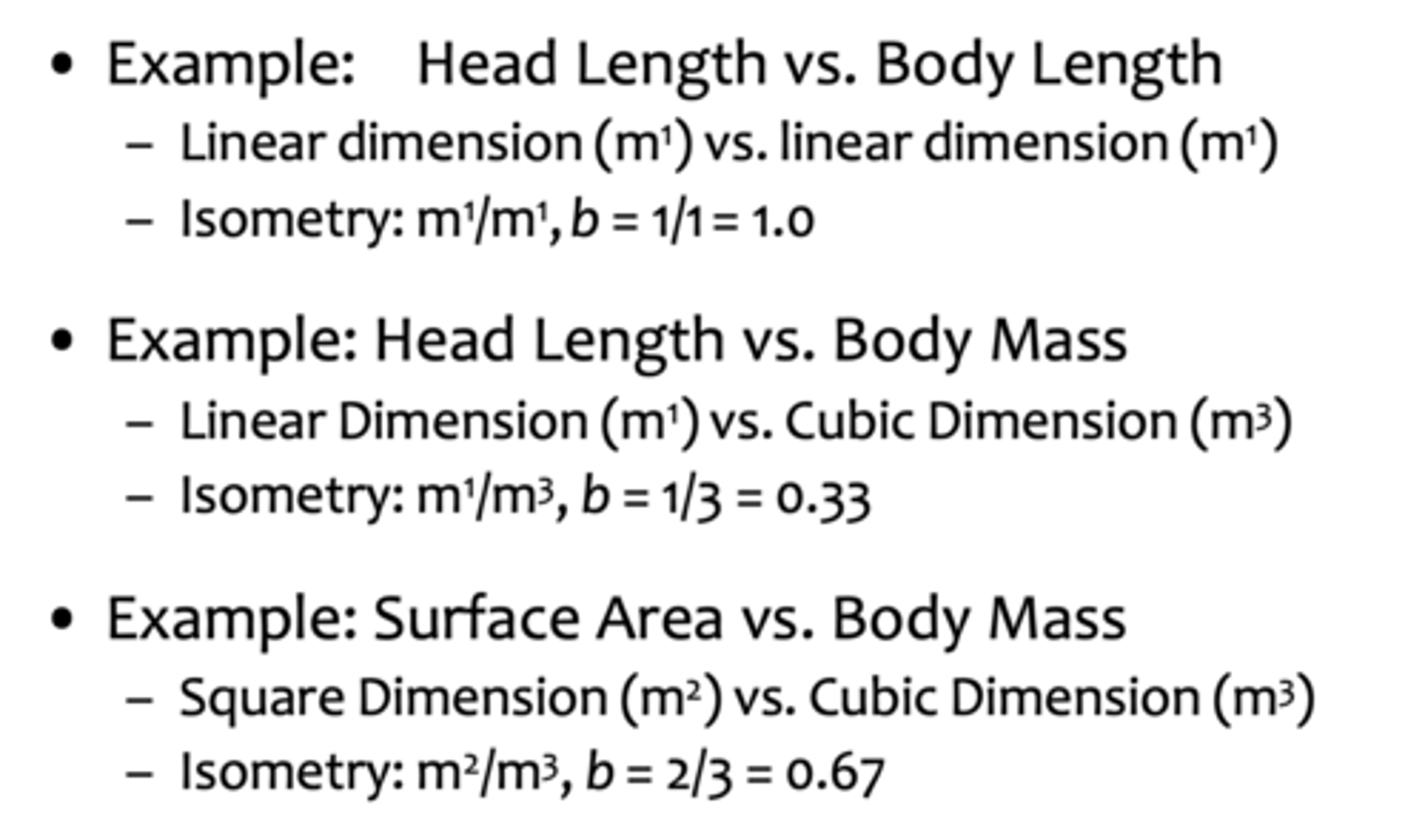
isometry for different dimensions
scaling of skeleton to body
We expect b = 1 for skeleton mass/body mass isometry;
However, because of increased weight loading, may expect b > 1: - skeleton becomes relatively more massive with increased body size
Remember that skeleton (dense bone material) itself disproportionately adds to body weight!
Considering the properties of the skeleton, we observe the scaling of 1.33 for isometry for skeletal weight loading.
implications of scaling
Living organisms vary HUGELY in body mass and size;
The magnitude of many biological/physiological processes depends on the body size and mass, e.g.:
it determines the surface/volume ratio of an organism;
It affects the metabolic rate, respiration, digestion, water balance, thermoregulation, etc
geometrically similar objects
In geometrically similar objects, the ratio of two linear dimensions is equal and independent of the size of the objects.
If L = length (or a linear dimension) then:
Area is proportional to L2 - areas increase with the square (L2) of linear dimensions
Mass and volume are proportional to L3 - volumes (and hence masses) increase with the cube (L3) of linear dimensions
why scaling matters
the surface to volume ratio decrease with size. A large number of physiological process (heat loss, evaporation, water absorption in aquatic animals,...,etc.) depend on surface area
the exchange surfaces (epithelia) tend to increase their areas of contact by folding, flattening, and branching.
Discuss the outcomes of differential scaling using case studies or theoretical examples
elephant and lsd. A previous study found that a dose of 0.1 mg was safe for 2.6 kg cats, but was sufficient to produce a psychotic effect. Poor old Tusko weighed 7722 kg, and hence Jolly and his collaborators decided to "scale-up" the dose by 2970 times. 0.1 (mg/cat) x (7722/2.6) = 0.1 x 2970 = 297
however the amount of energy that an animal uses is not proportional to body mass.
The amount of energy used by animals per unit mass decreases with body size.... Per gram, a shrew uses a lot more energy than an elephant! And this is what doomed poor Tusko...
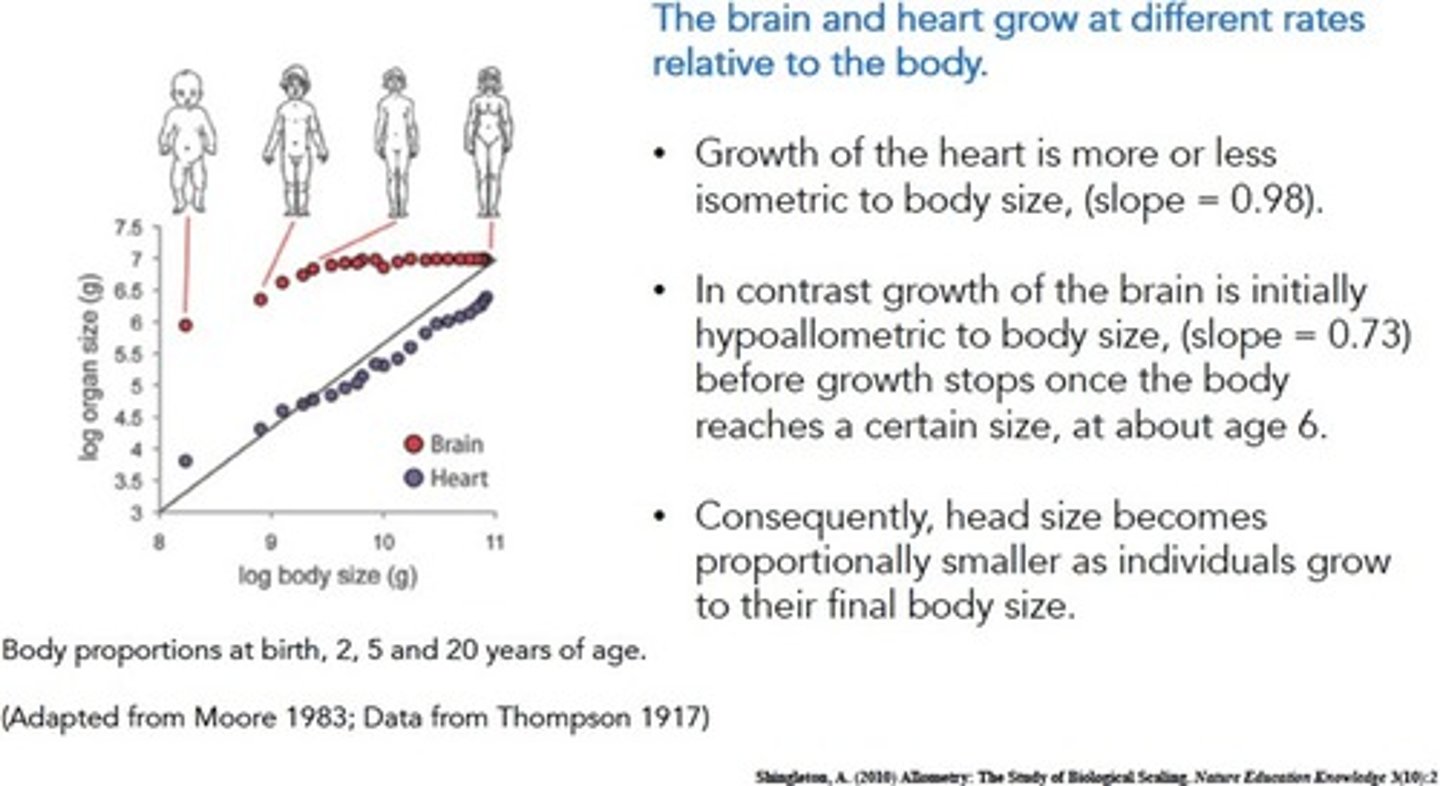
ontogenetic growth
growth during development.
how does differential scaling arise
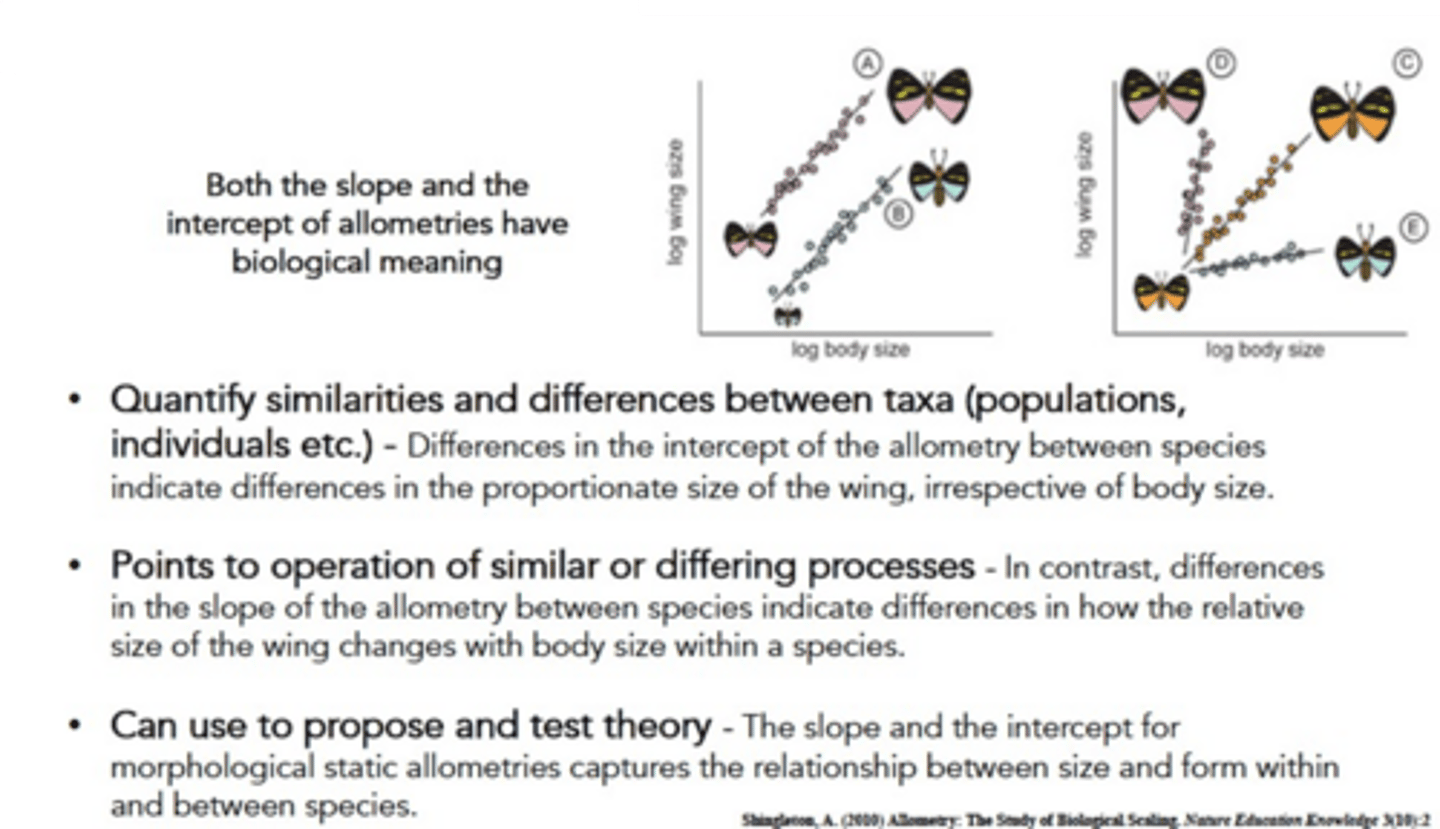
how do we use allometry in bio